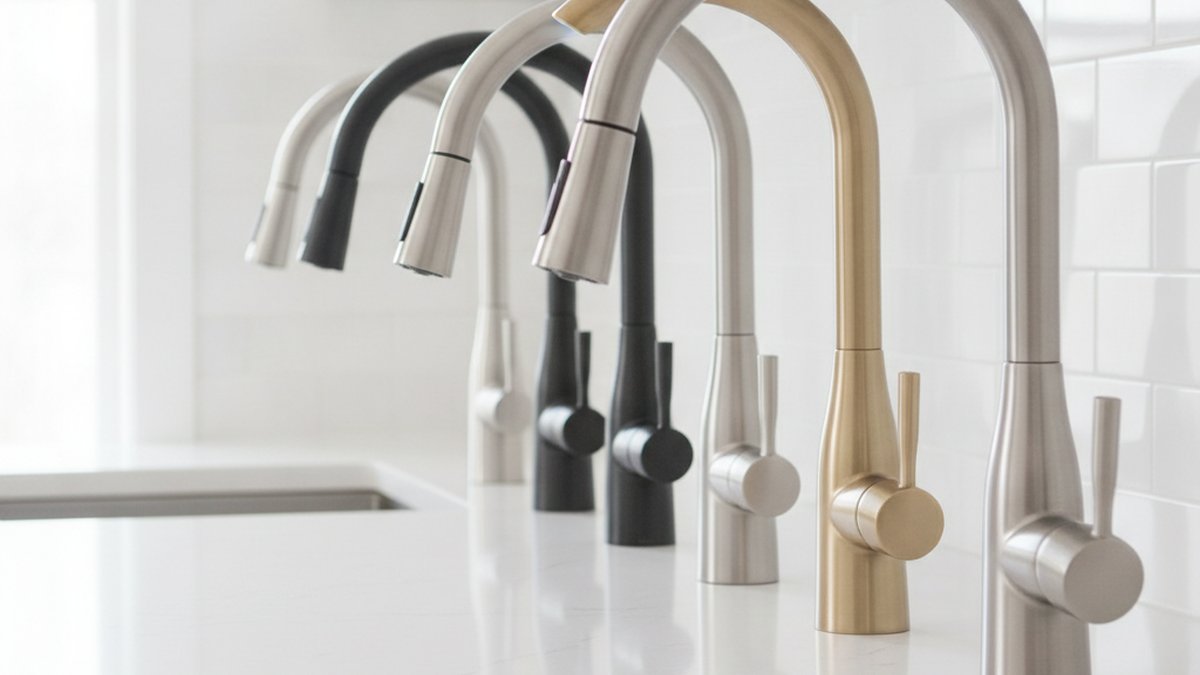
If you’ve been comparing pull down kitchen faucet brands and feeling like every product page says the exact same thing — “premium spray head,” “spot-resist finish,” “durable ceramic cartridge” — you’re not imagining it. The specs blur together on purpose. What actually separates a faucet you’ll love for 15 years from one you’ll rip out in three isn’t the marketing bullet points; it’s the cartridge, the hose, the finish process, and whether you can get a replacement part shipped to your door for free. This guide breaks down the brands that matter, what each one is genuinely good at, and how to match one to your sink, your water, and your budget.
We sell and service these faucets every day, so this isn’t a repackaged spec sheet. It’s the same advice we’d give a friend standing in front of a wall of 40 nearly identical boxes.
What are the best pull down kitchen faucet brands right now?
The best pull down kitchen faucet brands in 2026 are Moen, Delta, Kohler, Grohe, Kraus, and Adeaga — each strong in a different area. Moen and Delta dominate on serviceability and lifetime warranties, Kohler and Grohe lead on build feel and finish depth, and Kraus and Adeaga give you the most faucet for the least money without cutting the parts that actually fail.
Here’s the honest split. If you want a faucet you’ll never think about again and can fix in five minutes if it ever leaks, Moen and Delta are the safe answer — their parts are in every hardware store in America. If you care about the faucet feeling like a piece of jewelry and don’t mind paying for it, Grohe and Kohler are built heavier and finished better. And if you want 90% of that quality at 60% of the price, Kraus and Adeaga are where value shoppers should look.
| Brand | Typical Price | Best For | Warranty | Watch Out For |
|---|---|---|---|---|
| Moen | $180–$400 | Easy repairs, Spot Resist finish, MotionSense | Limited lifetime | Some plastic internals on budget lines |
| Delta | $160–$380 | MagnaTite dock, Touch2O, parts everywhere | Limited lifetime | Touch models need batteries/wiring |
| Kohler | $220–$550 | Premium look, sweep spray, heavy build | Limited lifetime | Pricey replacement cartridges |
| Grohe | $250–$700 | German engineering, silky finish, high flow feel | Limited lifetime | Parts cost more, fewer local stockists |
| Kraus | $130–$300 | Value, commercial-style spring necks | Limited lifetime | Heavier spray head, lighter brand support |
| Adeaga | $120–$280 | Value, solid-brass bodies, on-trend finishes | Limited lifetime + free parts | Newer name, fewer big-box shelves |
What’s the real difference between a $150 and a $400 pull down faucet?
The real difference is in three parts you never see on the box: the cartridge, the spray hose, and the finish process. A $400 faucet almost always uses a heavier solid-brass body, a genuine ceramic-disc cartridge rated for 500,000+ cycles, a nylon-braided PEX hose that won’t kink, and a PVD (physical vapor deposition) finish that’s bonded, not sprayed. A $150 faucet may cut one or two of those corners — usually a zinc-alloy body or a cheaper hose that wears at the docking point.
That said, “expensive” and “good” aren’t the same thing. Plenty of mid-priced faucets ($180–$250) from the brands above use the same ceramic cartridges and PVD finishes as their flagship models — you’re often paying the extra $150 for a touchless sensor, a designer spout shape, or the brand name. Our rule of thumb: spend on the cartridge and hose, don’t overspend on the spout curve.
- Solid brass body: resists corrosion and holds threads better than zinc alloy — pick it up, a brass faucet feels noticeably heavier.
- Ceramic-disc cartridge: the single biggest predictor of a drip-free decade. Avoid rubber-washer valves entirely.
- Nylon-braided pull-down hose: the part that fails most on cheap faucets; look for a documented cycle rating.
- PVD or spot-resist finish: bonded finishes shrug off fingerprints and won’t flake around the spray head.
- Magnetic docking: Delta’s MagnaTite and similar magnets keep the spray head snapped up straight instead of drooping over time.
Which pull down faucet brand is easiest to repair myself?
Moen and Delta are the easiest pull down kitchen faucet brands to repair yourself, because their cartridges and spray hoses are sold in every hardware store and both companies ship free replacement parts for the life of the faucet. A dripping Moen or Delta is usually a 15-minute cartridge swap with no plumber required.
This matters more than people realize when they’re shopping. Every faucet eventually needs a new cartridge or O-ring — it’s not “if,” it’s “when.” With Moen and Delta you call, give them the model number, and a part shows up free. With a no-name Amazon brand, you’re often buying a whole new faucet because the specific hose or cartridge simply isn’t sold separately. If you’re the kind of person who’d rather fix than replace, brand availability of parts should weigh heavily in your decision. Our walkthrough on doing a faucet cartridge replacement yourself shows just how simple the job is once you have the right part in hand.
Grohe and Kohler parts exist and are high quality, but they cost more and sometimes need to be ordered online rather than grabbed locally. Adeaga splits the difference: newer to the market, but every model ships with a parts kit and offers free replacement cartridges and hoses under the warranty — which is the practical thing that actually keeps a faucet in service.
Which brand is best for hard water and low water pressure?
For hard water, choose a brand with a silicone or rubber “nubbed” spray face you can wipe clean — Delta, Moen, and Adeaga all use them — and a genuine ceramic cartridge that resists mineral scaling. For low water pressure, avoid heavily aerated spray heads and look for a faucet rated at a true 1.8 GPM or higher rather than an eco-restricted 1.5 GPM model.
Hard water is the number-one killer of spray performance. Minerals build up on the aerator and spray nozzles, and within a year the flow goes patchy. The brands that handle it best give you a spray face you can literally rub with your thumb to pop the scale off, plus a removable aerator you can soak. If your home has serious mineral content, that wipeable face is worth more than any finish upgrade. Our guide to cleaning a faucet head with CLR covers the deep-clean when wiping isn’t enough, and if your pressure has quietly dropped, it’s often just the aerator — see how to clean the aerator when water pressure drops.
On flow rate: don’t confuse “eco” with “weak.” A well-designed 1.8 GPM faucet from Grohe or Moen can feel stronger than a poorly designed 2.2 GPM one, because the spray pattern concentrates the water. If you already have low household pressure, steer away from the most heavily aerated “champagne” spray patterns and toward a straightforward stream-plus-spray toggle.
Pull-down vs. pull-out: which should I actually buy?
Buy a pull-down faucet if you have a deep single-bowl sink and want the tall, dramatic gooseneck look; buy a pull-out if you have a shallow sink, a window behind the faucet, or limited clearance. Pull-downs have a taller spout and a spray head that pulls straight down into the basin; pull-outs have a lower profile and a wand that pulls toward you horizontally.
Most modern kitchens go pull-down because the high arc gives you room to wash big pots and the spray head docks cleanly with a magnet. But there’s a real catch: if you have a low window sill or upper cabinet close behind the sink, that tall gooseneck won’t fit, and a pull-out is the smarter buy. Measure the height from your sink deck to the nearest obstruction before you fall in love with a 17-inch-tall faucet. If you’re leaning pull-out, our breakdown of the pull-out Kohler models is a good next read.
What finish should I choose — and which ones hide fingerprints?
Spot-resist stainless, brushed nickel, and matte black hide fingerprints and water spots the best; polished chrome and shiny finishes show every smudge. If your kitchen gets heavy daily use and you hate wiping, go with a brushed or matte finish in a PVD or “spot-resist” coating — they look clean with almost no maintenance.
Finish is where personal taste meets practicality. Here’s how the popular options actually behave day to day:
- Spot-resist / brushed stainless: the low-maintenance champion; matches most appliances and hides spots.
- Matte black: stunning and modern, hides fingerprints, but shows dried white water spots in hard-water homes — wipe after use.
- Brushed / champagne bronze: warm, on-trend, pairs beautifully with white and wood; a PVD version resists tarnish.
- Polished chrome: cheapest and most durable finish, but shows every fingerprint and spot.
- Oil-rubbed bronze: classic and forgiving, though it reads traditional rather than modern.
Matte black in particular has gone from trend to standard, and pairing it with a matching side sprayer or soap dispenser pulls a kitchen together — our look at the matte black kitchen faucet with side sprayer covers that combination in detail.
Is a big-name brand actually better, or is it just marketing?
For the internal parts that determine lifespan — cartridge, hose, valve — a mid-range faucet from a value brand like Kraus or Adeaga is genuinely comparable to a big name, because many use the same class of ceramic cartridges. Where big brands earn their premium is finish consistency, decades of parts availability, and touchless technology. If you never plan to use MotionSense or Touch2O, the value brands are a smart buy.
Reviews sites often crown the same three legacy brands every year, partly out of habit. That doesn’t make them wrong — Moen and Delta really are excellent — but it does mean genuinely good value brands get overlooked. The smart move is to read reviews for the specific model, not the brand halo. We dug into exactly this in whether Wirecutter’s kitchen faucet reviews are enough, and if you’ve narrowed things to Moen already, our guide to the best Moen kitchen faucet helps you pick the right model rather than just the right brand.
Adeaga’s own approach is built around this reality: solid-brass bodies and genuine ceramic cartridges in the finishes people actually want, priced below the legacy names because we’re not paying for a century-old advertising budget — and every faucet is backed by free replacement parts.
How much should I spend for my kitchen?
For most kitchens, spend $150–$300 on a pull-down faucet — that range gets you a solid-brass or reinforced body, a genuine ceramic cartridge, a braided hose, and a durable PVD finish from any reputable brand. Go above $350 only if you want touchless operation, a designer spout, or a specific premium finish.
- Under $130: fine for a rental or backup sink, but expect lighter internals and limited parts support.
- $150–$250 (the sweet spot): ceramic cartridge, braided hose, spot-resist finish — where 80% of buyers should shop.
- $250–$350: heavier brass, better finish depth, smoother handle feel, sometimes a basic sensor.
- $350+: touchless tech, flagship finishes, designer styling — real quality, but diminishing returns on durability.
Author note, testing, and warranty
This guide was written by the Adeaga fixtures team — plumbers and product testers who install, pressure-test, and service kitchen faucets every week. We bench-test cartridges for drip resistance, cycle spray hoses at their docking points, and run finishes through fingerprint and salt-spray checks before we recommend a model. Every faucet we discuss should meet standard North American plumbing certifications (look for ASME A112.18.1 / NSF 61 and, for lead safety, compliance with the U.S. Safe Drinking Water Act). Adeaga backs its own faucets with a limited lifetime warranty plus free replacement cartridges and hoses — because the part that fails should never be the reason you replace a whole faucet.
FAQ
Which pull down kitchen faucet brand lasts the longest?
Any of the major brands — Moen, Delta, Kohler, Grohe, Kraus, or Adeaga — will last 10–20 years if it has a genuine ceramic-disc cartridge and a solid-brass body. Longevity depends more on the cartridge and your water hardness than on the logo. Brands with free lifetime parts (Moen, Delta, Adeaga) effectively last even longer because you can refresh the wear parts for free.
Are cheap pull-down faucets worth it?
Value-brand faucets in the $130–$280 range are absolutely worth it if they use a ceramic cartridge, a brass or reinforced body, and a braided hose. Avoid the sub-$80 unbranded units — they typically use rubber-washer valves and hoses you can’t replace, so a small leak means a full replacement.
Do I need a plumber to install a pull-down faucet?
No. Most pull-down faucets install in 30–60 minutes with a basin wrench, and many now use quick-connect fittings. If you’re replacing an existing faucet, the hardest part is removing the old one — our guide on removing an old faucet without wrecking it covers the corroded-nut situations that trip people up.
What GPM should a kitchen pull-down faucet have?
Aim for 1.8 GPM, which balances water savings with real-world spray power for washing dishes and filling pots. Some regions cap kitchen faucets at 1.8 GPM by law. A well-designed 1.8 GPM faucet outperforms a cheap 2.2 GPM one because the spray pattern is engineered to concentrate flow.
Is matte black or stainless better for a pull-down faucet?
Stainless and spot-resist finishes hide water spots best and match most appliances, making them the safe, low-maintenance choice. Matte black looks more modern and hides fingerprints well, but shows dried mineral spots in hard-water homes, so plan to wipe it down. Both are excellent in a bonded PVD finish.
Which brand is easiest to get replacement parts for?
Moen and Delta are the easiest — their cartridges and hoses are stocked in nearly every U.S. hardware store and shipped free by the manufacturer. Adeaga ships free replacement cartridges and hoses under warranty, and Kohler and Grohe parts are high quality but usually ordered online.