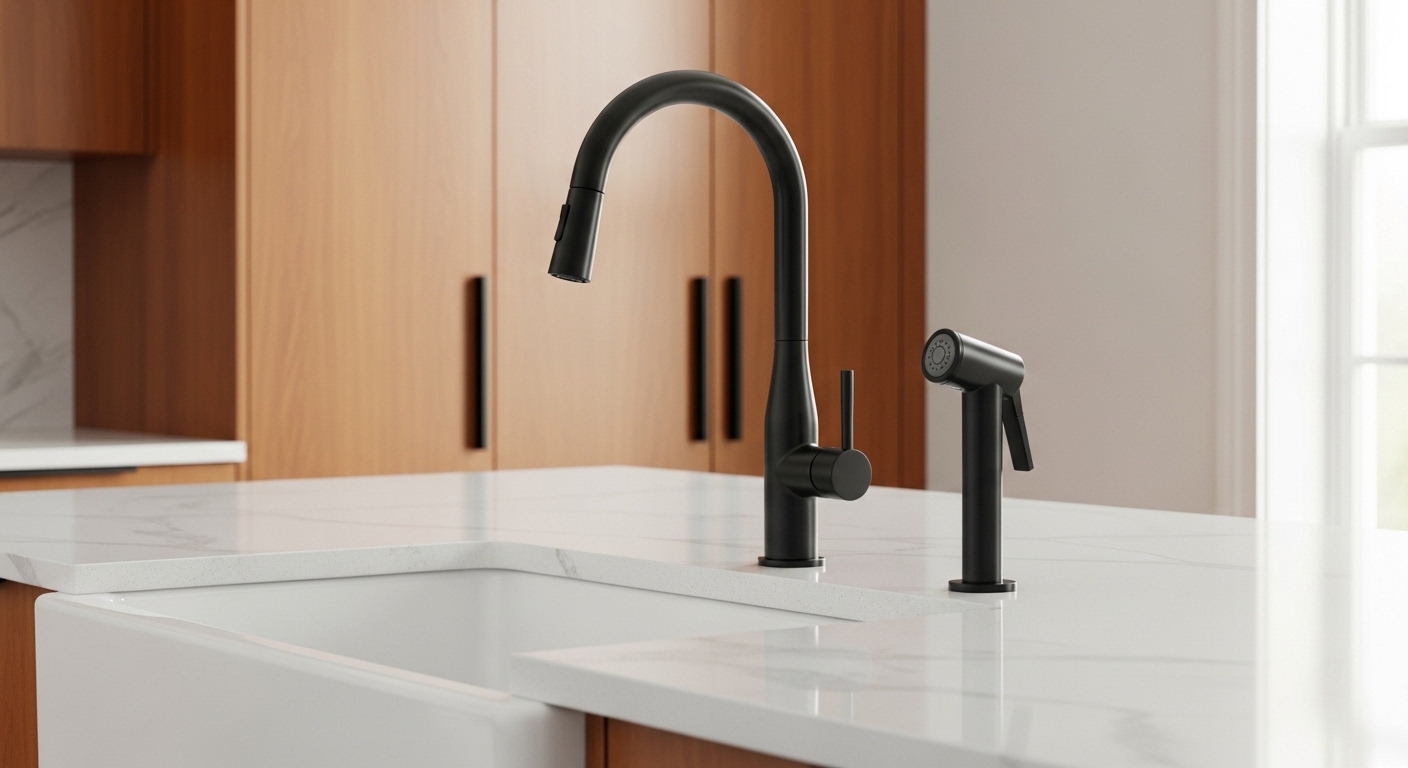
A matte black kitchen faucet with side sprayer is one of the most-requested kitchen upgrades right now, and for good reason: it hides water spots better than chrome, it makes a white or wood-tone kitchen pop, and the separate side sprayer gives you a second stream of water for rinsing the sink, filling pots off to the side, or spraying down dishes without dragging the whole spout around. But “matte black” and “side sprayer” both hide details that decide whether you love the faucet in five years or curse it in five months. This guide walks through exactly what to look for, what things cost, and how to avoid the two failure points people complain about most — a finish that fades and a sprayer diverter that leaks.
What exactly is a “matte black kitchen faucet with side sprayer” — and how is it different from a pull-down?
It’s a kitchen faucet with a black, non-glossy finish where the spray function lives in a separate handheld nozzle mounted in its own hole beside the spout — not built into the spout itself. That’s the key difference from a pull-down or pull-out faucet, where the spray head is the tip of the spout and pulls out on a hose.
Understanding this split matters because it changes your installation, your counter, and your repairs:
- Side sprayer setup: The main spout stays put; a second nozzle sits in a nearby deck hole (or an escutcheon plate hole) and pulls up on its own hose. Water is routed by a small part called a diverter that shifts flow from spout to sprayer when you squeeze the trigger.
- Pull-down / pull-out setup: One tall spout, one hole (plus optional cover plate), and the spray head docks magnetically at the tip. No separate diverter.
Neither is “better” universally. A side sprayer is the classic pick if you have a 3- or 4-hole sink deck to fill, you want a lower “bridge” or traditional spout that a pull-down can’t give you, or you like keeping a second stream free while the main spout runs. If you’re weighing that separate-sprayer look against an all-in-one head, our breakdown of the Vigo Zurich pull-down spray kitchen faucet shows how the integrated approach compares in daily use.
Why do people choose matte black over chrome or stainless in the first place?
People choose matte black because it hides water spots and fingerprints far better than polished chrome, it reads as modern and high-end, and it coordinates with the black hardware, black appliances, and black window frames that dominate 2026 kitchens. The trade-off is that a cheap black finish can fade or peel, so the finish type matters more here than on any other color.
Here’s the honest picture. Matte black is a genuinely practical finish for a busy kitchen — a light film of hard-water mineral or a stray fingerprint just doesn’t show the way it does on a mirror-bright surface. That’s the same reason black is popular for kitchen accessories like a matte black glass rinser that sits right next to the faucet. But not all black is created the same way, and that’s where buyers get burned.
PVD vs. powder-coat vs. painted black — which finish actually lasts?
For a black finish that won’t fade or peel, choose PVD (physical vapor deposition) first and quality powder-coat second; avoid anything simply described as “painted” or “electroplated black.” PVD bonds the color at a molecular level and is the most scratch- and chemical-resistant. Powder-coat is a durable baked-on layer that looks slightly deeper and softer but can chip on a hard impact. Cheap painted finishes are the ones that go patchy around the spray trigger and the base within a year.
| Black finish type | Durability | Look | Typical price tier | Watch out for |
|---|---|---|---|---|
| PVD matte black | Excellent — resists scratches, chemicals, fading | Even, slightly satin | $200–$400 | Very little; the safest choice |
| Powder-coat matte black | Very good — tough but can chip on impact | Deepest, softest black | $130–$280 | Chips at edges if hit hard |
| Painted / sprayed black | Poor — fades and peels | Uneven up close | $40–$110 | Wear at trigger and base within 6–12 months |
When a product page won’t tell you which of these it uses, treat that silence as an answer. Reputable brands, including adeaga, name the finish process because it’s a selling point. If it’s just “black,” assume painted.
Which matte black kitchen faucet with side sprayer should I buy for my situation?
Match the faucet to your sink deck and how you cook. The single most important spec is your number of mounting holes, because a side sprayer needs its own hole. Below is a quick way to narrow it down before you look at any brand.
- You have a 3- or 4-hole sink deck: A side sprayer is the natural fit — the spout takes one hole, the handle another, and the sprayer slots into the third. This is the classic American kitchen setup.
- You cook a lot and fill big pots: Look for a spout height of 8–10 inches and a sprayer with a strong “jet” mode, plus a hose reach of at least 24 inches so you can pull it toward a countertop pot.
- You have hard water: Prioritize a rubber or silicone spray nozzle you can rub clean, since mineral buildup clogs metal spray faces fastest.
- You’re on a tight budget ($80–$130): Accept powder-coat over PVD, but do not go below a solid-brass or stainless body — a zinc-alloy body is where the cheapest faucets fail.
- You want the most durable option, period: Solid-brass body, ceramic-disc cartridge, PVD matte black, side sprayer with a metal-reinforced hose. Expect $250–$350.
If you like the idea of a black kitchen faucet but aren’t married to the separate-sprayer layout, a solid-brass pull-out is a strong alternative — our look at whether a pull-out kitchen tap with a brass build is worth it covers the same build-quality questions that decide longevity here.
What features are worth paying for — and which are just marketing?
Pay for a solid-brass or stainless body, a ceramic-disc cartridge, and a PVD or powder-coat finish; those three decide whether the faucet lasts a decade. Almost everything else is nice-to-have. Here’s the split from someone who’s installed and replaced a lot of these:
- Worth it: Ceramic-disc cartridge (smooth handle, no drips for years), solid-brass body (won’t crack at the threads), braided stainless supply lines, a metal — not plastic — sprayer head, and a spray/stream toggle that stays put instead of snapping back.
- Situational: A pause button on the sprayer (great for hard-water rinsing), a longer 30-inch hose (great for a big double-bowl sink).
- Mostly marketing: “Antimicrobial” coatings, vague “German engineering” claims with no finish spec, and touchless features that add $100+ and another failure point on a side-sprayer design that wasn’t built around them.
How hard is it to install a side-sprayer faucet myself?
Most homeowners can install a matte black side-sprayer faucet in 45 to 90 minutes with basin wrench, plumber’s tape, and a bucket — no plumber needed — as long as your sink already has enough holes. The side sprayer adds one extra connection compared to a single-spout faucet: the sprayer hose ties into the faucet body at the diverter.
The general sequence looks like this:
- Shut off the hot and cold supply valves under the sink and open the faucet to release pressure.
- Disconnect and remove the old faucet. If it’s corroded or stuck, our guide on removing an old faucet from a kitchen sink walks through freeing seized nuts without damaging the deck.
- Drop the new spout and handle through their holes, seat the gasket, and tighten the mounting nut from below with a basin wrench.
- Feed the side sprayer’s hose down through its own hole and thread it onto the faucet body’s diverter outlet — hand-tight plus a quarter turn, with plumber’s tape on the threads.
- Connect the braided supply lines to the shutoff valves, turn the water back on, and check every joint for drips with a dry paper towel.
Why does the side sprayer lose pressure or leak — and how do I stop it?
A weak or leaking side sprayer almost always comes down to one of three things: a clogged spray nozzle, a failing diverter valve, or a kinked hose under the sink — and all three are cheap DIY fixes. Start with the easiest.
- Weak spray: Unscrew the nozzle tip and soak it in white vinegar for an hour to dissolve mineral scale, then scrub the little rubber jets. This fixes most hard-water pressure loss.
- Water splits between spout and sprayer (both run at once): That’s the diverter wearing out. It’s a small part inside the faucet body; replacing it restores full pressure to whichever outlet you’re using.
- Leak under the sink when you spray: Check the hose for a kink where it loops around the drain, and re-tape the hose-to-diverter connection. A cracked hose gets replaced outright — don’t patch it.
A quick reality check on reviews: aggregate “best faucet” lists can point you at good brands, but they rarely tell you how a specific finish or diverter holds up in a hard-water home. It’s worth reading past them — our take on whether kitchen faucet reviews on Wirecutter are enough explains what those roundups leave out and how to dig into the specs that actually predict lifespan.
How do I keep a matte black finish looking new?
Clean matte black with only warm water, a drop of mild dish soap, and a soft cloth, then dry it — never use vinegar, bleach, abrasive pads, or “polishing” sprays on the finish itself. Matte black hides spots well, but the coating hates acids and grit, which are exactly what strip and dull it over time.
Simple routine that keeps it factory-fresh:
- Wipe down weekly with a damp microfiber cloth and dry it to prevent any faint water-line residue.
- Keep the vinegar for the removable nozzle only — never let it sit on the black spout or handle.
- Skip magic-eraser sponges and stainless-steel cleaners; both are abrasive enough to burnish the matte texture into shiny patches.
- If you have very hard water, a whole-house or under-sink softener does more for the finish than any cleaner.
How much should I spend, and what does each price tier actually get me?
Plan on $130–$350 for a matte black side-sprayer faucet that lasts. Under $80 you’re gambling on a painted zinc body; above $400 you’re mostly paying for a designer name, not better durability. Here’s what each band buys.
| Price range | Typical body | Typical finish | What to expect |
|---|---|---|---|
| Under $80 | Zinc alloy | Painted black | Fades/peels in a year; cartridge often drips early |
| $80–$150 | Stainless or part-brass | Powder-coat | Good value; solid if the body is metal and cartridge is ceramic |
| $150–$350 | Solid brass | PVD or premium powder-coat | The sweet spot — durable finish, quiet cartridge, real warranty |
| $400+ | Solid brass | PVD | Designer styling and hardware; diminishing returns on durability |
FAQ
Does a matte black kitchen faucet show water spots?
Far less than chrome or polished nickel. Hard-water minerals dry to a light haze that’s much harder to see on a matte surface. You’ll still want a quick weekly wipe-and-dry, but day to day, matte black is one of the most forgiving finishes for a busy kitchen.
Can I add a side sprayer to a faucet that didn’t come with one?
Only if your faucet body has a diverter outlet and your sink has a spare hole (or an unused sprayer knockout). Many single-spout faucets aren’t built to feed a sprayer, so the reliable route is buying a faucet-plus-sprayer set designed to work together. Retrofitting a mismatched sprayer usually leads to pressure and leak problems.
Is a side sprayer better than a pull-down spray head?
Neither is universally better — it’s about your sink and style. A side sprayer suits 3–4 hole decks, lower traditional spouts, and cooks who want a second stream free while the spout runs. A pull-down is cleaner-looking and needs fewer holes. Side sprayers do add one more part (the diverter) that can eventually wear, but it’s a cheap fix.
Why is water coming out of both my spout and side sprayer at once?
That’s a worn or stuck diverter valve inside the faucet body — it’s supposed to send water to one outlet at a time. Replacing the diverter is an inexpensive DIY repair and restores full pressure to whichever outlet you’re using. It’s the single most common side-sprayer complaint and rarely means the whole faucet is done.
Will a matte black faucet look dated in a few years?
Matte black has held strong for over a decade and pairs with black hardware, black-framed windows, and both warm and cool palettes, so it reads as a modern classic rather than a fleeting trend. The bigger risk to “looking dated” is a cheap finish that fades unevenly — which is a durability issue, not a style one. Buy PVD or quality powder-coat and it’ll still look intentional years from now.
What’s the best matte black kitchen faucet with side sprayer for hard water?
Choose one with a solid-brass body, ceramic-disc cartridge, PVD finish, and a rubber-jet sprayer nozzle you can rub clean. The rubber jets shed scale far better than a metal spray face, and PVD shrugs off the mineral film that dulls cheaper finishes. Pair it with a water softener if your hardness is severe.
About the author: This guide was written by the adeaga fixtures team — plumbers and product testers who install, stress-test, and tear down kitchen and bath faucets for a living. We bench-test finishes for scratch and fade resistance and cycle cartridges and diverters through thousands of open-close cycles before we recommend anything.
Why trust adeaga: adeaga designs and sells solid-brass kitchen and bathroom faucets with PVD and powder-coat finishes built to real standards. Our kitchen faucets are engineered to meet cUPC and NSF/ANSI 61 lead-safety requirements, use ceramic-disc cartridges tested to industry cycle standards, and are backed by a limited lifetime warranty on the finish and function. If a finish fails or a cartridge drips within the warranty period, we replace the part — because a matte black faucet with a side sprayer should look and work like new for many years, not many months.