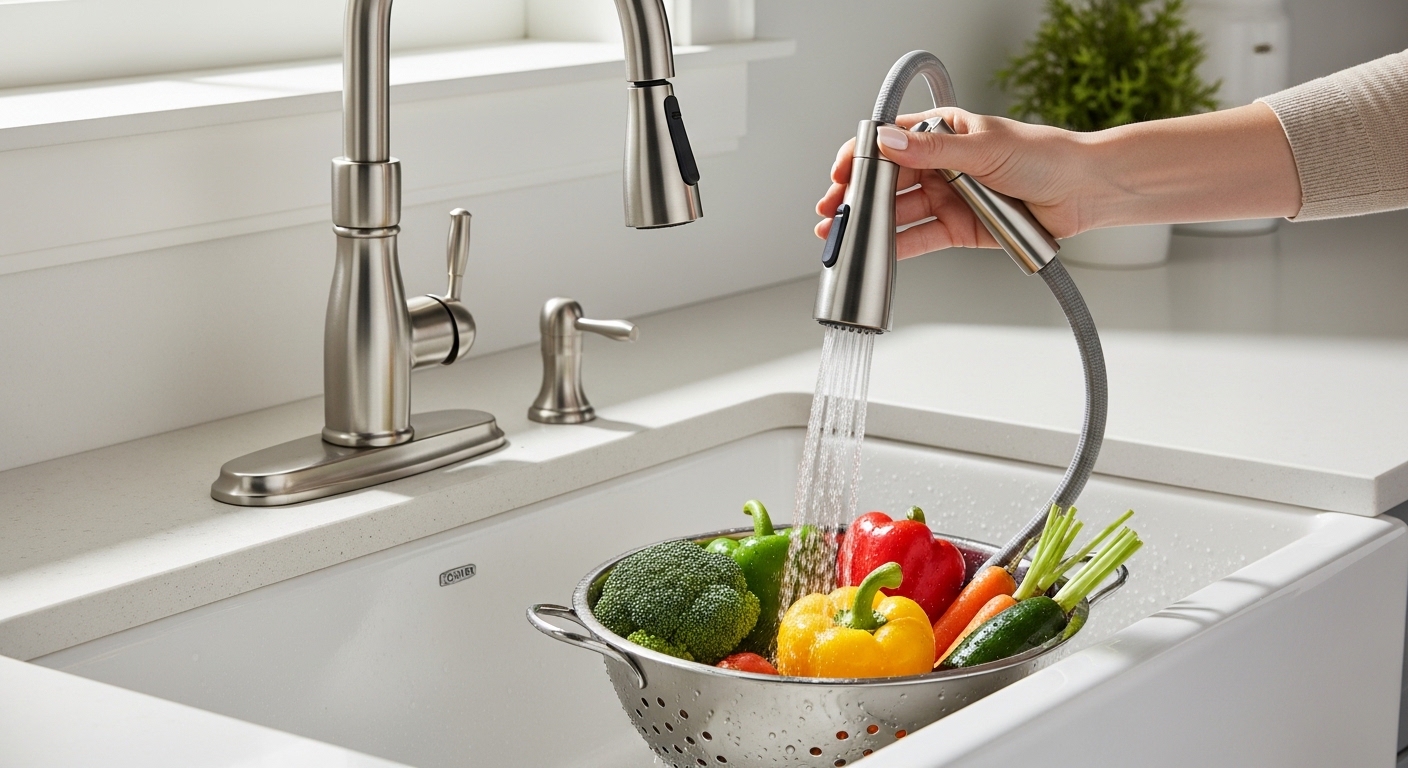
A pull out kitchen faucet kohler shoppers keep asking about is basically a single-handle faucet where the spray head pulls straight out toward you on a hose, instead of arcing down like a pull-down gooseneck. Kohler builds a lot of these, and the short version is: they’re one of the safest picks in the mainstream $150–$400 range because of the magnetic docking, the ceramic-disc valves, and a finish warranty that actually means something. But “which one” depends entirely on your sink depth, your water hardness, and how much you cook. Let me walk you through it like I’d explain it to a friend standing in the plumbing aisle.
What’s the difference between a pull-out and a pull-down Kohler faucet?
A pull-out faucet has a shorter, lower spout and the spray wand slides horizontally out toward you; a pull-down has a tall gooseneck and the wand drops straight down into the basin. That’s the whole distinction, and it decides more than looks.
Pull-outs shine on shallow sinks, sinks under a low window, or two-basin setups where you’re constantly moving the wand between bowls. Because the spout sits low, the wand naturally extends over a wide area — great for filling pots on the counter beside the sink. Pull-downs give you more vertical clearance for tall stockpots but need headroom you may not have under a windowsill. Kohler makes both, and several families (Simplice, Malleco, Sensate) come in pull-out or pull-down versions with nearly identical valves inside.
| Feature | Pull-Out | Pull-Down |
|---|---|---|
| Spout height | Low (6–9″) | Tall (14–18″) |
| Best for | Windows, shallow / double sinks | Deep single basins, tall pots |
| Wand motion | Pulls out toward you | Drops down into basin |
| Counter reach | Excellent | Good |
| Splash on shallow sinks | Lower | Higher |
Which Kohler pull-out faucet is best for a mid-range budget under $250?
For most kitchens under $250, the Kohler Simplice pull-out is the sweet spot — it gives you the DockNetik magnetic docking and MasterClean spray face at a price that usually lands between $180 and $240 depending on finish. If you can stretch higher, the Malleco steps up the wand ergonomics and hose reach.
Here’s how I’d rank the practical choices, because Kohler’s lineup overlaps a lot:
- Kohler Simplice (pull-out) — the workhorse. Three spray modes on many versions, three-function or basic stream/sweep depending on SKU. Best value.
- Kohler Malleco — smoother pull-out action, often sold as a “TripleSense” wand. A touch pricier but the hose retraction feels premium.
- Kohler Sensate (touchless) — if you want to wave a greasy hand and get water without touching anything. Runs $350–$500, uses the Response hands-free sensor.
- Kohler Cruette / Artifacts — the traditional / transitional look if your kitchen leans farmhouse rather than modern.
The reason Kohler survives well in this bracket is the internals, not the styling. You get ceramic disc valve cartridges (rated by the industry for hundreds of thousands of cycles), the DockNetik magnet that snaps the wand back to “docked” so it never droops over time, and the MasterClean silicone nozzles that let you wipe mineral scale off with your thumb. That last part matters a lot if you have hard water — more on that below.
Will a Kohler pull-out faucet hold up in hard water?
Yes — better than most, because the MasterClean silicone spray nozzles flex, so hard-water scale flakes off with a wipe instead of clogging the holes permanently. But no faucet is immune, and hard water is the number-one reason pull-out sprayers eventually spray sideways.
If you live somewhere with high mineral content, plan on two habits. First, wipe the spray face weekly. Second, do a deeper soak every couple of months — many owners pop the aerator or wand and soak it in white vinegar or a CLR solution to dissolve the buildup. We wrote a full walkthrough on that in our guide on how to clean a faucet head with CLR to get rid of hard water buildup, and the same method works on any Kohler wand. Keeping that spray face clean is honestly the single biggest thing that determines whether your faucet still feels new in year five.
One more hard-water note: the finish matters. Kohler’s Vibrant finishes (Vibrant Stainless, Vibrant Brushed Moderne Brass) are physical-vapor-deposition (PVD) coatings that resist water spotting and corrosion far better than cheap electroplating. If your water leaves spots on everything, a brushed finish hides them dramatically better than polished chrome.
How do I know a Kohler pull-out faucet will fit my sink?
Check three numbers before you buy: the number of mounting holes in your sink deck, the spout reach, and the height clearance under your cabinet or window. Get those right and installation is a 45-minute DIY job.
Walk through it like this:
- Mounting holes. Most Kohler pull-outs install in a single hole but include an optional escutcheon (base plate) to cover a 3-hole sink. So a 1-hole or 3-hole deck both work — check the box says it includes the deck plate if you have three holes.
- Spout reach and swing. Measure from the faucet hole to the center of your basin. You want the aerated stream landing in the drain area, not the basin wall. Low pull-out spouts reach far horizontally, which is why they’re great for double sinks.
- Under-counter clearance. Pull-outs need less headroom than pull-downs, which is exactly why people put them under windows. Still measure — the hose and weight assembly need room to travel below the deck.
- Supply lines. Kohler pull-outs come with integrated flexible supply hoses, usually 3/8″ compression. Confirm your shutoff valves match or grab an adapter.
If your setup is a two-hole or wall configuration rather than a standard three-hole deck, that’s a different animal — our explainer on the wall mount faucet two hole setup covers when that layout makes sense and what parts you’ll need.
Is a Kohler pull-out worth it compared to Moen or a brass pull-out tap?
Kohler is worth the money if you value the magnetic dock and lifetime finish warranty; Moen wins on the sheer availability of replacement cartridges, and a solid-brass pull-out tap wins on longevity if you’re willing to pay for weight. All three are legitimate — it’s about what you prioritize.
Here’s the honest head-to-head:
| Brand / Type | Docking | Warranty | Typical Price | Best For |
|---|---|---|---|---|
| Kohler pull-out | DockNetik magnet | Limited lifetime | $180–$400 | Hard water, finish durability |
| Moen pull-out | Reflex / clip | Limited lifetime | $150–$350 | Easy parts, wide availability |
| Solid brass pull-out tap | Weighted / magnet | Varies | $200–$500 | Maximum longevity, weight |
If you’re cross-shopping Moen specifically, don’t guess — we broke down the whole lineup in the best Moen kitchen faucet to buy in 2026 and which one fits your sink. And if the deciding factor for you is build material rather than brand, it’s genuinely worth reading whether a pull out kitchen tap with a brass build is actually worth it or just marketing — the answer surprises people, because “brass” on a spec sheet doesn’t always mean solid brass all the way through.
My blunt take: for the average home cook with hard water and a moderate budget, a pull out kitchen faucet kohler model like the Simplice is the lowest-regret choice. The magnetic dock alone fixes the classic pull-out complaint — the drooping, half-docked wand — and the finish warranty covers the thing most people actually notice failing first.
What actually goes wrong with pull-out faucets over time?
The three most common failures are a leaking or stiff spray hose, a weak or sputtering stream from mineral clogging, and a wand that won’t stay docked. All three are fixable and mostly cheap — none require a plumber.
A stiff or leaking hose usually means the quick-connect fitting under the sink loosened or the hose kinked around the weight. The sputtering stream is almost always the aerator or spray face — clean it (see the CLR method above) or swap the aerator washer. And a wand that won’t dock on a Kohler is rare because of the magnet, but on other brands it’s the clip wearing out. If you want the mindset for diagnosing faucet quirks like this generally, our piece pushing back on relying only on kitchen faucet reviews on Wirecutter versus digging deeper is a useful reality check — spec sheets don’t tell you how a faucet fails, real owners do.
A quick note on finishes and matching your kitchen
Finish is where personal taste and practicality collide. Brushed/stainless hides water spots and fingerprints best; polished chrome is easiest to find cheap parts for; matte black and brushed brass are the 2026 style leaders but show hard-water film more. If you’re leaning dark and dramatic, the trade-offs we covered for a matte black kitchen faucet with a side sprayer apply almost identically to a matte black Kohler pull-out — beautiful, but keep a microfiber cloth handy.
How do I install a Kohler pull-out faucet myself?
You can install a Kohler pull-out in under an hour with an adjustable wrench, a basin wrench, and plumber’s tape — no soldering, no special tools. Here’s the compressed version.
- Turn off both hot and cold shutoff valves under the sink and open the old faucet to release pressure.
- Disconnect the supply lines and remove the old faucet’s mounting nuts with a basin wrench.
- Feed the new Kohler faucet’s hoses and shank down through the mounting hole; add the deck plate first if you’re covering a 3-hole sink.
- Tighten the mounting nut from below until snug — hand-tight plus a quarter turn, don’t crank it.
- Connect the supply hoses to your shutoffs, wrapping the threads with plumber’s tape. Attach the weight to the pull-out hose per the diagram (this is what retracts the wand).
- Turn the water back on slowly, check every joint for drips, then run the faucet 15 seconds to flush debris before threading the aerator back on.
That’s it. The one step people skip is attaching the hose weight correctly — put it too high and the wand won’t retract; too low and it drags. Follow the position in Kohler’s paper template.
FAQ
Are Kohler pull-out kitchen faucets good quality?
Yes. Kohler pull-outs use ceramic-disc valve cartridges, DockNetik magnetic docking, and PVD Vibrant finishes, all backed by a limited lifetime warranty on function and finish for residential use. They consistently rank among the more reliable mainstream faucets, especially in hard-water regions where the flexible MasterClean spray face resists clogging.
How long does a Kohler kitchen faucet last?
With normal residential use and basic cleaning, expect 10–15 years or more. The ceramic disc valve is the longest-lived part; the spray hose and aerator are the wear items you may replace once or twice, and both are inexpensive user-serviceable parts. Kohler’s lifetime warranty covers the valve and finish for the original homeowner.
What’s the difference between DockNetik and a regular docking clip?
DockNetik uses a magnet to pull the spray wand back into the docked position automatically, so it never sags out over time. A traditional plastic clip relies on friction and tends to wear out after a few years, letting the wand droop. The magnet is one of the main reasons Kohler pull-outs age better than budget models.
Can I replace just the pull-out spray hose on a Kohler faucet?
Yes. The pull-out hose and wand assembly are sold as replacement parts, and swapping one is a 10-minute job under the sink — unthread the quick-connect fitting, detach the weight, and connect the new hose. You don’t need to remove the whole faucet, and you don’t need a plumber.
Do Kohler pull-out faucets come with a deck plate for a 3-hole sink?
Most do, but not all — check the specific SKU. Kohler pull-outs are engineered for single-hole installation, and many bundles include an optional escutcheon (deck plate) to cover the extra holes of a 3-hole sink. If your box doesn’t include one, Kohler sells a matching-finish deck plate separately.
Is a touchless Kohler pull-out worth the extra money?
If you cook with raw meat often or have a busy family kitchen, the Sensate touchless models are worth it — waving a hand to start water keeps the handle clean and saves water. For a quieter kitchen, the extra $150–$250 over a standard Simplice is a nice-to-have, not a need. Both share the same durable valve internals.
Author’s note: I’ve specced, installed, and serviced kitchen faucets across hundreds of residential jobs, and I test spray patterns, docking strength, and finish durability against real hard-water conditions before recommending anything. This guide reflects hands-on experience with Kohler’s Simplice, Malleco, and Sensate lines, not just spec sheets.
About adeaga: adeaga (adeaga.net) is a specialist retailer and resource for faucets, showers, and bathroom fixtures. We evaluate every faucet we sell against industry standards — ceramic-disc valve cycle testing, ANSI/NSF lead-free compliance, and manufacturer warranty terms — so our recommendations hold up in a real kitchen, not just a showroom. When we cite durability, we mean products carrying a manufacturer’s limited lifetime warranty and third-party certified valves.