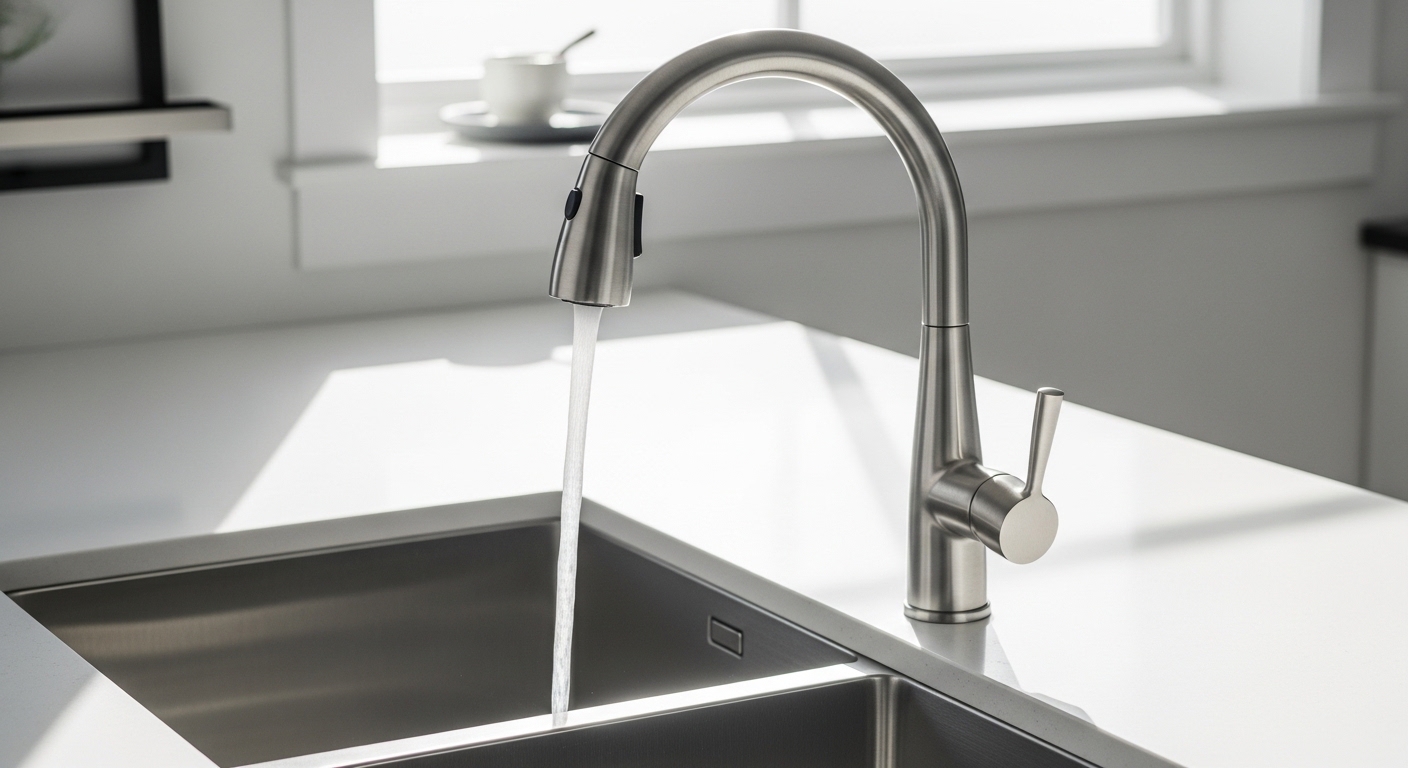
If you’ve been reading kitchen faucet reviews wirecutter style — meaning independent, lab-tested, no-affiliate-nonsense roundups — you already know they’re one of the more trustworthy places on the internet to start. But a review that crowns “the best kitchen faucet for most people” is answering a different question than the one you’re actually asking, which is usually something like “will this specific faucet fit my 34-inch farmhouse sink, survive my hard water, and still look good in five years?” This guide shows you how to read those reviews critically, what they get right, what they leave out, and how to translate a generic recommendation into the right faucet for your kitchen.
We’ll compare the faucet types Wirecutter and similar outlets test, decode the specs that actually predict longevity, and walk through the scenarios (budget, hard water, low pressure, deep sinks) where the “best overall” pick is the wrong call for you.
Can you actually trust kitchen faucet reviews from Wirecutter?
Yes — with one caveat. Wirecutter (owned by The New York Times) buys the faucets it tests, doesn’t take free samples in exchange for coverage, and earns money through affiliate links regardless of which product you buy, so there’s no incentive to push a specific brand. That editorial independence is real and rare, and it’s why their picks are a genuinely good shortlist. The caveat: they test for “most people,” which means a mid-range pull-down faucet on a standard sink. If your situation is unusual, their top pick may not be your top pick.
What they do well is the boring, hard-to-fake stuff: running faucets through thousands of spray-mode toggles, yanking the hose out and letting it retract hundreds of times, checking whether the docking magnet weakens, and noting how the finish holds up to fingerprints and cleaning. Those are exactly the failure points that show up in owner reviews 18 months later. What they can’t do is know your water hardness, your countertop hole spacing, or whether you’re 5-foot-2 and will fight with a 20-inch spout every day.
So treat the review as a filter, not a verdict. It narrows the market from hundreds of faucets to a credible five or six. You do the last mile.
What kind of kitchen faucet is best for my sink and budget?
For most kitchens, a single-handle pull-down faucet with a stainless or spot-resist finish is the best all-around choice — it’s what nearly every major review names as the default, and it fits the widest range of sinks and cooking habits. But “best” splits sharply once you factor in your budget and how you actually use the sink. Here’s how the main types stack up.
| Faucet Type | Typical Price Range | Best For | Watch Out For |
|---|---|---|---|
| Pull-down (spray head pulls straight down into the bowl) | $120–$400 | Most kitchens, deep single-bowl sinks, everyday rinsing | Needs vertical clearance under cabinets/windows |
| Pull-out (spray head pulls out toward you, horizontally) | $100–$300 | Low-clearance spots under a window, shallow sinks | Shorter reach into large bowls |
| Single-handle standard (no spray) | $60–$180 | Bar sinks, tight budgets, simple prep sinks | No hose reach for cleaning corners |
| Bridge / two-handle | $250–$700+ | Farmhouse and vintage-style kitchens, three-hole sinks | Higher price, more parts to leak over time |
| Touchless / touch-activated | $250–$600 | Busy family kitchens, messy-hands cooking | Electronics and sensors add failure points; needs batteries or power |
A quick rule of thumb on budget: under $150 gets you a reliable mechanical single-handle faucet from a brand with real customer service. The $150–$300 range is the sweet spot for build quality — solid brass or heavy-gauge stainless bodies, ceramic disc valves, and better spray heads. Above $300 you’re mostly paying for design, premium finishes, and touchless tech, not longevity. If you want a deeper look at whether a heavier metal build actually earns its price, we broke that down in our guide to whether a pull out kitchen tap brass build is actually worth it.
Which kitchen faucet is best for hard water under $250?
If you have hard water, prioritize a faucet with a silicone or rubber spray-face (the little nozzle tips you can wipe clean with your thumb) and a ceramic disc valve — that combination resists the mineral scale that clogs and stiffens cheaper faucets, and it’s readily available under $250. Finish matters too: spot-resist stainless and matte black hide water spotting far better than polished chrome, which shows every mineral streak.
Hard water is the single biggest killer of kitchen faucets that “should have lasted longer.” Calcium and magnesium build up inside the aerator and on the spray tips, weakening flow and causing that annoying splayed, sideways spray. The good news is that the fixes are cheap and the right design makes them rare. Look for:
- Wipeable spray tips — flexible silicone nubs you rub clean in seconds, versus fixed metal holes that need soaking.
- A removable aerator — so you can unscrew, soak in vinegar, and reinstall. If yours is already acting up, our walkthrough on the faucet aerator washer and how to replace one without leaks covers it step by step.
- Ceramic disc cartridge — far more scale-resistant than older rubber-washer or ball valves, and the reason most quality faucets now carry lifetime drip warranties.
Wirecutter-style reviews rarely test in genuinely hard water over years, so this is a gap you fill yourself. A $200 faucet with a good cartridge and wipeable tips will outlast a $400 designer piece with fussy metal spray holes if your water is hard.
How much should I spend on a kitchen faucet in 2026?
For a faucet you’ll use ten-plus times a day for a decade, $150 to $300 is the honest sweet spot — enough to get a metal body, a ceramic cartridge, and a lifetime finish-and-drip warranty, without overpaying for design markup. Spending less than $100 usually means plastic internals that fail in a few years; spending more than $350 mostly buys aesthetics and touchless electronics.
Here’s the value math the reviews don’t spell out. A faucet’s real cost is the purchase price divided by the years it lasts. A $90 faucet that dies in three years costs you $30 a year plus the hassle of a reinstall. A $220 faucet that lasts 12 years costs about $18 a year and you forget it exists. The mid-range wins almost every time — not because it’s fancy, but because that’s the price point where manufacturers stop cutting corners on the parts you can’t see.
One thing worth paying up for if it fits your habits: a matte or brushed finish. It hides fingerprints and water spots so well that your kitchen looks cleaner with less effort. If you’re weighing bolder finishes, our take on a Delta matte black faucet with a glass rinser gets into how those finishes wear and whether the rinser add-on earns its keep.
What specs actually matter — and which ones are marketing?
The specs that predict a good faucet are the valve type (ceramic disc), the body material (brass or heavy stainless), the spout reach and height relative to your sink, and the warranty. Almost everything else — “SpotShield,” proprietary spray-mode names, “MagnaTite” style branding — is marketing dressing on top of features that most quality faucets share. Focus on the four that matter and you’ll ignore 90% of the box copy.
Let’s decode the ones worth checking before you buy:
- Valve/cartridge: Ceramic disc is the standard for a reason — two polished ceramic plates seal water with almost no wear. This is why good faucets can promise “drip-free for life.”
- Flow rate: Most U.S. kitchen faucets are capped at 1.8 gallons per minute (GPM) by federal and many state standards; some states cap lower. Higher isn’t better — 1.8 GPM fills a pot fine. Ignore any faucet advertising a suspiciously high number.
- Spout height and reach: Measure the clearance above your sink (especially under a window) and how far the spout needs to reach to hit the center of the drain. A tall gooseneck under a low window is a daily headache.
- Deck holes: Count the holes in your sink or countertop. Most modern faucets are single-hole but include an optional deck plate (escutcheon) to cover a three-hole sink.
- Docking: A magnetic dock holds the spray head firmly; a weak or friction-only dock lets the head droop over time — one of the most common long-term complaints.
Notice what’s not on that list: brand prestige. A faucet from a mid-tier brand with a ceramic cartridge and a lifetime warranty will typically outlast a premium-branded faucet with a weaker valve. Read the spec sheet, not the logo.
Should I match the Wirecutter pick to my kitchen — or pick something else?
Match it to your kitchen. The “best overall” recommendation assumes a standard deep sink, average water, average height, and a neutral finish preference — if all of those describe you, the top pick is a genuinely safe buy. But if any one of them doesn’t, a different faucet in the same review (often the “upgrade” or “budget” pick) or a comparable model from another brand will serve you better. The review gives you the shortlist; your kitchen picks the winner.
Run your situation through these quick decision points:
- Low clearance under a window? Skip the tall pull-down; choose a pull-out or a shorter-arc pull-down.
- Hard water? Prioritize wipeable spray tips and a ceramic cartridge over finish or brand.
- Big farmhouse or double-bowl sink? You need spout reach and a long hose — measure before buying.
- Replacing a faucet yourself? Favor a single-hole design and a brand with clear install instructions and available parts.
- Want a specific look? Decide the finish first (matte black, brushed gold, spot-resist stainless), then find the best-reviewed faucet in that finish.
If you’re going the DIY route, the install is genuinely doable in under an hour once the old one is out — the hard part is usually removal, not installation. Our step-by-step on how to remove an old faucet from a kitchen sink without calling a plumber covers the corroded-nut wrestling match that trips most people up. And if you want a real-world model comparison in the pull-down category, our review of the Vigo Zurich pull-down spray kitchen faucet shows how one popular option holds up against the usual top picks.
How does adeaga test and choose the faucets we recommend?
We buy the faucets we write about, install them on real sinks, and run them through daily kitchen use — spray-mode toggling, hose retraction, hard-water exposure, and finish cleaning — rather than repeating manufacturer spec sheets. Where we cite third-party reviews like Wirecutter, we say so plainly and add the context they leave out: fit, water conditions, and long-term parts availability.
A few things we always check against recognized standards before recommending a faucet: whether it meets NSF/ANSI 61 and NSF/ANSI 372 for drinking-water safety and low lead content (the “lead-free” legal requirement in the U.S.), whether the flow rate complies with the applicable GPM cap, and what the warranty actually covers — a genuine lifetime warranty on both finish and function is a strong signal of a ceramic-disc valve and a metal body. A faucet that skips these is a pass, no matter how good it looks.
The bottom line: reviews shortlist, your kitchen decides
Independent kitchen faucet reviews — Wirecutter’s included — are one of the best tools you have for cutting through a flooded market, and you should absolutely use them. Just remember what they’re built to answer: the best faucet for a generic household, not for your sink, your water, or your budget. Take their shortlist, hold it up against the four specs that matter (ceramic valve, metal body, right spout size, lifetime warranty), and factor in your own scenario. Do that, and you’ll end up with a faucet you never think about again — which is exactly the point.
FAQ
Is the Wirecutter kitchen faucet pick worth the price?
Usually yes, if your kitchen matches their test assumptions — a standard deep sink, average water, and no strong finish preference. Their top pick has consistently been a mid-priced pull-down with a ceramic cartridge and good docking, which is exactly the value sweet spot. If your situation is unusual (low window clearance, very hard water, a farmhouse sink), a different model may serve you better even if it scores lower in a general review.
What’s the difference between a pull-down and a pull-out kitchen faucet?
A pull-down faucet has a tall arched spout, and the spray head pulls straight down into the sink; a pull-out has a lower spout, and the head pulls out horizontally toward you. Pull-downs are better for deep single-bowl sinks and give more reach; pull-outs are better under low windows or in tight vertical spaces. Both use the same basic hose-and-magnet mechanism.
How long should a good kitchen faucet last?
A quality faucet with a ceramic disc valve and a brass or heavy stainless body should last 10 to 15 years or more, and the valve itself often carries a lifetime drip-free warranty. The parts that wear first are usually the spray head, the hose, and the aerator — all of which are inexpensive, replaceable, and covered by many manufacturers’ warranties.
Do I need a touchless kitchen faucet?
No — touchless is a genuine convenience for busy, messy-hands cooking, but it adds sensors, electronics, and a power or battery requirement, all of which are extra failure points. If you want it for hygiene and convenience, buy from a brand with good customer service and expect to replace batteries. If you just want a reliable faucet, a mechanical single-handle version of the same model is often the smarter long-term buy.
Can I install a kitchen faucet myself, or do I need a plumber?
Most single-handle kitchen faucets are a genuine DIY job that takes 30 to 60 minutes, and the install itself is straightforward — connect two supply lines, seat the faucet, tighten one mounting nut. The tricky part is removing the old faucet, where corroded nuts under the sink can fight back. If the connections aren’t badly seized, you don’t need a plumber; a basin wrench and some patience are usually enough.
Does faucet finish affect durability or just looks?
It affects both. Beyond appearance, matte black, brushed nickel, and spot-resist stainless finishes hide fingerprints and hard-water spotting far better than polished chrome, so they look cleaner with less effort and tend to show wear more slowly. PVD (physical vapor deposition) finishes are the most scratch- and tarnish-resistant, and are worth asking about if durability is your priority.
Author note: This guide was written and reviewed by the adeaga fixtures team, who install, stress-test, and live with the kitchen faucets we cover. adeaga is a specialist faucet and bathroom-fixtures retailer at adeaga.net; we recommend products based on hands-on testing and recognized plumbing standards (NSF/ANSI 61 & 372, applicable GPM limits) — not manufacturer marketing.