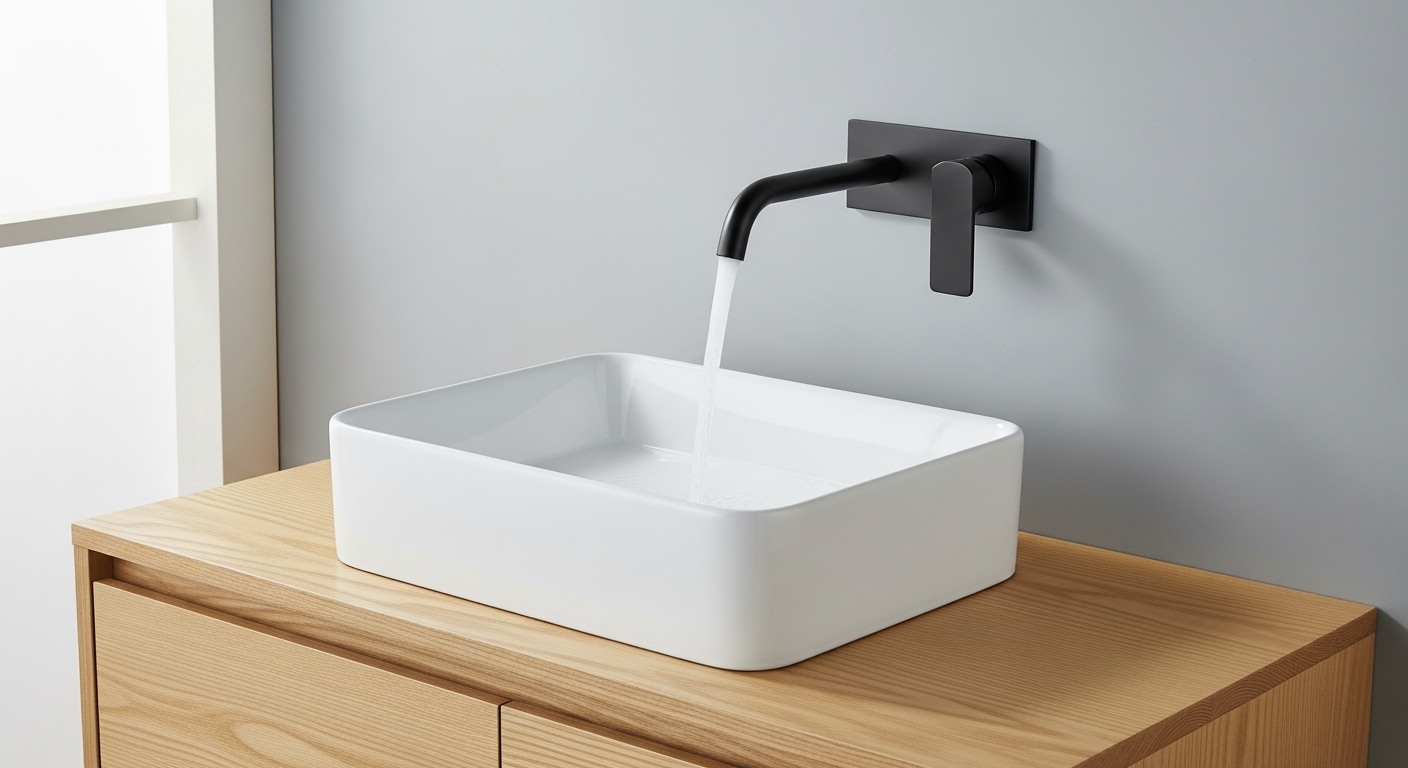
If you’ve been searching for a wall mount faucet two hole configuration, you’re almost certainly staring at a bathroom vessel sink, a floating vanity, or a utility/pot-filler situation where a deck-mounted faucet just won’t work. The good news: two-hole wall faucets are one of the cleanest, most modern-looking ways to plumb a basin. The catch: the rough-in behind the wall has to match the faucet exactly, and “two hole” can mean two different things depending on the design. This guide walks through what you’re actually buying, how to measure so you don’t order the wrong spread, and which style fits your bowl and budget.
What does “two hole” actually mean on a wall mount faucet?
“Two hole” means the faucet needs exactly two openings in the wall (or in a mounting plate/escutcheon) to install — and there are two common layouts. The first is a single-lever mixer where one hole carries the spout and one carries the combined handle-and-valve body, plumbed together behind the wall. The second is a widespread-style pair where the two holes hold two separate elements that are joined internally. Either way, you are drilling or roughing in two points, not one and not three.
This matters because faucet listings use “hole” language loosely. A three-hole wall faucet (two handles plus a center spout) is a different animal and needs a wider rough-in. So when a product says “wall mount faucet two hole,” confirm whether the two holes are for spout + single lever or for two joined bodies, and what center-to-center distance it expects. Get that wrong and you’re patching drywall.
- Spout + single lever (most common today): sleek, one-handle temperature and flow control, typically 6–8 inch centers.
- Two joined bodies: often found on wider commercial or laundry/utility mixers, sometimes on wrist-blade “hospital” faucets.
- Escutcheon-mounted: both holes hide behind a single cover plate for a tidy finished look and easier alignment.
Is a wall mount two hole faucet better than a deck-mounted one for a vessel sink?
For a tall vessel sink, yes — a wall mount two hole faucet is usually the better choice, because it clears the height of the bowl and keeps the counter open and easy to wipe. Deck-mounted vessel faucets have to be extra-tall to reach over the rim, which can look top-heavy and splash more. Mounting the spout on the wall lets you set the exact height and reach you want above the bowl.
That said, “better” depends entirely on your rough-in. A wall mount only wins if you can get water lines into the wall at the right height and spread — either during new construction, a remodel with the wall open, or a wall you’re willing to open up. If your supply lines already come up through the vanity or countertop, a deck-mounted faucet is far cheaper and less disruptive. If you’re weighing the whole decision for a bowl-on-counter setup, our guide on whether a high end vessel sink faucet is worth it breaks down the height and reach math in more detail.
| Setup | Best for | Rough-in needed | Countertop look | Typical price (faucet only) |
|---|---|---|---|---|
| Wall mount, two hole | Vessel sinks, floating vanities, wall-hung basins | Water lines in wall at set height + spread | Cleanest — nothing behind the bowl | $90–$400 |
| Deck mount, single hole vessel | Bowls on standard vanities | Lines up through counter/cabinet | Tall faucet behind bowl | $50–$250 |
| Widespread, three hole deck | Traditional drop-in / undermount basins | Three holes, 8 in centers, on deck | Two handles + spout on counter | $70–$350 |
| Wall mount, three hole | Wide basins, tub fillers, commercial | Three holes in wall, wide spread | Spread-out, traditional | $120–$500 |
How do I measure the rough-in so I order the right spread?
Measure center-to-center between the two supply outlets in the wall, and measure the height above the finished bowl rim — those two numbers decide whether a faucet fits. The most common two-hole spreads are 6, 7, and 8 inches, so your ordered faucet must match that measurement, not “close enough.” A half-inch off and the escutcheons won’t line up over the valve bodies.
Here’s the practical order of operations, whether you’re roughing in new or matching existing plumbing:
- Set your bowl height first. Know the finished rim height of your vessel or basin before you locate the spout, so water lands in the center of the bowl, not the front lip.
- Plan spout height. Aim for the spout outlet roughly 4–8 inches above the rim — enough to fill a glass or wash hands without splashing.
- Confirm reach. The spout should project so the stream lands near the drain. Too short and water hits the wall side of the bowl.
- Match the centers. Measure hole-to-hole and buy the faucet rated for exactly that spread.
- Check the valve depth. Wall faucets bury a valve body in the wall; make sure your wall cavity and finished thickness fall within the faucet’s adjustable range.
What finish and material should I choose for a wall mount two hole faucet?
Choose a solid brass body with a durable PVD finish — matte black, brushed gold/brushed brass, brushed nickel, or chrome are the most future-proof for 2026. Body material matters more on a wall faucet than almost anywhere else, because once it’s set in the wall, swapping it is a real job. A solid brass core resists corrosion and holds up to hard water far better than zinc-alloy or thin plated parts.
On finish, PVD (physical vapor deposition) coatings are the ones to look for — they’re bonded at a molecular level and shrug off scratches and cleaner chemicals that would strip an electroplated finish. Matte black and brushed nickel hide water spots best; polished chrome shows every drop but wipes clean instantly. If you’re leaning warm-metal, we compared how well those tones age in our piece on whether a brushed gold faucet for a vanity will look dated or hold up — the same logic applies to a wall mount.
- Matte black: hides spots, bold contrast on white bowls, very on-trend and staying that way.
- Brushed gold / brushed brass: warm, forgiving of fingerprints, pairs beautifully with vessel sinks.
- Brushed nickel: the safe, timeless neutral that goes with everything.
- Chrome: cheapest to produce, easiest to clean, but shows water spots.
What’s the difference between the adeaga wall mount two hole models?
The short version: adeaga’s two-hole wall faucets split into a compact single-lever line for vessel sinks and a wider joined-body line for utility and commercial-style basins. Both use a solid brass body and a ceramic-disc cartridge, but they differ in spread, reach, and handle style. Picking between them comes down to your bowl size and rough-in spread.
Every adeaga faucet body is pressure-tested before it ships and the cartridges are rated to the industry-standard 500,000-cycle mark that quality ceramic-disc valves are held to — that’s the part that decides whether a faucet drips in year two or year twelve. If you ever do need to service one, the process is the same family of steps as a deck faucet; our walkthrough on the vessel sink faucet cartridge covers how those ceramic-disc units come out and go back in.
How hard is it to install a wall mount two hole faucet myself?
If the plumbing is already roughed into the wall at the right spread and height, installing the visible faucet is a moderate DIY job — mostly connecting the valve body, sealing the escutcheons, and mounting the spout. If the water lines are not in the wall yet, that’s the hard part, and it usually means opening drywall and running new supply lines, which pushes most people toward a plumber. Be honest about which situation you’re in before you buy.
The general sequence, once the rough-in exists, looks like this:
- Shut off the water and confirm zero pressure at the outlets.
- If you’re replacing an old faucet, remove it cleanly — the same care you’d use to remove an old faucet from a kitchen sink applies to a wall unit: disconnect, don’t force, and protect the finished wall.
- Set the valve body/bodies at the correct depth for your finished wall thickness.
- Connect supply lines, tightening to spec — not gorilla-tight, which cracks fittings.
- Mount the escutcheon plate(s) and spout, sealing against the wall with the supplied gaskets or a thin bead of silicone.
- Turn the water back on slowly and check every joint for weeping under pressure.
One rule that saves a lot of grief: test under real pressure before you close up or caulk anything. A joint that looks dry at a trickle can weep at full household pressure. Run it, wait, and wipe every connection with a dry paper towel to catch the slow drips.
What are the downsides of a wall mount two hole faucet?
The honest downsides are three: the rough-in is unforgiving, servicing means going through the wall, and water can pool between the spout and the wall if the escutcheon isn’t sealed. None are dealbreakers, but you should know them before you commit. A deck faucet you can swap in an afternoon; a wall faucet you’re marrying to that wall.
- Rough-in is permanent-ish. The spread and height are locked once the wall is finished. Measure twice, order once.
- Service access. Cartridge swaps come from the front through the escutcheon, but a bigger failure can mean opening the wall.
- Splash and pooling. A poorly sealed escutcheon lets water sit against the wall; seal it and pick the right spout reach.
- Cost of the mistake is higher. Getting the wrong deck faucet is a return; getting the wrong wall rough-in can be drywall work.
FAQ
What spread do most wall mount two hole faucets use?
Most use 6, 7, or 8 inch center-to-center spreads, with 8 inches being the traditional “widespread” standard. Always measure your actual hole-to-hole distance and match the faucet to it exactly — spreads are not adjustable by more than a small tolerance.
Can I put a wall mount two hole faucet over any vessel sink?
Almost any, as long as you set the spout height and reach so the stream lands near the center of the bowl. Taller bowls need the spout mounted higher; shallow, wide bowls need more reach so water doesn’t hit the near rim. Confirm the numbers before you locate the rough-in.
Is a two hole wall faucet the same as a widespread faucet?
Not exactly. A classic widespread faucet has three pieces (two handles plus a spout) on 8 inch centers. A two hole wall faucet has only two openings — typically a single lever plus a spout, or two joined bodies — so it reads cleaner and needs one fewer rough-in point.
Do wall mount faucets meet plumbing code and standards?
Reputable wall mount faucets are built to the same low-lead (“lead-free” wetted-surface) and flow-rate standards as deck faucets, and quality ceramic-disc cartridges are cycle-tested for long-term drip-free performance. Check that any faucet you buy lists compliance with recognized North American plumbing standards and comes with a clear warranty on both the finish and the valve.
What warranty should I expect on a wall mount two hole faucet?
Look for a limited lifetime warranty on the finish and the cartridge from a serious brand — that’s the norm for solid-brass, PVD-finished faucets, and adeaga backs its bodies and cartridges on those terms. A short one-year warranty is a red flag on a fixture you’re setting into a wall.
Can I convert a deck-mounted setup to a wall mount two hole faucet?
Yes, but it’s a real remodel, not a swap. You’ll need to run new supply lines into the wall at the correct spread and height, cap or reroute the old deck stub-outs, and patch the counter or backsplash. Budget for a plumber unless the wall is already open and you’re comfortable running supply lines.
Author note: This guide was written by the adeaga fixtures team, drawing on hands-on installation and bench testing of wall-mounted and vessel faucets across brass and finish types. adeaga (adeaga.net) designs and sells faucets and bathroom fixtures direct to homeowners, and we pressure-test every faucet body and cycle-test cartridges to industry standards before they reach your door. When a spec here says a number, it’s because we’ve measured it — not because it sounded good.