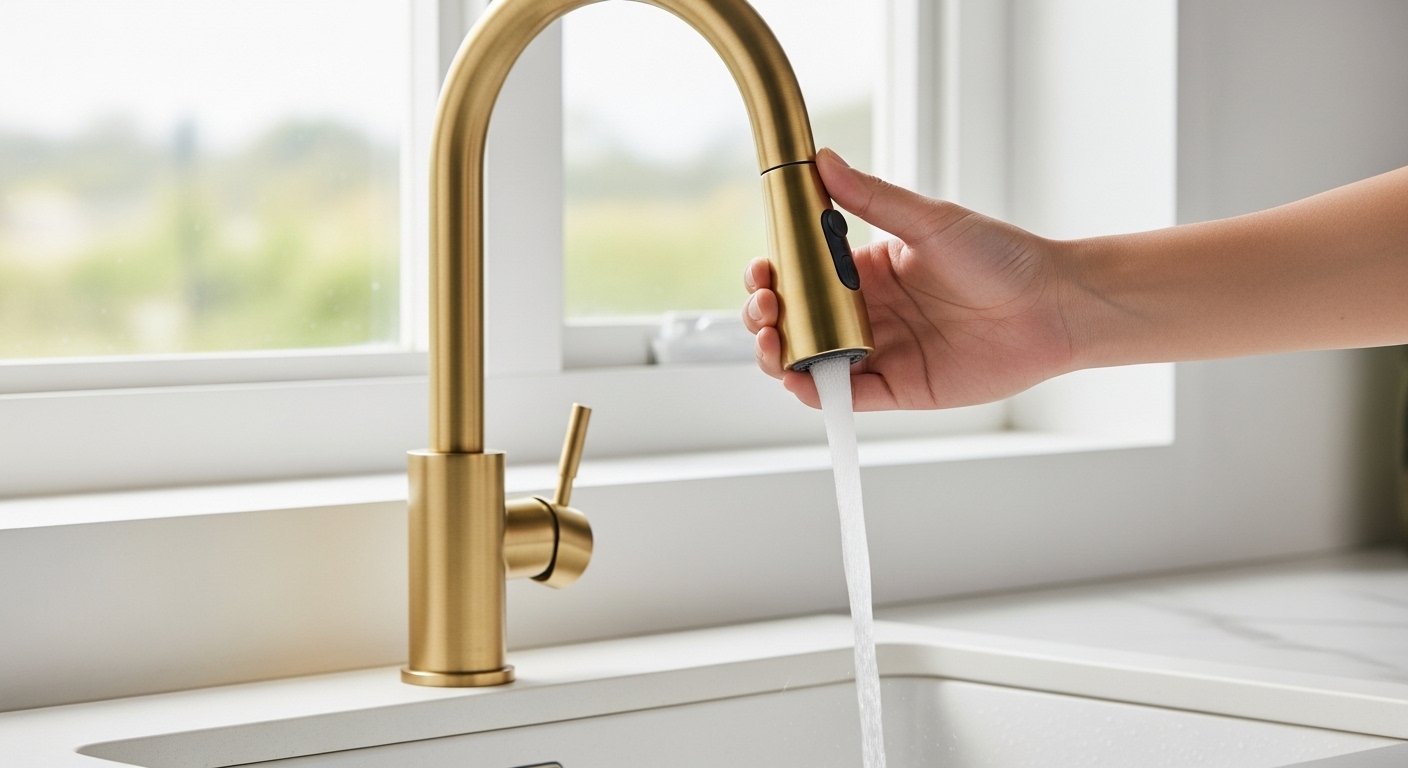
If you’ve been comparing specs, a pull out kitchen tap brass model is one built around a machined solid-brass waterway and body, with a spray head that pulls straight out on a hose toward you (rather than pulling down into the sink). The brass part matters more than most product pages let on: it’s the difference between a tap that stays leak-free for a decade and one that pinholes at the base after three or four years of hot water and mineral scale. Below I’ll break down exactly when the brass premium pays for itself, when it doesn’t, and how to tell real brass from a “brass-finish” tap that’s actually zinc underneath.
What does “pull out kitchen tap brass” actually mean — and is it different from pull-down?
It means two separate things bundled into one product: the pull-out spray action, and the brass construction. They’re independent choices, and it’s worth separating them. Pull-out refers to how the spray head moves — you grip the nozzle and draw it horizontally out of the spout on a flexible hose, typically 60–80 cm of reach. Pull-down, by contrast, arcs the head down into the bowl from a taller gooseneck spout.
Brass refers to the metal of the tap’s internal waterways and outer body. In plumbing, “brass” almost always means a dezincification-resistant (DZR / CR) brass alloy — the kind rated for potable water. Here’s the quick contrast most buyers care about:
| Feature | Pull-Out Tap | Pull-Down Tap |
|---|---|---|
| Spray head motion | Horizontal, toward you | Vertical, down into bowl |
| Best for | Shallow sinks, low windowsills, tight spaces | Deep bowls, big pots, high clearance |
| Reach for filling side pots / watering plants | Excellent — hose extends outward | Limited — stays over the sink |
| Spout height | Usually lower profile | Tall gooseneck |
| Typical hose length | 60–80 cm | 50–60 cm |
So if your tap sits under a window that won’t clear a tall gooseneck, a pull-out brass tap is often the smarter pick — you get the reach without the height. Get the metal right and the motion right, and you’ve got a tap that outlasts the kitchen it’s fitted in.
Why does the brass body matter — what actually goes wrong with cheaper taps?
The brass body matters because it’s the part that fails silently and expensively: corrosion, pinhole leaks, and stripped threads almost always start in the material the manufacturer chose to save money on. Cheaper pull-out taps use zinc alloy (sometimes called “zamak”) or plastic for the body and internal channels, then plate the outside so it looks identical to brass on the shelf.
Here’s what plays out over a few years of real use:
- Dezincification: Non-DZR alloys leach zinc when exposed to hard or slightly acidic water, leaving a weak, porous, reddish structure that eventually pinholes and weeps under the sink.
- Thermal fatigue: Kitchen taps cycle from cold to near-boiling constantly. Zinc and plastic expand and contract more aggressively than brass, which loosens joints and cracks bodies over time.
- Thread stripping: The connection points for hoses and cartridges wear far faster in soft metals, so a repair that should be a five-minute cartridge swap becomes a full replacement.
- Finish peeling: Plating adheres far better and more durably to brass than to zinc — one reason budget taps flake at the spout. If you’ve ever dealt with that, our guide on why a brushed nickel faucet peels and how to stop it walks through the same root cause.
Brass sidesteps most of this. A DZR brass waterway resists mineral attack, tolerates thermal cycling, and holds threads for cartridge changes years down the line. That last point is underrated — when the tap eventually drips, you want to fix the cartridge, not bin the whole unit. If you’re the type who’d rather repair than replace, that’s genuinely easier on a brass tap; our walkthrough on how to change a kitchen tap cartridge in the UK shows exactly how straightforward that job is on a properly built tap.
How do I tell real solid brass from a “brass-finish” tap that’s really zinc?
The fastest checks are weight, a magnet, and the spec sheet — real brass is heavy, non-magnetic, and openly declared. A “champagne brass” or “brushed brass” finish tells you nothing about what’s underneath; it’s a colour, not a material. Here’s how to separate the two before you buy:
- Heft it. A solid-brass pull-out tap feels noticeably dense — often 1.8–3 kg for the body alone. If it feels suspiciously light for its size, it’s likely zinc or plastic-cored.
- Magnet test (in person). Brass is non-magnetic. A weak magnet that clings anywhere on the body signals a steel or steel-reinforced zinc structure hiding under plating.
- Read the material line, not the finish line. Look for “solid brass body,” “brass waterway,” or “DZR/CR brass.” Vague phrases like “premium alloy,” “metal construction,” or “zinc-brass” usually mean not-solid-brass.
- Check the cartridge and valve. Reputable brass taps pair the body with a ceramic-disc cartridge rated for 500,000+ cycles. If the listing hides the cartridge type, that’s a flag.
- Look for standards marks. WRAS approval (UK), or compliance with EN 817 / cUPC / NSF/ANSI 61 for wetted materials, tells you the brass is certified safe for drinking water.
One honest caveat: many excellent taps use a brass body with a stainless-steel spout tube or a stainless spray-head shell. That’s not a downgrade — 304 stainless is a fully legitimate, corrosion-resistant material. The thing you’re trying to avoid is a zinc core dressed up in brass-coloured plating.
Which pull out kitchen tap brass finish should I choose — and will it date fast?
For a finish that won’t look dated in a couple of years, brushed/satin brass and brushed nickel are the safest long-term bets; polished chrome is timeless but shows every water spot. The finish sits on top of the same solid-brass body, so this is purely about looks and cleaning effort. Here’s how the common options actually behave day to day:
| Finish | Look | Fingerprints / spots | Longevity of style |
|---|---|---|---|
| Brushed / satin brass | Warm, matte gold | Hides them well | Very durable trend-wise |
| Polished brass | Bright, traditional gold | Shows spots readily | Classic but bolder |
| Brushed nickel | Soft silver-grey | Excellent — hides marks | Extremely safe, neutral |
| Matte black (over brass) | Modern, graphic | Shows limescale, not prints | Trendy, mildly risky |
| Polished chrome | Bright mirror silver | Shows every spot | Timeless, never wrong |
If you’re leaning gold, a PVD-coated brushed brass is worth the small premium — PVD (physical vapour deposition) bonds the colour at a molecular level and resists scratching and tarnish far better than standard electroplating. It’s the same reasoning we use when weighing warm finishes elsewhere; our take on whether a brushed gold faucet looks dated applies almost directly to kitchen brass.
Is a brass pull-out tap worth it for hard water and heavy daily use?
Yes — hard water and heavy use are exactly the conditions where brass earns its premium. In a hard-water area (most of the south and east of the UK, and much of the US Midwest and Southwest), mineral-laden water accelerates the corrosion that destroys zinc bodies, while brass shrugs it off. If your household runs the tap dozens of times a day — big family, home cook, lots of pot-filling and rinsing — the cycle count on the valve and the thermal stress on the body both climb fast, and brass simply holds up longer.
Where brass is overkill: a lightly used utility sink, a holiday let, or a rental you’ll leave in two years. In those cases a decent stainless or WRAS-approved zinc tap does the job at lower cost. Match the tap to the workload — that’s the whole decision.
A quick real-world scenario: say you’ve got a shallow ceramic sink under a low window, hard water, and you cook most nights. That’s the textbook case for a brushed-brass pull-out (not pull-down) tap — the horizontal spray clears the window, the brass survives the scale, and the ceramic-disc cartridge handles the cycle count. Spend the extra £60 here and you’ll likely never think about the tap again.
How hard is a brass pull-out tap to install and maintain myself?
For most single-hole sinks it’s a 45–90 minute DIY job with basic tools — no plumber required if your existing supply valves are in good shape. The extra weight of a brass body actually makes installation feel more stable, and the standard fittings (usually 3/8″ or 1/2″ flexible tails) connect the same way as any other tap. The one part unique to pull-out models is the hose: you thread it down through the spout and attach the counterweight, which snaps or clamps onto the hose under the sink to pull the spray head back after use.
Maintenance is minimal:
- Descale the aerator/spray head every few months in hard-water areas — unscrew it and soak in white vinegar. This restores flow and stops splatter.
- Wipe the finish with a damp cloth only; skip abrasive or acidic cleaners, especially on brushed and black finishes.
- Check the hose and counterweight yearly for kinks or a weight that’s slipped, which is the usual cause of a spray head that won’t retract fully.
- Swap the cartridge, not the tap, if it starts to drip — on solid brass the threads will still be clean years later.
If you’re replacing an old unit first, the trickiest bit is usually getting the old one out cleanly; our guide on how to remove an old faucet from a kitchen sink covers the corroded-nut situations that trip people up.
FAQ
Is a solid brass kitchen tap safe for drinking water?
Yes, provided it uses a dezincification-resistant (DZR/CR) brass and carries the right approval — WRAS in the UK, or NSF/ANSI 61 in the US. Modern potable-water brass is low-lead or lead-free by regulation, so it’s safe for drinking and cooking. Avoid unbranded taps with no certification, since those can’t verify their alloy.
What’s the difference between pull-out and pull-down for a small sink?
For a small or shallow sink, pull-out usually wins. Its lower spout fits under cabinets and windows, and the horizontal spray reaches out to fill pots on the counter, so you’re not fighting a tall gooseneck in a tight space. Pull-down shines mainly when you have a deep bowl and high overhead clearance.
How much more does a brass pull-out tap cost than a zinc one?
Expect to pay roughly £40–£120 more for a genuine solid-brass model over a comparable zinc-alloy tap, depending on brand and finish. PVD-coated brass finishes add a little more. Given that a brass tap commonly lasts 10–15+ years versus 3–6 for cheap zinc, the cost per year is usually lower.
Why won’t my pull-out spray head retract back into the spout?
Almost always the counterweight under the sink has slipped, come loose, or is catching on a pipe or the cabinet wall. Open the cabinet, find the weight clamped on the hose, make sure it hangs freely, and reposition or re-clamp it lower on the hose for more pull. A kinked hose can cause the same symptom.
Can I put a brass pull-out tap on any kitchen sink?
Most single-hole sinks and worktops (standard 32–35 mm tap hole) take a modern pull-out brass tap directly. For a two- or three-hole sink you may need a base/escutcheon plate to cover the extra holes, which many taps include. Always check the tap’s minimum worktop thickness and the reach measurement against your sink layout before buying.
The bottom line
A pull out kitchen tap brass build is worth paying for when you cook often, live with hard water, or want a tap you can repair rather than replace. Verify it’s genuinely solid brass — weight, magnet, spec sheet, and a WRAS or NSF/ANSI 61 mark — pick a brushed finish for the easiest upkeep, and match the pull-out action to a sink where a tall pull-down would get in the way. Do that, and you’ve bought a tap once instead of three times.
Author note: This guide was written by the Adeaga fixtures team, who specify, pressure-test, and install kitchen and bathroom taps year-round. At Adeaga (adeaga.net) we test tap bodies for material and finish adhesion and stand behind our brass taps with a multi-year warranty on the body and cartridge, in line with EN 817 and WRAS/NSF potable-water standards. We recommend brass where it genuinely earns its place — and say so when it doesn’t.