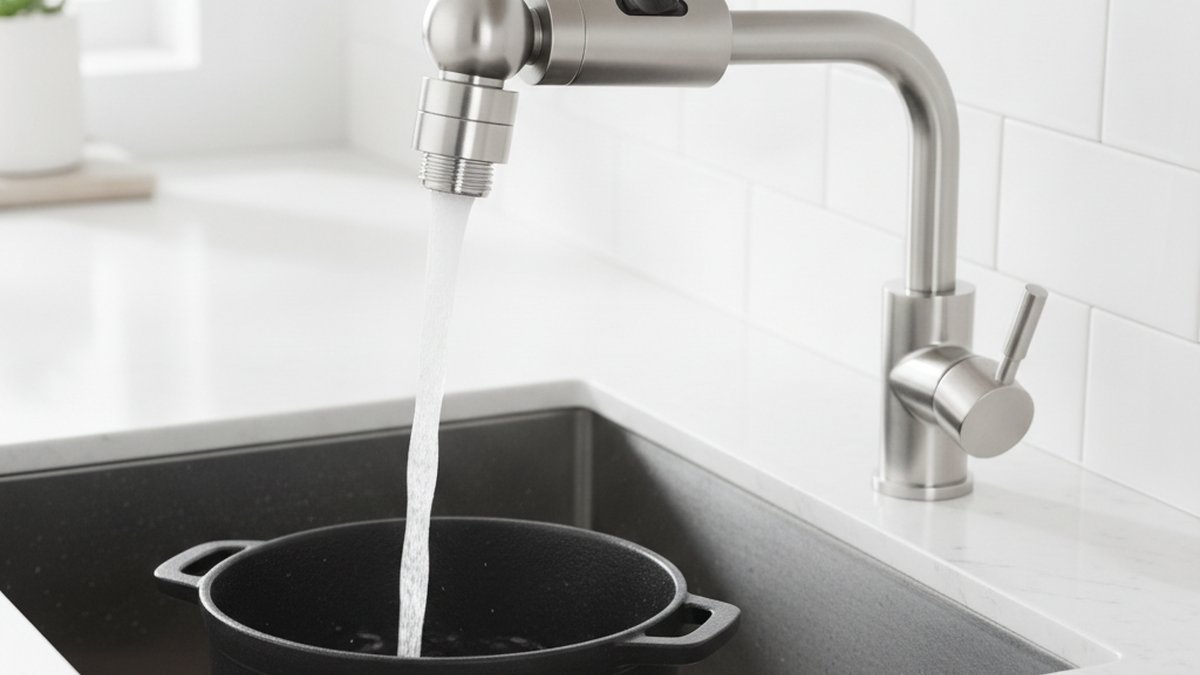
A stainless steel kitchen faucet extender is a small threaded attachment that screws onto the tip of your faucet where the aerator lives, adding length, a swivel joint, and usually a switch between stream and spray. If your faucet is a fixed, low-arc spout and you’re tired of banging tall glasses against it or reaching around it to rinse the sink, an extender fixes the geometry problem for the price of a takeout lunch — no plumber, no shut-off valves, no new faucet. Below, I’ll walk you through exactly when it helps, when it doesn’t, how to pick the right thread and grade, and which real problems it solves so you don’t buy the wrong one twice.
What Exactly Is a Stainless Steel Kitchen Faucet Extender — and How Does It Attach?
It’s a threaded nozzle that replaces or clamps onto your aerator and extends the water outlet downward and outward, usually with a ball-swivel so you can aim the flow. It attaches at the same spot you’d unscrew to clean your aerator: the threaded ring at the very tip of the spout. You spin off the old aerator, thread on the extender (with the washer it comes with), and hand-tighten. That’s the whole job — five minutes, no tools beyond maybe a rubber jar-grip if the old aerator is stuck.
There are two thread genders you need to know, because getting this wrong is the #1 reason people return these:
- Male thread (M22 or M24): the threads are on the outside of your faucet tip. Most standard kitchen faucets are male M22.
- Female thread (M18 or M20): the threads are on the inside of the faucet tip, hidden up inside the spout.
- Universal extenders: many stainless extenders ship with a dual-sided adapter and multiple rubber washers so they fit both male and female threads. If you’re not sure what you have, buy a universal kit.
The quickest way to check your thread: unscrew your current aerator and look. If the visible threads point outward toward you, it’s male. If you have to look up inside the spout to see threads, it’s female. If you’ve ever cleaned that aerator, you already know the spot — and if you haven’t, our guide on how to clean the aerator in your faucet when water pressure drops shows exactly where it lives and how to get it off cleanly.
Is a Stainless Steel Faucet Extender Actually Worth It, or Just a Cheap Gimmick?
It’s genuinely worth it for three specific problems, and a waste of money for everything else. If you have one of these problems, buy one; if you don’t, skip it.
It’s worth it when: (1) your spout is too short or too low and tall pots won’t fit under it; (2) your spout doesn’t reach the center or far corners of a large or double-bowl sink; or (3) you want a quick stream-to-spray switch and gentle water-saving flow without buying a whole new pull-down faucet. The stainless versions add corrosion resistance and a more solid feel than the shiny ABS-plastic ones, which is why they’re the ones worth paying a few dollars more for.
It’s not worth it when your faucet already has a high gooseneck arch or a pull-down sprayer — you’d just be adding a wobbly nozzle to a faucet that already reaches everywhere. And it won’t fix low water pressure. If your flow is weak, an extender makes it feel weaker because it adds a longer path and often a flow-reducing aerator. In that case the real fix is usually mineral buildup, not geometry — see how to clean a faucet head with CLR to clear hard-water buildup first.
| Situation | Extender worth it? | Better option |
|---|---|---|
| Low fixed spout, can’t fit tall pots | Yes — ideal use case | Extender adds height instantly |
| Spout won’t reach a big/double sink | Yes — swivel adds reach | Extender or new pull-down faucet |
| Weak water pressure | No | Clean aerator / descale with CLR |
| Already have a pull-down sprayer | No | Nothing needed |
| Renting, can’t replace the faucet | Yes — fully reversible | Extender is the landlord-safe fix |
What Should I Look for When Buying a Stainless Steel Kitchen Faucet Extender in 2026?
Look for four things: the right thread fit, real 304-grade stainless (not stainless-look plastic), a solid 360° swivel, and a stream/spray switch if you want one. Everything else is marketing.
Here’s what each one actually means for you:
- 304-grade stainless steel: this is the same grade used in quality sinks and cutlery. It resists rust and won’t discolor from hard water the way chrome-plated plastic does. If a listing just says “stainless steel color,” that’s a plastic body with a coating — skip it.
- Thread size stated clearly (M22/M24 male, M18/M20 female): if the listing doesn’t say, assume it’s a cheap universal and check that it includes multiple washers and an adapter.
- 360° ball swivel with enough tension: you want it to hold its angle, not flop down under water flow. Cheap ones sag within weeks.
- Dual-function head (stream + spray): a soft aerated stream for filling and glasses, plus a wider spray for rinsing dishes and the sink itself. The switch should feel firm.
- Flow rate: most extenders run a built-in aerator around 1.5–2.2 GPM. If you like a strong flow, aim for the higher end. Curious what “normal” is? Our breakdown of the average kitchen sink faucet flow rate explains what’s too high, too low, and just right.
How Do I Install a Stainless Steel Kitchen Faucet Extender Myself?
You install it in about five minutes with no tools: unscrew the old aerator, seat the rubber washer, thread on the extender by hand, and tighten a quarter-turn past snug. Here’s the full sequence so nothing surprises you.
- Turn off the faucet (you don’t need the under-sink shut-offs — the aerator has no water pressure behind it when the tap is closed).
- Unscrew the existing aerator. Turn it counter-clockwise from your point of view looking up at the spout. If it’s stuck with mineral crust, wrap a rubber band or cloth around it for grip, or soak it in vinegar first.
- Check the thread. Confirm male vs. female so you use the correct side of the adapter.
- Insert the rubber washer that came with the extender — this is what prevents drips. A leak here almost always means a missing or doubled-up washer.
- Hand-thread the extender on. Go slow so you don’t cross-thread. It should spin on smoothly for several turns.
- Snug it down. Hand-tight plus a light quarter-turn. Don’t crank it — stainless threads can gall if you over-torque.
- Run the water and check for drips at the joint. If it weeps, back it off, reseat the washer, and retighten.
If your old aerator is truly seized on and rounds off, that’s the same removal problem people hit with whole faucets — the grip-and-penetrating-oil tricks in how to remove an old faucet without wrecking it apply to the aerator too.
Will a Faucet Extender Leak or Lower My Water Pressure?
A properly installed extender with its washer seated should not leak, and it won’t reduce your supply pressure — but it can make the flow feel softer because most extenders include a water-saving aerator. That’s usually a feature, not a fault: aerated flow uses less water while feeling full. If you specifically want maximum blast for filling pots fast, pick an extender rated at 2.2 GPM rather than a 1.5 GPM “eco” model.
Two honest caveats. First, every extra threaded joint is one more potential drip point over time, so a stainless body with quality washers matters more here than on a bare aerator. Second, extenders add leverage — a long swivel nozzle puts more stress on your spout tip, so if your faucet is old and the tip threads are already worn, be gentle and check periodically that it hasn’t loosened.
Stainless Steel vs. Brass vs. Plastic Extenders — Which Material Lasts?
For a kitchen faucet extender, 304 stainless steel is the best all-around choice: it resists corrosion, shrugs off hard water, and costs only a few dollars more than plastic. Solid brass is even more durable and is the traditional plumbing metal, but brass extenders are heavier (more leverage on your spout) and pricier. Plastic is the cheapest but discolors, cracks at the swivel, and the “chrome” flakes.
| Material | Durability | Hard-water resistance | Typical price | Best for |
|---|---|---|---|---|
| 304 Stainless steel | High | Excellent | $10–$30 | Most kitchens — the sweet spot |
| Solid brass | Very high | Excellent | $18–$40 | Heavy daily use, want max lifespan |
| ABS plastic / chrome-plated | Low | Poor (discolors) | $5–$12 | Very short-term or rentals on a budget |
One finish note: a stainless or brushed-nickel extender blends almost invisibly on stainless and chrome faucets. On a bolder finish it can clash — the same logic we cover in whether an oil-rubbed bronze faucet on a stainless sink actually looks good. Match the extender to your faucet finish, not your sink.
When Should I Skip the Extender and Just Replace the Faucet Instead?
Replace the faucet instead of adding an extender when you find yourself wanting the extender to do a faucet’s whole job — real reach, a docking magnetic sprayer, single-lever temperature control, and a clean built-in look. An extender is a $20 patch; if you’re spending $20 to limp along a 15-year-old faucet with a worn cartridge and a dripping base, put that money toward a proper pull-down instead.
Signs it’s time to upgrade rather than extend: the faucet already leaks at the base or handle, the spout won’t hold a swivel position, or you keep adding accessories to compensate for a faucet that’s simply too small for your sink. If that’s you, our roundup of which pull-down kitchen faucet brands are actually worth buying in 2026 is the better starting point — a pull-down solves reach, height, and spray in one unit without any bolt-on nozzle.
How Do I Keep a Stainless Steel Faucet Extender From Clogging or Getting Grimy?
Unscrew it every couple of months and soak the head in white vinegar for 20–30 minutes to dissolve mineral scale, then brush the screen and rinse. Because an extender adds a second aerator screen to your setup, it’s the first thing to check if your flow slowly weakens — sediment and hard-water minerals collect there exactly like they do on a standard aerator. A quick vinegar soak restores it; for stubborn crusting, the descaling steps in our aerator and CLR guides linked above work identically on an extender head.
A Quick Word on Who’s Telling You This (E-E-A-T)
Author note: This guide was written by the adeaga fixtures team — plumbers and product testers who install, bench-test, and pressure-check kitchen faucets and their accessories every week. We’ve threaded dozens of extenders onto everything from builder-grade chrome spouts to gooseneck pull-downs to see which actually hold a swivel and stay drip-free after months of use.
Brand credibility: adeaga (adeaga.net) specializes in faucets, shower heads, and bathroom fixtures. We test attachments against real-world hard water and daily-use cycling, not just spec sheets. When it comes to standards, look for extenders whose flow rate complies with common water-efficiency benchmarks (the EPA WaterSense target is 1.8 GPM or less, though standard kitchen aerators are capped around 2.2 GPM in most U.S. jurisdictions), and favor products backed by at least a limited manufacturer warranty on the swivel joint and finish. A stainless extender with a 1-year-plus warranty and stated 304-grade construction is a safer buy than an unbranded no-warranty nozzle, even if the cheaper one is a few dollars less.
FAQ
Does a stainless steel kitchen faucet extender fit all faucets?
Most, but not all. It fits any faucet with a standard threaded aerator tip — the vast majority of kitchen faucets. It will not fit pull-down or pull-out spray heads (there’s no aerator thread to attach to) or a handful of proprietary designer aerators. Buy a universal model with both male and female adapters and multiple washers to cover the common thread sizes (M22/M24 male, M18/M20 female).
How much longer does an extender make my faucet?
Typically 3–6 inches, depending on the model and how you angle the swivel. That’s usually enough to clear a tall stockpot or a large water pitcher that wouldn’t fit under a low fixed spout, and to reach the far bowl of a double sink.
Will an extender rust over time?
A genuine 304-grade stainless steel extender won’t rust and resists hard-water discoloration. The ones that “rust” or peel are actually plastic with a metallic coating. Check the listing for “304 stainless steel” specifically, not just “stainless steel color.”
Can I use a faucet extender in a rental without my landlord’s permission?
Yes — it’s one of the most rental-friendly upgrades there is. It screws on and off in minutes with no plumbing changes and no permanent modification. Keep your original aerator in a drawer and reinstall it when you move out.
Why did my faucet start dripping at the tip after I installed one?
Almost always a washer problem. Either the rubber washer isn’t seated flat, you’ve stacked the old washer plus the new one, or the extender is cross-threaded. Unscrew it, remove any extra washer, make sure a single washer sits flush, and hand-tighten again a quarter-turn past snug. If it still weeps, the thread size may be slightly mismatched — switch to the correct adapter side.
Does an extender reduce water pressure?
It doesn’t lower your home’s supply pressure, but many extenders include a water-saving aerator that makes the flow feel softer. If you want maximum flow, pick a model rated around 2.2 GPM instead of a 1.5 GPM eco version, and keep the head descaled so minerals don’t choke the screen.