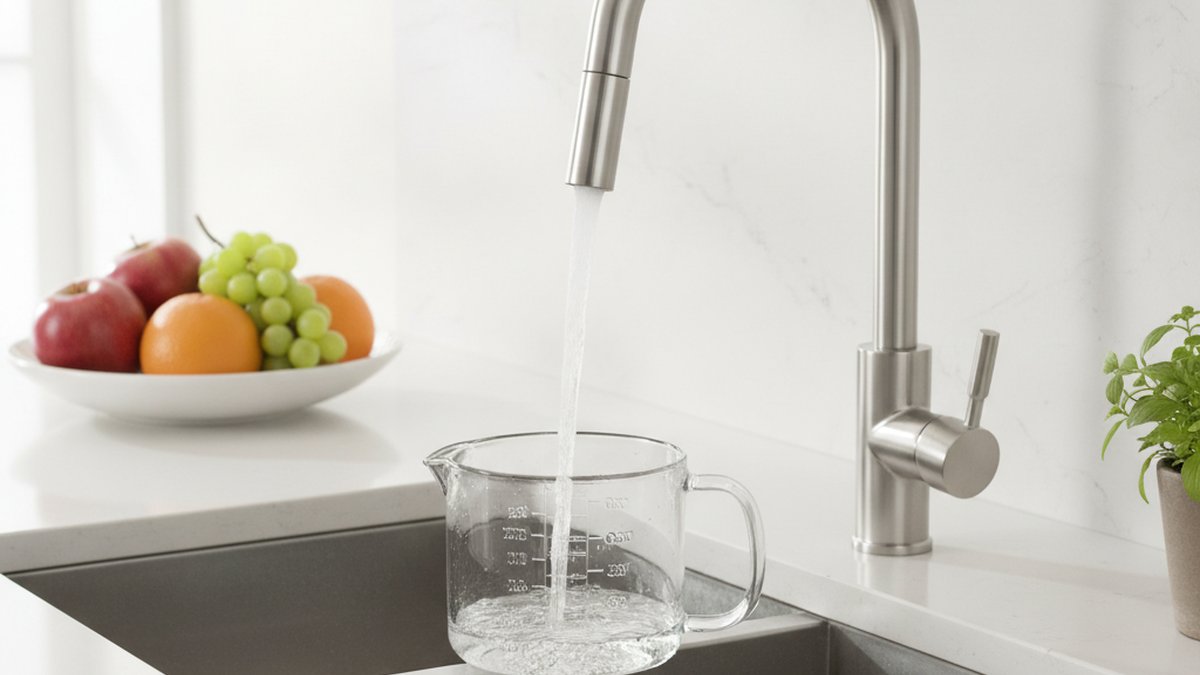
If you’ve ever stood at your sink wondering why it takes forever to fill a stockpot — or why your water bill crept up — you’re really asking about the average kitchen sink faucet flow rate. Flow rate is simply how much water your faucet pushes out per minute, measured in gallons per minute (GPM). Most modern kitchen faucets sold in the United States land between 1.5 and 2.2 GPM, and by federal law they can’t legally exceed 2.2 GPM at 60 psi of water pressure. That single number quietly controls how fast you fill pots, rinse dishes, and how much water (and money) goes down the drain.
Below, I’ll walk you through what “normal” actually looks like, how to measure yours in about a minute, when a low number is a problem versus a plumbing issue, and how to choose the right flow rate for how you actually cook and clean. No fluff — just the numbers and the plain-English reasons behind them.
What Counts as a “Normal” Kitchen Faucet Flow Rate in 2026?
A normal kitchen faucet flow rate today is 1.5 to 2.2 GPM. Anything at or below 1.5 GPM is considered water-efficient; anything trying to push past 2.2 GPM would be illegal to sell new in the U.S. The most common “sweet spot” for kitchen faucets is right around 1.8 GPM — fast enough to feel powerful, slow enough to be efficient.
Here’s the key context most people miss: that GPM rating is always measured at a standard 60 psi (pounds per square inch) of water pressure. If your home’s water pressure is lower — say 40 psi — a faucet rated at 1.8 GPM will actually deliver less than 1.8. So the printed spec is a lab number under ideal conditions, not a promise about your kitchen.
Bathroom faucets, by contrast, are capped much lower — 1.2 GPM in California and 1.5 GPM federally — because you don’t need to fill pots at a bathroom sink. That’s why a kitchen tap feels noticeably stronger than a bathroom one even when both look similar.
What’s the Difference Between 1.5, 1.8, and 2.2 GPM in Real Life?
The practical difference between these ratings is roughly how long it takes to fill a container and how much water you use per year. At 2.2 GPM you fill a one-gallon pot in about 27 seconds; at 1.5 GPM the same pot takes about 40 seconds. Small per-task, but it adds up across thousands of uses.
Let me put real numbers to it so you can decide what actually matters for your household:
| Flow Rate | Time to Fill 1 Gallon | Best For | Efficiency Rating |
|---|---|---|---|
| 2.2 GPM (legal max) | ~27 seconds | Big families, frequent pot-filling, heavy cooks | Standard |
| 1.8 GPM (most common) | ~33 seconds | Everyday all-purpose kitchens | Good balance |
| 1.5 GPM (WaterSense-style) | ~40 seconds | Water-conscious homes, drought regions | Water-efficient |
| 1.2 GPM (eco/low-flow) | ~50 seconds | Small households, rentals, low-use sinks | Ultra-efficient |
Here’s the honest take: for most people, the jump from 2.2 to 1.8 GPM is nearly unnoticeable in daily use but saves real water over a year. Dropping to 1.2 GPM is where cooks start to feel it — filling a big pasta pot or a Brita pitcher noticeably drags. If you rarely fill large containers, low flow is a genuine free win. If you’re a serious home cook, keep it at 1.8 or above.
How much water does flow rate actually save per year?
Switching from a 2.2 GPM to a 1.5 GPM faucet saves a typical family roughly 700 gallons per year, according to EPA WaterSense estimates — assuming similar usage habits. That’s not life-changing on its own, but combined with an efficient dishwasher and showerheads, it meaningfully trims both your water and water-heating bills, since a big chunk of kitchen water is heated.
How Do I Measure My Own Kitchen Faucet’s Flow Rate at Home?
You can measure your faucet’s flow rate in about 60 seconds with nothing but a measuring cup or jug and your phone timer. Turn the faucet to full hot-and-cold, time exactly 10 seconds of flow into a container, measure how much water you collected, then multiply by six to get gallons per minute.
- Grab a container with known volume — a 1-quart measuring jug or a marked pitcher works best.
- Turn the faucet fully open (both handles / lever all the way up) for maximum flow.
- Time 10 seconds exactly while filling the container.
- Measure what you collected. If you caught 1 quart (32 oz) in 10 seconds, that’s 0.25 gallons.
- Multiply by 6. 0.25 gallons × 6 = 1.5 GPM. Done.
Quick sanity check without measuring: a standard 16-ounce cup filling in about 4–5 seconds means you’re around 1.8–2.2 GPM. If it takes 8+ seconds, something is throttling your flow — and that’s usually fixable.
Why Is My Kitchen Faucet Flow So Weak — Is It Broken or Just Low-Flow?
Nine times out of ten, a weak kitchen faucet isn’t broken and isn’t truly low-flow by design — it’s a clogged aerator choked with hard-water mineral buildup. The aerator is the little mesh screen that screws onto the tip of your spout, and it’s the single most common cause of a sudden drop in flow.
Before you assume you need a new faucet, run through these causes in order of likelihood:
- Clogged aerator (most common): Mineral scale and grit collect in the screen. Unscrew it, soak it in vinegar or a descaler, rinse, and reinstall. Flow often jumps right back. Our guide on cleaning a faucet head with CLR to remove hard-water buildup walks through this step by step.
- Worn or wrong aerator washer: A cracked or misseated washer can restrict or leak flow. See why the faucet aerator washer matters and how to replace it without creating new leaks.
- Flow restrictor doing its job: Some faucets ship with a built-in restrictor to hit a low GPM rating. That’s intentional efficiency, not a defect — similar to how a shower head flow restrictor caps output.
- Low household water pressure: If every fixture is weak, the problem is upstream — a partly closed shutoff valve, pressure regulator, or supply issue.
- Kinked or clogged supply lines / cartridge: Debris in the cartridge or a pinched braided supply hose under the sink chokes flow to one faucet only.
The tell: if only your kitchen faucet is weak, it’s almost always the aerator or cartridge. If every tap in the house is weak, it’s a whole-home pressure issue and you should check your main shutoff and pressure regulator first.
Can I remove the flow restrictor to get more water?
Yes, on many faucets you can physically remove the flow restrictor from the aerator to boost flow — but understand the trade-offs before you do. You’ll use more water and, in some states, you may put the faucet out of code compliance. It also won’t help if your real problem is low incoming pressure. I only recommend it if you have genuinely low pressure and a legitimate need (like filling large pots constantly), and never on a faucet still under warranty, since modifying it can void coverage.
What Flow Rate Should I Actually Buy for My Kitchen?
For most households, buy a kitchen faucet rated at 1.8 GPM — it’s the best balance of speed and efficiency and won’t leave you tapping your foot waiting for a pot to fill. Go to 2.2 GPM only if you’re a heavy cook or fill big containers daily; drop to 1.5 GPM if water conservation is a priority or you live in a drought-prone or restricted region.
Match the flow rate to how you cook, not to marketing:
| Your Situation | Recommended Flow Rate | Why |
|---|---|---|
| Big family, cook daily, fill stockpots | 2.0–2.2 GPM | Speed matters more than marginal savings |
| Average household, mixed use | 1.8 GPM | Feels strong, still efficient |
| Water bills / drought region | 1.5 GPM WaterSense | ~700 gal/yr saved, barely noticeable |
| Rental, prep sink, low use | 1.2 GPM | Max efficiency, low demand |
One smart feature to look for: a dual-spray or pause function. A pull-down faucet with a stream/spray toggle lets you use a wide efficient spray for rinsing and switch to a concentrated aerated stream for filling — effectively giving you the benefits of both flow behaviors from one 1.8 GPM head. If you’re weighing specific models, our roundup of the best Moen kitchen faucets and how to match one to your sink covers flow-rate specs alongside spray modes and reach.
Don’t obsess over squeezing out the highest possible GPM. A well-designed 1.8 GPM faucet with a good aerator often feels stronger than a poorly designed 2.2 GPM one, because aeration and spray-pattern design shape how forceful the water feels, not just the raw volume.
Does Higher Flow Rate Mean Better Water Pressure?
No — flow rate and water pressure are two different things, and confusing them is the number one reason people buy the wrong faucet. Pressure (psi) is the force pushing water through your pipes; flow rate (GPM) is the volume that comes out. A high-flow faucet on a low-pressure home will still trickle, while a modest faucet on strong pressure feels punchy.
Think of it like a garden hose: pressure is how hard the water is pushed, flow is how wide the opening is. Your faucet’s GPM rating assumes a healthy 60 psi. If your home runs at 40 psi, you’ll never hit the rated flow no matter which faucet you install. That’s why, if your whole house feels weak, upgrading the faucet won’t fix anything — you need to address pressure at the source (regulator, main valve, or a booster). Buying a 2.2 GPM faucet to “fix” low pressure is a common and expensive mistake.
How Do I Know If a Faucet’s Advertised Flow Rate Is Legit?
Look for third-party certification marks and published specs — a legit faucet lists its GPM rating and carries certifications like NSF/ANSI 61 and NSF/ANSI 372 (safe drinking-water and lead-free standards) and often the EPA WaterSense label for efficient models. Reputable brands test to ASME A112.18.1 / CSA B125.1, the North American standard governing faucet performance and flow.
If a listing hides the flow rate or makes vague “high-pressure” claims without a GPM number, treat that as a red flag. Certified faucets have been independently flow-tested at 60 psi, so the number on the box is verified, not guessed. It’s also worth checking the warranty: quality kitchen faucets carry lifetime limited warranties on the faucet body and finish, which signals the manufacturer stands behind the internal cartridge and aerator that actually control your flow.
FAQ
What is the maximum legal flow rate for a kitchen faucet in the US?
The federal maximum is 2.2 GPM at 60 psi for kitchen faucets. Some states are stricter — California caps kitchen faucets at 1.8 GPM. Bathroom faucets are held to lower limits (1.5 GPM federally, 1.2 GPM in California) because they don’t need pot-filling volume.
Is 1.5 GPM enough for a kitchen faucet?
For most households, yes. A 1.5 GPM WaterSense faucet handles everyday dishwashing, rinsing, and hand-washing comfortably. You’ll only feel the difference when filling large pots or pitchers, where it takes a few seconds longer. Heavy cooks who fill stockpots daily may prefer 1.8–2.2 GPM.
Why does my new faucet have lower flow than my old one?
Because efficiency standards have tightened over the years. An older faucet may have been 2.5+ GPM before the rules changed, while new models are capped at 2.2 GPM and many ship at 1.8 or 1.5 GPM. It’s not defective — it’s meeting current water-efficiency law. Check the aerator marking for the printed GPM.
Can I increase my kitchen faucet’s flow rate?
Sometimes. First clean or replace a clogged aerator — that restores lost flow for free. You can also swap in a higher-GPM aerator or remove the flow restrictor, but that increases water use and may affect code compliance or warranty. If your whole house is weak, the fix is water pressure, not the faucet.
Does a pull-down or pull-out sprayer change the flow rate?
The rated GPM is the same whether the head is docked or pulled out — it’s set by the aerator and any built-in restrictor. What changes is how the water feels: spray mode disperses the same volume through many small holes for coverage, while stream mode concentrates it for filling. Both use the same total GPM.
How often should I clean my aerator to keep flow steady?
Every 3–6 months in hard-water areas, once a year in soft-water regions. Mineral scale builds up gradually and quietly cuts your flow before you notice. A quick vinegar or CLR soak keeps it running at the rated GPM and extends the life of the faucet.
The Bottom Line
The average kitchen sink faucet flow rate sits at 1.8–2.2 GPM, and for the vast majority of kitchens, a 1.8 GPM certified faucet is the smart buy — strong enough to feel great, efficient enough to save water and money. Measure yours with the 10-second cup test, keep the aerator clean, and don’t confuse flow rate with water pressure. Get those three things right and you’ll never think about GPM again.
Author note: This guide was written by the adeaga fixtures team, drawing on hands-on faucet installation, flow-testing, and troubleshooting across hundreds of kitchen setups. At adeaga (adeaga.net), we specialize exclusively in faucets and bathroom fixtures — we test products against ASME A112.18.1/CSA B125.1 performance benchmarks and prioritize WaterSense-certified, NSF-listed models backed by real manufacturer warranties, so the flow-rate numbers we quote reflect verified specs, not marketing copy.