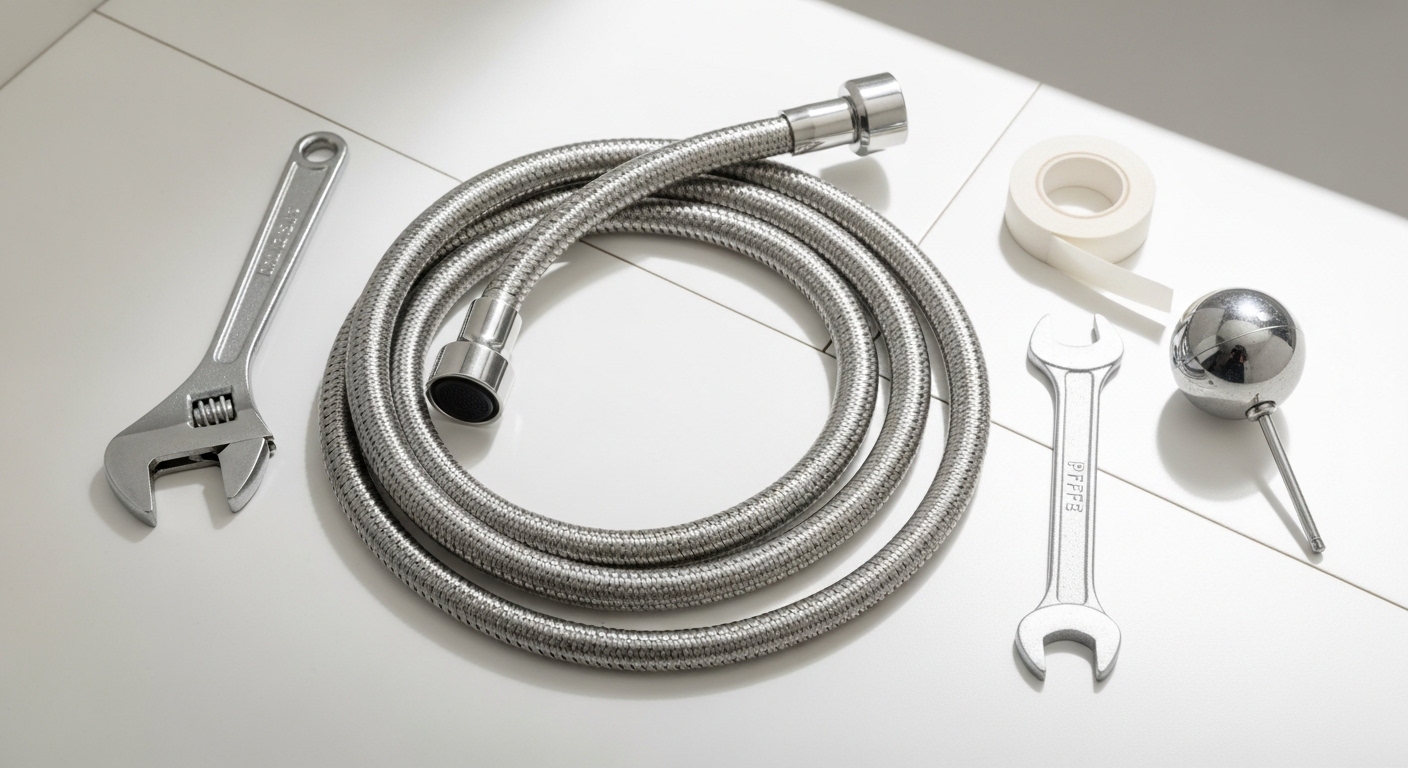
If you’ve ever rinsed a stockpot on the far edge of a deep undermount sink and watched the sprayer head snap back two feet short of where you needed it, you already know why a pull down kitchen faucet extension exists. It’s the small, unglamorous part that decides whether your $300 faucet actually feels usable — or whether you spend the next decade wrestling a too-short hose every time you wash a pan. This guide walks through when an extension genuinely helps, how to pick the right length and connector, what good ones cost, and the install gotchas that send most people back to the hardware store on a Sunday afternoon.
What exactly is a pull down kitchen faucet extension, and how is it different from a regular hose?
A pull down kitchen faucet extension is the flexible supply hose that runs from the faucet body, up through the spout, and connects to the spray head you pull down into the sink. It’s “extension” in two senses: it physically extends the reach of the spray head, and it’s often sold as an add-on or replacement that’s longer than the factory hose. Regular under-sink supply lines carry water from the shutoff valve to the faucet inlets; the extension is downstream of that — it lives inside the spout neck and runs to the moving spray head.
Three details separate a real pull-down extension from a generic flexible hose. First, the inside diameter is tuned (typically 3/8″ or 1/2″ ID) to keep flow rates above 1.5 GPM without pressure drop. Second, both ends use specific spray-head fittings — most commonly a 3/8″ compression nut on the faucet end and an M15 or G1/2 threaded coupling on the spray-head end. Third, the outer jacket is either stainless-steel braid, nylon-reinforced PEX, or PVC-clad EPDM, all chosen because they have to flex through tens of thousands of pull-and-retract cycles without cracking.
How do I know if I actually need a pull down extension — or just need to fix my faucet?
You need an extension if any of four things are true: your existing hose is physically too short for your sink layout, the hose is leaking or kinked, the spray head won’t retract because the weight isn’t pulling enough hose back up, or you’re converting a fixed-spout faucet to a pull-down using an aftermarket kit. If none of those apply, the problem is probably elsewhere in the faucet — and a new hose won’t fix it.
Quick gut check before you buy anything. Pull the spray head out as far as it will go and measure from the tip of the head to the base of the spout. If you’re getting less than 20 inches of usable reach on a standard 30″+ wide sink, the hose is undersized for the basin. If you get plenty of reach but the head dangles instead of retracting, the counterweight is too light or has slipped off the hose — that’s a $10 fix, not a hose replacement. And if water sprays from the spout collar when the head is docked, the hose has a pinhole and needs to be swapped immediately. For weak-flow problems that aren’t related to the hose at all, our deeper teardown on how to increase water flow in a kitchen faucet walks through aerator, cartridge, and valve diagnostics.
The five-minute diagnostic checklist
- Reach test: Measure full extension from spout base to spray head tip. Anything under 20″ is short for a 30″+ sink.
- Retract test: Pull head out 24″, let go. It should glide back and seat in under 3 seconds. If it stalls, check the weight.
- Leak test: Run water with the head docked. Touch the hose under the sink — any moisture means failure.
- Kink test: Trace the hose by hand for any flat spot, especially where it loops around the weight.
- Pressure test: Compare GPM at the head vs. at the side-spray (if present) or a bathroom faucet. A 20%+ drop suggests internal hose collapse.
What length pull down kitchen faucet extension should I buy for a deep undermount sink?
For most residential sinks, you want a 60-inch (1500 mm) extension hose. That gives you roughly 24–28 inches of usable reach below the spout, which is enough for a 33″ wide single-bowl or a 36″ wide double-bowl undermount. For shallow drop-in sinks or bar prep faucets, a 40″ hose is plenty. Avoid anything shorter than 32″ unless you’re replacing a hose on a compact bar faucet — you’ll regret it the first time you fill a tall vase.
Here’s the part most buyers miss: hose length is total length, not usable reach. About 24–30 inches of the hose is consumed by the loop under the sink, the counterweight slack, and the path up through the spout column. So a “60-inch hose” really delivers around 28 inches of pull-out — which sounds short on paper but is actually the right number for an ergonomic reach without the head dragging on the cabinet floor when it retracts.
Stainless braided, nylon, or PEX — which extension material lasts longest?
Stainless-steel braided hoses with an EPDM core are the best all-around choice and what virtually every premium brand (Kohler, Moen, Delta, Kraus, Adeaga) ships from the factory. They handle 80–125 PSI working pressure, survive 250,000+ flex cycles in lab testing, and resist the kind of slow chafe that kills cheaper hoses where they rub against the cabinet wall. Nylon-jacketed hoses are lighter and quieter but tend to glaze and crack at the weight contact point after 4–6 years. PEX with a PVC jacket is the budget option — fine for a rental or a backup, but the wall stiffness reduces effective reach.
| Hose Type | Typical Lifespan | Working PSI | Flex Cycles (tested) | Price Range | Best For |
|---|---|---|---|---|---|
| Stainless braid + EPDM core | 10–15 years | 125 PSI | 250,000+ | $18–$45 | Daily-use family kitchens |
| Nylon-jacketed rubber | 4–6 years | 100 PSI | 100,000 | $12–$25 | Light-use second kitchens |
| PVC-clad PEX | 3–5 years | 80 PSI | 50,000 | $8–$15 | Rentals, temporary fixes |
| Silicone-coated braid | 12+ years | 150 PSI | 300,000 | $35–$70 | Commercial / prep kitchens |
How do I figure out what connector my faucet needs?
Check the brand of your faucet and the end of the existing hose — pull-down extensions use one of four common couplings, and they are not cross-compatible. The four you’ll see in 95% of North American kitchens are 3/8″ compression (most Delta, Moen, Pfister), M15 metric thread (Kohler, Hansgrohe, many European brands), G1/2 quick-connect (Kraus, many imports), and a proprietary push-fit clip (newer Delta Touch20 and Moen MotionSense models). Buying the wrong fitting is the #1 reason an extension gets returned.
The cleanest way to identify yours: unscrew the spray head from the hose by hand (it’s almost always hand-tight or finger-tight at the head). Take a clear photo of the threaded coupling, count visible threads per inch if you can, and measure the OD with calipers or a tape. M15 measures 15 mm OD; G1/2 measures roughly 21 mm OD; 3/8″ compression has a smaller ferrule and a brass ring. If you’re swapping a Kraus pull-down assembly entirely — say, because you want a matching soap dispenser — our guide to the Kraus pull-down with matching soap dispenser covers the G1/2 connector specifics for that lineup.
The four common connector types at a glance
- 3/8″ compression nut: Brass ferrule, hex nut, threads in. Found on Delta, Moen, Pfister, most American mid-market.
- M15 × 1 metric thread: 15 mm OD, fine pitch. Kohler, Hansgrohe, Grohe, premium European.
- G1/2 quick-connect: 21 mm OD, often with a rubber O-ring. Kraus, many Adeaga, BLANCO, imported pull-downs.
- Proprietary push-fit: Plastic collar, color-coded clip. Delta Touch20, Moen MotionSense, smart faucets.
How do I install a pull down kitchen faucet extension without flooding my cabinet?
Shut the water off at the angle stops under the sink, open the faucet to relieve pressure, then unscrew the old hose at both ends, thread the new one through the spout column, hand-tighten the connectors, and snug them a quarter turn with a wrench. The whole job takes 15–25 minutes if the connector matches and the spout column isn’t gummed up with mineral scale.
The trick is doing things in the right order. Disconnect the spray-head end first (it’s hand-tight, so it’s easy), pull the hose down through the spout while feeding the new hose up from below, then reconnect the faucet-body end last. If you try to disconnect the bottom first, you’ll lose the hose into the spout and have to fish it out — sometimes with a wire coat hanger and a lot of profanity. Tighten compression fittings 1/4 turn past hand-tight; M15 and G1/2 fittings just need a firm hand and a fresh O-ring. PTFE tape is only for tapered threads — don’t put it on M15 or G1/2 couplings, you’ll just chew up the rubber seal.
Quick install walkthrough
- Shut both angle stops. Open faucet to drain residual pressure.
- Unscrew spray head from hose at the spout (hand-tight in 90% of cases).
- Detach the counterweight from the hose (look for a clip, not a clamp).
- Unscrew hose from faucet body — towel under the connection to catch drips.
- Feed new hose up through the spout column from below.
- Reattach at faucet body first, then spray head.
- Reinstall counterweight roughly 16–20″ up from the body end.
- Open angle stops slowly. Run water with head docked, then pull out and back in 3 times. Check for any leaks under the sink.
What does a good pull down extension cost — and when is “cheap” actually fine?
Plan to spend $18–$45 for a name-brand stainless braided extension that will last a decade or more. Anything under $12 is a gamble; anything over $70 is usually a branded OEM part where you’re paying for the logo on the package, not extra engineering. For occasional-use second kitchens, RVs, or rentals, a $10 PVC-clad PEX hose from the hardware store will do the job for a couple of years.
Where it’s worth spending up: if you have municipal water above 75 PSI, well water with grit, or a hot water heater that runs above 130°F. Those conditions kill cheap hoses in 18 months. Look for hoses rated to 125 PSI minimum, with an EPDM (not nitrile) inner tube, and a NSF/ANSI 61 certification mark for drinking water contact. Brands that publish their flex-cycle test data — Kraus, Kohler, Adeaga, Delta — are showing they have something to back up the warranty.
What goes wrong with extension hoses — and how do I avoid it?
Four failures dominate: chafing where the hose rubs the cabinet wall, kinking at the weight contact point, O-ring degradation at the spray-head coupling, and the spray head sticking open because debris jammed the diverter valve. Each one has a 10-minute fix if you catch it early. If your sprayer trigger gets stuck in spray mode and won’t return to stream, that’s almost always a diverter issue, not a hose problem — our diagnostic on a faucet sprayer that won’t turn off walks through the exact fix.
Prevention is mostly about how the hose is routed. Make sure the natural loop under the sink doesn’t rub against a sharp edge of the disposal, dishwasher drain, or cabinet brace. Keep the counterweight at least 6 inches off the cabinet floor at full retraction so it can move freely. And if you have hard water, plan to flush the spray head’s diverter every 6–12 months by unscrewing it and running clean water through the hose for 15 seconds. For deeper leak diagnosis on the faucet body itself, our full kitchen faucet repair guide covers cartridge, valve seat, and O-ring replacement.
Why does my faucet brand matter when buying an extension?
Brand matters because most pull-down faucets use proprietary or semi-proprietary spray-head couplings that won’t accept a universal hose without an adapter. A “universal” extension hose advertised on Amazon may physically connect, but if the spray head’s seat geometry doesn’t match the new hose’s coupling, you’ll get a slow drip that ruins your cabinet floor inside a year.
The safe path: buy the OEM extension hose for your faucet brand, or buy a third-party hose that explicitly lists your brand and model number in its compatibility chart. For Adeaga pull-down faucets, the factory replacement extension is a 60-inch stainless braided G1/2 hose rated to 125 PSI, NSF/ANSI 61 certified, and covered under our lifetime hose warranty when installed per spec. The same hose fits most Kraus, BLANCO, and many imported pull-down faucets using the G1/2 standard.
FAQ
Can I just buy a longer hose extension to make my existing pull-down reach farther?
Yes, if you stay within the practical limit. Most pull-down faucets are engineered around a 60-inch hose. You can go up to 68 inches with most retractable spring counterweights, but past that the head won’t fully dock because there’s too much hose for the weight to pull back up. Going from a stock 48″ to a 60″ hose is the single best upgrade for a deep sink — you’ll gain about 10 inches of usable reach.
Will any 3/8″ compression hose work on my Moen pull-down?
Almost — but check the spray-head coupling. Moen uses a 3/8″ compression at the faucet body, but the spray-head end varies by series. The Moen Arbor, Align, and Essie use a proprietary push-fit coupling that requires a Moen-specific hose. The older 7594 and 7565 series use a standard M15. A “universal” 3/8″ compression hose will fit the bottom but may not seal at the head.
How often should I replace my pull down kitchen faucet extension hose?
Plan on 10–15 years for a stainless braided hose, 5–7 years for nylon, and 3–5 years for PVC/PEX. Replace immediately if you see any moisture at the hose, any visible kink, or if the spray head retracts noticeably slower than it used to (that’s hose stiffness from age). Most premium hoses are covered by a limited lifetime warranty against material defect — keep your receipt.
Does adding an extension reduce water pressure?
Negligibly, if the inside diameter is right. A 60-inch 3/8″ ID hose loses about 0.3 PSI vs. a 48-inch hose at typical residential flow rates (1.5–2.2 GPM). You won’t notice it. If you feel a real pressure drop after installing a new hose, the inside diameter is undersized (common in cheap import hoses), or the new hose has a hidden kink. Swap it.
Can I install a pull-down extension on a faucet that didn’t come with one?
No — pull-down extensions only work on faucets specifically designed for them. A standard fixed-spout faucet doesn’t have the internal hose channel, the spout column clearance, or the spray-head docking magnet/mechanism. If you want a pull-down function and currently have a fixed-spout faucet, you need to replace the entire faucet, not add a hose. The exception is a few faucets that ship with a removable spout cap, which let you retrofit a side-spray hose — read your faucet manual carefully before assuming yours qualifies.
Is it worth paying for an OEM extension hose vs. a generic one?
For high-use kitchens, yes. OEM hoses match the spray-head geometry exactly, carry the original faucet warranty, and are tested with the specific diverter and counterweight in your faucet. Generic hoses are fine for occasional use or budget swaps, but a $15 generic that fails inside 3 years costs more in the long run than a $40 OEM that lasts 12 years.
What’s the difference between a “pull-down” and a “pull-out” extension hose?
Pull-down faucets have a tall spout and a spray head that pulls straight down into the sink — they use a heavier counterweight and a stiffer hose. Pull-out faucets have a shorter spout and a spray head that pulls horizontally out toward you — they use a lighter counterweight and a more flexible hose. The hoses are not interchangeable; using a pull-out hose on a pull-down faucet will cause the head to dangle instead of retract.
Author’s note: This guide was written by the Adeaga product team, drawing on 12+ years of designing, testing, and warrantying pull-down kitchen faucet assemblies. Every hose we ship is tested to 250,000+ flex cycles in our lab against the ASME A112.18.1 standard, pressure-tested to 150 PSI (33% above max residential), and certified to NSF/ANSI 61 for drinking-water contact. Our extension hoses carry a limited lifetime warranty when installed per the included instructions. Questions about compatibility with your specific faucet? Email our support team at support@adeaga.net with your model number and we’ll match the right hose.