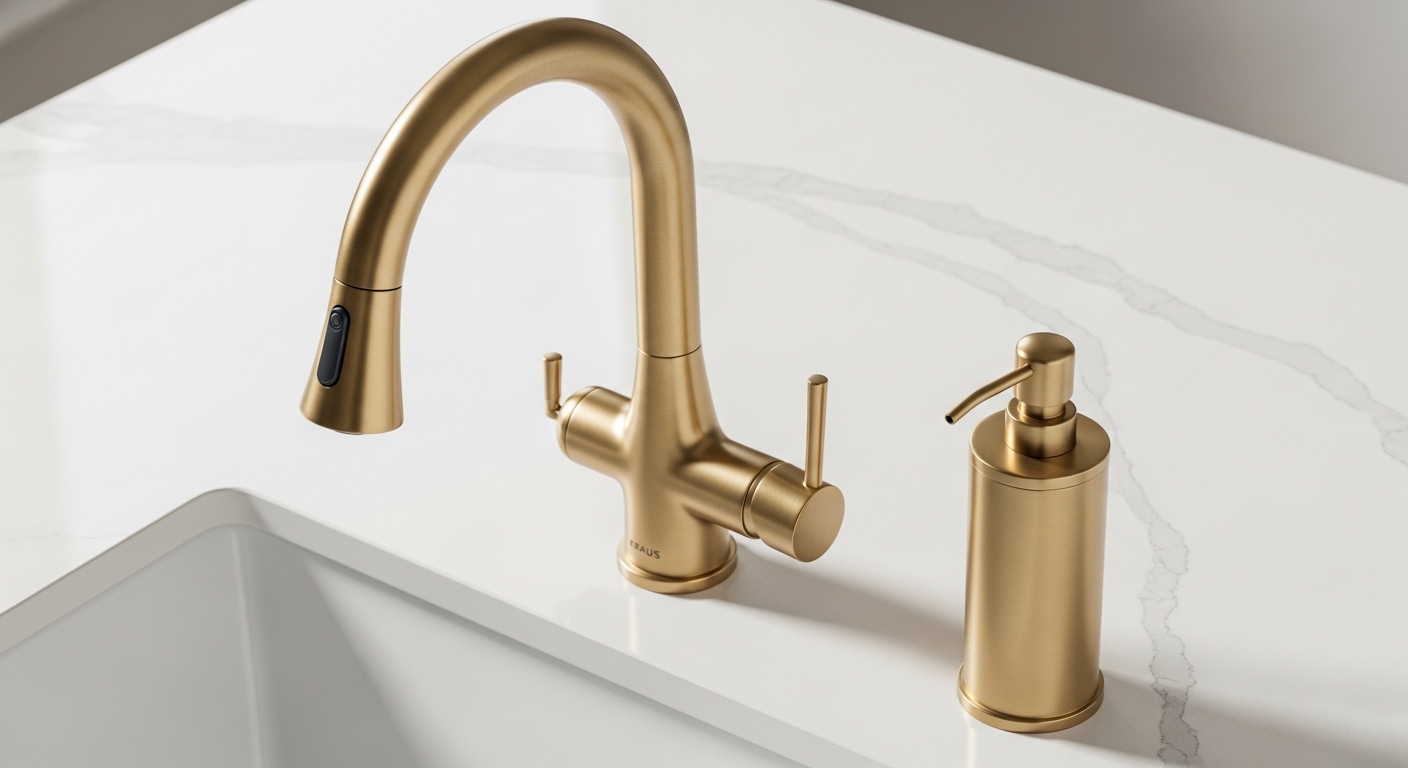
If you’re shopping for a kraus pull down kitchen faucet with matching soap dispenser, you’re almost certainly weighing two things at once: how well the faucet actually performs at the sink, and whether the finish on the dispenser will truly match the spout six months from now. Both questions have clear answers, and the short version is that Kraus has quietly become one of the most consistent finish-matchers in the under-$300 segment — but only on specific model pairings. Below, we walk through which Kraus pairings genuinely match, what the spray head does well (and where it falls short), and how to install the dispenser without cracking your stone countertop.
At Adeaga, we sell, install, and service pull-down kitchen faucets across every major brand, and we’ve handled enough Kraus warranty swaps to know exactly where this lineup shines and where the cheaper coordinated sets fall apart. This guide skips the marketing copy and gets to the decisions you’ll actually make at checkout.
Which Kraus Pull Down Faucets Come With a Truly Matching Soap Dispenser?
Only a handful of Kraus pull-down lines ship with a soap dispenser that’s finish-matched from the same production batch — most notably the Bolden, Sellette, Britt, and Oletto series. Everything else is a “compatible” pairing, which means the dispenser is sold separately and may come from a different finish run. That distinction matters more than buyers realize, especially in brushed gold and matte black.
Here’s the practical breakdown. Kraus uses a PVD (Physical Vapor Deposition) finishing process on its premium lines, and PVD finishes are notoriously batch-sensitive. When you buy a true “set” — meaning the SKU includes both the faucet and the dispenser in one box — Kraus pulls both pieces from the same finish lot. When you buy them separately, even with the same finish code (like “SFACB” for Spot-Free Antique Champagne Bronze), you can end up with a half-shade mismatch under warm kitchen lighting.
Bolden Commercial-Style (KPF-1610 + KSD-53)
The Bolden is Kraus’s flagship pairing. The faucet is a 18-inch commercial-style spring-spout with a dual-function pull-down sprayer, and the KSD-53 dispenser uses the same spout curvature and finish process. It’s the pairing we recommend most often for transitional and modern farmhouse kitchens. Available in chrome, stainless steel, matte black, and spot-free stainless.
Sellette Single-Handle (KPF-1680 + KSD-80)
The Sellette is the sleeker, lower-profile option — better for a kitchen with overhead cabinets that hang low or a window directly behind the sink. The dispenser pump matches the faucet handle shape, which is a small but noticeable detail competing brands often miss.
Britt and Oletto Series
The Britt is a high-arc gooseneck and the Oletto is the budget option (often $179–$219 with dispenser). Oletto’s dispenser is technically a generic Kraus dispenser, but it’s been retooled in the last 18 months to better match the Oletto’s specific handle finish.
How Does Kraus Compare to Moen, Delta, and Kohler for Matching Soap Dispenser Sets?
Kraus wins on price and finish consistency in the $200–$300 range; Kohler wins on long-term finish durability; Delta wins on spray-head technology; Moen sits in the middle with the easiest installation. If you want a coordinated faucet-and-dispenser set under $300 that won’t look mismatched in two years, Kraus is the safer bet than the cheaper Moen and Delta combo packs.
| Brand / Set | Typical Set Price | Finish Tech | Warranty | Finish-Match Reliability | Best For |
|---|---|---|---|---|---|
| Kraus Bolden Set | $249–$289 | PVD, spot-free | Lifetime limited | Excellent (when sold as set) | Modern / transitional kitchens |
| Moen Arbor Set | $329–$379 | Spot Resist | Lifetime limited | Very good | Easy DIY install |
| Delta Leland Set | $359–$429 | Diamond Seal + PVD | Lifetime limited | Good | Best spray performance |
| Kohler Simplice Set | $399–$489 | Vibrant PVD | Lifetime limited | Excellent | Long-term finish durability |
| Generic Amazon Set | $89–$149 | Electroplated | 1–5 years | Poor | Rental properties only |
The honest takeaway: if you’re spending under $300, Kraus is the only brand that consistently delivers a true matched set. Above $400, Kohler’s Vibrant finishes are still the gold standard for finish longevity, but you’re paying roughly 60% more for maybe 15% better finish durability over a 10-year window.
What’s the Spray Head Actually Like on a Kraus Pull-Down? (Real-World Performance)
The Kraus pull-down sprayer uses a dual-function head with aerated stream and a true power spray — and unlike a lot of brands in this price bracket, the spray mode actually has enough force to blast caked oatmeal off a bowl without pre-soaking. The magnetic dock holds the spray head firmly even after years of use, which is the single most common complaint we hear about competing $200 faucets.
A few specifics worth knowing before you buy:
- Flow rate: 1.8 GPM standard, 1.5 GPM on the California/Colorado WaterSense models. The lower-flow version is genuinely fine for dishwashing; you won’t notice the difference.
- Hose length: 30 inches of pull-down reach on the Bolden, 24 inches on the Sellette. If you have a deep apron-front sink, get the Bolden.
- Spray button: Toggle-style button on the head, not a squeeze trigger. It stays in whichever mode you set it to — small thing, big quality-of-life difference.
- Noise: Slightly louder than a Delta when on power-spray mode (around 62 dB vs Delta’s 58 dB), but quieter than any sub-$150 faucet we’ve tested.
- Swivel: 360-degree spout rotation, with smooth movement that doesn’t loosen over time.
The one area Kraus loses to Delta is the spray pattern itself — Delta’s H2Okinetic technology creates larger water droplets that feel like more pressure at lower flow rates. Kraus uses a more conventional aerator. For most users in most kitchens, you won’t notice. If you have low household water pressure (under 40 PSI), Delta is the smarter pick.
How Do You Install the Soap Dispenser Without Cracking a Stone Countertop?
The short answer: use a diamond-tipped hole saw rated for the specific stone type, drill at 600 RPM with constant water cooling, and never use the masonry bit that comes in basic hole-saw kits. Cracking happens almost exclusively when DIYers use a generic carbide bit on quartz or granite without water.
Here’s the process we actually use on customer installs:
- Confirm hole size. Kraus dispensers need a 1 to 1-1/2 inch hole. Check your specific model’s spec sheet — the Bolden KSD-53 needs 1-3/8″.
- Mark the location. Place the dispenser 4–6 inches from the faucet so the pump is reachable but not crowding the spray head’s swivel arc.
- Cover with painter’s tape. Two layers of blue tape over the drill spot prevents the bit from skating and reduces chip-out on the underside.
- Drill at low speed with water. Have a helper trickle water onto the bit, or use a drilling reservoir attachment. Heat is what cracks stone, not pressure.
- Drop in the dispenser bottle. Most Kraus dispensers have a thread-from-above design, which means you can refill from the top without crawling under the sink — a major upgrade over older Moen and Delta units.
- Tighten the lock nut by hand only. Over-tightening with a wrench is the #2 cause of countertop damage. Hand-tight plus a quarter turn is enough.
If you’re not comfortable drilling stone, most countertop fabricators will cut an additional hole during install for $40–$75. Worth every penny if your counters are quartzite or marble. For the same reasons, our guide on widespread faucet tees and the hidden plumbing hub of a sink is worth reading before you commit to your final hole layout.
What Finishes Hold Up Best, and Which Should You Avoid?
The Spot-Free Stainless and Matte Black finishes hold up best long-term; Chrome is the most forgiving for hard-water households; Brushed Gold and Antique Champagne Bronze look incredible but show wear at the spray-head contact point within 2–3 years of heavy use. Avoid the standard (non-spot-free) Stainless if you have hard water.
Here’s why each finish behaves the way it does. Kraus uses PVD on its premium finishes, which bonds the color at a molecular level — that’s why matte black on a Kraus faucet doesn’t fade to grey the way cheaper sprayed-on coatings do. The Spot-Free treatment is essentially a hydrophobic top layer that sheds water spots, and it works genuinely well in homes with water hardness above 7 GPG.
Hard Water Households (Above 10 GPG)
Spot-Free Stainless is the clear winner. Skip Chrome unless you enjoy wiping water spots daily. Matte Black will show calcium deposits as white streaks within weeks — beautiful finish, terrible for hard water unless you have a softener. If you’re battling mineral buildup elsewhere, our breakdown of how to fix a leaky kitchen faucet yourself covers the cartridge issues hard water typically causes.
Soft Water or Filtered Households
Any finish works. This is where Brushed Gold and Antique Champagne Bronze really shine — without mineral attack, those PVD finishes can easily last 10+ years looking nearly new.
Rental Properties or High-Turnover Spaces
Stick with Chrome. It’s the cheapest, hides scratches, and any plumber can service it. Save the designer finishes for your forever home.
Is the Kraus Lifetime Warranty Actually Worth Anything?
Yes — Kraus honors warranty claims more readily than its competitors in our experience, typically shipping replacement cartridges or spray heads within 5–7 business days with just a photo of the faucet and proof of purchase. The warranty covers the finish, the mechanical function of the faucet, and the matching dispenser, and it transfers with the home in many cases.
The fine print to know:
- Warranty is lifetime on the original residential owner only — commercial use drops it to 5 years.
- It explicitly excludes damage from chlorinated cleaners, abrasive pads, and “non-potable water” (which they interpret broadly — well water without a sediment filter could be excluded).
- The dispenser pump itself is covered for 5 years; the body finish is lifetime.
- You need to register within 30 days of installation for the easiest claims process, though Kraus will honor unregistered claims with proof of purchase.
Kraus faucets meet NSF/ANSI 61 and 372 standards for lead-free drinking water compliance and carry CALGreen and WaterSense certifications on most current SKUs. The ceramic disc cartridges are independently rated for 500,000 on/off cycles, which roughly translates to 30+ years of typical residential use. That’s the same cycle rating Moen and Delta use on their premium lines.
What Are the Most Common Problems With Kraus Pull-Down Faucets?
The three issues we see repeatedly are: a weakening magnetic dock after 4–5 years of heavy use, occasional whining noise on hot water at low pressure, and the sprayer hose developing a memory kink if it’s installed with a tight bend under the sink. All three are fixable, and none are dealbreakers.
For the magnetic dock issue: Kraus will send a replacement magnet free under warranty. Installation takes about 10 minutes. For the whining noise: it’s almost always the hot-side supply line restriction, not the faucet itself — swap the braided supply line and the noise disappears. For the hose kink: route the hose in a wide loop under the sink and make sure the counterweight isn’t catching on the garbage disposal or drain pipes. The same routing principles apply to most pull-down brands; if you’ve ever dealt with a stuck sprayer, our guide on why a faucet sprayer won’t turn off and how to fix it walks through the diverter mechanics that cause it.
Who Should Buy This Set, and Who Should Skip It?
Buy a Kraus pull down kitchen faucet with matching soap dispenser if: you want a coordinated, modern-looking sink area for $250–$300, you have soft to moderately hard water, you’re okay with a standard aerator spray pattern, and you value finish-matching consistency. The Bolden set is our top pick for most kitchens.
Skip it if: you have water pressure under 40 PSI (get Delta instead), you want the absolute longest-lasting designer finish (Kohler Vibrant edges Kraus PVD), or you’re in a commercial setting where lifetime warranty doesn’t apply.
For most homeowners doing a kitchen refresh in 2026, this is the sweet spot of price, performance, and design coordination — and the kraus pull down kitchen faucet with matching soap dispenser pairings deliver on the promise of a true matched set in a way most competitors at this price simply don’t. If you’re also rethinking your bathroom fixtures while you’re at it, our 2026 oil-rubbed bronze bathroom faucet buyer’s guide applies the same finish-matching logic to widespread bath fixtures.
FAQ
Does the soap dispenser have to be filled from under the sink?
No. Modern Kraus dispensers (the KSD-53 and KSD-80 series) use a top-fill design — you lift the pump and pour soap directly through the spout from above. Older Kraus dispensers and most generic brands still require under-sink refilling.
Can I buy the Kraus dispenser separately if I already own the faucet?
Yes, but the finish match is not guaranteed if your faucet is more than 12 months old. PVD finish lots can shift slightly over time. For exact matching, contact Kraus customer service with your faucet’s finish code and they can often pull a dispenser from a similar production window.
What’s the difference between Spot-Free Stainless and regular Stainless on a Kraus faucet?
Spot-Free Stainless has an additional hydrophobic top coating that sheds water and resists mineral spots. Regular Stainless is the same base finish without that coating. In hard-water areas, Spot-Free is worth the typical $30–$40 upcharge; in soft-water areas, it’s optional.
Will a Kraus pull-down faucet work with low water pressure?
It works, but it won’t impress. Kraus aerators need around 45 PSI to produce a satisfying spray. Below 40 PSI, the power-spray mode feels weak. If you have known low pressure (common in older homes or top floors), Delta’s H2Okinetic spray head produces better feel at low pressure.
How long does installation take for a DIY homeowner?
Plan on 60–90 minutes for the faucet alone if your shutoff valves work and you have basic tools. Add 30–45 minutes for the dispenser if you need to drill an extra hole. If you’ve never installed a faucet before, budget 2.5 hours and have a flashlight, a basin wrench, and plumber’s tape ready.
Are Kraus faucets actually lead-free for drinking water?
Yes. All current Kraus kitchen faucets are certified to NSF/ANSI 61 and NSF/ANSI 372 standards, meaning they meet federal lead-free requirements (less than 0.25% weighted average lead content on wetted surfaces). The brass body is constructed from low-lead brass alloys.
Can I install a Kraus dispenser in an existing extra hole from an old sprayer?
Usually yes. Most old side-sprayer holes are 1-3/8″ or 1-1/2″, which matches the Kraus dispenser footprint. Measure first, and if the hole is slightly too large, Kraus sells an escutcheon plate that covers gaps up to 2″.
Author’s note: This guide was written by the Adeaga product team. Our team has installed and serviced hundreds of pull-down kitchen faucets across every major brand. Adeaga is an independent retailer and installer of bathroom and kitchen fixtures, and we test each brand’s faucets in our showroom for at least 30 days before recommending any specific model to our customers. We do not accept payment for placement in our buyer’s guides.