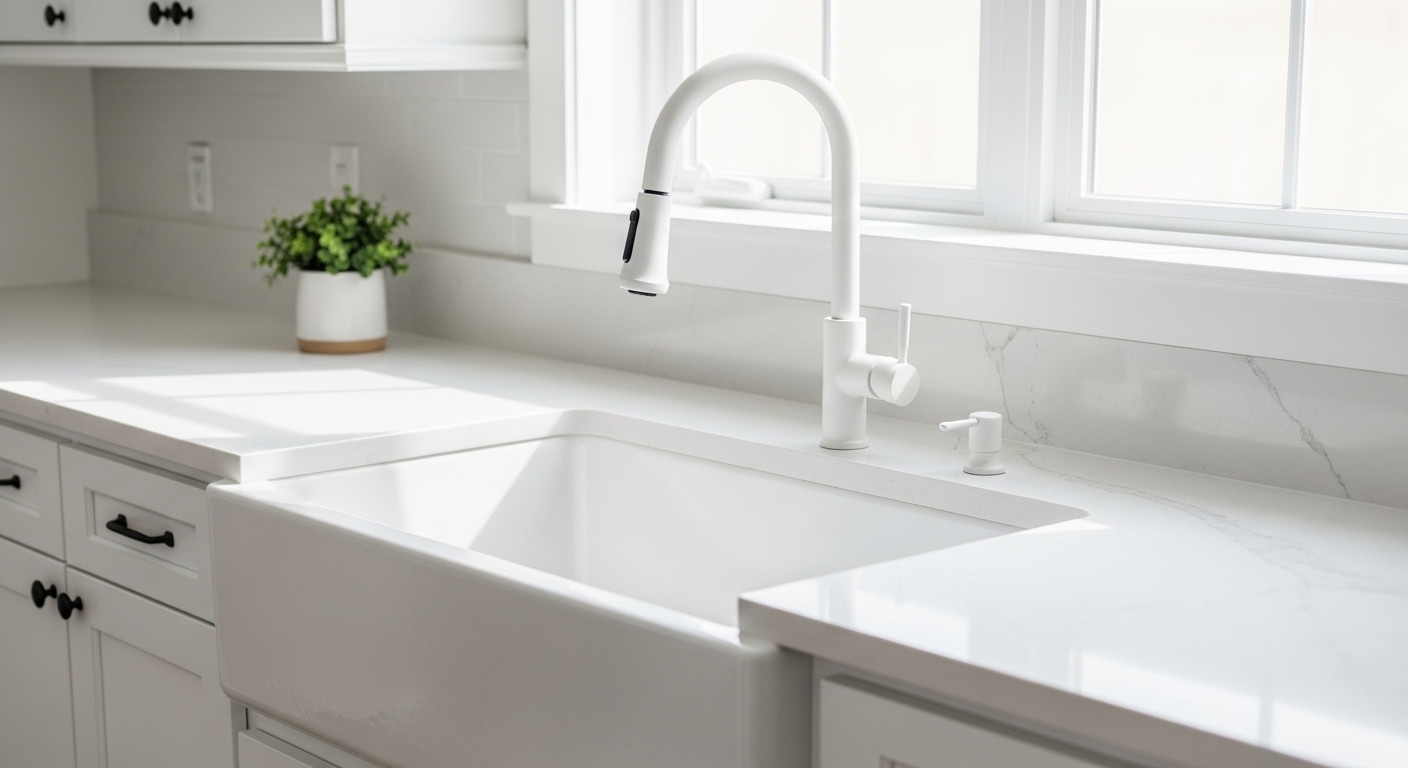
If you’ve been eyeing a kitchen faucet in white and wondering whether it’s a smart buy or a trend you’ll regret, here’s the honest answer: white faucets have quietly become one of the most requested finishes in kitchens, and a good one holds up just as well as chrome or stainless. The catch is that “white” covers everything from a $30 spray-painted big-box special to a $250 European-grade powder-coated fixture — and the difference in how they age is huge. This guide walks you through exactly what to look for, what to avoid, and which style fits your sink and your budget.
Does a White Kitchen Faucet Actually Look Good — or Will It Look Dated Fast?
A white kitchen faucet looks good and stays timeless when it matches a white sink, apron-front sink, or light quartz/marble countertop — that’s when it reads as intentional and high-end rather than random. It’s the classic pairing for farmhouse, coastal, Scandinavian, and modern-minimal kitchens, and unlike a bright trend color, white doesn’t announce a specific “era,” so it ages slowly.
Where white gets risky is against a dark stainless or copper sink, where the faucet can look like an add-on that didn’t come with the set. The trick most designers use is repetition: if there’s white somewhere else in the room — cabinets, subway tile, a white sink, white pendant shades — a white faucet ties the whole thing together. If white appears nowhere else, a single white faucet floating over a steel sink tends to look accidental.
One quiet advantage people underrate: white hides hard-water spots far better than chrome. On a mirror-polished chrome faucet, every dried water droplet shows as a gray speckle. On a matte white finish, those same mineral spots practically disappear until buildup gets heavy — which means your faucet looks clean with less wiping.
What Does a Kitchen Faucet in White Actually Cost in 2026?
A decent kitchen faucet in white runs $90–$280 in 2026, with the sweet spot for a durable, name-brand pull-down model sitting around $130–$190. Below roughly $80 you’re usually getting painted plastic or a thin coating over zinc that chips at the spout tip within a year or two; above $280 you’re paying for premium European ceramic-look finishes or designer names.
Here’s roughly how the tiers break down:
| Price tier | What you typically get | How white finish holds up |
|---|---|---|
| $30–$80 | Plastic body or thin-coated zinc, single spray mode | Chips at spout/handle, can yellow near heat in 1–2 yrs |
| $90–$190 | Solid brass or stainless core, baked powder-coat, pull-down spray | Stays true white for years; resists chipping |
| $200–$280 | Premium powder-coat or ceramic-style finish, magnetic dock, better cartridge | Excellent; often color-matched to sinks |
| $280+ | Designer/European finishes, sensor or touch tech | Best-in-class, warrantied finish |
The single most important spending decision isn’t the number — it’s what’s under the white. A brass or stainless body with a factory-baked powder coat behaves completely differently from a plastic body with sprayed-on paint. Spend where it matters.
Will a White Finish Chip, Stain, or Turn Yellow Over Time?
A quality white kitchen faucet with a baked-on powder-coat or ceramic-style finish will not chip, stain, or yellow under normal kitchen use — those problems come almost entirely from cheap sprayed paint on plastic bodies. The finish type matters far more than the color itself.
There are three common ways manufacturers make a faucet white, and they age very differently:
- Baked powder coat (best): Electrostatically applied, then oven-cured onto a metal body. Hard, uniform, and bonded — this is what you want. Resists scratches from pots and rings.
- Ceramic/enamel-style coating (premium): Found on higher-end European faucets, very hard and glossy, often color-matched to ceramic sinks.
- Spray paint on plastic (avoid): Cheap, and it shows. Chips at the spout tip and handle base, and can yellow where hot water constantly runs through a thin plastic neck.
Yellowing specifically is almost always a plastic-body problem — heat plus UV from a nearby window slowly discolors low-grade resin. A metal-bodied faucet with a proper coating doesn’t have that failure mode. Staining, meanwhile, is usually just hard-water mineral buildup sitting on the surface, not the finish breaking down. If your white faucet starts looking dingy, it’s typically limescale you can remove — the same way you’d descale any fixture. Our guide on how to clean a faucet head with CLR works the same way for a white finish, though you’ll want to dilute and rinse quickly so the cleaner never sits on a coated surface.
Which Type of White Kitchen Faucet Fits My Sink — Pull-Down, Pull-Out, or Single-Handle?
For most kitchens, a single-handle pull-down white faucet fits best — it suits standard and deep sinks, gives you a tall clearance for filling pots, and the spray head docks cleanly back into the spout. Choose a pull-out (shorter, spray head pulls horizontally toward you) only if you have a low window behind the sink or a shallow bar sink where a tall arch won’t fit.
Match the faucet to your sink and your space, not just your taste:
- Deep single-bowl or farmhouse sink: High-arc pull-down. The tall spout gives you room to wash big pots, and white looks especially at home on an apron-front basin.
- Window directly behind the sink: Low-profile pull-out or a shorter arc, so the spout clears the sill and you can still open the window.
- Bar or prep sink: Compact single-handle. A big kitchen-scale faucet overwhelms a small basin.
- Two people cooking / heavy use: Look for a magnetic dock (the spray head snaps back firmly instead of drooping over time) and a solid-brass valve body.
Also count your sink’s mounting holes before you buy. A single-handle faucet needs one hole; if your sink or countertop has three or four holes from an old setup, you’ll want a matching white deck plate (escutcheon) to cover the extras — most white faucets sell one designed to match. If you’re weighing white against another popular finish, our breakdown of the matte black kitchen faucet with side sprayer covers the same body-and-spray decisions from the opposite end of the color spectrum, and it’s a useful sanity check before you commit.
White vs. Chrome vs. Stainless vs. Matte Black — Which Should I Pick?
Pick white for soft, light kitchens where you want to hide water spots and match a white sink; pick stainless or chrome for a safe, resale-neutral look; pick matte black for high contrast and drama. White sits between “statement” and “safe” — it’s distinctive without being risky.
| Finish | Best kitchen style | Hides water spots? | Resale-neutral? | Upkeep |
|---|---|---|---|---|
| White | Farmhouse, coastal, minimalist | Yes (matte) | Mostly | Low — quick wipe |
| Chrome | Traditional, transitional | No — shows everything | Very | Higher — spots often |
| Stainless / brushed nickel | Almost anything | Somewhat | Very | Low |
| Matte black | Modern, industrial | Yes, but shows dust/limescale film | Less | Medium |
The practical takeaway: white and matte black are the two “hides droplets” finishes, but white reads warmer and softer while black reads bolder. If your kitchen already leans light and airy, white amplifies that. If you want the faucet itself to be a focal point, black or a warm brass does that job better. There’s no wrong answer — it’s about what you want the faucet to do in the room.
How Do I Keep a White Kitchen Faucet Clean So It Stays Looking New?
Keep a white kitchen faucet looking new by wiping it with a soft damp cloth and mild dish soap a couple times a week, and descaling the aerator every month or two — skip abrasive powders, scouring pads, and bleach, which dull or micro-scratch the finish. That’s genuinely the whole routine.
A few specifics that make a difference:
- Daily-ish: A quick wipe with a soft microfiber cloth removes food splashes before they dry. On white, this alone keeps it looking clean.
- Hard water areas: Mineral film builds at the aerator (the screen at the spout tip) and around the base. Unscrew and soak the aerator in diluted vinegar or a descaler, then rinse. A clogged aerator kills your flow long before it looks dirty.
- Never use: Magic-eraser-style melamine pads, comet/ajax powders, steel wool, or bleach wipes. They’re fine on some steel but can haze or scratch a coated white surface.
- Stubborn spots: A paste of baking soda and water, applied gently with a soft cloth, lifts most stains without scratching.
Because white doesn’t broadcast every droplet the way polished chrome does, most people find it’s actually lower-maintenance in daily life — you’re wiping because food splashed, not because the finish looks spotty after every use.
Is a White Faucet Built as Tough as a Metal-Finish One?
Yes — a white faucet is exactly as durable as its metal-finish sibling as long as the body underneath is the same solid brass or stainless steel; the white coating sits on top of identical internal hardware. The valve cartridge, hoses, and mounting are unchanged. Color is a finish, not a downgrade.
What actually determines how long a faucet lasts is the cartridge — the internal valve that controls flow and mixes hot and cold. A ceramic-disc cartridge is the gold standard; it’s what separates a faucet that drips in two years from one that runs smooth for a decade. When you shop white, don’t get so focused on the coating that you ignore the guts. A solid-brass body with a ceramic-disc cartridge in white will outlast a plastic-body chrome faucet every time. If you want to see how build quality plays out across colors and price points, our look at whether a pull-out kitchen tap with a brass build is worth it breaks down exactly which internal parts matter, and the same logic applies to a white faucet. It’s also worth cross-checking independent testing — our take on relying on kitchen faucet reviews from Wirecutter explains how to read pro reviews without getting misled by finish photos alone.
Author Note, Brand Credibility & Warranty
About the author: This guide was written by the adeaga fixtures team — people who install, test, and torture-test kitchen and bathroom faucets for a living. We’ve mounted white faucets on everything from fireclay farmhouse sinks to stainless bar basins, and we’ve watched cheap coatings fail firsthand, which is exactly why the “what’s under the white” advice above is so blunt.
Why trust adeaga: At adeaga.net we specialize exclusively in faucets and bathroom fixtures — not general home goods — so our recommendations come from hands-on product testing rather than repackaged spec sheets. The faucets we stand behind use solid-brass or stainless bodies, ceramic-disc cartridges, and finishes certified to standard durability and lead-safe drinking-water requirements (the same NSF/ANSI and cARB-style benchmarks reputable manufacturers test against). Look for a manufacturer that backs the finish specifically — a strong white faucet carries a limited lifetime warranty on both the finish and the cartridge, which tells you the maker actually trusts the coating not to chip or yellow. If a white faucet only warranties the mechanism and not the finish, that’s a quiet signal the coating is the weak point.
FAQ
Do white kitchen faucets show water stains more than chrome?
No — the opposite. A matte white finish hides dried water droplets and light mineral spots much better than polished chrome, which shows every speckle. Heavy limescale buildup will eventually show on any finish, but for everyday spots, white stays looking clean with less wiping.
Can I put a white faucet on a stainless steel sink?
You can, and some people love the contrast, but it works best when white appears elsewhere in the kitchen — white cabinets, tile, or countertops — so the faucet doesn’t look like an orphan. On a dark stainless sink with no other white nearby, the faucet can read as an afterthought. White shines brightest on white or light-colored sinks.
How long does a white kitchen faucet finish last?
A baked powder-coat or ceramic-style finish on a metal body lasts many years — realistically the life of the faucet — without chipping or yellowing. A sprayed-paint finish on a plastic body often starts chipping at the spout and handle within one to two years. The finish type, not the color, decides longevity.
Are white faucets harder to clean than other finishes?
No. The routine is the same as any faucet — soft cloth, mild soap, occasional aerator descaling. The only rule specific to white is avoiding abrasive pads and powders that can haze the coating. Because white masks droplets, many owners find it’s actually less demanding day to day.
Is a white kitchen faucet a passing trend I’ll regret?
White is a classic, not a fad — it’s been a staple in farmhouse and coastal kitchens for decades and doesn’t tie itself to a specific year the way a bright color would. As long as it coordinates with something else white in your kitchen, it ages gracefully and stays resale-friendly for most buyers.
What should I check before buying a white faucet online?
Confirm three things: the body material (solid brass or stainless, not plastic), the cartridge type (ceramic disc), and the warranty (ideally lifetime on both finish and mechanism). Also count your sink’s mounting holes and check whether a matching white deck plate is included if you need to cover extra holes.