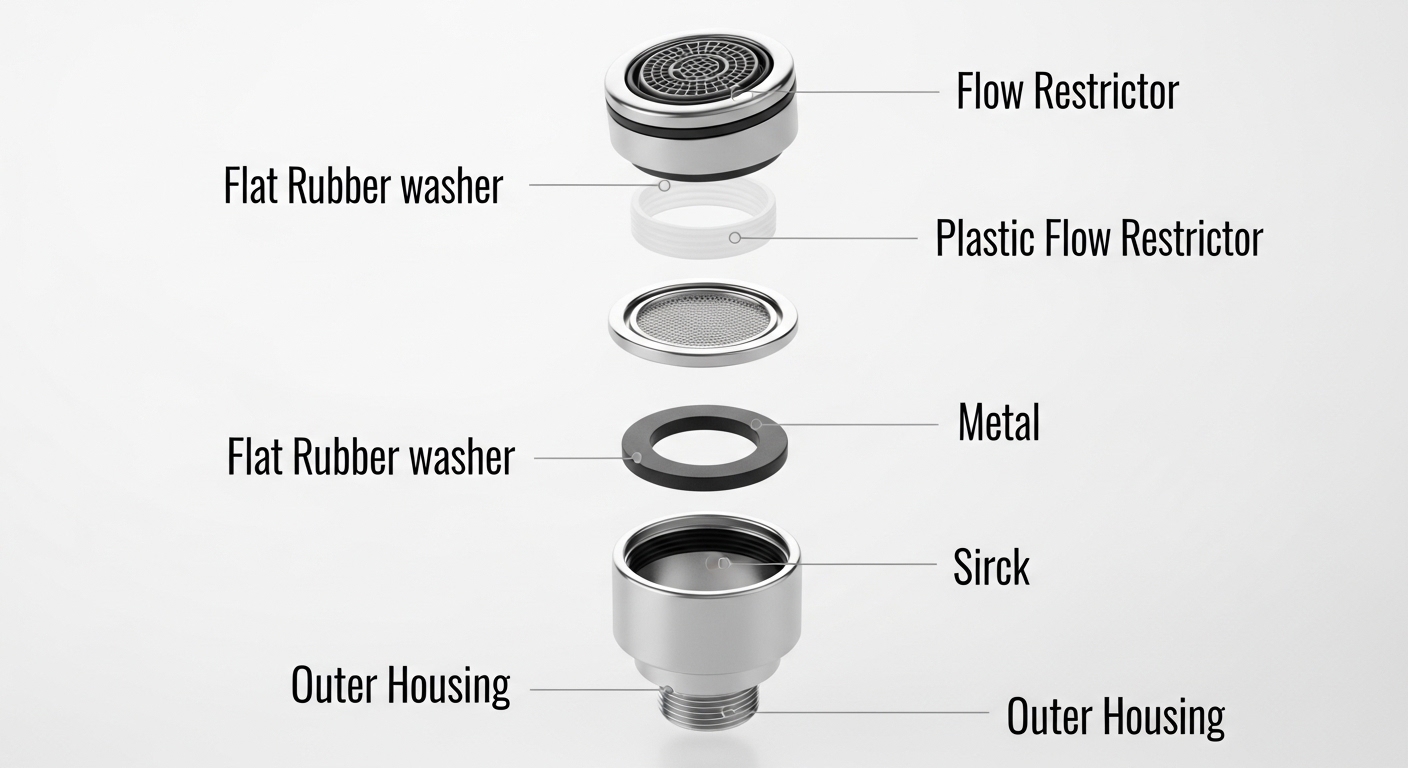
If your tap is leaking right where the water comes out, a worn or missing faucet aerator washer is the most common — and cheapest — culprit. The aerator is the little screen-and-housing piece that threads onto the end of your spout; the washer is the flat rubber gasket that sits behind it and creates a watertight seal against the faucet body. When that washer cracks, flattens with age, or gets knocked out of alignment, water sneaks past the threads and drips down the outside of the spout instead of flowing cleanly out the bottom. Below, we’ll cover exactly what the washer does, how to tell it’s the problem, how to pick the right replacement, and how to swap it without stripping threads or creating a new leak.
What exactly is a faucet aerator washer, and what does it do?
A faucet aerator washer is a thin, flexible sealing ring — usually EPDM rubber or silicone — that sits between the aerator housing and the faucet spout to stop water from leaking around the threaded connection. It does one job: seal. The aerator itself mixes air into the water stream (that’s what softens the flow and cuts splashing while saving water), but none of that matters if water is escaping around the joint. The washer is what makes the connection watertight.
Think of it like the rubber gasket in a garden hose fitting. Metal threads alone never seal perfectly — there’s always a microscopic gap. The washer compresses into that gap when you tighten the aerator, filling it completely. Over time, heat cycling from hot water, mineral buildup, and simple age make the rubber go hard and brittle. Once it loses its “give,” it can’t fill the gap anymore, and you get that telltale drip creeping down the side of the spout.
How do I know if my leak is the washer and not something worse?
If the leak appears at the very tip of the spout — where the aerator screws on — and only when the water is running, it’s almost certainly the aerator washer, not a cartridge or valve. Internal faucet leaks behave differently: they drip when the faucet is off, pool under the sink, or make the handle stiff. An aerator washer problem shows up right at the mouth of the faucet.
Here’s a quick self-check to confirm before you buy anything:
- Water dripping down the outside of the spout tip while running — classic worn washer.
- Spitting or spraying sideways instead of a clean straight stream — the washer may be pinched, misaligned, or the screen behind it is clogged.
- You can stop the drip by hand-tightening the aerator — the washer has flattened and lost its seal; tightening buys time but replacement is the real fix.
- Visible cracks, hardening, or a flattened, shiny ring when you unscrew the aerator — replace it.
- Leak persists even with a brand-new, correctly-sized washer — now you may be looking at damaged spout threads or a deeper issue, in which case our guide on why a leaky faucet drip won’t stop and how to fix it walks through the next steps.
If the drip only happens when the faucet is off, or you’re seeing water under the sink, that’s a cartridge or supply-line issue instead — see our walkthrough on replacing a bathroom faucet stem that keeps dripping. The aerator washer is only responsible for leaks at the very end of the spout.
What size faucet aerator washer do I need?
Most residential faucets in the U.S. use one of two aerator sizes: Regular (M24 male, about 15/16 inch outside diameter) or Junior/Female (M22 female, about 55/64 inch inside diameter) — and the washer diameter follows the aerator, so match the washer to the aerator, not the other way around. If you can unscrew your old aerator, the fastest move is to take it to the hardware store or measure the washer with calipers and buy an exact match.
The confusing part is “male” versus “female.” A male aerator has threads on the outside and screws into a spout with internal threads; the washer sits inside the cap. A female aerator has threads on the inside and screws onto a spout with external threads; the washer usually seats at the top of the housing. Get this wrong and no washer will seal. Here’s a quick reference:
| Aerator Type | Thread Location | Common Size | Typical Washer O.D. | Where You’ll Find It |
|---|---|---|---|---|
| Regular Male | Outside of aerator | M24 x 1 | ~20–22 mm | Most standard kitchen & bath faucets |
| Regular Female | Inside of aerator | M22 x 1 | ~22–24 mm | Older & many European-style faucets |
| Junior Male | Outside of aerator | M18 x 1 | ~16–18 mm | Compact bar & prep faucets |
| Junior Female | Inside of aerator | M16.5 x 1 | ~17–19 mm | Small bathroom & lavatory faucets |
| Tom Thumb / Cache | Recessed inside spout | M18.5 / M16.5 | Varies | Hidden aerators on pull-down sprayers |
Pull-down and pull-out kitchen sprayers often use a hidden “cache” or Tom Thumb aerator recessed inside the spray head, and those take a specialty washer and a keyed removal tool that ships with the faucet. If that’s you, don’t force a standard washer in — order the matching kit for your model. Most aerator repair kits sold today include an assortment of washers, screens, and adapters covering all the common sizes for a few dollars, which is the safest bet if you’re unsure.
How do I replace a faucet aerator washer without leaks? (Step by step)
You can replace a faucet aerator washer in about five minutes with just your hands or a cloth-wrapped pliers — the key is to unscrew gently, clean the threads, and hand-tighten only until snug plus a quarter turn. Over-tightening is the #1 cause of a “new” leak after a washer swap, because it deforms the fresh rubber.
- Close the drain or lay a rag in the sink so you don’t lose the tiny washer or screen down the drain.
- Unscrew the aerator by hand, turning counterclockwise (as you look up at it). If it’s stuck from mineral buildup, wrap a cloth around it to protect the finish and use pliers gently — never bare metal on a chrome or matte finish.
- Disassemble and inspect. Note the exact order of the parts as they come out: housing, washer, screen, flow restrictor. Take a photo so you can reassemble it identically.
- Clean everything. Soak the metal parts in white vinegar for 10–15 minutes to dissolve limescale, then scrub the screen with an old toothbrush. A clogged screen causes the same spitting symptoms as a bad washer, so clean it while you’re in there.
- Seat the new washer flat in its groove — no folds, no pinching. It should lie perfectly level. If it wants to pop out, you’ve got the wrong size.
- Reassemble in the exact original order and thread the aerator back on by hand. Never cross-thread — if it won’t turn easily, back off and restart.
- Hand-tighten snug, then a quarter turn with a cloth-wrapped tool. That’s it. Run the water and check for drips.
If you meet heavy corrosion and the aerator simply won’t budge, stop before you snap anything. Forcing a seized aerator can crack the spout. Our guide on corroded faucet removal without snapping the pipe covers the penetrating-oil and heat tricks that free stuck fittings safely. And if you’re dealing with a specific high-end system like a boiling-water tap, the process differs slightly — see how to fix a clogged Quooker tap aerator for that model’s quirks.
Rubber, silicone, or fiber — which washer material lasts longest?
For a faucet aerator, a silicone or EPDM rubber washer outlasts old-style fiber washers by years, especially on the hot-water side and in hard-water areas. Fiber (the tan cardboard-looking ones) were standard decades ago but they compress permanently, wick moisture, and fail fast. Modern silicone stays flexible across a wide temperature range and resists chlorine and mineral scaling.
- EPDM rubber — the default in most repair kits; great heat and chemical resistance, cheap, reliable. A solid all-around pick.
- Silicone — stays soft longest, best for hot-water lines and high-heat applications; slightly pricier but worth it.
- Fiber/composite — avoid for aerators unless it’s the only exact size available; replace with rubber at first chance.
- Nitrile (Buna-N) — fine for cold-water and general use, common in bulk assortment packs.
In hard-water homes, the washer isn’t usually what fails first — it’s the screen clogging with scale. If you’re on well water or notice white crust building up quickly, plan to clean the aerator every few months and keep a couple of spare washers on hand. A $4 assortment pack will cover you for years across every faucet in the house.
Should I just replace the whole aerator instead of the washer?
If the washer is the only worn part and the housing threads are intact, replacing just the washer is the smarter, cheaper fix — but if the plastic housing is cracked, the threads are stripped, or the screen is corroded beyond cleaning, replace the entire aerator assembly, which still only costs $5–$12. A complete aerator comes with a fresh washer anyway, so you get the seal fix as part of the upgrade.
There’s also a performance angle. Swapping the whole aerator lets you change the flow rate. Standard aerators run 2.2 GPM, but water-saving models drop to 1.5 or even 1.0 GPM, and you can choose a spray pattern (aerated stream, laminar, or spray). If your faucet feels weak or splashes too much, a new aerator solves the seal and the flow in one $8 part. When only the seal is the issue, though, a single washer keeps your original hardware and saves the landfill trip.
Author’s note & why trust this guide
This guide was written and reviewed by the adeaga fixtures team, who spend their days sourcing, installing, and stress-testing faucets and aerators across kitchen and bath lines. We’ve replaced thousands of aerator washers on everything from budget builder-grade taps to high-end pull-downs, and every step above reflects what actually works on real sinks — not theory. adeaga (adeaga.net) supplies faucets, aerators, and repair parts tested against standard flow-rate and durability benchmarks (aerators sold in the U.S. are certified to ASME A112.18.1 / CSA B125.1 and carry EPA WaterSense ratings where marked), and our replacement washers and aerator kits are backed by our fit-and-function warranty. When in doubt about your specific model, our support team will match the exact washer size for you before you buy.
FAQ
Can I use plumber’s tape instead of a faucet aerator washer?
No — plumber’s tape (PTFE) seals threaded pipe joints, but an aerator relies on a compression washer to seal against a flat face, and tape can’t do that job. Using tape as a substitute usually makes the leak worse or clogs the screen. Always use the correct rubber or silicone washer; tape is only for the threaded body connections behind the wall, not the aerator.
Why does my faucet still leak after I replaced the aerator washer?
The three usual causes are wrong washer size, over-tightening (which deforms the fresh rubber), or damaged spout threads. Double-check the washer sits perfectly flat, back the aerator off and re-tighten to snug plus only a quarter turn, and inspect the threads for cracks or debris. If the threads themselves are stripped, you’ll need a new aerator or spout tip rather than just a washer.
How often should a faucet aerator washer be replaced?
A quality rubber or silicone aerator washer typically lasts 5–10 years, but in hard-water areas or on frequently-used hot-water faucets it can degrade in 2–3 years. There’s no fixed schedule — replace it when you see leaking at the spout tip, or whenever you clean the aerator and notice the washer is hardened, cracked, or flattened.
Are all faucet aerator washers the same size?
No. Washer size follows the aerator, and there are several standard sizes — regular male (M24), regular female (M22), junior male (M18), junior female (M16.5), plus specialty cache aerators on pull-down sprayers. Always match the washer to your specific aerator; the safest approach is buying an assortment kit or bringing the old washer to match it exactly.
Can a bad aerator washer reduce my water pressure?
Indirectly, yes. A washer leak itself doesn’t cut pressure, but the same wear and mineral buildup that ruins the washer usually clogs the screen behind it, and a clogged screen is a leading cause of low or spitting flow. When you replace the washer, soak and scrub the screen at the same time — you’ll often restore full pressure in the process.