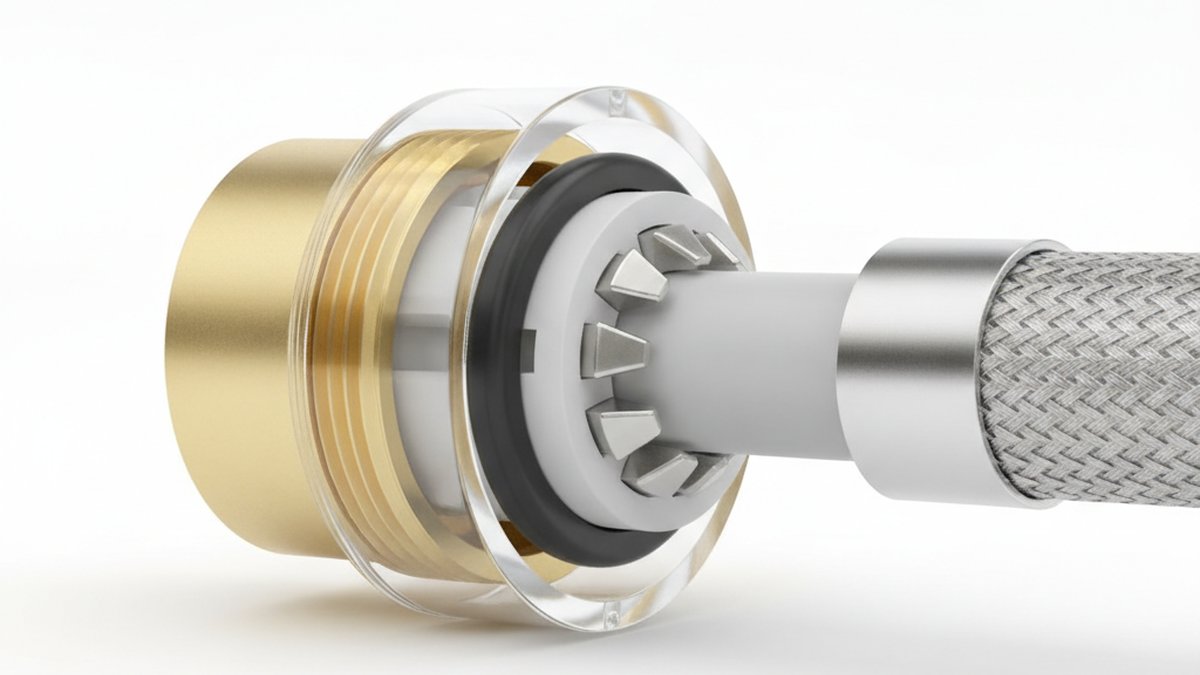
If you’ve ever knelt in a dark sink cabinet trying to cross-thread a slippery brass nut by feel, a faucet quick connector is the fix. It replaces the old screw-and-tape ritual with a fitting you simply push onto the tube — an internal ring of stainless teeth grips the pipe and an O-ring seals it instantly. At adeaga we sell and test these connectors across dozens of faucet models, and the honest truth is that most leaks and stripped fittings we see come from mismatched sizes, not bad parts. So this guide is built around the one question that actually matters: which connector fits your tap?
What exactly does a faucet quick connector do — and is it really no-tools?
A faucet quick connector is a coupling that joins two water lines (or a line and a faucet tailpiece) by pushing them together instead of screwing them. Yes, it’s genuinely no-tools for the connect step: you cut the tube square, push it in until it bottoms out, and the collet locks it. To disconnect, you press the release ring and pull.
Inside, three things do the work. A grab ring (a circle of angled stainless teeth) bites the pipe so water pressure can’t shove it back out. An O-ring or EPDM seal presses against the tube wall to stop leaks. And a collet/release collar lets you undo the joint by hand. That’s the whole trick that used to require a basin wrench and ten minutes of blind fumbling.
Where they show up on a faucet:
- Supply-line to tailpiece — connecting the flexible braided hose from your shutoff valve to the faucet’s inlet.
- Sprayer/pull-down hose — many modern kitchen faucets already use a quick connector where the hose meets the faucet body under the sink.
- Accessory adapters — attaching filters, aerator splitters, or dishwasher/washing-machine lines to the spout.
- Repairs — splicing a new section of tube when an old fitting corrodes.
Which faucet quick connector size do I actually need?
Match three numbers: your tube’s outside diameter, the faucet’s thread size, and the pressure rating. For a typical North American home that’s a 3/8″ push-fit on the supply side and a 1/2″ or M-thread on the faucet inlet, rated to at least 0.9 MPa. Get those three right and the connector just works.
Here’s how to read your own setup without guessing. The supply tube coming out of your wall or floor shutoff is almost always 3/8″ OD (compression) in the US, or 10mm in the EU/UK. The faucet’s own inlet is usually a threaded stud — commonly M10, G3/8, or 1/2″-14 NPSM depending on brand. The confusion happens because “3/8 compression” and “3/8 NPT” are different things that share a number, so check whether your tap uses a male thread, a female thread, or a plain tube end.
| Connector type | Best for | Typical size | Tools needed | Pressure rating |
|---|---|---|---|---|
| Push-fit (collet) | Fast supply-line swaps, PEX/copper | 3/8″ or 1/2″ OD | None (tube cutter only) | Up to ~1.6 MPa |
| Threaded quick coupler | Faucet inlet studs, adapters | M10 / G3/8 / 1/2″ NPSM | Hand-tight, sometimes wrench | Up to ~1.0 MPa |
| Snap/bayonet (garden-style) | Outdoor spouts, hose splitters | 3/4″ GHT | None | Up to ~0.8 MPa |
| Braided hose w/ built-in QC | Modern pull-down kitchen faucets | Brand-specific | None | Varies by brand |
If you’re unsure which thread your tap uses, our team walks through adapter matching in detail in this guide to choosing the right faucet adapter — the same “measure the thread first” logic applies directly to quick connectors.
How do I install a faucet quick connector without leaks?
Cut the tube square, push the connector on until it stops, then tug it to confirm it’s locked — that’s the whole job, and it takes under two minutes per joint. Leaks almost always come from a burred cut or a tube that wasn’t pushed all the way home. Here’s the reliable sequence:
- Shut off the water at the under-sink valves and open the faucet to release pressure.
- Cut the tube square with a proper tube cutter, not scissors. An angled or crushed end won’t seal against the O-ring.
- Deburr and mark the insertion depth. Many connectors give you a depth; mark it with a pen so you know it bottomed out.
- Push firmly and fully until the tube seats against the internal stop. You’ll feel it click past the grab ring.
- Tug-test the joint. Pull the tube — it should not move at all.
- Turn the water back on slowly and check for weeping around the collar. A tiny seep usually means the tube isn’t fully inserted.
If you’re doing this as part of a bigger swap — say, changing the whole faucet — read our walkthrough on how to remove an old faucet from a sink without wrecking it first, then add the quick connectors on reassembly. And if you’re only replacing the moving part up top, replacing just the kitchen faucet head often pairs perfectly with a quick-connect sprayer hose.
Push-fit vs threaded quick connector — which is better for a kitchen faucet under $50?
For most under-$50 kitchen jobs, push-fit wins on speed and threaded wins on longevity in high-heat or high-vibration spots. If you rent, move often, or hate wrenches, buy push-fit. If it’s a permanent install behind a hot-water line you rarely touch, a threaded coupler with an O-ring is marginally more forgiving over a decade.
The practical differences:
- Push-fit is faster, reusable, and rotates freely (handy when a rigid connection would kink). The trade-off: it depends entirely on a clean, fully-inserted tube.
- Threaded quick couplers tolerate slightly imperfect tube ends because the compression does more of the sealing work, but they take a few more seconds and you can over-tighten and crack a plastic body.
- Material matters more than type. A brass or 304 stainless body outlasts acetal plastic on hot lines. For cold-only bathroom supplies, quality plastic is fine.
One scenario people forget: if your faucet spout sits too low or short for your sink, you might be adding an extender rather than a plain connector. We cover that specific case in our review of stainless steel kitchen faucet extenders, several of which use the same quick-connect fittings discussed here.
Will a faucet quick connector work with my existing faucet brand?
Usually yes — quick connectors attach to the standardized supply lines and inlet threads that nearly every brand shares, so they’re brand-agnostic on the supply side. The exception is a brand’s proprietary internal hose connector (common on some pull-down kitchen faucets), where you must use that brand’s replacement hose or a listed adapter.
So the rule of thumb is: on the wall-valve-to-faucet side, a generic quick connector fits practically anything. On the sprayer-hose-inside-the-faucet-body side, check whether the manufacturer uses a universal 3/8″ or a keyed clip specific to that model. When in doubt, photograph the existing fitting and measure it with calipers before ordering — the number on the old part is worth more than any guess.
Are faucet quick connectors safe for drinking water and long-term use?
Yes, provided the connector is certified for potable water — look for a body marked lead-free brass or NSF/ANSI 61 compliant, with an EPDM or silicone seal rather than a cheap unmarked rubber. A properly rated push-fit connector is designed to hold for 10+ years and is used inside code-approved plumbing every day.
What to actually check before you trust one on your drinking-water line:
- Certification: NSF/ANSI 61 (health effects) and ideally NSF 372 (lead-free) markings.
- Seal material: EPDM or silicone handles temperature swings better than generic nitrile on hot lines.
- Pressure/temperature rating: at least 0.9 MPa and 90°C for hot-water use; cold-only can be lower.
- Warranty: reputable connectors carry a multi-year warranty — a signal the maker actually pressure-tested them.
At adeaga, every quick connector we stock is pressure-cycle tested in-house to well beyond normal household pressure before it ships, and we back the fittings with our standard warranty. Certification isn’t marketing fluff here; it’s the difference between a fitting that seals for a decade and one that weeps in a year.
How do I remove or reuse a quick connector if I get it wrong?
Press the release collar squarely against the connector body while pulling the tube straight out — the collet lets go and the tube slides free. Push-fit connectors are reusable as long as the grab ring and O-ring aren’t damaged; threaded ones simply unscrew. Never yank a locked push-fit without pressing the collar, or you’ll score the tube and cause a leak on reinstall.
A few real-world recovery tips: if the tube end got scratched during removal, cut off the last inch and re-square it before reconnecting. If the O-ring looks flattened or nicked, replace the connector rather than fight a slow drip — they’re inexpensive. And if you’re troubleshooting a leak that started right after install, 9 times out of 10 the tube simply wasn’t pushed to the internal stop.
What’s the bottom line — should I buy a faucet quick connector?
If you value speed, plan to change fittings again someday, or just don’t own a basin wrench, a faucet quick connector is one of the best small upgrades you can make under a sink. Match your tube diameter and thread size, buy a certified lead-free connector rated to at least 0.9 MPa, cut clean, push fully, and tug-test — and you’ll have a leak-free joint in the time it used to take just to find the wrench. For permanent hot-water installs, spend a little more on a brass or stainless body; for everything else, a quality push-fit is plenty.
FAQ
Do faucet quick connectors leak over time?
A correctly sized, certified quick connector rarely leaks over its rated life — most connectors are designed for 10+ years and are pressure-tested before sale. Leaks almost always trace to a burred or angled tube cut, a tube not pushed fully to the stop, or a damaged O-ring from improper removal. Cut square, insert fully, and tug-test and you eliminate nearly every leak risk.
What size faucet quick connector fits a standard kitchen sink?
Most US kitchen faucets use a 3/8″ outside-diameter supply tube into the wall valve and a 1/2″ or M-thread inlet on the faucet itself. In the EU/UK you’ll more often see 10mm tube and G3/8 or M10 threads. Measure your existing tube’s outside diameter and check whether the faucet stud is male or female threaded before buying.
Can I install a quick connector on a hot water line?
Yes, as long as the connector is rated for hot water — look for at least a 90°C temperature rating and an EPDM or silicone seal. For permanent hot-water spots, a brass or stainless-body connector holds up better over a decade than an acetal plastic one. Cold-only bathroom supplies can use a lower-rated fitting safely.
Are push-fit quick connectors safe for drinking water?
They are, provided the fitting carries NSF/ANSI 61 (and ideally NSF 372 lead-free) certification and uses a food-safe seal like EPDM or silicone. Certified push-fit connectors are used inside code-approved potable plumbing routinely. Avoid unmarked bargain connectors on any line you drink or cook from.
How do I remove a push-fit faucet quick connector?
Press the release collar firmly and squarely against the connector body while pulling the tube straight out — the internal collet releases and the tube slides free. Don’t pull without pressing the collar, or the grab ring will score the tube. If the tube end gets scratched, cut off the last inch and re-square it before reconnecting.
Do I need a plumber to fit a faucet quick connector?
No — that’s the entire point of a quick connector. Shutting off the water, cutting the tube square, and pushing on the fitting takes a couple of minutes with no wrench. The only tool you truly need is a proper tube cutter for a clean, square end. If you’re comfortable turning off your under-sink valves, you can do this yourself.
Author note: Written by the adeaga fixtures team — we’ve installed, bench-tested, and pressure-cycled hundreds of faucet connectors across major kitchen and bathroom brands. adeaga is a specialist faucet and bathroom-fixtures retailer at adeaga.net; every connector we stock is tested beyond normal household pressure and backed by our standard warranty. When we say a fitting seals for a decade, it’s because we pushed it well past code before it reached your cart.