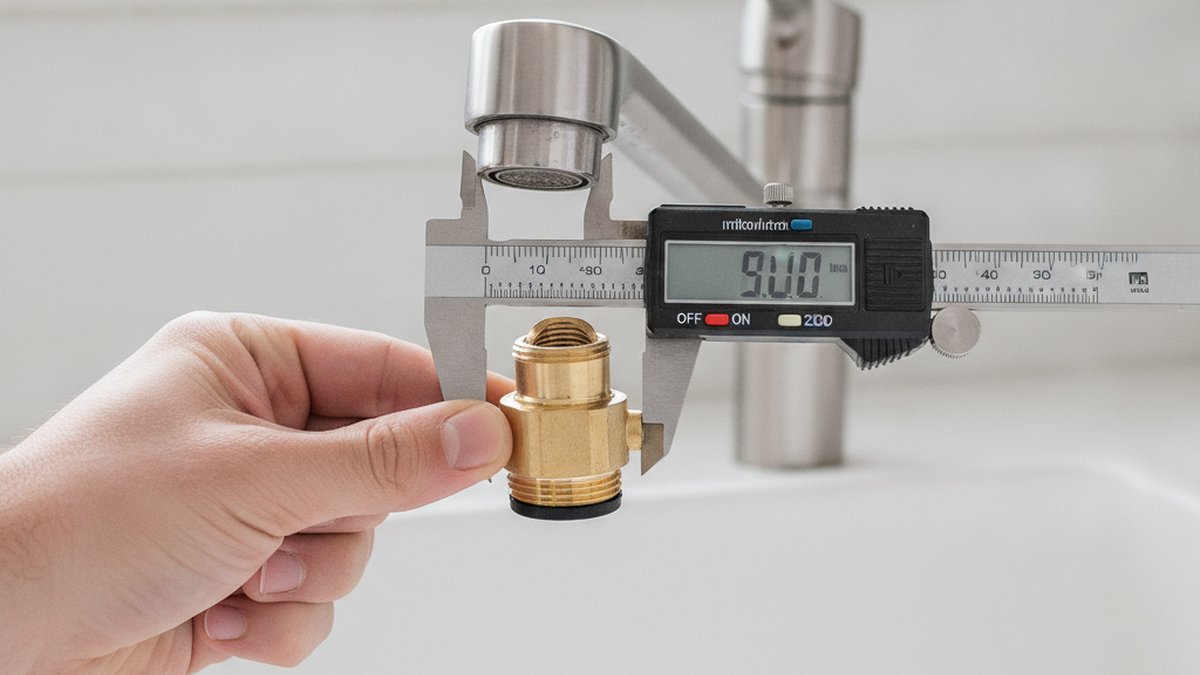
If you’ve stood in the plumbing aisle holding your phone, googling “faucet adapter praxis” while trying to figure out why the fitting you grabbed won’t screw onto your tap, you’re not alone — it’s the single most common reason a quick job turns into a second trip to the store. The good news: adapters are cheap and there are really only three or four things you need to get right. Praxis (the Dutch and Belgian DIY chain) stocks a solid range of them, but the store can’t tell you which one fits your specific spout — so this guide walks you through measuring, matching, and buying the correct adapter the first time, whether you’re hooking up a dishwasher, a garden hose, a water filter, or a portable washing machine.
At adeaga we sell and test faucet fittings every day, and the mistakes people make are remarkably consistent. Let’s fix that.
What exactly is a faucet adapter, and why won’t the one from Praxis fit my tap?
A faucet adapter is a small threaded (or clamp-on) fitting that screws onto the end of your tap spout and converts its thread to a different size or type — usually so you can attach a hose, a filter, a dishwasher inlet, or a spray attachment. It won’t fit your tap when the thread size or thread gender is wrong, and that’s true no matter which store you buy it from.
Here’s the part that trips everyone up. The tip of almost every modern tap has an aerator — the little mesh insert that mixes air into the water. That aerator screws into the spout using one of a handful of standard threads. When you buy an adapter, you’re really buying a fitting that either replaces the aerator or screws onto the same thread the aerator uses. So the question isn’t “which adapter does Praxis sell?” — it’s “what thread is on the end of my tap?”
The two most common European sizes are:
- M22 (male): the outside of the spout has a 22 mm external thread — the aerator screws into the spout from below, or a cap threads over the outside.
- M24 (female): the inside of the spout has a 24 mm internal thread and the aerator screws up inside it.
A huge number of standard kitchen and bathroom taps are effectively “M22 male / M24 female” — meaning one adapter with M22 threads on the outside and M24 on the inside covers both. That’s why so many “universal tap adapter” kits from Praxis and elsewhere are labelled M22/M24. But there are outliers — M18, M28, and imperial ¾”/½” BSP on older or imported fixtures — so measuring beats guessing every single time.
How do I measure my tap thread before I drive to Praxis?
Unscrew the aerator and measure the thread diameter in millimeters with calipers or a ruler — that number, plus whether the thread is on the inside or outside of the spout, is everything you need. Do this before you leave the house and you’ll never buy the wrong adapter again.
Step by step:
- Unscrew the aerator by hand (turn it toward you as you face the spout — righty-tighty still applies, so lefty-loosey). If it’s stuck with limescale, a rubber glove or a cloth for grip usually does it. If it truly won’t budge, our guide on cleaning a faucet aerator that doesn’t come off walks through freeing it without cracking the housing.
- Measure the widest thread diameter. If the thread is on the outside of the spout, measure across the outside (that’s your “male” size, e.g. M22). If the threads are hidden inside the spout, measure the internal diameter (that’s your “female” size, e.g. M24).
- Note the gender. External threads on the spout = you need a female-threaded adapter to screw over it. Internal threads = you need a male-threaded adapter to screw up into it.
- Photograph it and take the old aerator with you. Comparing threads side by side in the aisle beats reading a package.
One warning: don’t confuse thread diameter with the physical size of the spout. A chunky pull-down kitchen spout can still have a standard M24 aerator inside a big decorative housing. Measure the thread, not the chrome.
Which faucet adapter type should I buy for my situation?
Match the adapter to the job: garden-hose thread for hoses and portable appliances, a diverter for dishwashers and washing machines, and a smooth clamp-on adapter for taps that have no usable thread at all. Here’s a direct comparison of what Praxis and similar stores typically carry.
| Adapter type | Fits this thread | Best for | Typical price |
|---|---|---|---|
| M22/M24 universal tap adapter | M22 male + M24 female (covers most) | Hoses, filters, spray attachments | €4–€9 |
| Tap-to-garden-hose (¾” GHT) adapter | M22/M24 → ¾” hose thread | Filling buckets, watering, portable washers | €5–€12 |
| Dishwasher / washing-machine diverter | M22/M24 with a valve + hose outlet | Portable dishwashers and washing machines | €8–€18 |
| Clamp-on / push-on universal adapter | Smooth (unthreaded) spouts | Taps with an internal “cache aerator”, no thread | €6–€14 |
| Thread reducer (e.g. M24→M22 or ½”→¾”) | Two threaded fittings that don’t match | Connecting an existing hose or filter | €3–€7 |
A few notes that save money and frustration:
- Brass beats plastic for anything permanent or under pressure. Plastic adapters are fine for a temporary garden hose, but they crack and cross-thread far more easily. If you’ll leave it attached, spend the extra euro or two on brass or chrome-plated brass.
- Check the washer. A cheap adapter with a hard or missing rubber washer will drip at the joint no matter how tight you crank it. A soft, intact washer seals with just hand-tightening plus a quarter turn.
- Don’t over-tighten. These are fine threads in soft metal. Snug plus a small nudge is enough — force strips the thread.
If your real goal is to bring the spout closer or extend its reach rather than change the thread, an adapter isn’t the right tool — you want a proper extension. We cover that in our guide to whether a stainless steel kitchen faucet extender is worth it, which is a different fitting for a different problem.
Can I connect a dishwasher or washing machine with a Praxis faucet adapter?
Yes — for a portable dishwasher or washing machine you use a faucet diverter adapter that screws onto the tap’s aerator thread and has its own valve to switch flow between the tap and the appliance hose. A permanently plumbed appliance, on the other hand, connects to the supply line under the sink, not the spout, and doesn’t use a faucet adapter at all.
For the portable route, buy a diverter rated for the appliance’s flow, confirm it matches your M22/M24 (or measured) thread, and make sure the diverter body is metal — the plastic ones are the number-one cause of mid-cycle leaks because they warp under warm water and constant pressure. Set the tap to a moderate flow rather than full blast; the appliance regulates what it needs, and blasting the tap just stresses the joint. If you’re not sure what a normal flow looks like for a kitchen tap, our breakdown of the average kitchen sink faucet flow rate gives you the baseline numbers to check against.
What if my tap has no thread at all?
If the end of your spout is smooth and the aerator sits recessed inside (a “hidden” or cache aerator), no threaded adapter will grip it — you need a universal push-on or clamp-on adapter that grips the outside of the spout with a rubber sleeve and a tightening collar. These are the ones sold as “universal, fits all taps,” and they’re the honest answer to a tap that genuinely has nothing to screw onto.
Two realities to set expectations:
- Clamp-on adapters are lower pressure connections. They’re great for filling a bucket, running a garden hose, or a low-flow filter — but push the pressure and they can pop off. Treat them as temporary, not plumbed-in.
- They rely on a snug rubber seal, so a spout with a very tapered or oddly shaped tip may never seal perfectly. In that case, replacing the aerator housing with a standard threaded one is a cleaner long-term fix — and if you’re comfortable swapping the whole spout tip, our walkthrough on how to replace a kitchen faucet head without calling a plumber covers the mechanics.
Is buying the adapter from Praxis better than buying online from adeaga?
Buy from Praxis when you need it in your hand today and you’ve already measured your thread; buy from a specialist like adeaga when you want the exact thread match, brass build quality, and a warranty on a fitting you’ll leave connected long-term. Both are valid — it’s a convenience-versus-precision trade-off, not a right-versus-wrong one.
The honest guidance: for a €4 temporary garden-hose adapter you’ll use twice a summer, grab it off the shelf at Praxis. For a diverter you’ll run a dishwasher through every day, or a filter connection you want leak-free for years, the material and thread tolerance matter more than saving a trip — and that’s where a tested, spec-listed fitting earns its keep. Whatever you choose, the deciding factor is still the thread measurement you took at home, not the store’s logo on the bag.
A quick real-world scenario
Say you’ve got a standard chrome mixer tap, you want to run a portable dishwasher, and your budget is under €20. Measure the spout: you find internal M24 threads. You buy an M22/M24 brass diverter adapter (€12), check it comes with a soft washer, hand-tighten it a quarter-turn past snug, attach the dishwasher hose, and set the tap to medium flow. Total cost, one fitting, no plumber, no leaks. That’s the whole job — and it’s why measuring first is 90% of the battle.
FAQ
What size is a standard faucet adapter thread in Europe?
Most European kitchen and bathroom taps use M22 male (22 mm external) or M24 female (24 mm internal) aerator threads, which is why so many universal adapters are labelled “M22/M24.” Older or imported taps may use M18, M28, or imperial ¾” BSP, so always measure your own spout before buying.
How do I know if my tap needs a male or female adapter?
Look at where the threads are. If the threads are on the outside of the spout, you need a female adapter that screws over them. If the threads are hidden inside the spout, you need a male adapter that screws up into them. Unscrewing the existing aerator makes this obvious in seconds.
Why does my faucet adapter leak even when it’s tight?
A leak at the joint almost always means a worn, hard, or missing rubber washer — not insufficient tightening. Over-tightening actually makes it worse by deforming the washer or stripping the fine thread. Replace the washer with a soft new one and hand-tighten plus a quarter turn. If the leak is coming from the tap body rather than the adapter, that’s a cartridge or O-ring issue instead.
Can I use a plastic faucet adapter permanently?
It’s not recommended. Plastic adapters cross-thread and crack easily and warp under warm water and constant pressure, which is why they’re the top cause of leaks on portable appliances. Use plastic only for temporary, low-pressure jobs like a garden hose, and choose brass or chrome-plated brass for anything you’ll leave connected.
Will a universal faucet adapter fit any tap?
A threaded “universal” adapter only fits taps with a compatible M22/M24 thread — it won’t grip a smooth, unthreaded spout. For taps with no external thread you need a clamp-on/push-on universal adapter that seals with a rubber sleeve, and that type is best treated as a lower-pressure, temporary connection.
Do I need plumber’s tape on a faucet adapter?
Usually no — faucet adapters seal with a rubber washer, not with the threads, so PTFE tape isn’t needed and can even prevent the washer from seating properly. Save the tape for threaded pipe connections that seal metal-to-metal, such as under-sink supply fittings.
About the author: This guide was written by the adeaga fixtures team, who fit, test, and troubleshoot faucet adapters, aerators, and diverters daily across kitchen and bathroom installations. Our advice is based on hands-on bench testing of thread fitment and leak performance, not spec sheets alone.
Why trust adeaga: adeaga specializes in faucets and bathroom fixtures, and every threaded adapter we sell is checked against standard M18–M28 and ¾” BSP thread gauges for correct fitment. Our brass adapters are pressure-tested and backed by a manufacturer warranty, and we list the exact thread size on every product so you match it to your measured spout with confidence.