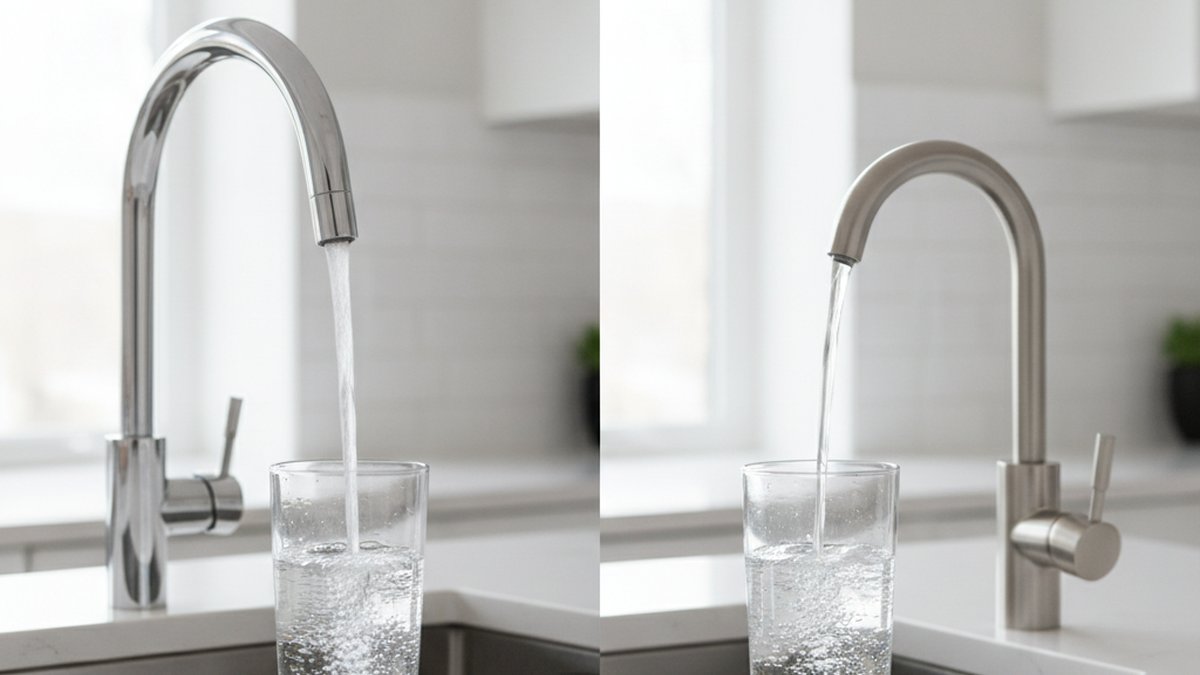
The whole tap water vs filter debate usually gets framed as “safe vs unsafe,” and that’s the wrong way to think about it. In almost every U.S. municipality, the tap water leaving your kitchen faucet already meets EPA drinking-water standards. The real question isn’t whether tap water will make you sick tomorrow — it’s whether you want to remove the things tap water is legally allowed to contain: chlorine taste, hardness minerals, trace lead from old plumbing, and the occasional PFAS or nitrate depending on where you live. That’s a decision about taste, health margins, and appliance protection — not survival.
So this article does two things. First, it tells you, honestly, when tap water is perfectly fine and buying a filter is just spending money on peace of mind. Second, if you do want a filter, it shows you exactly which type matches your situation and budget — because a $25 pitcher and a $250 under-sink reverse-osmosis system solve completely different problems.
Is tap water actually safe to drink, or do I really need a filter?
In the vast majority of American cities, tap water is safe to drink straight from the faucet — it’s tested constantly and regulated more tightly than bottled water. You need a filter only if (a) your annual water quality report flags a specific contaminant, (b) your home was built before 1986 and may have lead solder or service lines, or (c) you simply don’t like the taste. Those are three real reasons; “I saw a scary video” is not.
Every public water system in the U.S. is required to send you a Consumer Confidence Report (CCR) once a year — it’s usually on your utility’s website. It lists exactly what’s in your water and at what level. This is the single most useful thing you can read before spending a dime on filtration. If your report is clean and the water tastes fine, tap water is genuinely all you need. If you see lead above 0 ppb, nitrate near 10 mg/L, or PFAS detections, that changes the math.
Two situations override a clean city report. First, well water: private wells aren’t regulated or tested by anyone but you, so if you’re on a well, you should test annually and almost always filter. Second, old plumbing: even if the water leaving the treatment plant is pristine, lead can leach from pipes and solder inside your own home. That’s a fixture-and-plumbing problem, and it’s exactly why some households filter at the faucet even in cities with excellent water.
What does a water filter actually remove that tap water leaves in?
Filters remove chlorine and its taste, sediment, hardness minerals, heavy metals like lead, and — depending on the technology — nitrates, PFAS, and dissolved solids. But no single filter removes everything, and that’s the part marketing pages hide. The technology determines what comes out.
Here’s the honest breakdown of what each filter type targets:
- Activated carbon (the most common): excellent at chlorine, taste, odor, and some VOCs and lead. Does nothing for hardness minerals or dissolved salts.
- Reverse osmosis (RO): removes nearly everything — lead, PFAS, nitrates, fluoride, dissolved solids — but wastes some water and strips beneficial minerals too. Best for genuinely problematic water.
- Ion-exchange / water softeners: target calcium and magnesium (hardness). Great for protecting your faucet and appliances, but they don’t purify for health and they add sodium.
- Ceramic and hollow-fiber: catch sediment, cysts, and bacteria — useful for well water or emergencies, less so for chemical taste.
The takeaway: match the filter to the problem on your water report. If your only complaint is chlorine smell, a $30 carbon filter is perfect and RO is overkill. If you have measurable lead or PFAS, you need carbon block certified for those specifically, or RO. Don’t buy a softener expecting cleaner-tasting water, and don’t buy RO expecting it to fix hardness at every tap.
Tap water vs filter: which type fits my situation and budget?
The right choice depends on what your water report shows and how much plumbing you want to touch. A pitcher is cheapest and needs zero installation; an under-sink RO system costs the most and needs a dedicated filter faucet, but delivers the cleanest water on demand. Here’s how the main options actually compare.
| Option | Upfront cost | Removes | Install | Best for |
|---|---|---|---|---|
| Straight tap water | $0 | Nothing (relies on city treatment) | None | Clean CCR, good taste, modern plumbing |
| Filter pitcher | $25–$50 | Chlorine, taste, some lead | None | Renters, taste-only complaints |
| Faucet-mounted filter | $30–$60 | Chlorine, lead, sediment | Screws onto spout | Quick upgrade, low commitment |
| Under-sink carbon | $80–$180 | Chlorine, lead, VOCs, PFAS (if certified) | Moderate DIY | Daily drinking + cooking water |
| Under-sink RO | $180–$350 | Nearly everything incl. nitrate, fluoride, dissolved solids | Dedicated faucet + drain | Well water, flagged contaminants |
| Whole-house softener | $400–$1,500 | Hardness minerals (all taps) | Professional | Hard water damaging fixtures |
Notice that the cheapest real filters and the most expensive ones solve different problems, not the same problem at different quality levels. A pitcher improves taste; RO changes your water chemistry. If your goal is “my coffee tastes like a pool,” stop at a $35 faucet filter. If your goal is “my well tested positive for nitrates,” you’re in RO territory.
Does hard water ruin my faucet faster than a filter would cost?
Yes — if your water is genuinely hard, mineral scale will shorten the life of your faucet’s aerator, cartridge, and finish, and the repair costs can quietly exceed the price of addressing the water. Hard water is the one case where “filtering” (technically softening) pays for itself in protected fixtures, not just better taste.
Hard water leaves that chalky white crust on your spout and inside your aerator, and it slowly clogs the tiny passages in the faucet cartridge. Over a few years that means dropping pressure, a spray that goes sideways, and finishes that look permanently cloudy no matter how you scrub. If you’re already fighting buildup, our guide on how to clean a faucet head with CLR and the walkthrough on cleaning the aerator when your water pressure drops will buy you time — but if you’re doing that every couple of months, a softener or scale-reducing filter is the real fix.
There’s also a flow-rate angle people miss. Scale narrows the openings in your aerator, which drops your effective flow even when your home pressure is fine. If your faucet has slowed down and you’re wondering what “normal” even is, our breakdown of the average kitchen sink faucet flow rate shows what you should be getting — and hard-water scale is one of the top reasons real-world flow falls below spec.
Is bottled water better than either tap water or a filter?
No — for daily drinking, filtered tap water beats bottled on cost, environmental impact, and often quality, since a large share of bottled water is just filtered municipal tap water resold at a huge markup. Bottled makes sense for emergencies or travel, not as your everyday kitchen supply.
Run the numbers: a household drinking bottled water can spend several hundred dollars a year, while an under-sink carbon filter costs $80–$180 up front plus roughly $40–$60 a year in replacement cartridges — and it delivers water on demand at your faucet with no plastic to haul or recycle. Bottled water is also regulated by the FDA rather than the EPA, and the standards are, in some respects, looser than what your city already meets. You’re usually paying more for less oversight.
The one honest exception: short-term situations — a boil-water advisory, a move into a home before you’ve tested the well, or a road trip. Keep a case on hand for those. For the 360-odd normal days a year, a filter at the faucet is cheaper and greener than a truck delivering water in plastic.
How do I install an under-sink filter myself?
Most under-sink carbon filters are a genuine DIY job — you tap into the cold-water supply line under the sink, mount the filter housing, and either route it to your existing faucet or add a small dedicated filter faucet. Plan on 1–2 hours the first time, and shut off the water before you start.
Here’s the basic sequence for a standard under-sink carbon system:
- Turn off the cold-water shutoff valve under the sink and open the faucet to release pressure.
- Mount the filter housing to the cabinet wall using the included bracket, leaving room to unscrew it for cartridge changes.
- Install the supplied T-fitting on the cold-water line to feed the filter.
- Connect the inlet and outlet tubing to the housing, pushing fully into the quick-connect fittings.
- If your kit includes a dedicated filter faucet, drill or use an existing sink knockout hole and mount it, then run the outlet tube up to it.
- Turn the water back on slowly, check every fitting for drips, and flush the new cartridge for 5–10 minutes before drinking.
If you’re adding a separate filter faucet and your sink doesn’t have a spare hole, that’s the same skill as installing any deck fixture — the mounting, the supply hookup, and the leak check are identical to a standard faucet swap. The only specialized step is the T-fitting on the supply line, and modern quick-connect kits make that push-and-lock simple. Take your time on the fittings; that’s where 90% of first-timer leaks happen.
When is plain tap water genuinely the right call?
Plain tap water is the right call when your city’s water report is clean, your home has modern (post-1986) plumbing, and the water tastes fine to you. In that situation, a filter is optional comfort, not a health necessity — and there’s nothing wrong with skipping it.
It’s worth saying clearly because the filtration industry has an incentive to make everyone feel their tap is dangerous. It usually isn’t. American municipal water is one of the great public-health successes, tested for dozens of contaminants around the clock. If you’ve read your CCR, you’re not on a well, and your glass tastes clean, you can drink straight from the faucet with confidence and put your money toward a better faucet instead of a filter you don’t need.
The nuance is that “tap water vs filter” isn’t one decision for your whole house — it’s per-use. Plenty of people happily drink unfiltered tap water but still run a small carbon filter for coffee and cooking because it makes a noticeable taste difference. That’s a completely reasonable middle ground: tap for most things, filtered for the few where taste matters.
FAQ
Does filtering tap water remove the fluoride that’s good for teeth?
Basic carbon filters and most pitchers leave fluoride in — only reverse osmosis, distillation, or special activated-alumina filters remove it. So if you drink a standard carbon-filtered glass, you’re still getting fluoride. If you use RO and are concerned about dental health, that’s worth mentioning to your dentist, though most people get plenty of fluoride from toothpaste.
How often do I need to change my filter cartridge?
Follow the manufacturer’s rated capacity, not a guess — most carbon cartridges last 3–6 months or a set number of gallons. Change it on schedule even if the water still tastes fine, because an exhausted carbon filter can actually release trapped contaminants back into your water. Set a phone reminder; it’s the single most-neglected part of owning a filter.
Will a filter improve my water pressure or make it worse?
A clean filter has minimal effect on pressure, but a clogged or undersized one can noticeably slow your flow. RO systems in particular deliver water more slowly by design because they push it through a fine membrane, which is why they store filtered water in a tank. If your pressure dropped after installing a filter, the cartridge is likely due for replacement.
Is it safe to drink hot tap water if I have a filter?
No — never drink or cook with hot tap water, filtered or not. Hot water sits in your water heater and dissolves more metals and sediment from your plumbing than cold water does, and most under-sink filters are rated for cold lines only. Always draw cold water for drinking and cooking, then heat it on the stove or kettle.
Do I need a filter if I already have a water softener?
Often yes, because a softener and a filter do different jobs — a softener removes hardness minerals to protect your fixtures, but it doesn’t remove chlorine, lead, or organic contaminants, and it adds a little sodium. Many homes pair a whole-house softener with a small under-sink carbon or RO filter at the kitchen faucet for drinking water. They complement each other rather than compete.
Can I just boil tap water instead of filtering it?
Boiling kills bacteria and viruses but does nothing for chemical contaminants like lead, nitrates, or PFAS — it can even concentrate them as water evaporates. Boiling is the right response to a boil-water advisory, not a substitute for a filter. If your concern is taste or chemical contaminants rather than microbes, a filter is what you want.
About the author: This guide was written by the adeaga fixtures team, who spend their days testing kitchen and bathroom faucets, aerators, and filtration fittings — and fielding the same “should I filter my water?” question from customers every week. We wrote this to give the straight answer we give them: read your water report first, then buy the filter that matches it, not the one with the scariest ad.
About adeaga: adeaga (adeaga.net) is a specialist retailer of faucets, shower systems, and bathroom fixtures. Our filter-compatible faucets and cartridges are tested against NSF/ANSI Standard 42 (taste and chlorine) and Standard 53 (health-related contaminants like lead), and our kitchen faucets are backed by a manufacturer warranty on finish and function — so whether you filter or not, the fixture delivering your water is built to last. Standards and certifications referenced here are current as of 2026; always confirm a specific product’s NSF certification listing before you buy.