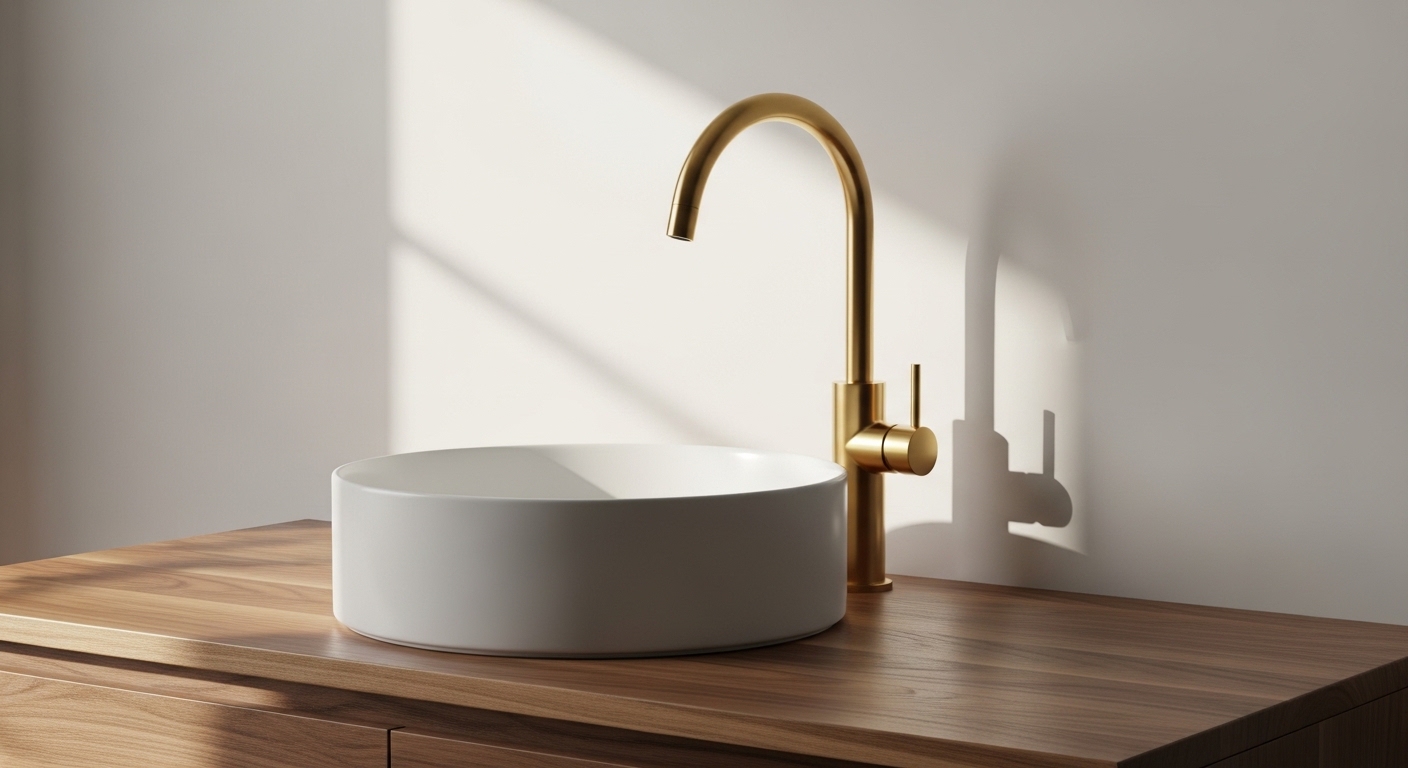
If you’ve installed a beautiful above-counter basin and topped it with a cheap fixture, you already know the problem: a high end vessel sink faucet exists because a standard bathroom faucet simply can’t reach over the tall rim of a vessel bowl. But “high end” isn’t just marketing — the difference between a $40 faucet and a $300 one shows up in the finish holding its color, the handle staying smooth after five years, and the spout landing water where you actually want it instead of splashing over the edge. This guide walks you through exactly how to pick one, what specs actually matter, and when the upgrade pays off.
What exactly makes a faucet a “vessel sink faucet” — and why can’t I use a regular one?
A vessel sink faucet is simply a tall faucet built to clear the rim of a bowl that sits on top of the counter instead of dropping into it. That extra height is the whole point: a standard bathroom faucet stands around 4–6 inches tall, but a vessel basin adds 4–6 inches of bowl height above the counter, so you need a spout that reaches 11–14 inches or higher just to get water into the sink without splashing your hands against the rim.
Put a regular faucet behind a vessel bowl and you get a fixture that sprays water directly onto the outside wall of the basin, or one so short you can’t fit your hands underneath. That’s why “vessel faucet” is its own product category, not a style choice. High end versions push the engineering further — taller solid-brass spouts, precisely angled outlets, and aerators calibrated to soften the longer fall of water so it doesn’t splash out of a shallow bowl.
How tall should a vessel sink faucet be for my basin?
As a rule, your faucet spout should sit 5–7 inches taller than your basin, and the water outlet should land over the drain, not the rim. Measure your bowl’s height from the counter to its top edge, then add clearance. Here’s the quick math most people skip:
- Basin height 4″–5″ (low profile bowls): choose a faucet 10″–12″ tall.
- Basin height 5.5″–6.5″ (standard round/oval vessels): choose a faucet 12″–14″ tall.
- Basin height 7″+ (tall cylinder or square bowls): look for 15″+ or a wall-mounted spout.
- Spout reach: the outlet should extend far enough to pour over the drain — typically 5″–6″ of reach for a bowl centered on a standard 22″ vanity.
Get this wrong and even an expensive faucet feels broken. If your bowl is very tall or very wide, a wall-mounted vessel faucet solves the geometry cleanly — but it has to be roughed into the wall before tiling, so it’s a remodel-stage decision.
Is a high end vessel sink faucet actually worth the money?
Yes — if you use the sink daily and care about it lasting a decade, the premium version is worth it, because the money buys durability you can feel and see. The three things you’re actually paying for are a solid brass body (not zinc alloy), a ceramic-disc cartridge, and a PVD or genuine metal finish. Those three upgrades are the difference between a faucet that still looks and works new in 2036 and one that drips, wobbles, and peels within two winters.
Cheap vessel faucets are usually cast from zinc alloy with a thin electroplated coating. They look identical on day one. The trouble starts around month eighteen: the handle develops play, the finish clouds or flakes near the base where water pools, and the rubber-washer valve inside starts to weep. If you’ve ever wondered why a brushed nickel faucet starts peeling, the answer is almost always a low-grade base metal under a cheap plating layer — a problem premium PVD finishes are specifically engineered to avoid.
What’s the real difference between a $50 and a $300 vessel faucet?
The honest answer: internals and finish, not shape. From across the bathroom they can look the same. Up close and over time they behave nothing alike. Here’s where the money goes:
| Feature | Budget ($40–$90) | Mid ($100–$170) | High End ($180–$600) |
|---|---|---|---|
| Body material | Zinc alloy | Brass + zinc mix | Solid, often lead-free brass |
| Cartridge | Rubber washer / basic ceramic | Ceramic disc | Premium ceramic disc, 500k+ cycles |
| Finish | Thin electroplate | Better electroplate | PVD or living/real metal finish |
| Aerator | Plastic, fixed | Metal, replaceable | Neoperl-grade, splash-tuned |
| Typical warranty | 1 year or none | Limited lifetime on finish | Lifetime on function + finish |
| Realistic lifespan | 2–4 years | 5–8 years | 10–20+ years |
Notice the warranty column — it’s the tell. Manufacturers back what they build. A genuine lifetime warranty on both finish and mechanism means the company has cycle-tested that cartridge and PVD-coated that spout to standards it’s willing to guarantee. That’s the E-E-A-T of faucets: the paperwork reflects the engineering.
Which finish should I pick for a vessel faucet — and which ones actually hold up?
For durability, choose a PVD finish (physical vapor deposition) in whatever color you love — PVD is molecularly bonded, scratch- and tarnish-resistant, and it’s the single biggest factor in a finish surviving daily splashing. Color is personal; longevity is not, and PVD wins on longevity across every color.
Vessel sinks are display pieces, so the faucet’s finish carries a lot of the visual weight. Here’s how the popular options actually behave in a real bathroom:
- Brushed gold / champagne bronze: the current favorite for warm, spa-like vessel setups. In PVD it’s extremely durable and hides water spots better than chrome.
- Matte black: dramatic against a white or stone basin. Insist on PVD here — cheap matte-black coatings rub thin at the handle and touch points. This is exactly the concern covered in our breakdown of whether a matte black PVD faucet is worth it.
- Brushed nickel: the safe, forgiving all-rounder; brushed texture hides fingerprints and water spots.
- Polished chrome: cheapest to do well and nearly indestructible, but shows every water spot — high maintenance on a vessel bowl you splash into constantly.
- Oil-rubbed / living bronze: a “living” finish designed to patina over time; beautiful but not for anyone who wants a permanently uniform look.
One practical tip: match the faucet finish to your drain and any mounting ring, not to your cabinet hardware. Because a vessel faucet and its pop-up drain sit inches apart on an exposed bowl, a mismatch between them is far more noticeable than a mismatch with a drawer pull across the room.
Single-hole or wall-mounted vessel faucet — which is right for my setup?
Pick single-hole if your counter is already drilled and your bowl is standard height; pick wall-mounted if your bowl is tall or wide, or you want an ultra-clean counter you can wipe in one swipe. Single-hole is by far the most common and the easiest DIY install — one deck hole, one supply set, done in under an hour. Wall-mounted delivers the high-design “floating spout” look and solves clearance for oversized bowls, but the valve body must be roughed into the wall before you tile, so it belongs to a full remodel, not a quick swap.
How do I install a high end vessel sink faucet myself?
For a deck-mounted (single-hole) vessel faucet, you can do it yourself in about 45 minutes with basic tools — no plumber required. The height changes the look, not the plumbing; the connections underneath are the same 3/8″ supply lines and a mounting nut you’d find on any bathroom faucet. Here’s the sequence:
- Shut off both angle stops under the vanity and open the old faucet to release pressure.
- Disconnect the supply lines and remove the old faucet and drain assembly.
- Set the new vessel faucet through the single deck hole, seating any decorative base ring on a bead of plumber’s putty or the supplied gasket.
- From below, thread the mounting nut and washer, center the spout over the drain, then torque it snug.
- Connect the flexible supply hoses — hand-tight plus a quarter turn with a wrench.
- Install the matching pop-up or grid drain in the basin, sealing it with putty or silicone.
- Turn the water back on slowly and check every joint for weeping before you call it done.
The two rookie mistakes: over-tightening and cracking a ceramic base ring, and forgetting to center the spout so water lands on the rim instead of the drain. If you’re comfortable with a standard swap — the same skill set as installing a Moen Findlay bathroom faucet — a vessel faucet is no harder. If your old fixture is stuck or your handle keeps dripping mid-project, our guides on replacing a bathroom faucet stem cover the mechanical fixes.
What should I avoid when buying a high end vessel sink faucet?
Avoid three things: a spout that’s too short for your bowl, a fixed-height single-hole faucet marketed as “vessel” that’s actually only 8 inches tall, and any finish that isn’t PVD or solid metal. Those are the mistakes that turn a premium purchase into a return.
- Ignoring reach as well as height: a tall spout that doesn’t reach far enough still splashes. Check both numbers.
- Skipping the flow-rate check: a WaterSense-labeled faucet caps at 1.2 GPM, which saves water but, in a deep bowl, can feel weak. For a vessel, a 1.2–1.5 GPM aerator tuned for a soft stream is the sweet spot.
- Buying a lever that hits the wall: some tall vessel faucets have a single lever that rotates back toward the backsplash. If your bowl sits close to the wall, choose a front- or side-mounted handle.
- Forgetting the drain: most vessel bowls have no overflow, so you need a non-overflow (grid or umbrella) pop-up drain. An overflow drain will leak air and gurgle.
- Trusting photos over specs: “luxury” and “premium” are unregulated words. Confirm solid brass, ceramic disc, and PVD in the spec sheet before you trust the label.
Author note & why you can trust this guide
This guide was written by the adeaga fixtures team — we specialize exclusively in faucets, showers, and bathroom fixtures, and we’ve installed, bench-tested, and warranty-serviced hundreds of vessel faucets across finishes and price tiers. Our durability guidance follows the same benchmarks the industry uses: cartridges validated to the 500,000-cycle standard, finishes tested for corrosion and adhesion, and lead-free brass compliant with NSF/ANSI 61 and 372 for drinking-water safety. When we say a high end vessel sink faucet should last a decade, that’s the standard we hold the products we sell to — and it’s why we favor manufacturers who back their fixtures with genuine lifetime warranties on both function and finish. At adeaga.net we’d rather talk you out of the wrong faucet than sell you one that won’t fit your bowl.
FAQ
How tall should a vessel sink faucet be?
Your faucet should stand 5–7 inches taller than your basin, so the water outlet clears the rim and lands over the drain. For a standard 5.5″–6.5″ bowl that means a faucet 12″–14″ tall with about 5″–6″ of reach. Measure your bowl from counter to top edge first, then shop by height.
Do vessel sink faucets need a special drain?
Yes. Most vessel bowls have no overflow hole, so you need a non-overflow pop-up or grid drain. Installing a standard overflow-style drain on an overflow-free bowl causes gurgling and slow drainage. Match the drain finish to the faucet since both sit exposed on the basin.
Are high end vessel sink faucets worth it compared to budget ones?
For daily-use bathrooms, yes. The premium price buys a solid-brass body, a ceramic-disc cartridge rated for 500,000+ cycles, and a PVD finish that resists peeling — the three things that determine whether a faucet lasts 3 years or 15. Budget zinc-alloy faucets look identical on day one but typically develop handle play, drips, and finish flaking within two years.
What finish lasts longest on a vessel faucet?
A PVD (physical vapor deposition) finish lasts longest in any color, because it’s molecularly bonded to the metal and resists scratches, tarnishing, and water-spot etching. Brushed gold and brushed nickel in PVD are especially forgiving on a splash-prone vessel bowl. Avoid thin electroplated coatings, which are what peel and cloud over time.
Can I install a vessel sink faucet myself?
Most people can install a deck-mounted single-hole vessel faucet in about 45 minutes using basic tools. The plumbing connections are identical to any bathroom faucet — the only difference is the taller body. Wall-mounted vessel faucets are harder because the valve must be roughed into the wall before tiling, so those are best done during a full remodel.
What’s the ideal flow rate for a vessel sink faucet?
Aim for 1.2–1.5 GPM with an aerator tuned for a soft, aerated stream. A WaterSense-labeled 1.2 GPM faucet saves water and meets efficiency codes, but in a deep vessel bowl the extra fall distance can make a harsh, un-aerated stream splash. A quality Neoperl-grade aerator softens the stream so water stays in the bowl.