If you’ve been searching for a bathtub faucet attachment because you want a handheld sprayer for rinsing hair, bathing kids or dogs, or cleaning the tub without a full remodel, the good news is you almost never need a plumber. Most attachments thread or clamp onto the spout you already have. The tricky part is that “bathtub faucet” covers a dozen different spout designs, and the wrong adapter simply won’t seal. This guide walks through the real questions people ask — what types exist, how to measure your spout, what fits a spout with no threads, and which attachments are worth the money.
At adeaga, we’ve fit and tested tub attachments across hundreds of real bathroom setups, from 1970s galvanized rough-ins to modern freestanding fillers, so the advice below is grounded in what actually seals and holds up — not just what looks good in a product photo.
What exactly counts as a “bathtub faucet attachment”?
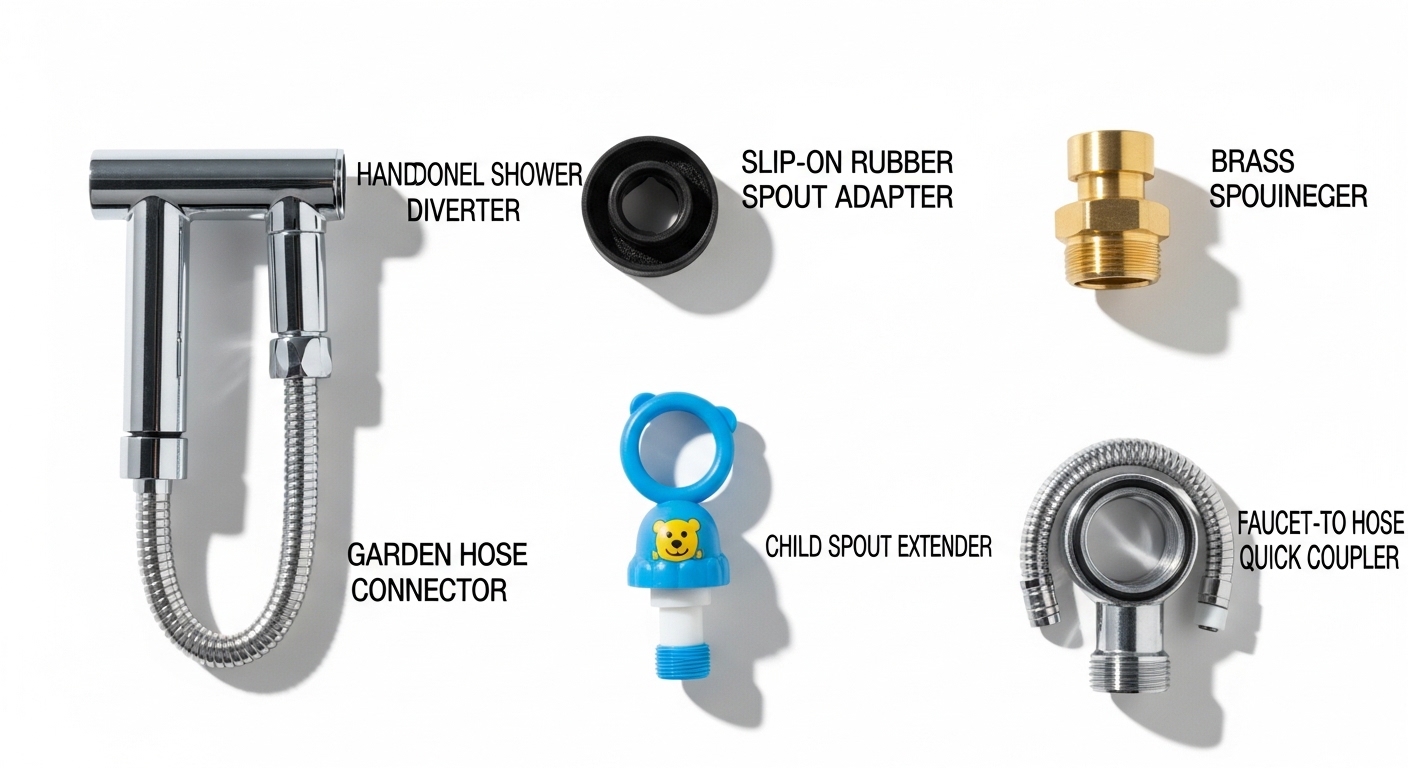
A bathtub faucet attachment is any accessory that connects to your tub spout or filler to add a function it didn’t ship with. The four you’ll run into most are handheld shower diverters, slip-on/clamp-on spout adapters, threaded hose connectors, and spout extenders or covers. Each solves a different problem.
- Handheld shower diverter attachment: Clamps or screws onto the spout and adds a diverter valve plus a hose and handheld sprayer. This is the single most-searched attachment — people want a detachable sprayer without opening the wall.
- Slip-on / clamp-on adapter: A rubber-lined sleeve that grips a smooth, unthreaded spout so you can attach a hose. Ideal for tubs with no visible threads.
- Threaded hose connector: Screws directly onto a spout that has aerator threads or garden-hose threads — the most secure, leak-free option.
- Spout extender / cover: A soft silicone shell (often animal-shaped) that pushes the water stream forward and cushions the spout — mostly for households with young kids.
Knowing which category you need saves you from the number-one mistake: buying a threaded connector for a spout that has no threads, or vice versa.
How do I attach a handheld shower to a bathtub faucet without any threads?
Use a clamp-on (slip-on) diverter attachment — it’s the fix for spouts with no threads. These wrap a rubber gasket around the outside of the spout and tighten with a hose clamp or a spring-loaded collar, giving you a diverter and handheld hose without cutting into the plumbing. They’re the go-to for older tubs and rentals where you can’t modify anything permanent.
To install one: slide the rubber sleeve over the end of the spout, position the diverter outlet facing down, tighten the clamp until the gasket compresses snugly, then screw the handheld hose onto the diverter’s threaded port. Run the water and pull the diverter tab up to send flow to the sprayer. If you see drips around the collar, tighten a quarter-turn more or reseat the gasket — don’t overtighten to the point the plastic cracks.
Clamp-on attachments trade a little elegance for zero commitment: they may weep slightly under full pressure and they look bulkier than a threaded unit. But for a rental or a quick fix, they’re the least invasive route. If your tub spout is corroded or spinning loose before you even start, deal with that first — our guide on handling corroded faucet removal without snapping the pipe covers how to get a stuck spout off safely so a new attachment actually seals.
How do I know which attachment will fit my tub spout?
Measure your spout and identify its connection type before you buy anything — that one step prevents 90% of returns. Tub spouts fall into two mounting families and a few thread standards, and the attachment has to match both.
First, figure out how the spout mounts. Slip-fit spouts slide over a ½” copper stub and lock with a small hex set screw underneath — no threads visible at the wall. Threaded spouts screw onto a ½” iron pipe nipple, so twisting the spout counterclockwise loosens it. Second, look at the business end of the spout: many have interior aerator threads, and some diverter spouts have a downward hose port. Attachments connect to those threads or to the spout’s outer diameter.
| Attachment type | Fits which spout | Connection | Best for |
|---|---|---|---|
| Clamp-on diverter | Smooth/unthreaded spouts | Rubber gasket + clamp on outer diameter | Rentals, older tubs, no-modify setups |
| Threaded diverter adapter | Spouts with aerator threads | Screws into ½”–14 or 15/16″–27 threads | Secure, leak-free handheld install |
| Garden-hose (GHT) connector | Spouts with ¾” GHT tip | ¾” male/female hose thread | Filling buckets, pet baths, hoses |
| Slip-on spout extender/cover | Any spout up to ~2.5″ wide | Silicone friction fit | Child safety, softer stream |
The most common U.S. thread sizes you’ll encounter on tub attachments are ½”–14 NPT (standard pipe), 15/16″–27 (large aerator), 55/64″–27 (small aerator), and ¾”–11.5 GHT (garden hose). A cheap thread-gauge or a quick trip to a hardware store with the spout removed settles any doubt. If you can’t tell whether yours is slip-fit or threaded, reach under the spout with a flashlight and look for that set screw — a set screw almost always means slip-fit.
Is a bathtub faucet attachment worth it, or should I just replace the whole faucet?
An attachment is worth it when your existing spout and valve work fine and you only want to add a function — that’s a $15–$45 fix versus $150+ for a new faucet and a half-day of labor. Replace the whole faucet instead when the valve leaks, the finish is failing, or you want a permanent built-in diverter and cleaner looks.
Here’s the honest trade-off. Attachments are fast, reversible, and landlord-friendly, but the good ones still have visible hardware and a hose hanging off the spout. A built-in diverter tub spout or a proper wall-mount handheld system looks integrated and lasts longer, but it means shutting off water and swapping parts. If you’re already comfortable with a wrench, replacing the spout itself is often only marginally harder than a clamp-on adapter — and our walkthrough on how to replace an old bathtub faucet without calling a plumber shows exactly how far a DIYer can get in an afternoon.
For freestanding and Roman tubs, the calculus is different: those fillers rarely take clamp-on attachments cleanly, so a handheld is usually plumbed in from the start. If you’re weighing a full filler upgrade, the buyer’s breakdown in our VEVOR Roman tub faucet review is a useful reality check on cost versus finish quality, and the Jaquar bathtub faucet guide covers how a higher-end filler with an integrated handheld compares to bolting on an attachment.
Which bathtub faucet attachment is best for bathing kids or a dog?
For kids and pets, the best combination is a clamp-on or threaded handheld diverter with a long (5–6 ft) hose plus a silicone spout cover, ideally with a flow rate around 1.8–2.5 GPM so rinsing is quick but gentle. The handheld gives you control to rinse without splashing eyes; the cover cushions the hard spout and softens the stream.
Look for these features when it’s mostly kids and dogs:
- A long hose (60″+): Short hoses fight you when you’re leaning over the tub. Longer reach lets you rinse a dog’s back legs or a toddler’s hair without repositioning.
- A pause or trickle button on the sprayer head: Lets you stop flow at the head while you lather, saving water and hassle.
- A soft silicone spout cover: Prevents head-bumps and lowers scald risk from a hot metal spout.
- A secure diverter: A wobbly diverter that flips back to the spout mid-rinse is the top complaint — a threaded adapter beats a clamp-on here if your spout has threads.
One caution: many pet-bathing hoses use a ¾” garden-hose thread so they can double for outdoor use, while indoor handheld showers use aerator or pipe threads. Confirm the thread before you assume a single hose will do both jobs.
Why does my bathtub faucet attachment leak, and how do I fix it?
Most attachment leaks come from three fixable causes: a missing or pinched washer, mismatched threads, or a diverter that isn’t fully engaged. Check the washer first — nine times out of ten a fresh rubber or fiber washer at the connection stops the drip.
Run through this quick diagnostic:
- Leak at the hose-to-spout joint: Unscrew it, confirm the washer is seated flat (not folded), and add a wrap of PTFE plumber’s tape on tapered threads. Hand-tighten plus a gentle quarter-turn — no pliers-crushing.
- Leak around a clamp-on collar: The gasket isn’t compressing evenly. Reseat it square to the spout and tighten the clamp in small increments while the water runs.
- Water dribbling from the spout while the sprayer runs: Normal for many diverters (a small bleed is by design), but heavy flow means the diverter seal is worn — replace the diverter cartridge or the whole adapter.
- Leak that started at the wall, not the attachment: That’s the spout or valve, not your add-on. A slip-fit spout that drips behind the escutcheon may just need its set screw and O-ring checked.
If the leak traces back to the spout base or the valve behind it rather than your attachment, that’s a different repair — the diagnostic steps in our free standing tub faucet repair guide apply to the underlying fixture. And if you notice a gap or rough edge where the spout meets the wall, a tub spout beauty ring cleans up the transition and hides the very gap where drips sometimes escape.
What should I check before buying? A quick pre-purchase checklist
Before you click buy, confirm these five things — it’s the difference between a five-minute install and a return.
- Spout mount type: Slip-fit (set screw) or threaded? This dictates whether a clamp-on or threaded attachment is even an option.
- Thread size: ½” NPT, 15/16″–27 or 55/64″–27 aerator, or ¾” GHT. Match it exactly.
- Spout outer diameter: Clamp-on adapters list a max diameter (often ~2.5″). Measure the widest point.
- Finish match: Chrome, brushed nickel, matte black — pick a hose and head that match your existing hardware so it doesn’t look tacked on.
- Certification: Look for a fixture that meets NSF/ANSI 61 and 372 (lead-free) standards and carries at least a limited warranty. Cheap uncertified hoses can shed and clog aerators fast.
If you want to round out the setup — shut-off couplers, replacement washers, filters, and extra hose length — our overview of which shower faucet accessories actually matter helps you skip the gimmicks and buy only what earns its place.
Do bathtub faucet attachments reduce water pressure?
A well-made attachment barely changes pressure; a cheap one with a narrow hose or a clogged inline restrictor can noticeably weaken the spray. Handheld heads are also flow-rated (often 1.8, 2.0, or 2.5 GPM), so a low-flow head will feel gentler by design — that’s a spec choice, not a defect.
If pressure drops after installing an attachment, check for a flow restrictor disc inside the hose fitting or a screen full of debris. Removing or cleaning it usually restores flow, though removing a restrictor increases water use. Kinked or too-thin hoses are another culprit. The same principles that govern kitchen flow apply here, and our deep dive on how to actually increase water flow at a faucet explains restrictors, aerators, and mineral buildup in plain terms.
The bottom line
A bathtub faucet attachment is the fastest, cheapest way to add a handheld sprayer, a hose connection, or child-safe features to a tub you otherwise like. Start by identifying your spout — slip-fit or threaded, and its thread size — then match the attachment to that connection. For a no-modify rental, a clamp-on diverter wins; for a secure, leak-free result, a threaded adapter is better; and for a permanent, integrated look, replacing the spout or faucet itself may be the smarter long-term move. Measure twice, buy once, and check for lead-free certification and a warranty before you commit.
FAQ
Can I add a handheld shower to any bathtub faucet?
Almost any tub — yes. If your spout has threads, use a threaded diverter adapter; if it’s smooth, use a clamp-on diverter that grips the outside of the spout. The only tubs where it’s tricky are freestanding and Roman fillers, which usually need a plumbed-in handheld rather than a bolt-on attachment.
What thread size is a standard bathtub faucet attachment?
Most U.S. tub attachments use one of four threads: ½”–14 NPT (pipe), 15/16″–27 or 55/64″–27 (aerator), or ¾”–11.5 garden-hose thread. Measure your spout’s outlet or bring the removed spout to a hardware store to confirm before buying an adapter.
Will a clamp-on diverter leak?
It can weep slightly at high pressure because it seals against the outside of the spout with a rubber gasket rather than threading in. Seating the gasket square and tightening the clamp evenly stops most drips. If you have aerator threads, a threaded adapter is more leak-resistant.
How do I attach a hose to my bathtub faucet to fill a bucket or bathe a dog?
Use a faucet-to-hose adapter that matches your spout: a threaded connector if your spout has aerator threads, or a rubber slip-on coupler if it’s smooth. Many pet and utility hoses use a ¾” garden-hose thread, so confirm the fitting matches before assuming a single hose covers both indoor and outdoor use.
Are bathtub faucet attachments safe for drinking or filling water?
Choose an attachment and hose certified to NSF/ANSI 61 and 372 (lead-free) if water may be used for drinking or cooking. Many bargain hoses are labeled for non-potable use only, so read the packaging — the certification is the signal that the materials are safe for contact water.
Do I need to turn off the water to install a bathtub faucet attachment?
No, for a clamp-on or threaded attachment that goes onto the spout’s outlet — the spout stays in place and you just add hardware to the end. You only need to shut off the water if you’re removing the spout itself or replacing the valve behind the wall.
Author note: This guide was written and fixture-tested by the adeaga bath hardware team, which specializes in faucets, tub fillers, shower systems, and connection hardware. Our recommendations reflect hands-on fitting across slip-fit and threaded spouts and prioritize NSF/ANSI-certified, warrantied components. Always follow the manufacturer’s instructions for your specific attachment, and when in doubt about your plumbing, consult a licensed plumber.