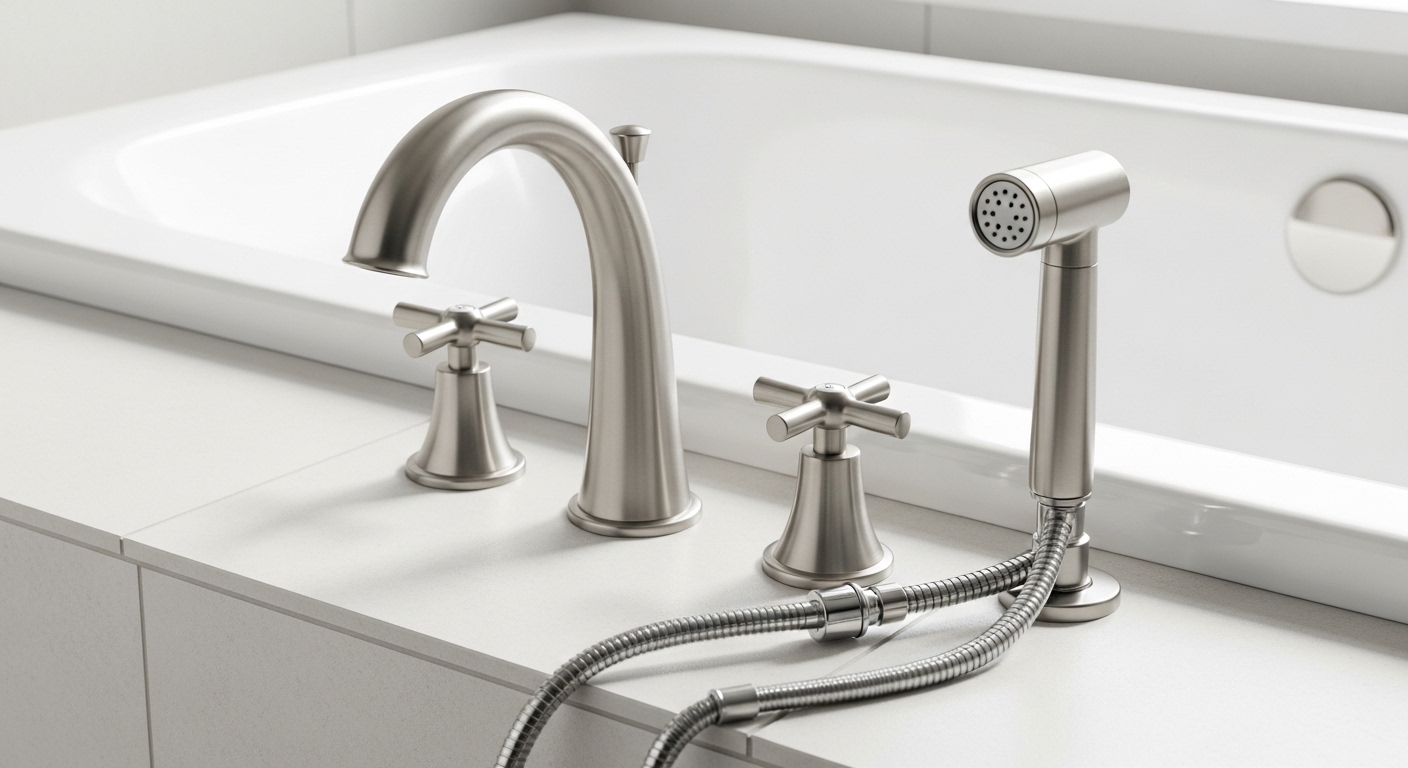
If you’ve been pricing out a deck-mounted tub filler and keep landing on a vevor roman tub faucet because everything else costs three times as much, you’re asking exactly the right question. A Roman tub faucet is the kind that mounts on the flat deck around your bathtub — not on the wall and not on the floor — usually spreading across three to five pre-drilled holes for the spout, two handles, and sometimes a handheld sprayer. VEVOR has become the go-to budget option for this category, and for a lot of bathrooms it genuinely makes sense. Below I’ll walk you through who it’s right for, where it cuts corners, how to choose the correct configuration, and what to check before you click buy.
What exactly is a Roman tub faucet, and how is it different from a regular tub faucet?
A Roman tub faucet is a tub filler that mounts horizontally on the deck (the flat ledge) surrounding a drop-in or platform bathtub, with a high-arc spout that pours water down into the tub from above. It’s different from a standard tub-and-shower faucet, which mounts on the wall and shares plumbing with a showerhead.
The name comes from the deep “Roman” soaking tubs these fillers were designed for. The defining trait is the deck mount and the wide hole spread. Where a wall faucet hides its valve body inside the wall, a Roman tub set runs its valves and supply lines under the deck, which means installation usually requires access from below — a basement, a crawl space, or an open cabinet. This is the single most important thing to understand before buying, because it shapes whether the install is a weekend job or a wall-opening project.
Roman tub fillers come in a few common layouts:
- 3-hole: spout plus two widely spaced handles, no sprayer. The cleanest, most classic look.
- 4-hole: spout, two handles, and a separate handheld sprayer/diverter. The most popular for soaking tubs.
- Single-hole / single-post: a tall waterfall column where everything comes through one body — less common in the VEVOR lineup but available.
Is a VEVOR Roman tub faucet good quality, or is it cheap junk?
A VEVOR Roman tub faucet is decent mid-budget quality — better than the no-name fillers on marketplace listings, but a step below brands like Delta, Moen, or Kohler. The brass-or-zinc body, ceramic disc cartridges, and PVD-style finishes are perfectly serviceable for normal home use; what you’re really paying less for is finish longevity, cartridge replaceability, and customer support.
Here’s the honest breakdown. Most VEVOR Roman tub fillers use a brass or brass-and-zinc-alloy body. Brass is what you want for the water-contact parts — it resists corrosion and handles mineral-heavy water far better than pure zinc. The handles and decorative trim are often zinc alloy, which is normal even on mid-tier brands. The valves are typically ceramic disc cartridges, the same technology premium brands use, rated for tens of thousands of open-close cycles before they start to drip.
Where VEVOR saves money is in the details that don’t show up on day one: the thickness of the finish plating, the precision of the cartridge tolerances, and the availability of exact replacement parts five years from now. A premium faucet drips and you order the OEM cartridge in two minutes; a budget faucet drips and you’re matching a generic cartridge by caliper measurement. None of that makes it junk — it makes it a calculated trade-off. If you want a deeper look at how plating quality affects longevity, our guide on whether a matte black PVD faucet is worth it explains why the coating process matters more than the color.
How much should I expect to pay, and how does VEVOR compare to Delta or Moen?
Expect to pay roughly $80–$180 for a VEVOR Roman tub faucet, versus $250–$700 for comparable Delta, Moen, or Kohler deck-mounted fillers. You’re getting 90% of the daily function for 30–40% of the price — the gap is in warranty, finish guarantees, and parts support, not in whether it pours water well.
| Feature | VEVOR Roman Tub Faucet | Mid-Range Brand (Delta/Moen) | Premium (Kohler/Brizo) |
|---|---|---|---|
| Typical price | $80–$180 | $250–$450 | $450–$700+ |
| Body material | Brass / zinc alloy | Solid brass | Solid brass |
| Cartridge | Ceramic disc | Ceramic disc | Ceramic disc |
| Finish warranty | Limited / 1–2 yr | Lifetime (many) | Lifetime |
| Replacement parts | Generic match | OEM, widely stocked | OEM, widely stocked |
| Handheld sprayer included | Often yes | Sometimes extra | Sometimes extra |
| Best for | Budget remodels, rentals | Primary baths | High-end / forever homes |
The takeaway: if this is your forever-home primary bathroom and you’ll be staring at this faucet for 20 years, the lifetime finish warranty on a premium brand may justify the extra $300. If it’s a guest bath, a rental, a flip, or a secondary tub you use occasionally, the VEVOR delivers the look and function for a fraction of the cost.
How do I know which VEVOR Roman tub faucet fits my tub?
Match the faucet to your tub by counting your existing deck holes and measuring the center-to-center spread between them — that’s the make-or-break spec. If your tub deck already has holes drilled, the new faucet must match that hole count and spacing, or you’ll be drilling new holes (hard in cast tubs) or capping old ones.
Here’s the order I’d check things in:
- Hole count. Count the existing holes: 3 or 4 is most common. Buy a faucet that matches.
- Center spread. Measure from the center of the outermost holes. Roman fillers commonly span 8 to 16 inches. VEVOR lists this spec — match it within an inch or so, since the supply hoses give a little flex.
- Deck thickness. The mounting hardware has to clamp through your deck. Thick tile-over-mortar decks need longer threaded shanks; check the faucet’s maximum deck thickness rating.
- Access from below. Confirm you can reach the underside to tighten mounting nuts and connect supply lines. No access = no easy install.
- Finish match. Match the faucet finish to your other fixtures — brushed nickel, chrome, matte black, oil-rubbed bronze. Mixing finishes in one room reads as a mistake, not a choice.
If you’re replacing an existing deck filler rather than installing fresh, the swap is genuinely DIY-friendly — similar in spirit to the process in our walkthrough on how to replace an old faucet on a bathtub without calling a plumber. The Roman-style underside connections are a little more involved, but the principle is the same: shut off water, disconnect supply lines, unbolt, reverse.
What problems do people actually run into with deck-mounted tub fillers?
The most common real-world complaints with deck-mounted tub fillers — VEVOR or otherwise — are low water flow, supply-line leaks under the deck, and handles that loosen over time. The good news is all three are predictable and mostly preventable with the right install and water-pressure setup.
Slow fill rate. A Roman tub filler needs volume, not just pressure, to fill a deep soaking tub in a reasonable time. If your supply lines are only ½-inch or your home pressure is low, even a good faucet will trickle. Run the largest supply lines the valve accepts. If your whole house struggles with flow, the diagnostics in our guide on how to increase water flow in a kitchen faucet apply to tub fillers too — the culprits (pressure, line size, debris in the aerator/cartridge) are identical.
Under-deck leaks. Because the connections live under the deck where you can’t see them, a slow drip can go unnoticed and rot cabinetry or subfloor. Use thread tape on every threaded joint, hand-tighten then a quarter-turn with a wrench, and check all connections under load before you close anything up.
Loose handles. Deck handles take side-to-side leverage and can work loose. Most have a small set screw under a decorative cap or button; snug it periodically. This is a universal faucet issue, not a VEVOR-specific flaw — the same fix appears in our piece on a loose Kohler faucet handle.
Can I install a VEVOR Roman tub faucet myself?
Yes, most homeowners can install a VEVOR Roman tub faucet themselves in 2–4 hours if they have access to the underside of the tub deck. The hard requirement isn’t skill — it’s reachability. Without access from below, this becomes a job for a pro who may need to open a wall or panel.
The basic sequence, assuming a replacement or accessible new install:
- Shut off the hot and cold supply and open the faucet to relieve pressure.
- From below, disconnect the old supply lines and remove the old mounting nuts (skip if new install).
- Drop the new spout, handle valves, and sprayer (if included) into their holes from above.
- From below, thread on the mounting washers and nuts and snug them — don’t overtighten zinc nuts or they’ll crack.
- Connect hot and cold supply lines with thread tape; connect the spout and sprayer hoses to the diverter body.
- Turn water back on slowly, check every joint for leaks, then run a full hot-and-cold test.
Take photos of the under-deck layout before you start — it’s the single best way to avoid confusion when you’re lying on your back reconnecting hoses by feel.
Author note & how we evaluate
This guide was written by the Adeaga fixtures team, where we’ve spent years sourcing, installing, and stress-testing bathroom and kitchen faucets across price tiers — from sub-$100 budget fillers to premium deck-mounted sets. We evaluate Roman tub faucets on body material, cartridge cycle life, finish adhesion, flow rate under typical 40–60 PSI household pressure, and ease of install. When we say a budget faucet is “worth it,” we mean it passed real bench and in-home use, not a spec sheet.
A note on standards and warranty: look for faucets that meet NSF/ANSI 61 and NSF/ANSI 372 (“lead-free”) for anything that touches drinking water, and confirm cartridge ratings where listed. Always register your product and keep the receipt — even a limited 1–2 year warranty on a VEVOR is only useful if you can prove the purchase date. Adeaga only recommends fixtures we’d put in our own homes, and we’re upfront about trade-offs so you buy once and buy right.
FAQ
Are VEVOR Roman tub faucets lead-free and safe for drinking water?
Most VEVOR Roman tub fillers use brass water-contact parts and are marketed as lead-free, but always confirm the listing cites NSF/ANSI 372 compliance. Tub fillers are lower-risk than kitchen faucets since the water isn’t typically consumed, but lead-free brass is still the standard you want.
Do VEVOR Roman tub faucets come with a handheld sprayer?
Many 4-hole VEVOR models include a handheld sprayer and diverter as part of the set, which is one of the brand’s better value points — name brands often sell the sprayer separately. Check the hole count and included components in the product listing before buying, since 3-hole sets omit the sprayer.
How long does a VEVOR Roman tub faucet last?
With normal use and decent water quality, expect 5–10 years of solid service from the ceramic cartridges, possibly longer. The finish is usually the first thing to show wear in hard-water areas. Wiping the faucet dry and avoiding abrasive cleaners meaningfully extends the look of the finish.
What’s the difference between a Roman tub faucet and a freestanding tub filler?
A Roman tub faucet mounts on the flat deck around a drop-in tub, while a freestanding filler is a tall floor-mounted column for standalone tubs with no deck. They are not interchangeable — your tub type dictates which you need. If you have a standalone soaker, you want a floor-mount filler, and our free standing tub faucet repair guide covers that style in depth.
Can I replace just the cartridge in a VEVOR Roman tub faucet if it drips?
Usually yes — the ceramic disc cartridge is a replaceable part, but the challenge is sourcing an exact match since VEVOR doesn’t stock OEM parts as widely as major brands. Measure the old cartridge carefully (length, diameter, spline count) and match a generic equivalent, or contact VEVOR support for the part spec.
Is a VEVOR Roman tub faucet a good choice for a rental property?
Yes — the low price, included sprayer, and acceptable durability make VEVOR Roman tub faucets a smart pick for rentals, flips, and secondary baths where you want a good-looking, functional fixture without premium-brand cost. For a forever-home primary bath, the lifetime finish warranty of a premium brand may be worth the upgrade.