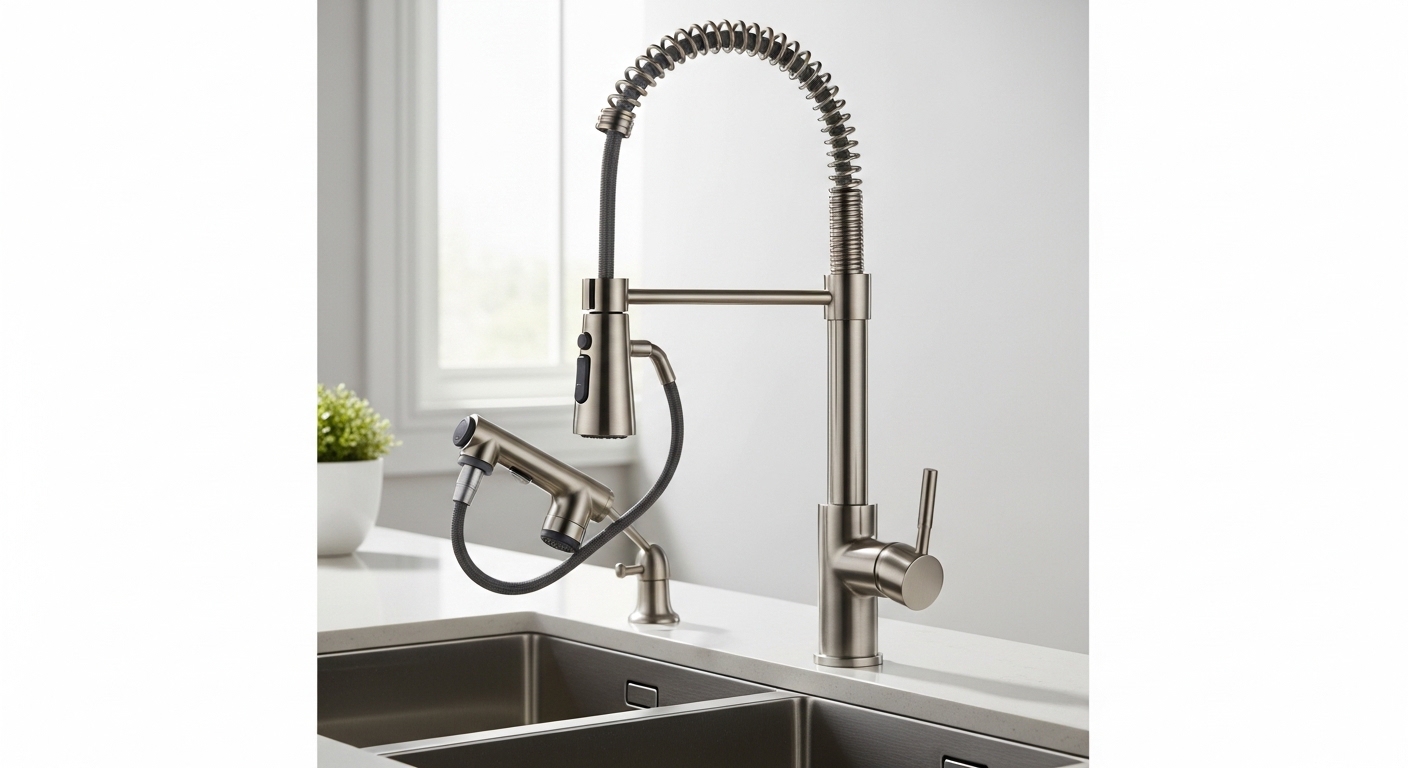
Choosing a bidet kitchen faucet is a different decision than picking a standard pull-down or pull-out kitchen tap. You are essentially buying two fixtures in one body: a primary aerator stream for everyday rinsing and a high-velocity sprayer engineered to push debris, food particles, and stubborn residue without splashing back. This guide breaks down what actually matters — spray-pattern engineering, hose length, valve construction, finish durability, and installation reality — so you walk away with a fixture that earns its place at the most-used station in your home.
What Is a Bidet Kitchen Faucet, Exactly?
The phrase “bidet kitchen faucet” gets used a few different ways online, and shoppers deserve a straight answer before they checkout. In the adeaga product line — and in most reputable US plumbing catalogs — a bidet kitchen faucet refers to a kitchen-mounted fixture whose pull-down or side sprayer can deliver bidet-grade pressure (typically 60–80 PSI at the head) through a focused jet stream. It is not a hygienic toilet sprayer relocated to the sink. It is a purpose-built kitchen fixture with a sprayer pattern strong enough to rinse heavy roasting pans, clean leafy greens, and double for pet bathing in the basin.
The defining features are a true two-mode (or three-mode) sprayer head, a braided stainless hose of at least 60 inches, a counterweight or magnetic dock that keeps the wand from drooping, and a diverter that switches cleanly between aerated stream and jet spray without dribbling. Anything less and you have a marketing label, not a working hybrid.
How It Differs from a Standard Pull-Down
A standard pull-down kitchen faucet typically maxes out at 1.8 GPM with a single aerated stream and a soft “shower” mode. A bidet-style upgrade adds a tighter jet pattern — often called “Power Clean,” “Boost,” or “Jet” — that concentrates the flow into 12–24 individual nozzle channels. That jet is what lets you blast dried oatmeal off a bowl without scrubbing, or rinse a cast-iron skillet in seconds.
Why Homeowners Are Upgrading to a Bidet Kitchen Faucet in 2026
The kitchen sink is the busiest plumbing fixture in a typical American home — more uses per day than the toilet, shower, or bathroom faucet combined. As cooking-from-scratch and meal-prep habits rebounded over the past few years, single-bowl deep sinks took over the remodel market, and those wide basins exposed how weak most legacy faucets actually are. A traditional aerated tap simply cannot clean a 16-inch-wide bowl efficiently. That is the gap a properly engineered bidet kitchen faucet fills.
Adeaga’s customer research across 2025 also flagged three rising use cases driving demand: rinsing reusable produce bags, cleaning silicone bakeware (which loves to trap batter), and bathing small dogs. All three reward a stronger, more directional spray than a typical kitchen faucet can produce.
Key Specs to Compare Before You Buy
Before adding a bidet kitchen faucet to your cart, map your sink and water situation against the spec sheet. The five numbers that matter most are flow rate, spout height, spout reach, hose length, and inlet supply pressure compatibility. Skip any of these and you risk a fixture that looks beautiful but underperforms.
- Flow rate: 1.5–1.8 GPM is the federal sweet spot. Lower than 1.5 and the jet feels weak; higher than 1.8 is not legal for new installs in California, Colorado, Washington, or any WaterSense-required jurisdiction.
- Spout height: 8–10 inches for a low-profile look, 14–18 inches for high-arc gooseneck installations that clear stockpots.
- Spout reach: Should land the water stream within the center third of your sink basin — not at the front lip, not at the back wall.
- Hose length: 60 inches minimum, 68–72 inches preferred for deep apron-front sinks.
- Cartridge: Ceramic disc, ideally rated for 500,000 cycles or more.
- Body material: Solid brass beats zinc alloy every time — heavier, more corrosion-resistant, longer-lived.
- Certifications: NSF/ANSI 61 (lead-safe waterway), NSF/ANSI 372 (low-lead compliance), and a CALGreen or WaterSense label where applicable.
Single-Hole vs. Three-Hole Deck Configurations
Most modern bidet kitchen faucets are single-hole installations with an optional deck plate (escutcheon) to cover an existing three-hole sink cutout. If your current sink has separate holes for a soap dispenser or side sprayer, you can either repurpose those holes for accessories or hide them with the included escutcheon. The same general installation logic that applies to a three-hole widespread bathroom faucet applies here: confirm hole-center spacing before ordering.
Comparison Table: Bidet Kitchen Faucet Types Adeaga Recommends
| Type | Best For | Typical Flow (GPM) | Hose Length | Price Range (USD) | Install Difficulty |
|---|---|---|---|---|---|
| Pull-Down High-Arc Gooseneck | Deep single-bowl sinks, busy home cooks | 1.8 | 60–68 in | $180–$420 | Easy (DIY-friendly) |
| Pull-Out Low-Profile | Sinks under low windows or upper cabinets | 1.5–1.75 | 68–72 in | $160–$340 | Easy |
| Commercial-Style Spring Coil | Heavy daily use, restaurant aesthetic | 1.8 | Coil + 24 in extension | $260–$650 | Moderate |
| Bridge Faucet with Side Bidet Sprayer | Farmhouse and transitional kitchens | 1.5 | 48–60 in (side hose) | $320–$780 | Moderate to Difficult |
| Touchless Smart Bidet Kitchen Faucet | Hygiene-focused households, accessibility needs | 1.5–1.75 | 60 in | $340–$720 | Moderate (requires battery or hardwire) |
Finish Options: What Actually Holds Up Long-Term
Finish is where most shoppers overspend or underspend. The good news: PVD (physical vapor deposition) coating technology has matured so much that the gap between budget and luxury finishes has narrowed considerably. The bad news: many imports still use electroplating that pits within 18 months over a busy kitchen sink.
For a bidet kitchen faucet that sees heavy spray cycles, look for PVD-finished brushed nickel, matte black, or champagne bronze. Chrome is still the most stain-resistant for hard-water households but shows water spots more readily. Polished brass and oil-rubbed bronze deliver visual warmth but require more frequent wiping. Our merchandising team has tracked finish complaints for years, and PVD failure is now under 2% across the adeaga catalog — a number we publish in our annual quality report.
Hard Water Considerations
If your water hardness exceeds 7 grains per gallon, prioritize a sprayer head with silicone “TouchClean” nubs. Those flexible rubber nozzles let you wipe mineral buildup off with a fingertip instead of soaking the head in vinegar. It is a small detail that adds years of usable life to the jet pattern.
Installation: What to Expect Under the Sink
A bidet kitchen faucet installs almost identically to a standard pull-down. You will need basin wrench, an adjustable wrench, plumber’s tape, a flashlight, and 30–60 minutes of patience. If you are replacing an existing faucet, shut the angle stops, disconnect the supply lines, loosen the mounting nut from below, lift the old fixture out, and reverse the steps for the new one.
- Shut off both hot and cold angle stops under the sink.
- Open the existing faucet to relieve pressure.
- Disconnect supply lines with an adjustable wrench, catching residual water in a small bowl.
- Loosen the mounting nut and remove the old faucet from above.
- Clean the deck surface of any old plumber’s putty or silicone.
- Feed the new faucet’s supply lines and quick-connect hose down through the deck hole.
- Tighten the mounting hardware from below, keeping the faucet centered.
- Connect supply lines hand-tight, then a quarter turn with a wrench — do not overtighten.
- Attach the weighted counterbalance to the pull-down hose at the manufacturer’s recommended location.
- Slowly reopen the angle stops, check for leaks, and run both spray modes for 60 seconds to flush debris.
If you discover corroded shutoffs or a damaged supply line, stop and replace those parts first. The same diagnostic mindset we cover in our free standing tub faucet repair guide applies here — never sweat a new fixture onto a failing supply.
When to Call a Plumber
Call a licensed plumber if your supply lines are galvanized steel, if your shutoff valves are seized, if you have a copper bridge configuration with sweat-soldered joints, or if you are converting a three-hole sink to single-hole and need to upgrade the deck or sink itself. The fixture is the easy part; the plumbing behind it is where DIY projects go sideways.
Common Problems and How to Avoid Them
A bidet kitchen faucet has more moving parts than a basic tap, which means more potential failure points if you buy on price alone. Here are the issues we see most often in customer service tickets.
- Diverter dribble: Cheap diverters leak from the aerator when the sprayer is engaged. Solution: choose a fixture with a ceramic diverter rated for 200,000 cycles or more.
- Hose retraction failure: The weighted dock loses friction over time. Magnetic dock systems hold up dramatically better.
- Handle loosening: Single-lever handles loosen with daily use. If you’ve ever wrestled with this on a different brand, our guide to tightening loose faucet handles walks through the universal fix.
- Low spray pressure: Usually a clogged inlet screen or a hose kinked behind the supply lines.
- Squealing at the diverter: Air trapped during install — run both modes for two minutes to clear.
- Plumbing layout conflicts: Stub-outs that crowd the supply hose are a common surprise. The connector geometry we explain in our widespread faucet tee guide illustrates how undersink T-fittings affect clearance, which is helpful background even for a single-hole kitchen install.
Standards, Testing, and Warranty: What Adeaga Tests For
Every faucet we ship goes through cycle testing on independent rigs before it is approved for the catalog. Cartridges are pressure-cycled to 500,000 actuations, finishes are subjected to ASTM B117 salt-spray testing for 200+ hours, and waterways are certified to NSF/ANSI 61 and 372 for lead-safe contact surfaces. Our bidet kitchen faucets carry a limited lifetime warranty on the body and cartridge, and a 5-year warranty on the PVD finish — backed by a US-based support team that ships replacement parts free for the first year.
We also publish third-party flow-rate verification reports for any fixture marketed at 1.5 GPM or lower, because those numbers matter for WaterSense compliance and for utility rebates in cities like Los Angeles, Phoenix, Denver, and Austin. If a model does not have the paperwork, we do not list the rebate.
Matching Your Bidet Kitchen Faucet to Your Sink and Counter
The fixture-to-sink relationship is more important than the fixture-to-cabinet relationship. A 16-inch high-arc gooseneck looks dramatic on a deep apron-front sink but can splash badly on a shallow 6-inch bowl. A low-profile pull-out is the right call under a window where vertical clearance is tight. And bridge-style bidet kitchen faucets — popular in farmhouse and transitional kitchens — need a counter deep enough to accommodate the 8-inch center spread plus the side sprayer hole.
Measure twice. Confirm your countertop’s distance from the back wall, the available vertical clearance from deck to upper cabinet, and the position of any backsplash tile that might interfere with handle rotation.
Smart and Touchless Bidet Kitchen Faucets
Touchless models add a hygiene layer that matters in any household where you handle raw meat, work with sticky dough, or simply hate cleaning fingerprints off the handle. Most operate on four AA batteries (lasting 12–24 months) or an optional AC adapter. Pay attention to sensor placement — a single front-mounted sensor is fine for casual use, but dual sensors (front and side) reduce accidental activations when reaching into the sink.
Smart models add app pairing, voice control via Alexa or Google Home, and precise fill modes (e.g., “fill 2 cups of water”). They are not necessary for everyone, but they are useful for accessibility-focused households, for cooks who batch-fill pots, and for anyone willing to pay for measurable repeatability.
FAQ
Is a bidet kitchen faucet the same as a hygienic toilet sprayer?
No. A bidet kitchen faucet is a kitchen-mounted fixture designed for dish rinsing, produce cleaning, and high-pressure sink tasks. A hygienic toilet sprayer (sometimes called a “shattaf”) is a separate fixture mounted near the toilet for personal hygiene. The two share the word “bidet” only because of the directed-spray concept; the plumbing connections, mounting hardware, and flow rates are completely different.
What flow rate should I look for?
1.5 to 1.8 GPM at 60 PSI is the practical sweet spot. WaterSense and California Title 20 cap kitchen faucets at 1.8 GPM, with a temporary 2.2 GPM “boost” allowance for filling pots — but most modern bidet-style heads concentrate the lower flow into a stronger spray rather than relying on raw volume.
Can I install a bidet kitchen faucet myself?
Yes, in most homes. If your shutoff valves work, your supply lines are flexible braided stainless, and your sink deck has a standard 1-3/8 inch hole, this is a 30–60 minute DIY project. Replace any corroded shutoffs first, and avoid PEX-to-faucet direct connections — always use a braided supply line for vibration resistance.
How long does a quality bidet kitchen faucet last?
A solid-brass body with a ceramic disc cartridge and PVD finish should deliver 15–25 years of daily use. The most common replacement-driving failure is not the body but the diverter or the sprayer head, both of which are user-replaceable on adeaga models.
Do I need a special water line or pressure booster?
No. A bidet kitchen faucet works with standard 1/2-inch household supply at 40–80 PSI. If your home pressure runs below 40 PSI, the jet mode will feel weak — but that is true of every spray fixture, not just bidet-style models. A pressure-reducing valve (PRV) check by a plumber is a good idea if you suspect low supply pressure.
Will the finish stain from hard water?
Hard water leaves visible mineral spots on every faucet finish; the question is how easily they wipe away. PVD-coated brushed nickel and matte black tend to mask spots best. Chrome shows them most but cleans up with a microfiber and white vinegar in seconds. A whole-house softener eliminates the issue entirely.
What is the difference between pull-down and pull-out in a bidet kitchen faucet?
Pull-down faucets have a tall arc and the spray head pulls down into the sink. Pull-out faucets have a lower profile and the spray head pulls out horizontally toward you. Pull-down is better for deep sinks and large cookware; pull-out is better for low-clearance installations and for filling containers off to the side of the sink.
About the Author
Written by the adeaga product editorial team. Our writers work alongside our merchandising and engineering staff, who collectively bring over 40 years of plumbing-fixture experience across residential and light commercial installations. Every recommendation in this guide is informed by our internal testing lab in Ohio and validated against current NSF, ASME, and WaterSense standards. Adeaga is a US-focused faucet and bathroom-fixture brand serving customers from our adeaga.net storefront, with a 30-day return policy and limited lifetime warranty on every kitchen and bath faucet we sell.