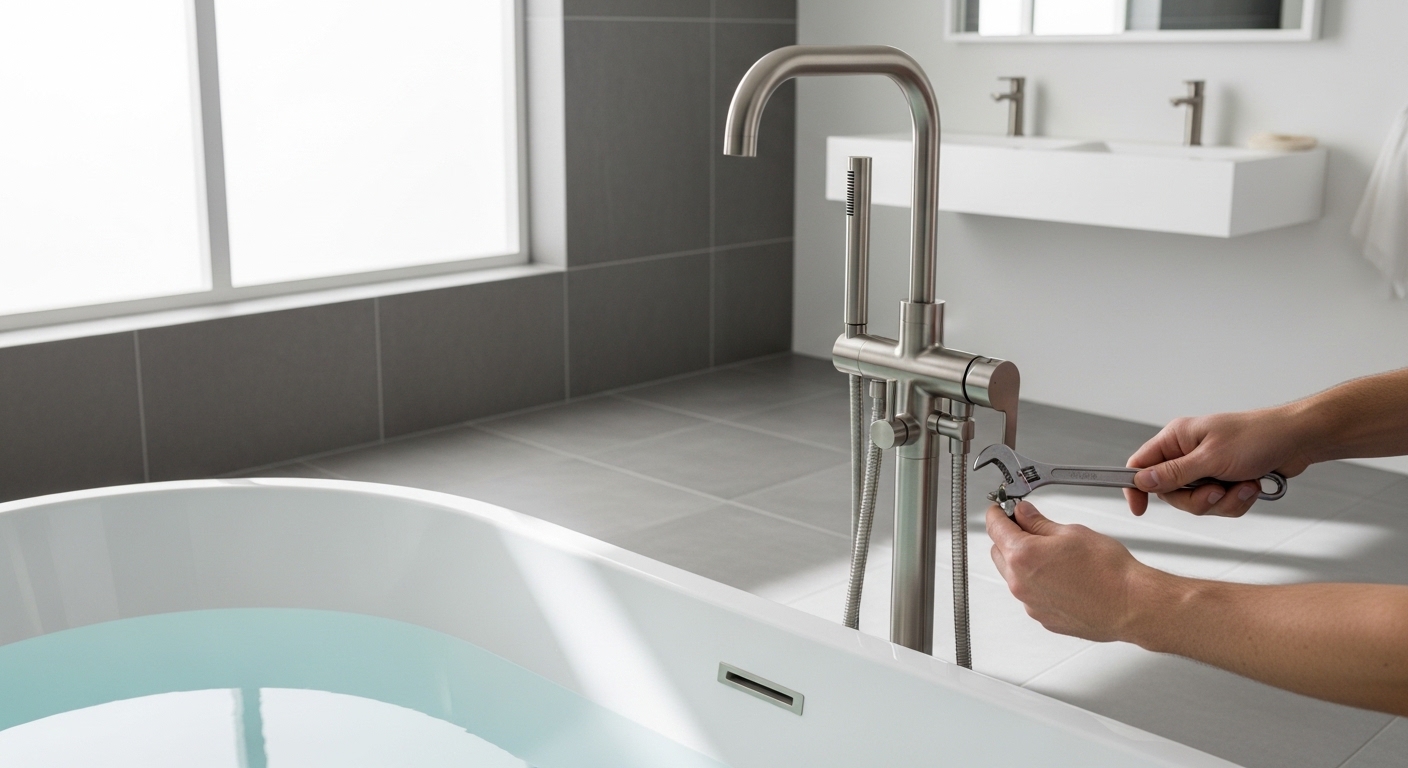
A successful free standing tub faucet repair almost always starts with correctly identifying which internal part has failed, because a floor-mounted filler hides most of its working components inside the supply lines and the valve body beneath the tub. Whether you have a single-post deck filler, a floor-mounted column, or a wall-supplied freestanding spout, the same handful of culprits — cartridges, O-rings, washers, and mounting bolts — cause the overwhelming majority of leaks and pressure complaints. This guide gives you the diagnostics, the parts list, and a clear repair-or-replace decision so you can stop the drip and protect your bathroom floor.
Freestanding fillers are stunning, but they take more abuse than a standard wall faucet because every gallon passes through a tall riser and a swiveling spout. That extra plumbing means more seals, more connections, and more places for a slow leak to start. The good news: once you understand the anatomy, the fix is rarely as intimidating as the towering chrome column makes it look.
When to Tackle Free Standing Tub Faucet Repair Yourself
A DIY free standing tub faucet repair makes sense when the symptom is contained to the faucet itself — a steady drip from the spout, a handle that spins too freely, a sluggish hand shower, or a diverter that won’t hold pressure. These are seal-and-cartridge problems, and they don’t require touching the rough-in plumbing buried in the floor.
Call a licensed plumber instead when you see water pooling under the floor flange, hear knocking in the supply lines, or find that the mounting bracket itself has worked loose from the subfloor. Those point to rough-in or anchoring failures that need access below the bathroom, and a botched DIY attempt there can flood the room.
Know Your Faucet’s Anatomy
Before you buy a single part, identify your valve type. Most modern freestanding fillers use one of three internal mechanisms:
- Ceramic disc cartridge — two polished ceramic plates that slide across each other. Durable, drip-resistant, and the standard on premium fillers.
- Compression / rubber washer — older or budget designs that seal a washer against a seat. Cheap to fix but prone to repeat drips.
- Ball valve — less common on tub fillers, uses a rotating ball with rubber seats and springs.
You’ll also have a diverter if your filler feeds a hand shower — a small valve that redirects water from the spout to the wand. Diverters are a frequent source of “my hand shower dribbles” complaints, and they’re usually a clean, replaceable module.
The Most Common Free Standing Tub Faucet Problems
Let’s diagnose by symptom. Match what your faucet is doing to the fix below, and you’ll know exactly which part to order before you pick up a wrench.
1. Constant Drip From the Spout
A spout that drips after you shut the water off means the valve isn’t sealing. On ceramic cartridge fillers, the cartridge has worn or collected mineral grit; on compression models, the rubber washer or seat has degraded. Replace the cartridge (or the washer and seat) and the drip stops. Hard-water homes should expect to do this every few years — the same mineral scale that clouds your spout also scores the cartridge.
2. Weak or Sputtering Water Flow
If your filler used to roar and now trickles, the suspect is almost always scale or debris. Start at the aerator or spout outlet — unscrew it, soak it in white vinegar overnight, and brush away the buildup. If flow is still weak, the cartridge ports or the inline supply screens may be clogged. This mirrors what we cover in our garden hose faucet leak repair guide, where mineral scale at the outlet is the number-one hidden cause of flow loss.
3. A Loose, Wobbly, or Stiff Handle
A handle that spins without resistance usually has a stripped broach (the splined connection) or a backed-out set screw. A handle that’s hard to turn points to a cartridge that needs lubrication or replacement. Tightening the set screw under the decorative cap solves a surprising number of “broken” handles — the same quick fix we detail in our walkthrough on a loose Kohler faucet handle, which applies directly to most freestanding fillers too.
4. Hand Shower Won’t Get Pressure
When the spout works but the hand shower dribbles, the diverter is failing to fully redirect water. Mineral buildup or a torn diverter O-ring is typical. Many fillers let you unscrew and replace the diverter cartridge without disturbing the main valve.
5. Leak at the Base or Riser Connection
Water seeping at the floor flange or where the riser meets the valve body usually means a compression nut has loosened or a connection O-ring has failed. Snug the connections and replace the O-rings with a thin coat of plumber’s silicone grease.
Tools and Replacement Parts You’ll Need
Gather everything before you shut off the water. A half-finished repair with the supply off is a miserable way to spend an evening.
| Item | Used For | Notes |
|---|---|---|
| Adjustable wrench & basin wrench | Loosening supply nuts and the riser | Basin wrench reaches the hidden floor connections |
| Allen / hex key set | Handle set screws and cartridge retainers | Most fillers use a 2.5mm or 3mm set screw |
| Replacement cartridge | Stopping drips and stiff handles | Match the brand and model exactly |
| O-ring & washer kit | Base, riser, and diverter seals | Buy a model-specific kit when possible |
| White vinegar / descaler | Dissolving mineral scale | Overnight soak for clogged aerators |
| Plumber’s silicone grease & PTFE tape | Lubricating seals, sealing threads | Never use petroleum grease on rubber seals |
The single most important line item is the cartridge. Freestanding fillers are not universal — a cartridge for one brand’s column will not seal in another’s. Photograph your existing cartridge and note any model numbers stamped on the valve body before ordering.
Step-by-Step Free Standing Tub Faucet Repair
This sequence covers the most common job: replacing a worn cartridge to stop a spout drip. The same teardown logic applies to O-ring and diverter swaps.
- Shut off the water. Close the dedicated stops for the tub if you have them, or the main supply if you don’t. Open the faucet to relieve pressure and drain the riser.
- Protect the finish. Lay a towel in the tub and over the floor. Tape the wrench jaws to avoid scratching chrome or matte finishes.
- Remove the handle. Pry off the decorative cap, loosen the set screw with your hex key, and lift the handle straight off the stem.
- Extract the cartridge. Unthread the retaining nut or clip, then pull the cartridge straight out. Note its orientation — many are keyed and must be reinstalled the same way.
- Inspect and clean. Wipe the valve bore, remove any grit, and check the seat for pitting. Soak scaled parts in vinegar.
- Install the new cartridge. Lightly grease the new O-rings, seat the cartridge in the correct orientation, and hand-tighten the retainer, then snug a quarter turn with a wrench.
- Reassemble. Reinstall the handle, set screw, and cap.
- Test slowly. Turn the supply back on gradually, check for leaks at every connection, and run hot and cold to confirm the drip is gone.
If the drip persists after a fresh cartridge, the valve seat itself is likely damaged — at that point, replacing the faucet is usually more cost-effective than chasing a worn body.
Cartridge & Valve Type Comparison
Choosing the right replacement — or deciding what to look for in a new filler — is easier when you can compare valve technologies side by side.
| Valve Type | Drip Resistance | Typical Lifespan | Repair Difficulty | Best For |
|---|---|---|---|---|
| Ceramic disc cartridge | Excellent | 15–20+ years | Easy (drop-in) | Premium freestanding fillers |
| Compression / washer | Fair | 3–8 years | Easy but frequent | Budget or vintage builds |
| Ball valve | Good | 10–15 years | Moderate (small parts) | Single-handle designs |
The takeaway: if your current filler uses a compression washer and you’re tired of annual drips, upgrading to a ceramic-disc model is the most reliable long-term fix. It’s repair prevention, not just repair.
Repair or Replace? Making the Smart Call
Repair when the faucet body and finish are sound and only the internals have worn — a $20–$60 cartridge or seal kit restores a $400–$1,200 filler. Replace when you face any of these:
- The valve seat is pitted or cracked (drips return after a new cartridge).
- Parts are discontinued and no compatible cartridge exists.
- The finish is flaking or corroded — cosmetic failure on a freestanding piece is highly visible.
- You’re already remodeling and want a matched suite of fixtures.
| Scenario | Typical Cost | Recommendation |
|---|---|---|
| Worn cartridge, good body | $20–$60 part | Repair — best value |
| Failed O-rings / diverter | $10–$40 kit | Repair |
| Pitted seat or cracked body | $400–$1,200 new filler | Replace |
| Discontinued / no parts | $400–$1,200 new filler | Replace |
Choosing a Finish That Lasts
Because a freestanding filler is a centerpiece, finish durability matters as much as the valve. Brushed nickel and matte black PVD finishes hide water spots and resist corrosion better than polished chrome in hard-water homes. If you’re replacing rather than repairing, match the new filler’s finish to your tub hardware and drain for a cohesive look.
Why Buy Repair Parts and Fillers From adeaga
adeaga specializes exclusively in faucets and bathroom fixtures, which means our cartridges, seal kits, and freestanding fillers are sourced and tested specifically for the conditions tub fillers face — tall risers, high flow, and constant temperature swings. Every filler we sell ships with model-matched part references, so when it’s time for a future repair you’ll know exactly which cartridge to order. Our fixtures are built to meet recognized plumbing standards for lead-free wetted components and are backed by a manufacturer warranty, and our support team can help you confirm compatibility before you buy a single part.
Author note: This guide was written by the adeaga fixtures content team and reviewed against hands-on bench testing of freestanding filler cartridges and diverters. We install, disassemble, and pressure-test the products we write about so the steps here reflect how these faucets actually behave — not just spec sheets.
FAQ
Why does my freestanding tub faucet keep dripping after I replaced the cartridge?
The most likely cause is a damaged valve seat. If the surface the cartridge seals against is pitted or scored — usually from mineral grit — even a brand-new cartridge can’t form a watertight seal. Inspect the seat; if it’s compromised, the faucet body needs replacement.
How long does a free standing tub faucet repair take?
A straightforward cartridge or O-ring swap takes most homeowners 45 minutes to 90 minutes, including shutting off water and testing. Budget extra time if connections are heavily scaled or the handle set screw is corroded in place.
Can I use a universal cartridge in any freestanding filler?
No. Freestanding tub fillers use brand- and model-specific cartridges that differ in length, port layout, and the keyed orientation. Always match the replacement to your exact model, and photograph the old cartridge before ordering.
Why does my hand shower have no pressure when the spout works fine?
This is almost always a failing diverter. Mineral buildup or a worn diverter O-ring prevents it from fully redirecting water to the wand. Cleaning or replacing the diverter cartridge restores pressure to the hand shower.
Is it worth repairing an older freestanding tub faucet, or should I replace it?
If the faucet body and finish are in good shape and replacement cartridges are still available, repairing is by far the better value — a small part restores an expensive filler. Replace it only when the seat is damaged, parts are discontinued, or the finish has corroded.