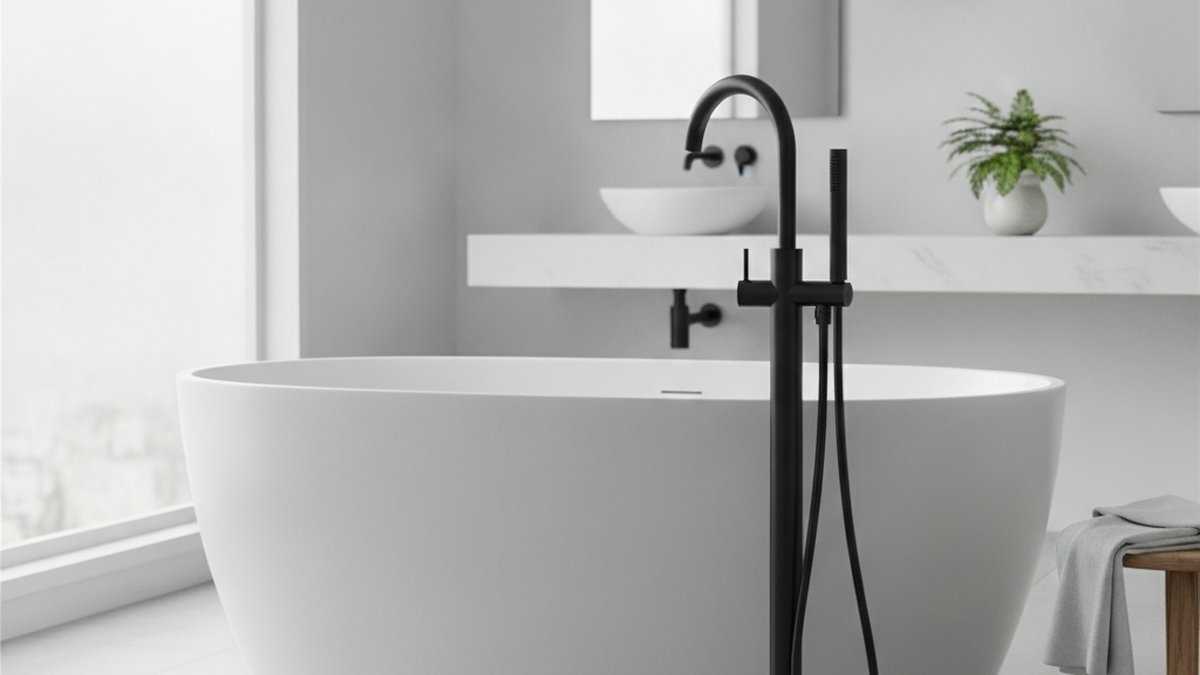
If you’ve been searching for a freestanding tub faucet delta setup, you’ve probably noticed the listings throw a wall of model numbers and finish codes at you without ever explaining what actually matters. This guide fixes that. We’ll walk through how to pick the right Delta floor-mount tub filler for your specific soaking tub, how to read the model number so you don’t buy the wrong rough-in, what the finishes really cost you in upkeep, and — because we’re a repair site first — exactly how to keep one working for a decade instead of calling a plumber the first time it drips.
Quick definition before we go further: a freestanding tub filler is a tall faucet that rises straight out of your bathroom floor and arches over the rim of a standalone tub. It’s different from a deck-mounted or wall-mounted filler because the water, the valve, and sometimes the handshower all come up through a single floor penetration. That one detail — floor-mounted plumbing — is the thing most people get wrong when shopping.
What exactly is a Delta freestanding tub faucet, and how is it different from a regular tub spout?
A Delta freestanding tub faucet is a floor-standing tub filler with its own valve body, designed to fill a soaking tub that isn’t against a wall. The key difference from a regular tub spout is that it’s a complete faucet — temperature control, volume, diverter, and usually a handshower — all in one column, fed by supply lines that come up through the floor rather than out of a wall.
A plain tub spout (the kind covered in our guide to whether a tub spout from Ferguson is worth it) is just the pour point — it relies on a separate valve in the wall. A freestanding filler bundles everything into the column you see. That’s why it costs more and why the plumbing underneath matters so much: there’s a rough-in valve buried in your floor that you’ll never see again once the tub goes in, so it has to be right the first time.
Mechanically, most Delta freestanding fillers use a cartridge-based mixing valve. The handle turns a cartridge that blends hot and cold; a diverter sends water either to the floor-mount spout or up to the handshower. When one of these faucets “goes bad,” it’s almost never the whole faucet — it’s the cartridge, the diverter, or an O-ring. Hold onto that fact; it saves you hundreds of dollars down the line.
Which Delta freestanding tub faucet should I buy for a deep soaking tub under $600?
For a deep soaking tub on a mid-range budget, prioritize flow rate and spout reach over styling, and make sure the model includes the floor-mount rough-in valve in the box or clearly lists which one it needs. A deep tub holds a lot of water, so a filler that only pushes 5–6 gallons per minute will test your patience every single bath.
Here’s the honest decision framework we give readers, in order of what actually matters:
- Flow rate first. Freestanding fillers are often exempt from the 1.8–2.2 GPM faucet limits because they’re filling a vessel, not a sink. Look for models rated around 6–7+ GPM at 60 psi if you hate waiting. A 70-gallon tub at 4 GPM is an 18-minute fill; at 7 GPM it’s about 10.
- Overflow-to-spout height. The spout outlet needs to clear your tub’s rim and overflow comfortably. Measure from your finished floor to the top of the tub, and compare against the spec sheet’s spout height.
- Handshower or not. If you rinse hair, bathe kids, or clean the tub, the handshower-on-a-column version is worth it. If it’s a pure soaking ritual, skip it and save money and complexity.
- Finish you’ll actually maintain. More on this below — it’s a bigger deal than the showroom makes it sound.
- Rough-in compatibility. Confirm the model’s required floor rough-in (Delta freestanding fillers commonly specify an R4700-series rough-in valve). Always verify the exact part on the spec sheet rather than assuming.
One warning the listings won’t give you: buy the faucet and its rough-in as a matched set from the same spec sheet. Mixing a trim kit with the wrong rough-in is the single most common and most expensive mistake with floor-mount fillers, because the fix means opening the floor.
What finish should I pick — and which Delta tub filler finish is easiest to keep clean?
For the lowest maintenance, pick a brushed finish (brushed nickel, or Delta’s spotshield-style brushed black/bronze); for the lowest price and timeless look, pick chrome; avoid polished brass if you hate polishing. Brushed finishes hide water spots and fingerprints far better than polished ones, which is the real daily difference.
Finish is where “commercial” shopping meets long-term reality. A polished chrome filler looks spotless in the showroom and shows every single water droplet in your actual hard-water bathroom. We dug into exactly this trade-off in our piece on whether a chrome finish on a faucet is still worth it — the short version is that chrome is durable and cheap but high-maintenance for spotting. Here’s how the common Delta freestanding finishes compare in plain terms:
| Finish | Look | Water-spot visibility | Upkeep | Best for |
|---|---|---|---|---|
| Chrome (polished) | Bright, classic, reflective | High — shows every drop | Wipe after use; cheap to buy | Budget builds, traditional baths |
| Brushed Nickel | Warm, soft satin | Low — hides spots well | Easy; very forgiving | Busy family bathrooms |
| Matte Black | Bold, modern statement | Medium — hides water, shows dust/soap film | Easy if you use gentle cleaners only | Contemporary soaking tubs |
| Champagne Bronze / Brushed Gold | Warm, high-end | Low | Easy; avoid abrasives | Design-forward spaces |
| Polished Brass | Shiny, vintage-gold | High | High — tarnish/polish | Period-correct restorations |
Whatever you choose, never clean a brushed or matte freestanding filler with an abrasive pad or an acidic lime-remover left to sit — those are the two things that permanently dull a PVD or powder-coat finish. Warm water, a drop of dish soap, and a microfiber cloth is genuinely all the finish wants.
How do I read a Delta freestanding tub faucet model number so I buy the right part?
Read it from the trim kit box or the Delta spec sheet, not the product-page title. The model number tells you the faucet family, the configuration (with or without handshower), and the finish suffix — and crucially, the spec sheet lists the exact rough-in valve the trim needs.
Finding and recording the right numbers before you buy — and keeping them afterward — is what makes repairs painless later. Here’s the practical order to do it in:
- Find the base model number. On freestanding Delta trim it’s usually a “T”-prefixed trim number (trim-only) paired with a separate rough-in. The spec sheet shows both together.
- Note the finish suffix. Delta finish codes are appended to the model — for example a suffix for matte black vs. chrome. Two faucets that look like different products are often the same faucet in two finishes.
- Record the rough-in valve number. This is the buried part. Write it on a label inside your vanity or snap a photo. The floor-mount rough-in is commonly an R4700-series valve; confirm the exact one on your spec sheet.
- Identify the cartridge. Delta’s wall/tub valves often use a MultiChoice/DIAMOND-seal cartridge; floor-mount fillers vary. When you register the product or keep the spec sheet, you’ll know the exact service cartridge later.
Why obsess over this? Because the day it drips, the difference between a $20 cartridge you order in two minutes and a $400 service call is whether you wrote down these numbers. If you ever misplace them, Delta’s parts lookup by model number (entered on their own site) will map the exploded diagram for you — but you need the model number to start, which is why recording it now pays off.
Can I install and maintain a Delta freestanding tub filler myself?
You can almost always maintain one yourself, and you can sometimes install the trim yourself — but setting the floor rough-in is a plumber-level job if the floor isn’t already open. The trim (the visible column and handles) attaches to a rough-in that must be positioned and plumbed before the finished floor goes down.
Be honest with yourself about which stage you’re at:
- New build or full remodel, floor open: This is the window to set the R4700-style rough-in to the exact height and centerline the spec sheet calls for. If you’re not confident soldering or crimping supply lines under load, hand this stage to a plumber. It’s the one part you cannot easily redo.
- Rough-in already set, installing trim: Very DIY-friendly. You’re mounting the column, connecting the quick-connects or threaded unions, and setting handles. Hand-tight plus the spec’d quarter-turns, then test for leaks.
- Faucet installed, something’s wrong: This is squarely DIY territory — cartridge swaps, O-ring replacement, diverter cleaning. If you’ve ever done a water faucet O-ring replacement, you already have the skills.
Because a freestanding filler is really the visible end of a larger system, it helps to understand the plumbing behind it. Our overview of what shower system plumbing actually involves walks through valves, supply lines, and pressure-balancing in the same plain-language way, and most of it applies to tub fillers too. And if you’re still deciding between a filler-plus-drain combo versus buying pieces separately, our companion guide on what freestanding tub faucet and drain you actually need covers the drain side in detail.
How do I fix a Delta freestanding tub faucet that drips or loses pressure?
A drip after the handle is off is almost always a worn cartridge; weak or uneven flow is usually mineral buildup in the aerator, diverter, or handshower — and both are DIY repairs with basic tools. You rarely need to replace a freestanding filler; you replace the one part that failed.
Here’s how the symptoms map to fixes:
- Dripping from the spout when closed: The mixing cartridge seals are worn. Shut off the supplies, pull the handle and bonnet, extract the cartridge, and replace it with the exact service cartridge for your model. Note orientation before you pull it.
- Handshower weak or spitting: Mineral scale in the handshower face or the diverter. Soak the handshower face in warm white vinegar for an hour and clear the diverter screen. (Our method for descaling is the same approach used for a faucet aerator that doesn’t come off.)
- Overall low flow from a once-fast filler: Debris screen or inline filter clogged — common after any plumbing work that stirs up sediment. Clean the screens at the inlets.
- Handle stiff or grinding: Cartridge needs cleaning or re-greasing with plumber’s silicone grease (never petroleum grease — it swells the O-rings).
On parts: you’ll face the OEM-vs-compatible choice. Genuine Delta cartridges and O-ring kits are often covered under Delta’s lifetime limited warranty on the faucet, which is a real reason to use them for the sealing parts. Compatible aftermarket cartridges exist and can be cheaper, but we tell readers plainly — for the one cartridge that controls your water temperature and your leak, the genuine part is usually worth it, and using a non-OEM part can complicate a warranty claim. For a cosmetic O-ring, aftermarket is fine.
FAQ
Does a Delta freestanding tub faucet come with the rough-in valve, or do I buy it separately?
It depends on the model — some are sold as a complete package and others sell the trim and the rough-in separately. Always check the spec sheet. Freestanding Delta fillers frequently pair a “T”-prefix trim with a separate floor-mount rough-in (commonly in the R4700 series). Confirm the exact rough-in on the spec sheet before ordering so the parts match.
What’s the GPM on a Delta freestanding tub filler, and is it enough for a big soaking tub?
Freestanding tub fillers typically flow much higher than sink faucets — often in the 6–7+ GPM range at 60 psi — because they’re exempt from low-flow sink limits when filling a vessel. For a large soaking tub that’s plenty; it’s roughly a 10-minute fill for a 70-gallon tub. Always check your specific model’s rated flow on the spec sheet, since it varies by valve.
How do I find the model number on a Delta freestanding tub faucet I already own?
Check the original spec sheet or box first. If those are gone, look for a sticker or stamped code on the rough-in valve body, the trim’s mounting hardware, or inside any access panel. If you still can’t find it, Delta’s parts lookup matches an exploded-diagram by model number entered on their official site — and photographing your handle and spout shape helps narrow the family.
Are aftermarket cartridges safe to use in a Delta tub filler?
They can work, but we recommend genuine Delta cartridges for the main mixing valve. The cartridge controls temperature and sealing, genuine parts are often covered under Delta’s lifetime limited faucet warranty, and a non-OEM part can complicate a warranty claim. For non-sealing cosmetic pieces, a quality aftermarket part is usually fine.
Why is my Delta freestanding tub faucet leaking at the base of the column?
A leak at the floor base is usually a loose supply connection or a failed O-ring/gasket at the union, not a cracked faucet. Shut off the supplies, check that the quick-connect or threaded union is fully seated, and replace the O-ring if it’s flattened or nicked. Re-grease with silicone, not petroleum, grease. If water appears only during use and vanishes when off, it’s an internal seal; if it’s constant, it’s a supply connection.
How long should a Delta freestanding tub faucet last?
The faucet body itself should last decades — Delta backs its faucets with a lifetime limited warranty on the original owner for materials and finish. The wear parts (cartridge, O-rings, handshower hose) are consumables you’ll refresh every several years depending on your water hardness. Hard water shortens cartridge life, so periodic descaling meaningfully extends it.
About this guide / author note: This article was written by the adeaga editorial team — independent faucet and shower repair writers who diagnose and document Moen and Delta fixtures hands-on, with a focus on identifying the exact cartridge or part a reader needs and comparing OEM versus compatible replacements honestly. We reference manufacturer spec sheets, published flow-rate and warranty terms, and standard plumbing practice; where we aren’t certain of a specific part number, we tell you how to verify it rather than guessing. adeaga is an independent repair and replacement-parts resource, not a retailer, and we don’t earn anything from which faucet you choose.
adeaga is an independent guide and is not affiliated with Moen or Delta. Brand names are used for identification only.