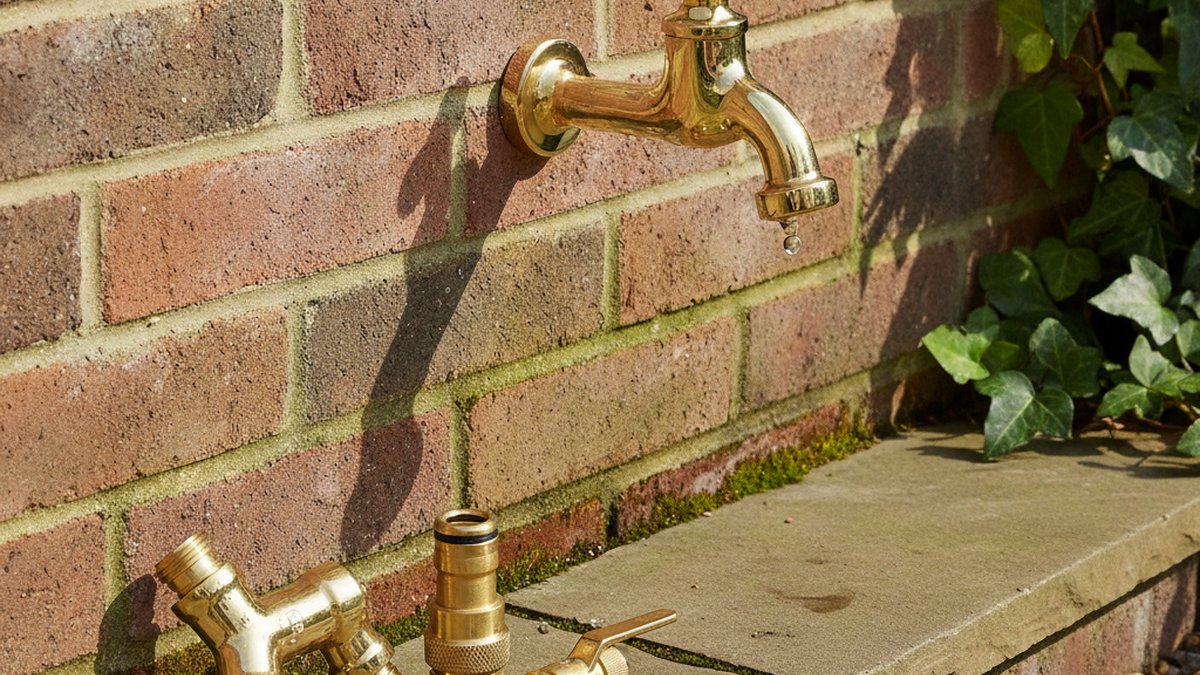
An outdoor faucet attachment is any fitting, adapter, or accessory that screws onto your outdoor spigot (also called a hose bibb or sillcock) to change what it can do — split one tap into two, add a shutoff valve, connect a hose quickly, filter the water, or convert an odd thread size so a standard garden hose fits. The confusing part is that “attachment” covers a dozen different products, and the right one depends entirely on what you’re trying to fix or add. This guide walks through each type, what fits what, and how to buy once instead of three times.
What is an outdoor faucet attachment, and how do I know which one I need?
An outdoor faucet attachment threads onto the spout of your outdoor tap to add a function it didn’t come with. To know which one you need, answer one question first: what problem are you solving? Connecting a hose faster, running two hoses at once, stopping a drip, or making a mismatched thread fit are four different jobs with four different attachments.
Nearly every standard residential outdoor spigot in North America ends in 3/4-inch GHT (garden hose thread), the same thread your garden hose uses. That’s the good news — most attachments are built around this standard, so they’re interchangeable. The trouble starts when your spigot has a different thread (older homes sometimes use 3/4-inch NPT pipe thread, which looks similar but is not compatible), or when the fitting is worn and the hose won’t seal no matter how hard you crank it.
Here are the main categories of outdoor faucet attachment, ranked by how often people actually buy them:
- Quick-connect adapters — a two-piece brass or plastic coupler that lets you push-and-click a hose on instead of screwing it. Best for people who swap hoses, sprayers, or nozzles constantly.
- Hose splitters (Y-valves) — turn one spigot into two (or four) independently controlled outlets. Ideal if you run a soaker hose and a sprinkler at the same time.
- Add-on shutoff valves — a lever valve at the faucet head so you can stop the flow without walking back to the main handle.
- Thread adapters / converters — fix a mismatch, e.g. male-to-male, GHT-to-NPT, or a metric European thread to US GHT.
- Vacuum breakers / anti-siphon attachments — a backflow preventer that stops contaminated hose water from being siphoned back into your drinking supply. Required by many local codes.
- Faucet extenders and swivel elbows — reposition the outlet if your spigot is jammed against a wall or too low to the ground.
- Inline filters and pressure regulators — clean sediment or drop pressure for delicate irrigation.
If you’re not sure what your outdoor tap is even called or how the parts fit together, our explainer on what a faucet quick connector is and which one you actually need covers the connector side of this in more detail and pairs directly with the quick-connect section below.
Brass or plastic — which outdoor faucet attachment actually lasts?
Buy brass for anything that stays outside or takes pressure; use plastic only for cheap, temporary, or indoor-adjacent connections. Brass attachments handle UV, freeze-thaw cycles, and constant tightening without cracking, while plastic threads strip and go brittle — often within a single summer of sun exposure.
That said, “brass” isn’t automatically premium. Look for solid, thick-walled brass rather than a thin brass-plated zinc alloy (sometimes labeled “metal”). Zinc-alloy fittings corrode from the inside and seize onto your spigot within a year or two, which is a nightmare to remove. A quality brass quick-connect set weighs noticeably more in your hand and usually carries a limited lifetime or multi-year warranty.
| Material | Typical price (adapter) | Lifespan outdoors | Best for | Watch out for |
|---|---|---|---|---|
| Solid brass | $8–$25 | 5–15+ years | Permanent spigot fittings, high pressure, freezing climates | Can seize if dissimilar metals aren’t greased |
| Stainless steel | $12–$30 | 10+ years | Coastal/salt air, premium builds | Pricey; overkill for a simple hose bibb |
| Brass-plated zinc | $4–$9 | 1–3 years | Short-term / renters | Corrodes internally, seizes onto threads |
| Reinforced plastic (nylon/ABS) | $3–$8 | 1–2 seasons | Light indoor use, temporary hookups | Threads strip, UV makes it brittle |
How do I connect a garden hose to an outdoor faucet without leaking?
To connect a garden hose leak-free, make sure a rubber washer sits inside the hose coupling, hand-tighten until snug, then add no more than a quarter-turn with pliers. Ninety percent of “leaking hose connection” problems are a missing, flattened, or misplaced washer — not a bad faucet.
Here’s the reliable sequence for installing any threaded outdoor faucet attachment:
- Turn off the spigot fully and release any residual pressure by opening the hose end.
- Check the threads. Wipe the spigot threads clean. If they’re crusted with mineral scale or corrosion, a wire brush helps the attachment seat evenly.
- Confirm the washer. Look inside the female fitting — you should see a flat rubber (or flat-with-mesh) washer. If it’s cracked or missing, replace it. A 10-pack of hose washers costs about $3.
- Add thread seal tape only on tapered/NPT threads, not on the flat-washer GHT connection. GHT seals on the washer, so tape there just makes a mess.
- Hand-tighten, then a quarter-turn. Cranking harder crushes the washer and actually causes leaks rather than stopping them.
- Turn the water on and watch the joint. A slow weep means back off, reseat the washer, and try again.
If water sprays from the handle or stem of the faucet itself rather than the connection, that’s a different repair — usually a worn packing washer or O-ring inside the valve. Our walkthrough on doing a water faucet O-ring replacement yourself covers that exact fix so you’re not chasing a leak with the wrong part.
Why does my hose spin freely on the spigot and won’t tighten?
If the hose or attachment spins without ever biting, the spigot’s external threads are stripped or the whole spout has come loose from the valve body — no attachment will seal onto damaged threads. You either repair the thread with a hose-bibb thread repair kit or replace the spigot.
This is one of the most common outdoor faucet complaints, and it’s worth diagnosing before you keep buying adapters that won’t hold. There’s a difference between a hose that spins (thread problem) and a faucet handle that spins without shutting off the water (valve stem problem). We break down the second scenario in detail in why your outdoor faucet keeps spinning and how to fix it — read that first if turning the handle no longer stops the flow, because in that case an attachment isn’t your fix at all.
For stripped external spigot threads, your options are:
- Thread repair adapter — a fitting with an internal set screw or compression grip that clamps onto the damaged spout. $10–$18 and a genuine 5-minute fix.
- Replace the hose bibb — if the spout wiggles at the base or the threads are gone entirely, swapping the whole bibb (about $12–$40) is more durable.
Do I need a splitter, a shutoff, or a quick-connect for my situation?
Choose a splitter if you run more than one hose, a shutoff valve if walking back to the main handle is annoying, and a quick-connect if you swap tools often — and many people end up stacking all three on one spigot. They’re not mutually exclusive; they thread together.
A typical “power setup” on a single outdoor faucet looks like this, in order from the spigot outward:
- Spigot → vacuum breaker / anti-siphon adapter (if not already built in) for code compliance and safe drinking water.
- → two-way or four-way splitter with individual lever valves.
- → quick-connect male ends on each outlet and on each hose/tool, so everything clicks on and off.
That stack lets you run a drip line to the garden on one valve while keeping a click-on spray nozzle ready on the other. If your indoor kitchen or utility tap has a different thread altogether and you’ve been fighting to get a European or off-brand adapter to fit, the same matching logic applies — our guide to figuring out which faucet adapter you actually need is a good primer on reading thread sizes so you order the right converter the first time.
What thread size is a standard US outdoor faucet?
Standard US outdoor faucets use 3/4-inch GHT (garden hose thread), which measures about 1 1/16 inch across the outside of the male threads. Some older or specialty spigots use 1/2-inch or 3/4-inch NPT pipe thread — if a garden-hose fitting won’t start threading, an NPT-to-GHT adapter is almost always the fix.
How do I stop my outdoor faucet attachment from freezing and cracking in winter?
Before the first hard freeze, disconnect and drain every attachment and hose, then store them indoors — water left inside a splitter or quick-connect expands when frozen and cracks the body, even solid brass. Leaving a hose attached also traps water against the valve and is a leading cause of burst pipes behind the wall.
Your end-of-season routine should be:
- Unscrew all attachments (splitters, timers, quick-connects) and shake them dry.
- Disconnect hoses, drain them, and coil them for storage.
- If you have an interior shutoff for the outdoor line, close it and open the outdoor faucet to drain the pipe.
- For non-frost-proof bibbs, add an insulated faucet cover ($5–$10).
- Store brass and plastic attachments somewhere above freezing — a garage shelf is fine.
Which outdoor faucet attachment should you buy from adeaga?
For 90% of homes, start with a solid-brass quick-connect kit plus a two-way brass splitter with independent shutoffs — that combination covers hose swapping, running two lines, and easy on/off, and it’s the setup we most often recommend. Add a thread-repair adapter only if your spigot threads are already worn, and a vacuum breaker if your bibb doesn’t have anti-siphon built in.
At adeaga, our outdoor faucet attachments are machined from solid, lead-free brass that meets NSF/ANSI 372 low-lead standards for potable-water contact, pressure-tested to well above typical residential supply pressure (most homes run 40–60 psi), and backed by a limited lifetime warranty against manufacturing defects. We chose flat EPDM washers over cheaper rubber because they hold their seal through more freeze-thaw cycles — the exact failure point on bargain attachments.
Author note: This guide was written by the adeaga fixtures team, drawing on years of hands-on faucet and hose-bibb installs and testing. We’ve installed, frozen, thawed, and deliberately over-tightened these attachments to find where they fail so you don’t have to. adeaga designs and sells faucets, shower systems, tub fillers, and connection hardware direct to homeowners at adeaga.net, and every spec above reflects parts we actually stock and stand behind.
FAQ
What is the most common outdoor faucet attachment people buy?
A brass quick-connect adapter set is the single most popular outdoor faucet attachment, because it eliminates the annoyance of screwing and unscrewing a hose every time you switch between a nozzle, a sprinkler, and a bare hose. A basic set runs $8–$18 and installs in under a minute.
Will a garden hose attachment fit any outdoor faucet?
It will fit any standard 3/4-inch GHT spigot, which is the vast majority of US outdoor faucets. It won’t fit an NPT pipe-thread spigot or a European metric thread without a converter — if the fitting won’t start threading after a full turn, stop and check for a thread mismatch rather than forcing it.
Why does my outdoor faucet attachment keep leaking even when tight?
Over-tightening is usually the culprit: cranking down on a garden-hose connection crushes and deforms the rubber washer so it can no longer seal. Replace the washer, hand-tighten plus a quarter-turn, and the leak almost always stops. If water comes from the faucet stem instead of the joint, you need an internal O-ring or packing washer, not a tighter attachment.
Do I need a vacuum breaker on my outdoor faucet?
In many jurisdictions, yes — a vacuum breaker (anti-siphon device) is required by plumbing code to prevent hose water from being drawn back into your drinking supply if pressure drops. Many modern frost-proof bibbs have one built in; if yours doesn’t, a screw-on vacuum breaker attachment costs about $8 and is cheap insurance for water safety.
Can I leave attachments on my outdoor faucet over winter?
No. Remove every attachment and hose before a hard freeze, drain them, and store them indoors. Trapped water freezes, expands, and cracks the fitting body — and a hose left connected can force ice back toward the valve and burst the pipe inside your wall. This five-minute task prevents the most expensive outdoor plumbing failure there is.
What’s the difference between a hose bibb, a spigot, and a sillcock?
They’re largely the same thing — an outdoor water tap that a hose threads onto. “Sillcock” usually refers specifically to the frost-proof style that extends through the wall so the valve sits inside where it stays warm, while “hose bibb” and “spigot” are used more generally. All three take the same 3/4-inch GHT attachments.