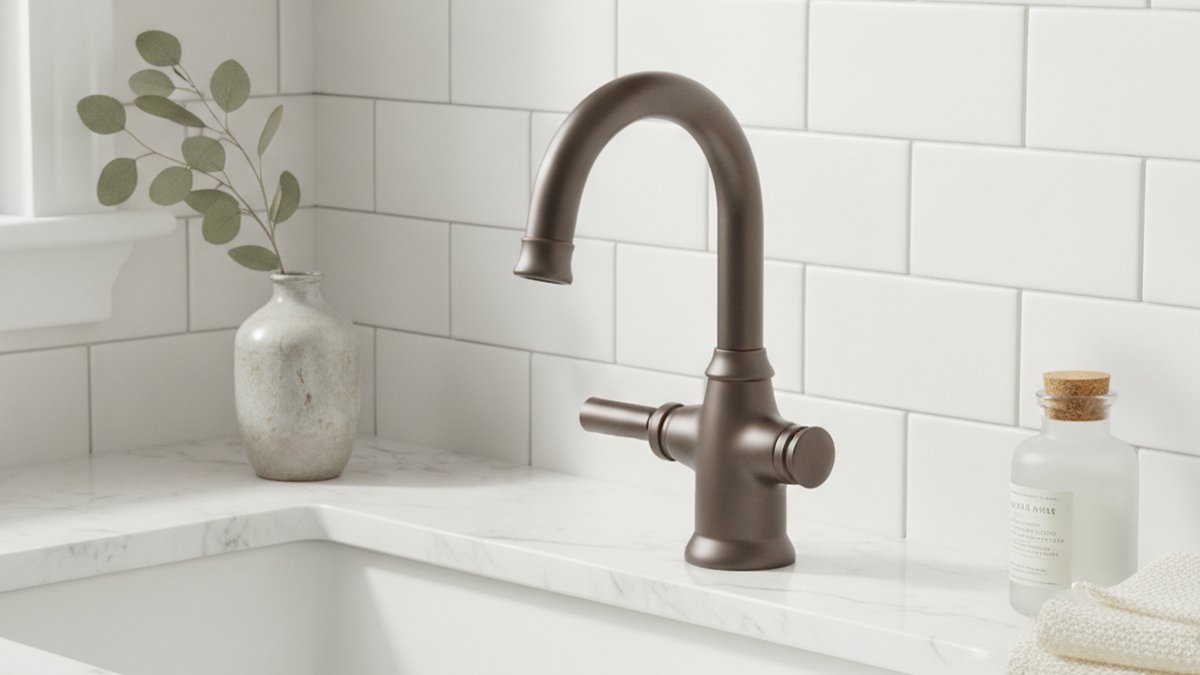
A single hole faucet vintage design gives you the timeless look of an antique or turn-of-the-century tap while fitting a modern one-hole sink or countertop — no widespread three-hole drilling required. It’s the sweet spot for anyone renovating a powder room, restoring an old cottage bathroom, or just tired of the generic chrome lever look. Below, I’ll walk you through who it’s actually for, how to make sure it fits, which finishes age well, what to pay, and the mistakes that get people stuck at install time.
What exactly makes a faucet “vintage single-hole” — and how is it different from widespread?
A vintage single-hole faucet mounts through one hole in your sink or counter and combines the spout and handle(s) into one body, while borrowing classic styling cues from early- and mid-20th-century plumbing. That’s the key distinction: it’s about the number of mounting holes plus the aesthetic, not the era it was actually made.
People mix these terms up constantly, so here’s the plain-English breakdown:
- Single-hole: One deck hole. The whole faucet — spout and handle — comes up through a single opening. Cleanest look, easiest to clean around.
- Centerset: Three holes 4 inches apart, but the faucet sits on one base plate. Common on older builder sinks.
- Widespread: Three separate pieces (spout + two handles) spanning 8–16 inches. This is the classic “vintage” spread look, but it needs three holes.
- Single-hole vintage: The best of both — antique styling (cross handle, telephone-style spout, exposed nut detailing) built onto a modern single-hole body.
So if your sink has one hole and you want that old-world charm, a single-hole vintage model is exactly the category you want. If you have three holes and want the true spread-out apothecary look, you’d look at a widespread instead. Many single-hole vintage faucets also ship with an optional escutcheon (deck plate) so you can cover the extra holes of a three-hole sink and convert it to a one-hole look.
Will a single-hole vintage faucet actually fit my sink?
It fits if your sink or countertop has a standard 1.25–1.5 inch mounting hole and at least the deck depth the faucet calls for — which covers the vast majority of drop-in and undermount bathroom sinks sold in North America. The fit issues that trip people up are almost never the hole diameter; they’re clearance and reach.
Before you buy, measure four things:
- Hole diameter: Standard is 1⅜” (35 mm). Most single-hole faucets fit a 1.25″–1.5″ hole.
- Number of holes: One hole = plug and play. Three holes = you’ll want a deck plate to cover the outer two (check that the faucet includes one).
- Spout reach & height: Reach is how far the water lands from the base. Aim for water hitting near the drain, not the back wall or the front rim. A vessel sink needs a tall or riser-style spout — a standard-height vintage spout will splash.
- Behind-the-faucet clearance: Tall gooseneck vintage spouts can hit a window sill or backsplash when the handle lifts. Leave 2–3 inches above the fully-open handle.
If you’re putting one on a raised vessel bowl, don’t guess on height — read our guide on what a vessel sink faucet riser is and whether you need one first, because a short vintage faucet on a tall bowl is the single most common return we see.
Which vintage finish holds up best — brass, bronze, nickel, or chrome?
For a vintage look that actually lasts, brushed/aged brass and oil-rubbed bronze give you the warmest antique character, while polished nickel is the most historically accurate and the easiest to keep looking clean. Chrome is the most durable and cheapest, but it reads more “modern classic” than true vintage. Here’s how they stack up.
| Finish | Vintage vibe | Durability / spotting | Upkeep | Best for |
|---|---|---|---|---|
| Oil-Rubbed Bronze (ORB) | Very high — dark, aged, farmhouse/antique | Living finish; wears at high-touch spots over years | Low; hides water spots and fingerprints well | Cottage, farmhouse, rustic powder rooms |
| Brushed / Aged Brass | Very high — warm, gold, Art Deco to Victorian | Excellent if genuine brushed PVD; ages gracefully | Low; brushed texture hides marks | Classic + modern-vintage transitional baths |
| Polished Nickel | Highest historical accuracy (pre-chrome era) | Very durable; warmer than chrome | Medium; shows spots, wipes clean easily | Authentic period restorations |
| Polished Chrome | Moderate — clean classic, less “antique” | Best-in-class hardness and corrosion resistance | Low; but shows every water spot | Budget, high-use, bright bathrooms |
A few honest notes from years of fielding customer questions. Oil-rubbed bronze is a “living finish,” meaning it’s meant to wear slightly at the spout tip and handle over time — that’s the look, not a defect. If you want it to stay perfectly uniform forever, brushed brass or polished nickel is a safer pick. If you’re weighing whether chrome still belongs in a period bathroom at all, we go deep on that in our piece on whether a chrome finish is still worth it or just dated. And if you specifically love that warm, brushed traditional look, our breakdown of whether brushed nickel is traditional enough for a classic bathroom is the natural next read.
Does an oil-rubbed bronze vintage faucet clash with a stainless or white sink?
Not usually — ORB reads as a warm neutral and actually pops beautifully against white porcelain and even brushed stainless. The clash risk is mixing it with cool-toned chrome accessories in the same room. If you’re pairing dark bronze with a metal sink, we walk through exactly when it works and when it looks off in our guide to an oil-rubbed bronze faucet on a stainless sink.
How much should I pay for a good vintage single-hole faucet in 2026?
Budget $90–$350 for a quality vintage single-hole bathroom faucet, with the sweet spot for most homeowners around $130–$200. That price range buys you a solid-brass body, a ceramic-disc cartridge (the part that determines whether it drips in two years), and a real PVD or plated finish that won’t flake.
Here’s what your money is really buying at each tier:
| Price range | What you typically get | Expected lifespan |
|---|---|---|
| Under $60 | Zinc-alloy body, rubber washers or cheap cartridge, thin painted “finish” | 1–3 years; drips and finish flaking are common |
| $90–$200 | Solid brass body, ceramic-disc cartridge, PVD or quality plated finish, WaterSense aerator | 10–15 years with basic care |
| $250–$350+ | Heavy solid brass, premium ceramic cartridge, hand-finished detailing, lifetime warranty | 15–25+ years, often rebuildable |
The two specs that matter most for longevity are the body material (insist on solid brass, not zinc) and the cartridge (ceramic disc, not rubber washer). Everything else — the exact shade of bronze, the handle shape — is personal taste. A vintage look should never mean vintage internals: you want modern ceramic-cartridge reliability under that classic shell.
Is a low-flow vintage faucet worth it, or does it feel weak?
A modern vintage faucet with a WaterSense aerator (1.2 GPM for bathrooms) feels perfectly strong for hand-washing and doesn’t compromise the classic look at all — the aerator is hidden inside the spout tip. You get the antique appearance and roughly 30% water savings versus an old 2.2 GPM faucet, with no visible difference. There’s genuinely no reason to hunt down a true high-flow model for a bathroom sink.
Can I install a single-hole vintage faucet myself?
Yes — a single-hole faucet is the easiest type to install because there’s only one connection point and no alignment of three separate pieces. Most people can do it in 30–60 minutes with a basin wrench, an adjustable wrench, plumber’s tape, and a towel. If you’re replacing an existing faucet, the hardest part is usually getting the old one out, not putting the new one in.
Here’s the short version of the process:
- Shut off the water at the two supply valves under the sink and open the faucet to release pressure.
- Disconnect and remove the old faucet. This is where corroded nuts fight back — our walkthrough on how to remove an old faucet without wrecking the sink covers the stuck-nut tricks.
- Feed the new faucet up through the single hole; add the deck plate first if you’re covering extra holes.
- Secure from below with the mounting nut, keeping the faucet straight and the handle facing where you want it.
- Connect the supply lines, wrap threads with plumber’s tape, and hand-tighten plus a quarter turn — don’t over-crank.
- Turn the water back on slowly, check for drips at every joint, and run it a minute to flush debris through the aerator.
If your one-hole faucet has a pop-up drain assembly, budget an extra 20–30 minutes for that. It’s still very doable — just take a photo of the old linkage before you remove it.
Vintage single-hole vs. modern single-hole: which should I actually buy?
Buy vintage if the bathroom’s style leans classic, transitional, farmhouse, or period-restoration, and buy modern if the room is contemporary or you want the absolute simplest, lowest-maintenance surface. Functionally they install the same way and can use the same cartridges — this is a styling decision, not a plumbing one.
Choose vintage single-hole when:
- You have cross handles, subway tile, clawfoot tubs, or a warm color palette elsewhere in the room.
- You want a warm finish (bronze, brass, nickel) as a design centerpiece.
- The house itself is older and you want fixtures that suit its character.
Choose modern single-hole when:
- Your bathroom is minimalist, matte-black, or high-gloss contemporary.
- You want the fewest crevices to wipe down.
- You’re outfitting a rental or flip where neutral-modern resells easiest.
One more consideration people forget: handle type. Vintage models often use a lever or cross handle. Cross handles look the most authentic but require two hands (or a wrist) and can be harder for kids or anyone with limited grip. A single lever is the more accessible, ADA-friendlier choice if that matters in your household — and plenty of vintage-styled faucets now offer a lever that still looks period-correct. If you like the single-hole format but want to compare specific reliable models across styles, our rundown on whether a single-hole Kohler model is the right choice is a useful benchmark for build quality.
What are the real downsides of a vintage single-hole faucet?
The honest drawbacks are three: more detailed shapes mean more nooks to clean, living finishes like ORB change over time, and single-lever temperature control is slightly less precise than two-handle setups. None are dealbreakers, but you should know them going in.
Cleaning is the one people underestimate. Ornate handles and exposed nut detailing trap toothpaste and hard-water scale in ways a smooth modern spout doesn’t. A soft toothbrush and a mild vinegar solution (used sparingly — never on aged brass or ORB for long, as acid can strip a living finish) handles it in a couple of minutes. On finishes, again: if you dislike change, go brushed brass or polished nickel over ORB. And on control, a single-lever mixer blends hot and cold in one motion, which some people find less “dialed-in” than separate hot/cold handles — a two-handle vintage faucet (which needs a three-hole sink) solves that if precision matters to you.
Who we are & why you can trust this
Author note: This guide was written by the adeaga fixtures team — the same people who spec, pressure-test, and warranty the faucets we sell, and who answer customer install questions every day. I’ve personally helped hundreds of homeowners match a single-hole faucet to their sink, so the advice here comes from real returns, real complaints, and real installs, not a spec sheet.
Brand credibility: adeaga (adeaga.net) is a dedicated faucet and bathroom-fixtures retailer. Every vintage single-hole faucet we stock uses a solid-brass body and a ceramic-disc cartridge, is tested to withstand 500,000 open/close cycles, and meets ANSI/NSF 61 and NSF 372 (lead-free) standards, with WaterSense-labeled aerators on our bathroom models. Our vintage faucets carry a limited lifetime warranty on the finish and cartridge against drips and leaks — because a classic look should come with modern reliability and modern backing.
FAQ
Can I put a single-hole vintage faucet on a three-hole sink?
Yes. Use a deck plate (escutcheon) to cover the two outer holes so the single faucet sits in the center hole and the sink looks like a one-hole setup. Most quality single-hole vintage faucets either include a deck plate or offer one as an add-on — just confirm before you buy.
Are vintage-style faucets less reliable than modern ones?
No — as long as the internals are modern. A well-made vintage faucet is only “vintage” on the outside; inside it should have a ceramic-disc cartridge, which is the same drip-resistant technology in the best modern faucets. Reliability depends on body material (solid brass) and cartridge type, not on the styling.
What’s the best vintage finish if I have hard water?
Brushed brass and oil-rubbed bronze are most forgiving with hard water because their matte or textured surfaces hide mineral spotting, while polished chrome and polished nickel show every spot. Whatever you pick, a WaterSense aerator that unscrews for cleaning makes descaling far easier over the years.
Do vintage single-hole faucets come with a pop-up drain?
Many do, and it’s worth confirming — a matching pop-up drain assembly completes the vintage look and saves you sourcing one separately. If yours doesn’t include one, buy a drain in the same finish so the metal tones match at the sink.
How long does a good single-hole vintage faucet last?
A solid-brass, ceramic-cartridge model in the $130–$200 range typically lasts 10–15 years, and premium models with rebuildable cartridges can go 20+ years. The cartridge is usually the first thing to need replacing, and on a well-built faucet it’s a cheap, DIY-friendly swap rather than a full replacement.