If you’ve ever stared at a wall of plumbing parts wondering which shower faucet fittings go together, you’re not alone — the terminology is genuinely confusing, and mixing the wrong pieces is the number one reason DIY shower installs leak or won’t turn on. This guide breaks down every fitting in plain language: what each part does, how to tell what size and thread you have, which pieces must match by brand, and where a universal fitting is fine versus where it absolutely isn’t. Whether you’re replacing a dripping handle or plumbing a shower from scratch, you’ll know exactly what to order.
What exactly counts as a “shower faucet fitting”?
A shower faucet fitting is any component that connects, seals, or controls water between your wall’s water supply and the shower head. It’s an umbrella term, and that’s why shopping for one gets confusing — “fitting” can mean the whole trim kit or a single 50-cent brass coupling.
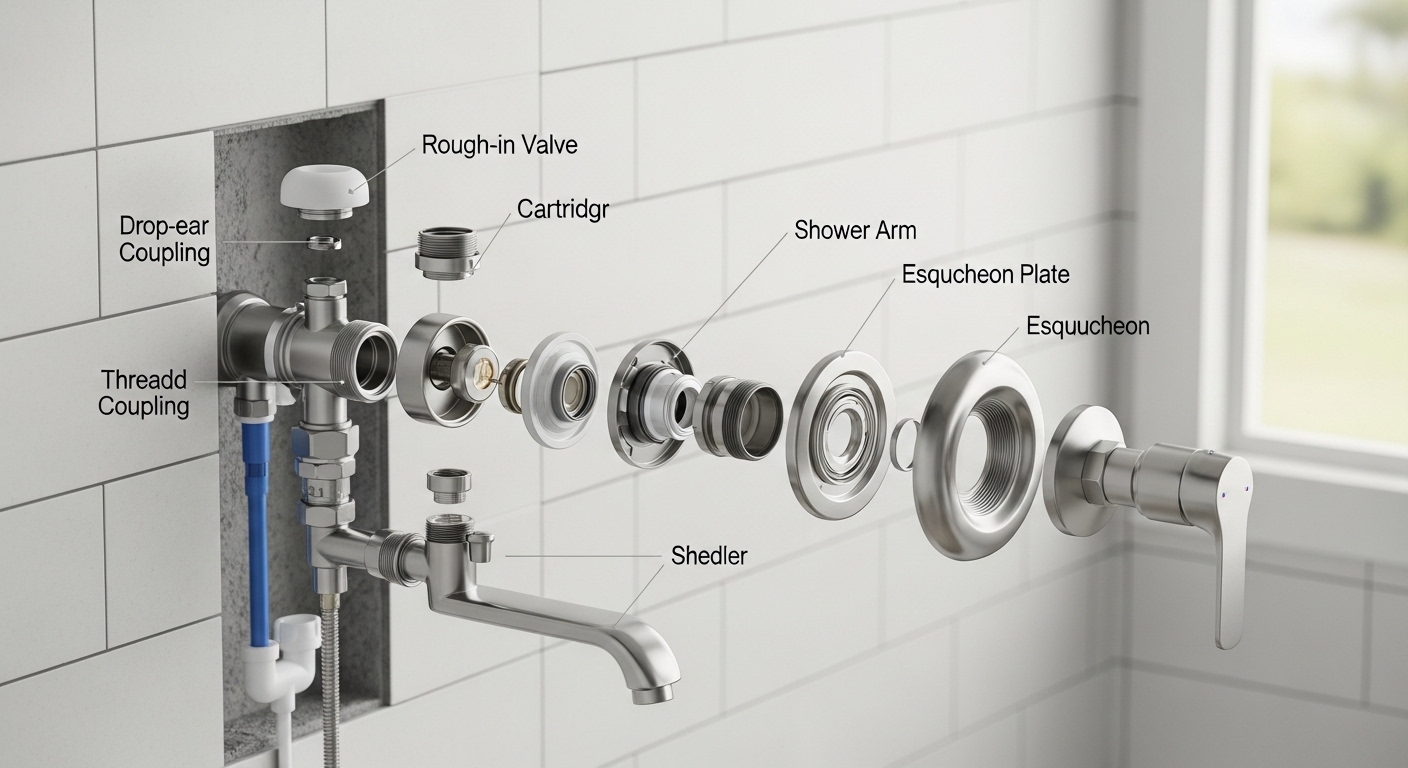
Here’s the honest breakdown of the parts people lump under “shower faucet fittings,” from the wall out:
- The rough-in valve (valve body): the workhorse buried inside the wall. It mixes hot and cold and holds the cartridge. You set this before the tile goes up.
- The cartridge: the replaceable insert inside the valve that actually starts, stops, and mixes the water when you turn the handle. When a shower drips or the temperature swings, this is usually the culprit.
- The trim kit: everything you see — the handle, the round or square escutcheon plate that covers the wall hole, and the sleeve. Trim is decorative and functional, and it must match the valve brand and series.
- The shower arm: the curved pipe that comes out of the wall and holds the shower head, threaded 1/2-inch NPT on both ends.
- The drop-ear elbow (drop elbow): a 90-degree fitting anchored inside the wall that the shower arm screws into.
- Couplings, adapters, and unions: the small threaded brass or stainless pieces that join pipe sizes, convert thread types, or let you disconnect sections later.
Understanding these categories is half the battle. Once you know whether you’re missing a cartridge or a whole trim kit, ordering the right shower faucet fittings becomes simple.
What size are shower faucet fittings — and what thread do they use?
Almost all residential shower faucet fittings in North America use 1/2-inch NPT (National Pipe Taper) threads at the connection points you interact with — the shower arm, the shower head, and the arm-to-elbow joint. The internal valve inlets are usually 1/2-inch as well, connecting to copper, PEX, or CPVC supply lines.
That said, “1/2-inch” is where people trip up, because pipe sizing is nominal, not literal. A 1/2-inch NPT fitting is closer to 3/4-inch across the threads — the number refers to the pipe’s rough inner diameter, not the thread you’re looking at. So when a listing says “standard 1/2-inch shower arm thread,” it will fit the vast majority of shower heads sold today.
| Fitting connection | Typical size / thread | Notes |
|---|---|---|
| Shower head to shower arm | 1/2 in. NPT | Universal on nearly all U.S. shower heads |
| Shower arm to drop-ear elbow | 1/2 in. NPT | Wrap threads with PTFE tape |
| Valve inlets (hot/cold) | 1/2 in. — sweat, PEX, or IPS | Match to your home’s supply pipe |
| Valve outlet to shower riser | 1/2 in. | Feeds the vertical pipe up to the arm |
| Handshower hose | 1/2 in. NPT (via wall elbow) | Some European brands use G1/2 (BSP) |
The one real exception is imported or European fixtures, which sometimes use G1/2 BSP (British Standard Pipe) threads. BSP and NPT look almost identical but seal differently and will cross-thread if forced. If you bought a fixture overseas or online from a UK/EU brand, check the spec sheet before assuming it’s NPT. For most American bathrooms, though, 1/2-inch NPT is the number to remember.
Do shower faucet fittings have to match the same brand?
Some do, some don’t — and knowing which is which saves you a return trip. The trim kit and cartridge must match your valve brand and series; the shower arm, shower head, and most couplings are universal 1/2-inch NPT and can be any brand.
This is the single most important thing to get right. Here’s the rule of thumb: anything decorative or control-related that touches the valve must be brand- and series-specific. A Moen trim kit will not fit a Delta valve. A Delta cartridge will not fit a Kohler body. The valve and its trim are engineered as a matched pair, and even within one brand, a Moen Posi-Temp trim won’t fit a Moen Moentrol valve. When you replace old trim, you have to identify the valve behind the wall first — not just the brand on the handle.
By contrast, the “plumbing” fittings farther from the valve are standardized. The shower arm, the drop elbow, threaded couplings, and the shower head itself follow the 1/2-inch NPT standard, so you can mix a generic brass shower arm with a designer shower head without any problem. That’s why you can buy a matte black shower arm to match a new finish even if your valve is an old chrome unit.
If you’re planning a full shower overhaul rather than a repair, it’s worth reading up on how the whole system fits together before you buy anything — our guide to choosing the best shower system for tile walls walks through matching the valve, trim, and rough-in so nothing clashes once the tile is up.
Pressure-balancing vs. thermostatic valves — which fitting is right for my shower?
Choose a pressure-balancing valve if you want a reliable, budget-friendly shower that won’t scald you when a toilet flushes; choose a thermostatic valve if you want precise, repeatable temperature control or you’re running multiple sprays at once. Both are code-compliant anti-scald fittings, but they work differently.
A pressure-balancing valve (also called Posi-Temp, Monitor, or Rite-Temp depending on the brand) uses a single cartridge and one handle to control both temperature and flow. It reacts to sudden pressure drops — like that toilet flush — and adjusts to keep the temperature roughly steady. It’s the standard in most American homes because it’s affordable, simple, and reliable.
A thermostatic valve uses a separate temperature control and a separate volume control, with a wax or bi-metal element that holds your exact set temperature regardless of pressure or incoming water temperature swings. It’s more expensive and the fittings are bulkier, but it’s the right pick for large showers with body sprays, rain heads, and a handshower all running together, since it can supply steady, high-volume mixed water.
| Feature | Pressure-balancing | Thermostatic |
|---|---|---|
| Typical price (valve + trim) | $80–$220 | $250–$700+ |
| Handles | One (temp + flow combined) | Two or more (temp + volume separate) |
| Anti-scald protection | Yes, reacts to pressure | Yes, holds exact temp |
| Best for | Standard single-head showers | Multi-spray / body-jet systems |
| Set-and-remember temp | No — adjust each time | Yes |
For a typical family bathroom with one shower head, a pressure-balancing valve is plenty and keeps your fitting budget sensible. Save the thermostatic setup for a spa-style build where multiple outlets demand steady volume.
How do I stop my shower faucet fittings from leaking?
Most shower fitting leaks come from three fixable places: unsealed threads, a worn cartridge, or a bad O-ring — and only one of them requires opening the wall. Seal threaded joints with PTFE tape, replace the cartridge every few years, and swap perished rubber seals, and the vast majority of drips stop.
Work through these in order when a fitting leaks:
- Wrap every threaded fitting with PTFE (plumber’s) tape. Three to four clockwise wraps on the shower arm and any NPT joint. Tape seals the taper threads; skipping it is the most common cause of a weeping shower arm.
- Replace the cartridge if the leak comes from the handle or the head keeps dripping when off. A worn cartridge lets water seep past even when the handle is closed. Cartridges are brand- and series-specific — match it exactly.
- Check the O-rings and seals. The small rubber rings inside the valve and on the shower arm harden and crack over time. A cheap seal kit often solves a leak that looks catastrophic.
- Confirm the escutcheon is caulked. Water running down the wall behind the trim plate isn’t always a fitting failure — sometimes it’s missing silicone around the escutcheon.
One leak people constantly misdiagnose is water dripping from the tub spout while the shower runs. That’s usually a worn diverter, not a bad fitting — we cover the exact fix in our guide to why a tub faucet leaks when the shower is on. And if you’re replacing the shower head itself rather than the plumbing, adding a flow restrictor during install is the moment to also re-tape the arm threads and kill any weep at the same time.
What shower faucet fittings do I need for a handheld or dual-head setup?
For a handheld shower you need a wall-mount supply elbow or a diverter, a 1/2-inch NPT hose, and a bracket; for a dual-head (fixed plus handheld) setup you add a diverter valve or a diverter tub spout so you can switch or split the flow. Everything still runs on the same 1/2-inch NPT standard, so the parts are widely available.
The simplest handheld upgrade doesn’t touch the wall at all: a slip-on diverter that mounts between your existing shower arm and shower head, giving you a second outlet for a handshower hose. If you’d rather not open plumbing, that add-on route is genuinely the path of least resistance — our breakdown of the best handheld shower head add-ons shows exactly which diverter fittings work without replacing your fixed head.
For a cleaner, permanent dual setup, you’ll want a proper 3-way diverter valve plumbed into the wall, with dedicated supply elbows for the fixed head and the handshower. This is more involved but looks integrated and lets you run both outlets at once if the diverter supports it. Match the diverter trim to your main valve brand for a consistent finish.
How do I know what fittings will fit my existing shower?
Identify the brand stamped on the trim or cartridge, note the number of handles, and measure the shower arm thread — those three facts tell you 90% of what you need to order compatible shower faucet fittings. When in doubt, pull the handle and photograph the cartridge; the shape is often enough to ID the valve series.
A practical checklist before you buy:
- Look for a logo on the handle, escutcheon, or the exposed cartridge stem — Moen, Delta, Kohler, Pfister, and American Standard all mark their parts.
- Count the handles. One handle usually means a pressure-balancing valve; two or three often means thermostatic or an older two-valve setup.
- Measure the arm. A caliper or even a ruler across the shower-arm thread confirms the standard 1/2-inch NPT.
- Photograph the cartridge. If you can shut off the water and pull the trim, the cartridge shape is the surest way to match a replacement.
If you can’t identify the valve at all — common in older homes — take the old cartridge to a plumbing supply counter, or match it against the manufacturer’s cross-reference chart online. Guessing wastes money, because a mismatched cartridge simply won’t seat.
FAQ
Are shower faucet fittings universal?
Partly. The shower arm, shower head, and threaded couplings use a universal 1/2-inch NPT standard, so those are interchangeable across brands. But the valve cartridge and trim kit are brand- and series-specific and must match your valve body exactly — a Delta trim will never fit a Moen valve.
Can I replace just the shower trim without replacing the valve in the wall?
Yes, as long as the new trim matches your existing valve’s brand and series. This is the easiest and cheapest way to update a shower’s look — new handle, escutcheon, and finish over the same rough-in valve. Just confirm the valve model first, because trim is engineered to fit one specific valve family.
What thread size is a standard shower head fitting?
1/2-inch NPT is the standard shower head thread across virtually all North American fixtures. If your fixture came from a UK or European brand, it may use G1/2 BSP threads instead, which look similar but aren’t interchangeable — check the spec sheet before forcing a connection.
Do I really need plumber’s tape on shower fittings?
Yes, on any threaded NPT connection like the shower arm and drop-elbow joint. Three to four clockwise wraps of PTFE tape seal the tapered threads and prevent the slow weep that shows up days after install. It costs a dollar and prevents the most common shower leak. Cartridges and O-ring seals, however, seal on rubber and don’t need tape.
How often should shower cartridges and fittings be replaced?
A quality cartridge typically lasts 5–10 years, though hard water shortens that. Replace it as soon as you notice temperature drift, a handle that’s hard to turn, or a drip that won’t stop when the water’s off. O-rings and seals are cheap wear parts — refreshing them every few years during any repair keeps the whole fitting assembly leak-free far longer.
Will a matte black or brushed gold shower arm work with my chrome valve?
Yes. Because the shower arm and head are universal 1/2-inch NPT fittings, you can mix finishes freely — a brushed gold arm and head work fine on an old chrome valve. Just know the trim at the valve will still be chrome unless you replace that separately with a matching-series kit.
About the author: This guide was written by the Adeaga fixtures team, drawing on hands-on installation and testing of hundreds of shower valves, cartridges, and trim kits across every major North American brand. We plumb, pressure-test, and disassemble the fittings we write about rather than repeating spec sheets.
Why trust Adeaga: Adeaga is a specialist faucet and bathroom-fixture retailer at adeaga.net. The fittings we recommend meet ASME A112.18.1/CSA B125.1 standards and carry anti-scald pressure-balancing or thermostatic protection, and we prioritize valves backed by manufacturer limited lifetime warranties on the body and finish. When we call a fitting “standard 1/2-inch NPT,” it’s because we’ve threaded it ourselves.