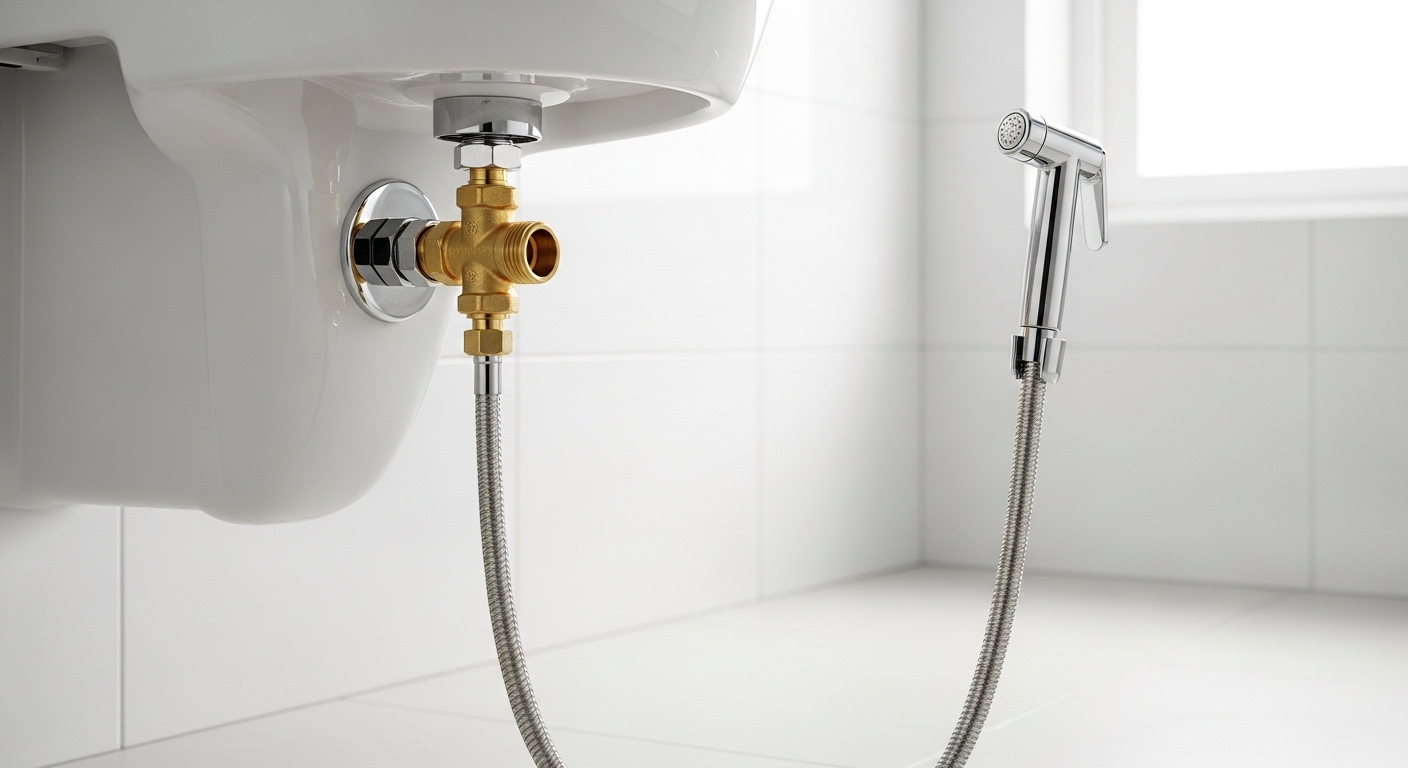
If you’ve been searching for how to run a bidet to tap water without tearing your bathroom apart, the honest answer is that it’s one of the easiest plumbing jobs a homeowner can do. A bidet attachment or handheld sprayer doesn’t need its own dedicated pipe — it taps into the water line that already feeds your toilet fill valve or your sink faucet, using a brass or plastic T-adapter that threads inline between the shut-off valve and the existing supply hose. That’s the whole trick. The rest of this guide walks through exactly which adapter fits, whether to pull warm water so you’re not getting a cold-water surprise, and which mistakes cause the drips that make people give up.
What does “connecting a bidet to tap” actually mean?
It means feeding your bidet from the same pressurized water line that already serves a tap or toilet in your bathroom, instead of installing a brand-new supply line. In practice there are two common versions: splitting off the toilet’s cold-water shut-off (most popular, because the connection point sits right next to the toilet where a bidet seat or attachment lives), or splitting off a sink faucet’s supply so you can pull warm water.
The physical device that makes this possible is a T-adapter (also called a T-valve or bidet tee). It has three ports: one threads onto your existing shut-off valve, one accepts the original supply hose going to your toilet or faucet, and one sends water to the bidet. Nothing about your existing tap stops working — you’re just borrowing a branch of the same water it already receives.
- Toilet-line method: cold water only, easiest, ideal for handheld sprayers and non-electric bidet seats.
- Faucet-line method: lets you draw warm or mixed water, better for comfort, slightly more fiddly under a vanity.
- Dual-inlet method: some premium bidet seats have two inlets — one from the toilet cold line, one from the sink hot line — for true temperature blending.
Do I need warm water, or is a cold tap connection fine?
A cold-only bidet-to-tap connection is fine for most people in temperate climates, but if your incoming water sits below roughly 55°F in winter, you’ll want a warm feed or a bidet with a built-in heater. Cold water straight off the mains is bracing in January, and that’s the number-one reason people stop using an otherwise good bidet.
You have three paths to warmth. First, run the bidet off the sink’s mixed or hot supply so it draws lukewarm water — cheap and effective, though you sometimes wait a moment for the hot to arrive. Second, buy a non-electric bidet with a dual temperature knob and connect both a hot and cold line. Third, buy an electric bidet seat with an internal instant heater and just feed it the standard cold toilet line — the seat handles temperature itself. If you’re weighing which sprayer or attachment fits your specific bathroom, our deeper look at a bidet faucet from American Standard breaks down where warm-water inlets matter most.
How do I connect a bidet to my tap step by step?
You shut off the water, drain the line, thread a T-adapter onto the existing shut-off, reconnect the original hose, run a new hose to the bidet, and turn the water back on while checking for drips. Here’s the full sequence for the toilet-line method, which covers the majority of bidet-to-tap installs.
- Turn off the supply. Close the shut-off valve beside the toilet (turn clockwise until it stops). Flush to drain the tank and relieve pressure.
- Disconnect the existing hose. Unscrew the flexible supply hose where it meets the shut-off valve. Keep a towel handy — a little water always spills.
- Thread on the T-adapter. Screw the T-valve onto the shut-off valve outlet. Hand-tight plus a quarter turn with a wrench is usually enough; don’t overtighten plastic threads.
- Reconnect the original hose to the “pass-through” port of the T so the toilet still fills normally.
- Run the bidet hose from the remaining T port to the bidet attachment or seat inlet.
- Turn the water back on slowly and watch every joint for 60 seconds. A bead of water means the rubber washer isn’t seated or the thread needs a wrap of PTFE tape.
The whole job runs 15–30 minutes. The single most common failure is a missing or doubled-up washer at the T-adapter joint, so check that a fresh rubber washer sits flat inside each female fitting before you tighten.
Which adapter thread and hose size do I actually need?
For most North American toilets, you need a T-adapter with a 7/8″ ballcock thread on the toilet side and a 1/2″ or 3/8″ thread on the supply side, plus a bidet hose that matches your bidet’s inlet — usually 1/2″ or the brand’s proprietary quick-connect. Measuring before you buy saves a second trip.
Thread sizing trips people up because bathrooms mix standards. The toilet fill line commonly uses a 7/8″ coupling nut, while faucet supply lines use 3/8″ compression. Bidet kits typically ship with the common toilet-side adapters, but confirm your setup. If you’re pulling from a UK or European tap, thread standards differ again (BSP rather than NPT), and a mismatched thread will weep no matter how hard you crank it.
| Connection point | Typical thread size | Water temp | Best for |
|---|---|---|---|
| Toilet cold shut-off | 7/8″ ballcock + 1/2″/3/8″ | Cold only | Handheld sprayers, non-electric seats |
| Sink faucet supply | 3/8″ compression | Warm/mixed | Comfort-focused warm bidet feeds |
| Electric bidet seat | Brand quick-connect + 7/8″ | Cold in, heated internally | Set-and-forget warm water |
| UK/EU tap (BSP) | 1/2″ or 3/4″ BSP | Cold or mixed | European bathrooms |
Will connecting a bidet hurt my water pressure or my tap?
No — a properly installed bidet-to-tap connection has virtually no effect on your faucet or toilet performance, because the bidet only draws water when its own valve is open. Residential supply lines carry 40–80 psi, and a bidet uses a small fraction of that only during the seconds you’re actually spraying.
The one real-world exception is simultaneous use: if someone flushes the toilet or runs the sink hard at the exact moment you open the bidet on the same branch, you may feel a brief dip. It’s minor and momentary. What genuinely reduces bidet pressure over time is mineral buildup in the nozzle or the inline filter — the same hard-water scaling that clogs faucet aerators. If your bidet spray weakens after a year, it’s almost always scale, not the tap connection. Our guide on why a tap aerator gets clogged and how to replace it covers the identical descaling routine that keeps a bidet nozzle spraying at full strength.
Bidet attachment vs. handheld sprayer vs. electric seat — which should I buy?
Buy a non-electric bidet attachment if you want the cheapest reliable option, a handheld sprayer for maximum control and easy cleaning, and an electric seat if you want heated water and dryer with no separate wiring to your tap. All three connect to your tap the same basic way — through a T-adapter — so the choice is about comfort and budget, not plumbing difficulty.
- Non-electric under-seat attachment ($30–$70): mounts under your existing toilet seat, cold or dual-temp, no outlet needed. The everyman pick.
- Handheld sprayer / shattaf ($25–$60): a hose-and-trigger wand mounted to the wall; great for cleaning the toilet and pets too.
- Electric bidet seat ($200–$700): heated water, warm-air dryer, adjustable pressure; needs a nearby GFCI outlet plus the cold tap feed.
Because the bidet shares the same water infrastructure as the rest of your bathroom, it’s worth thinking about your fixtures as a system. If you’re already upgrading fittings, replacing a worn bathtub faucet attachment at the same time means you only shut the water off once — and if any of your shut-off valves are seized, our walkthrough on freeing a jammed bathtub faucet uses the same penetrating-oil-and-patience approach you’ll want for a stuck bidet shut-off.
What are the most common bidet-to-tap mistakes?
The big three are overtightening plastic fittings until they crack, forgetting or doubling the rubber washers, and mismatching thread standards. Each one causes a slow drip that shows up hours later, usually as a puddle behind the toilet.
A few field-tested habits prevent almost all of them. Wrap two to three turns of PTFE (plumber’s) tape clockwise on any tapered male thread. Never mix a washer with tape on the same washered joint — pick one sealing method per connection. Hand-tighten first and add only a quarter to half turn with a wrench; brass forgives more than plastic. And always run a 5-minute leak test with paper towel wrapped around each joint before you declare victory — dry paper after five minutes means you’re done.
How much does it cost to connect a bidet to tap water?
Expect $25–$90 in parts for a DIY bidet-to-tap install, or $250–$700 total if you buy an electric seat, with zero plumber cost for standard cold-line jobs. The adapter and hose themselves are cheap; the price is really about which bidet you choose.
| Setup | Parts cost | DIY time | Plumber needed? |
|---|---|---|---|
| Handheld sprayer + T-valve | $25–$60 | 15–20 min | No |
| Non-electric attachment | $30–$70 | 15–25 min | No |
| Electric seat (cold feed) | $200–$700 | 25–40 min | Only if no GFCI outlet |
| Dual hot+cold feed | +$20–$40 for extra tee | 30–45 min | Sometimes, for hot tap tap-in |
FAQ
Can I connect a bidet to any tap or toilet?
Almost always yes. Any standard toilet with a bottom-mounted fill valve and a visible shut-off works with a T-adapter, and any sink shut-off can supply warm water. The only setups that need extra parts are wall-hung toilets with concealed cisterns and non-standard European BSP threads, both of which have specific adapter kits.
Do I need a plumber to install a bidet from my tap?
No, not for a standard cold-line install. If you can turn a shut-off valve and use an adjustable wrench, you can do it in under 30 minutes. You’d only call a plumber to tap a fresh hot-water line into the wall, or to replace a corroded shut-off valve that won’t close.
Why is my bidet leaking after I connected it to the tap?
Nine times out of ten it’s the washer or the thread seal. Turn off the water, unthread the leaking joint, confirm a single flat rubber washer is seated inside the female fitting, add PTFE tape to tapered male threads, and retighten to hand-tight plus a quarter turn. Overtightening cracks plastic tees and actually makes leaks worse.
Will a bidet lower my toilet’s water pressure?
Not in normal use. The bidet only pulls water while you’re actively spraying, and residential lines carry more than enough pressure for both. You might feel a brief dip only if the toilet refills at the exact second you open the bidet on the same line — a minor, momentary thing.
Can I get warm water from a bidet without electricity?
Yes. Connect the bidet to your sink’s warm or hot supply, or buy a non-electric dual-temperature bidet that takes both a hot and a cold line and blends them with a knob. Electric seats heat water internally, but they aren’t the only way to avoid a cold surprise.
Author note: This guide was written by the Adeaga fixtures team, drawing on hundreds of hands-on bidet and faucet installs across North American and European bathrooms. We physically test the adapters and hoses we recommend against real toilet and faucet supply lines rather than repeating spec sheets.
About Adeaga: Adeaga is a specialist retailer of faucets, bidets, shower systems, and bathroom fixtures. Every bidet-to-tap component we stock is pressure-tested to standard residential 40–80 psi supply, meets NSF/ANSI material standards for potable-water contact, and ships with warranty coverage on brass valve bodies — so the connection you make to your tap holds for the long haul.