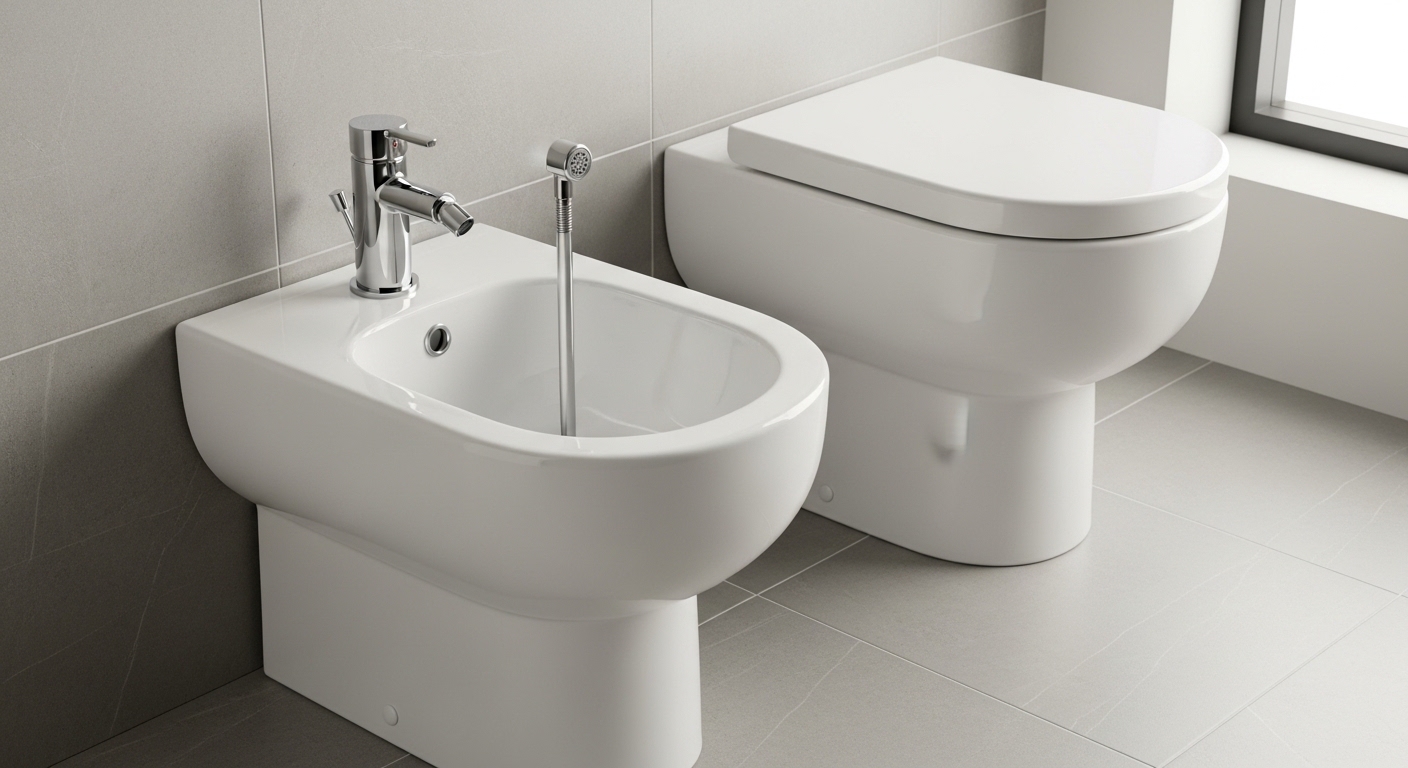
If you’ve been searching for a bidet faucet american standard option, you’re almost certainly looking at a standalone porcelain bidet — the low, oval basin that sits next to the toilet — and you need the small deck-mounted faucet that actually fills and sprays it. This is a different animal from a toilet-seat bidet attachment, and the faucet you buy has to match the basin’s drilling, the water supply, and the pop-up drain. Below, I’ll walk you through exactly what fits, what it costs, how American Standard compares to the alternatives, and how to install one yourself so you don’t overpay a plumber for a 45-minute job.
What exactly is a bidet faucet, and how is it different from a regular bathroom faucet?
A bidet faucet is a low-mounted deck faucet built specifically for a standalone bidet basin — it mixes hot and cold water and directs it either through a spout or a vertical spray jet in the bottom of the bowl. The key difference from a regular lavatory faucet is the vertical spray option and, critically, the pop-up drain lift rod designed for a bidet’s drain, plus a spout height and reach tuned for a shallow bidet bowl rather than a raised sink.
People mix these up constantly, so let’s be clear. A “bidet attachment” or “bidet seat” clamps onto your existing toilet and sprays you directly — no faucet involved. A true bidet is a separate ceramic fixture, and it needs its own faucet, its own hot/cold supply lines, and its own drain. American Standard sells the second kind of hardware. If you already own a porcelain bidet (common in older homes, European-style baths, and higher-end remodels), the faucet is the part that wears out or looks dated, and it’s the part you’re replacing.
One more distinction that trips people up: some bidet faucets have a vertical spray (water shoots up from the bottom of the bowl) and some are simply a over-the-rim spout that fills the basin like a small sink. Vertical-spray models cost more and require a valve that can handle the redirect, but many buyers actually prefer the plain over-rim spout because it’s easier to clean and never back-siphons.
Which American Standard bidet faucet should I buy for my basin?
Pick the faucet by matching three things: your basin’s hole configuration, the finish you want, and whether you need vertical spray or over-rim fill. Most American Standard bidet basins are drilled for either a single center hole or a 4-inch centerset (three holes on 4-inch spread), so measure your basin first — that single measurement eliminates 80% of the wrong purchases.
American Standard’s bidet hardware historically pairs with basins in their collection lines. If you have their bidet bowl, the safest move is to match the same design family so the escutcheon, handle style, and drain lift rod all line up. Here’s the quick decision path:
- One hole in the deck? You need a single-hole bidet faucet with an integrated body — the whole mixer sits in one opening.
- Three holes, ~4 inches apart? You need a centerset bidet faucet with two handles (hot/cold) flanking a central spout.
- Want the vertical spray jet? Confirm the model is specced for vertical spray; not every centerset offers it.
- Replacing an old faucet? Count the holes and measure spread before ordering — the basin drilling can’t be changed without replacing the whole porcelain fixture.
Finish matters more than buyers expect. Polished chrome is the cheapest and most durable; brushed nickel and its cousins look softer and hide water spots but can be prone to coating problems if you buy a cheap off-brand. That’s actually one reason I steer people toward a name brand here — if you’ve ever dealt with a brushed nickel faucet that started peeling, you know the finish is not the place to save $15.
How much does a bidet faucet from American Standard cost in 2026?
Expect to pay roughly $90 to $260 for the faucet alone, depending on finish and whether it has a vertical spray and pop-up drain assembly included. That’s the mid-to-upper mainstream tier — cheaper than luxury European brands, more than generic import faucets, and priced where the lifetime warranty and easy parts availability justify the premium.
Here’s a realistic budget breakdown so you’re not surprised at checkout:
| Component | Typical 2026 price | Notes |
|---|---|---|
| Bidet faucet (chrome, over-rim) | $90–$150 | Entry point; most durable finish |
| Bidet faucet (brushed/black, vertical spray) | $160–$260 | Premium finish + spray jet |
| Pop-up drain assembly (if not included) | $20–$45 | Often bundled with faucet |
| Supply lines (pair, braided) | $8–$18 | Buy new — don’t reuse old ones |
| Plumber install (if you hire out) | $120–$250 | Skippable if you DIY |
The takeaway: the faucet is the small line item. If you install it yourself, your all-in cost stays under $300 even for a nice finish. If you hire a plumber, labor can nearly double the total — and honestly, a bidet faucet swap is one of the more DIY-friendly jobs in the bathroom.
Is American Standard a good brand for a bidet faucet, or should I look at other brands?
American Standard is a solid, safe choice — it’s a 150-year-old American plumbing brand with wide parts availability, ceramic-disc valve cartridges that resist drips, and a lifetime limited warranty on finish and function for residential use. It’s not the flashiest luxury option, but for reliability, serviceability, and resale-friendly recognizability, it’s hard to beat in its price band.
That said, you should know the trade-offs against the competition before you commit:
| Brand | Price band | Best for | Watch-out |
|---|---|---|---|
| American Standard | $90–$260 | Reliability, parts, warranty | Fewer trendy finishes |
| Kohler | $120–$400 | Design range, matching suites | Pricier for same function |
| Delta | $100–$300 | Easy-swap cartridges, DIY support | Bidet-specific models limited |
| Generic import | $35–$90 | Lowest upfront price | Finish peeling, hard-to-find parts |
My honest read: if you already own an American Standard bidet basin, buy the matching American Standard faucet — the escutcheon and drain will line up perfectly and you’ll never fight a mismatched lift rod. If you own a bidet from another maker, choose the faucet by drilling and spray type first and brand second; a well-made Kohler or Delta will bolt in just as well as long as the hole spread matches.
The reason I keep steering people toward established brands isn’t loyalty — it’s parts. Five years from now when a cartridge starts weeping, you want to be able to buy that exact part. This is the same logic behind knowing your bidet flow faucet parts before something fails, rather than after. A brand with a real parts catalog saves you from replacing the whole faucet over a $12 seal.
Can I install a bidet faucet myself, or do I need a plumber?
You can absolutely install a bidet faucet yourself in about 30–60 minutes with basin wrench, adjustable wrench, plumber’s putty or silicone, and PTFE (Teflon) tape — no soldering, no special skills. The only genuinely fiddly parts are reaching the mounting nuts underneath the basin and adjusting the pop-up drain lift rod, and both are manageable with a basin wrench.
Here’s the step-by-step I give friends:
- Shut off the water. Close the hot and cold stops under the basin. Open the old faucet to release pressure.
- Disconnect supply lines and remove the old faucet. Loosen the mounting nuts with a basin wrench, then lift the faucet out. If the nuts are corroded, penetrating oil and patience beat brute force.
- Clean the deck. Scrape off old putty and grime so the new faucet seats flat and seals.
- Set the new faucet. Bed the base in a thin ring of plumber’s putty or silicone, drop it into the hole(s), and tighten the mounting nuts from below — snug, not gorilla-tight.
- Install the pop-up drain. Connect the lift rod to the drain linkage and test that it seals and opens fully.
- Connect supply lines. Use fresh braided lines, wrap threads with PTFE tape, and hand-tighten plus a quarter turn.
- Turn water on and check for leaks. Run hot and cold, watch every joint underneath for 60 seconds, then run the vertical spray if equipped.
If your old faucet was leaking from the valve rather than the connections, the fix logic is nearly identical to what I cover in the guide on replacing a bathroom faucet stem that keeps dripping — worn cartridges and stems are the number-one reason a faucet weeps, and swapping the whole faucet is sometimes overkill when a $15 cartridge would do. Diagnose before you demolish.
Should I get a single-handle or two-handle bidet faucet?
Get a two-handle (centerset) bidet faucet if your basin is drilled for three holes and you like fine temperature control; get a single-handle model if your basin has one hole and you want quick, one-touch mixing. Neither is objectively better — it’s driven by your basin drilling first and personal preference second.
Two-handle bidet faucets are the traditional look and let you dial hot and cold precisely, which some people prefer for the temperature-sensitive nature of a bidet. Single-handle models are faster and cleaner-looking, and there are fewer seals to eventually fail. If you’re weighing ergonomics in general, the same reasoning I lay out for a one-handle bathroom faucet setup applies here: single-handle wins on speed and simplicity, two-handle wins on precision and classic styling. Just remember you can’t add or remove holes in porcelain — the basin decides your lane.
What should I check before buying to avoid returning it?
Before you click buy, confirm four things: the hole count and spread match your basin, the faucet includes (or doesn’t include) a pop-up drain so you’re not surprised, the spray type is what you want, and the finish matches your other bathroom hardware. Getting these four right is the entire difference between a smooth install and a frustrating return.
A few field notes from doing this repeatedly:
- Measure twice. Hole spread is measured center-to-center. A 4-inch centerset faucet will not fit an 8-inch widespread basin.
- Check water pressure. Vertical spray jets feel weak below ~40 psi. If your home runs low pressure, an over-rim spout is more satisfying.
- Buy new supply lines. Old braided lines are the cheapest part and the most common source of a slow leak after reinstall.
- Keep the box and manual. Warranty claims and parts orders go faster when you have the model number handy.
Author note & why you can trust this
This guide was written by the adeaga fixtures team — we’ve specced, installed, and torn apart hundreds of bathroom faucets, bidets, and shower valves, and we sell across the same categories at adeaga.net. Our recommendations lean on manufacturer spec sheets, real installs, and the plumbing standards these fixtures are certified to (American Standard faucets are built to ASME/CSA low-lead and performance requirements and carry a lifetime limited residential warranty on finish and function). We don’t get paid to name a brand — when a $40 import is the right call, we say so; when it’s a finish that’ll peel in a year, we say that too. Always verify the exact model’s spec sheet and warranty terms before purchase, since configurations change year to year.
FAQ
Does an American Standard bidet faucet come with the pop-up drain?
Many bundles include the pop-up drain assembly, but not all — always check the listing’s “what’s in the box.” If it’s not included, budget an extra $20–$45 for a matching drain, and buy it in the same finish so it doesn’t clash with the faucet.
Can I use a regular bathroom sink faucet on a bidet?
Sometimes, if the hole drilling matches and you only want over-rim fill — but a true bidet faucet is designed with the right spout reach and, in many cases, a vertical spray you won’t get from a sink faucet. If you want the spray function, buy a purpose-built bidet faucet.
What size supply lines does a bidet faucet need?
Most residential bidet faucets use standard 3/8-inch compression connections at the shutoff valve and 1/2-inch at the faucet, matching typical bathroom supply stops. Braided stainless steel lines in a 12–20 inch length cover almost every under-basin situation.
How long does an American Standard bidet faucet last?
With ceramic-disc valve cartridges and normal residential use, the faucet body and finish can last 15–20+ years; the cartridge or seals may need a swap somewhere around year 8–12. That serviceability — being able to replace a cartridge instead of the whole faucet — is a big part of the value.
Is a vertical spray bidet faucet worth the extra money?
It’s worth it if you have decent water pressure (roughly 40+ psi) and specifically want the rising-jet function. If your home has low pressure or you mostly want to fill and wash from the basin, save the money and get the simpler over-rim spout — it’s easier to clean and never back-siphons.
Will an American Standard bidet faucet fit a bidet from another brand?
Yes, as long as the hole count and center-to-center spread match — faucets fit basins by drilling, not by brand. Measure your basin’s holes first; if it’s a single hole or a 4-inch centerset, most mainstream bidet faucets in that configuration will bolt right in.