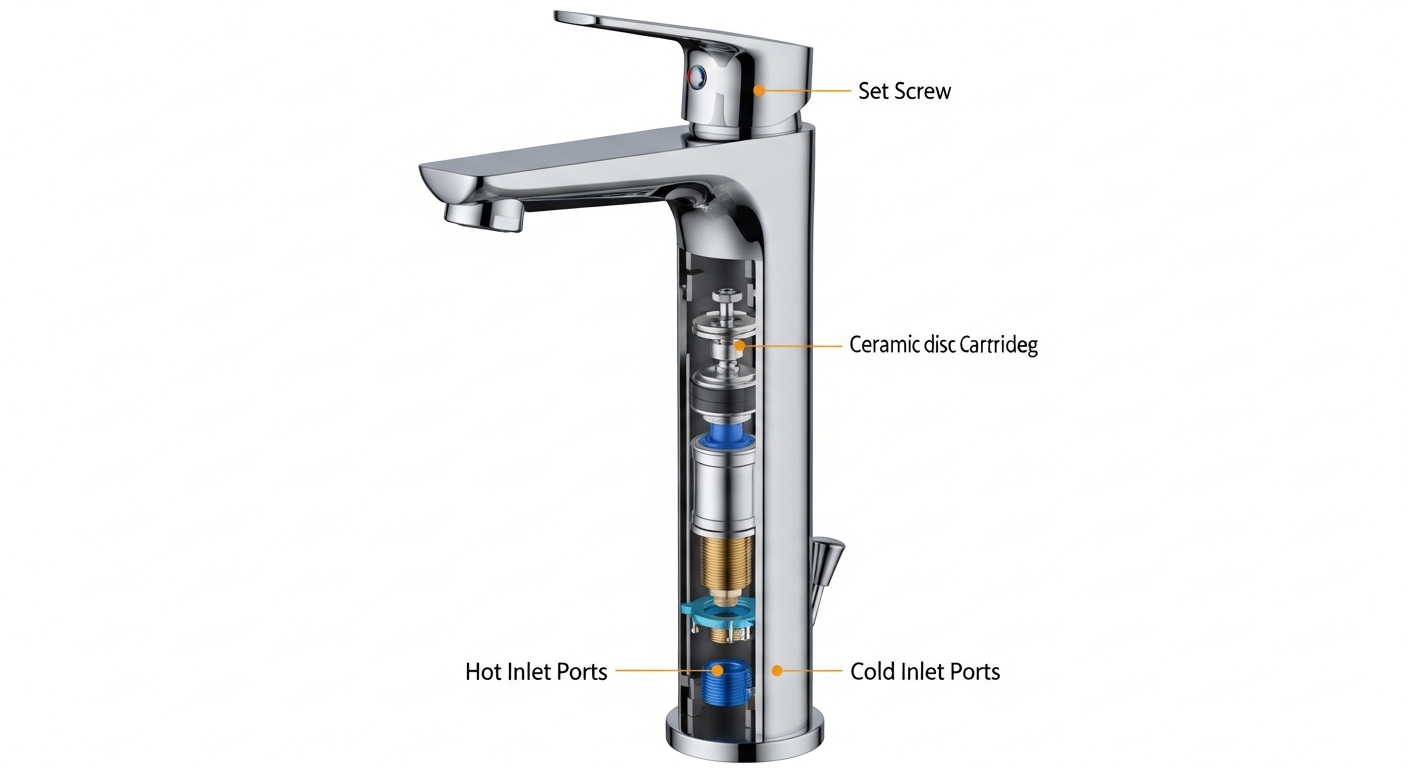
A vessel sink faucet cartridge is the heart of your faucet — the cylindrical valve, usually 1.5 to 3 inches long, that sits under the handle and controls temperature and flow. Because vessel faucets are tall, single-hole designs that sit above the counter to reach a bowl-style sink, the cartridge inside them does the same job as any mixer valve, just in a slimmer body. When people search for this part, they’re almost never buying a new faucet — they’re trying to stop a drip, fix a stiff handle, or figure out which replacement cartridge actually fits. This guide answers all of that in plain terms.
What Does a Cartridge Actually Do Inside a Vessel Sink Faucet?
The cartridge is the valve that mixes and meters your water — everything else is just a shell. When you lift or turn the handle, you’re rotating internal ceramic discs (or, in older faucets, moving a compression stem or a ball) that open ports to the hot and cold supply lines and blend them before the water reaches the spout. The faucet body, spout, and handle don’t touch the water pressure directly; the cartridge takes all of it.
That’s why the cartridge is the part that wears out. It has moving surfaces, rubber O-rings, and tiny seals that face constant pressure, mineral-laden water, and thousands of on-off cycles a year. A vessel faucet’s tall, narrow body doesn’t change this — it just means the cartridge is often a compact ceramic-disc unit designed to fit a slim single-hole install. Understand the cartridge and you understand 90% of what can go wrong with a vessel faucet.
How Do I Know If My Vessel Faucet Cartridge Is Bad (and Not Something Else)?
You’ve got a bad cartridge if the faucet drips after you shut it off, the handle feels stiff or gritty, hot and cold won’t mix properly, or water sputters at a steady flow. Those four symptoms point straight at the cartridge more than any other part. Here’s how to read them:
- Constant drip from the spout after shut-off: the ceramic discs or seals inside the cartridge no longer close fully. This is the number-one cartridge failure.
- Handle is hard to turn or grinds: mineral scale has built up on the ceramic discs. Common in hard-water homes.
- Water is only hot or only cold, or the temperature jumps around: a cracked cartridge or a failed internal seal is letting the sides cross-feed.
- Leak from the base of the handle, not the spout: usually a worn cartridge O-ring rather than the valve itself — still fixed by a cartridge swap or an O-ring kit.
- Sputtering or reduced flow: often the aerator first (unscrew and clean it), but if that’s clear, suspect debris lodged in the cartridge.
Quick test: shut off the two supply valves under the sink, open the faucet to release pressure, and feel the handle. If it’s rough or the drip stops only when supply is off but returns under pressure, the cartridge is the culprit. A dripping vessel faucet wastes real water — a slow drip adds up to hundreds of gallons a year — so it’s worth fixing promptly. If your trouble is actually a dripping stem-style bathroom faucet rather than a modern cartridge unit, our guide on how to replace a bathroom faucet stem that keeps dripping walks through that older design step by step.
What Are the Different Types of Vessel Sink Faucet Cartridges?
There are three main cartridge types — ceramic disc, compression stem, and ball — and modern vessel faucets almost always use ceramic disc because it’s the most durable and the smoothest to operate. Knowing which one you have decides which replacement you buy and how the repair goes.
| Cartridge Type | How It Works | Lifespan | Best For | Typical Cost |
|---|---|---|---|---|
| Ceramic disc | Two polished ceramic discs slide to open/close ports | 15–30 years | Modern single-handle vessel faucets; hard-water areas | $8–$35 |
| Compression stem | A rubber washer presses onto a seat to stop flow | 5–10 years | Older two-handle vessel setups; budget faucets | $3–$12 |
| Ball valve | A slotted ball rotates over inlet springs and seats | 10–15 years | Some single-handle designs; less common in vessel styles | $10–$25 |
For most vessel sink faucets bought in the last decade, you’re dealing with a ceramic disc cartridge. It’s the reason a good vessel faucet feels crisp and quarter-turns cleanly. Compression cartridges are simpler and cheaper but drip sooner because the rubber washer wears. Ball valves have more small parts (springs and seats) and are fussier to rebuild, which is why manufacturers have largely moved away from them for tall single-hole faucets.
Are Vessel Sink Faucet Cartridges Universal, or Do I Need an Exact Match?
They are not universal — you need a cartridge that matches your faucet’s brand, model, and internal design. This is the single biggest mistake people make: buying a generic “faucet cartridge” and finding it won’t seat, won’t align the hot/cold, or leaks worse than before. Cartridges vary in length, diameter, spline count (the number of teeth on the stem), and how the retaining clip or nut holds them.
Here’s how to get the right one the first time:
- Find the brand and model. Check the box, the manual, or the underside of the faucet body. Many faucets stamp a model number near the base.
- Pull the old cartridge and take it to the match. The surest method — bring the physical part or a clear photo with a ruler next to it. Measure overall length and stem diameter.
- Count the splines. The handle-end teeth (often 20-point, 24-point, etc.) must match so your handle re-seats correctly.
- Note the retention style. A horizontal brass clip, a threaded retaining nut, or a plastic collar each call for a different removal and reinstall.
- Buy OEM when you can. The manufacturer’s original cartridge is the safest bet; reputable universal replacements exist but confirm the fit chart before ordering.
If you bought a quality faucet, the maker likely sells the exact cartridge as a service part — often cheaply or under warranty. That’s one more reason investing in a well-built faucet pays off; our breakdown of whether a high-end vessel sink faucet is worth it covers how build quality affects parts availability and long-term repairs.
How Do I Replace a Vessel Sink Faucet Cartridge Myself?
You can replace a vessel sink faucet cartridge in about 15–30 minutes with a few basic tools — no plumber required for most single-handle designs. The process is the same idea as swapping any mixer valve; a vessel faucet is just taller, so give yourself a bit of clearance around the tall body.
Tools you’ll need: an adjustable wrench, a hex/Allen key for the handle set screw, needle-nose pliers, a Phillips screwdriver, plumber’s grease, and a towel. A cartridge puller helps if the old one is stuck, and white vinegar dissolves scale.
- Shut off the water. Close both supply valves under the sink and open the faucet to relieve pressure. Plug the drain so nothing small falls in.
- Remove the handle. Loosen the set screw (usually under the handle or behind a decorative cap) with the Allen key and lift the handle off.
- Expose the cartridge. Unscrew the decorative bonnet or dome, then remove the retaining clip or nut holding the cartridge.
- Pull the old cartridge straight up. Grip with pliers or a puller and lift without twisting. If it’s seized, soak the area in vinegar for 10–15 minutes to loosen scale.
- Drop in the new cartridge. Align the hot/cold orientation (there’s usually a keyed tab or notch — get this right or your temperatures reverse), then re-secure the clip or nut.
- Reassemble and test. Grease the O-rings, refit the bonnet and handle, slowly reopen the supply valves, and run the faucet to check for leaks and correct hot/cold sides.
The mechanics are nearly identical across brands. If you’d like to see a full cartridge swap illustrated end to end, our walkthrough on how to change a tap cartridge without calling a plumber uses the same removal-and-reseat sequence you’ll follow here.
Should I Replace the Cartridge or Just Buy a New Faucet?
Replace the cartridge if the faucet body and finish are still in good shape — it’s far cheaper and greener than a new faucet. A cartridge costs $8–$35; a decent vessel faucet runs $80–$300 or more. Unless the finish is peeling, the spout is corroded through, or you simply want a new look, the cartridge swap is the smart call.
Buy new instead when: the faucet is a bargain-bin unit with no available service parts, the base is leaking from a cracked body (not the cartridge), or you’re already remodeling. Also consider a fresh faucet if you’re constantly rebuilding a low-quality ball-valve unit — at some point the parts and effort outweigh a reliable ceramic-disc replacement. If you’re weighing single-handle designs for that upgrade, our guide on choosing a bathroom faucet one-handle setup covers what to look for so your next faucet is easy to service.
How Do I Make a New Cartridge Last Longer?
Keep water clean and seals lubricated, and a ceramic cartridge easily lasts 15+ years. The two enemies are mineral scale and grit. Here’s what actually helps:
- Address hard water. If you have scale problems, a whole-home softener or periodic vinegar cleaning of the aerator and cartridge dramatically extends life.
- Flush the lines after plumbing work. Debris kicked loose during any repair can score a new cartridge — run the supply into a bucket before reinstalling.
- Grease the O-rings. A dab of plumber’s silicone grease on install keeps seals supple and the handle smooth.
- Don’t over-torque the handle. Ceramic discs need only a light close. Cranking the handle shut wears seats faster.
- Clean the aerator quarterly. It’s the cheapest maintenance and prevents the flow problems people wrongly blame on the cartridge.
FAQ
How much does a vessel sink faucet cartridge cost?
Most replacement cartridges run $8–$35. OEM ceramic-disc cartridges from name brands sit in the $15–$35 range, while generic compression stems can be as little as $3–$12. If your faucet is under warranty, the manufacturer may send the cartridge free — always check before buying.
Can I use any cartridge in my vessel faucet?
No. Cartridges must match by brand, length, diameter, spline count, and retention style. A mismatched cartridge may not seat, may reverse your hot and cold, or may leak. Bring the old cartridge with you or confirm the model number against the maker’s fit chart before ordering.
How long does a vessel faucet cartridge last?
A quality ceramic-disc cartridge lasts 15–30 years. Compression cartridges with rubber washers last about 5–10 years, and ball valves roughly 10–15. Hard water and grit shorten all of these, so water quality is the biggest factor in real-world lifespan.
Why does my vessel faucet still drip after I replaced the cartridge?
Usually one of three things: the new cartridge wasn’t fully seated, the O-rings weren’t greased and pinched on install, or debris got trapped under the discs. Shut off the water, pull the cartridge, flush the lines, and reseat it carefully. If the drip continues, confirm you bought the exact matching model.
Do I need a plumber to change a vessel faucet cartridge?
For most single-handle vessel faucets, no — it’s a 15–30 minute DIY job with an Allen key, wrench, and pliers. Call a professional only if the cartridge is fused by heavy corrosion, the supply valves won’t shut off, or you find a cracked faucet body rather than a simple worn cartridge.
What’s the difference between a faucet cartridge and a faucet stem?
A stem is the older compression-style part with a rubber washer that presses onto a seat to stop water; a cartridge is a self-contained valve — most often ceramic disc — that mixes and meters flow. Modern vessel faucets use cartridges, while some vintage two-handle setups still use stems.
Author note: This guide was written by the Adeaga fixtures team, drawing on hands-on cartridge replacements across ceramic-disc, compression, and ball-valve faucets. We’ve disassembled and rebuilt hundreds of vessel and bathroom faucets to document what actually fails and how to fix it.
About Adeaga: Adeaga specializes in faucets, shower systems, and bathroom fixtures, with a focus on serviceable, long-lasting hardware. We test cartridges and finishes against real-world hard-water and cycle conditions, and we favor faucets that meet recognized durability and lead-free standards (such as ceramic-disc valves rated for 500,000+ cycles and finishes that carry manufacturer warranties). Whenever possible we recommend faucets whose makers stock replacement cartridges — because a faucet you can repair is a faucet worth owning.