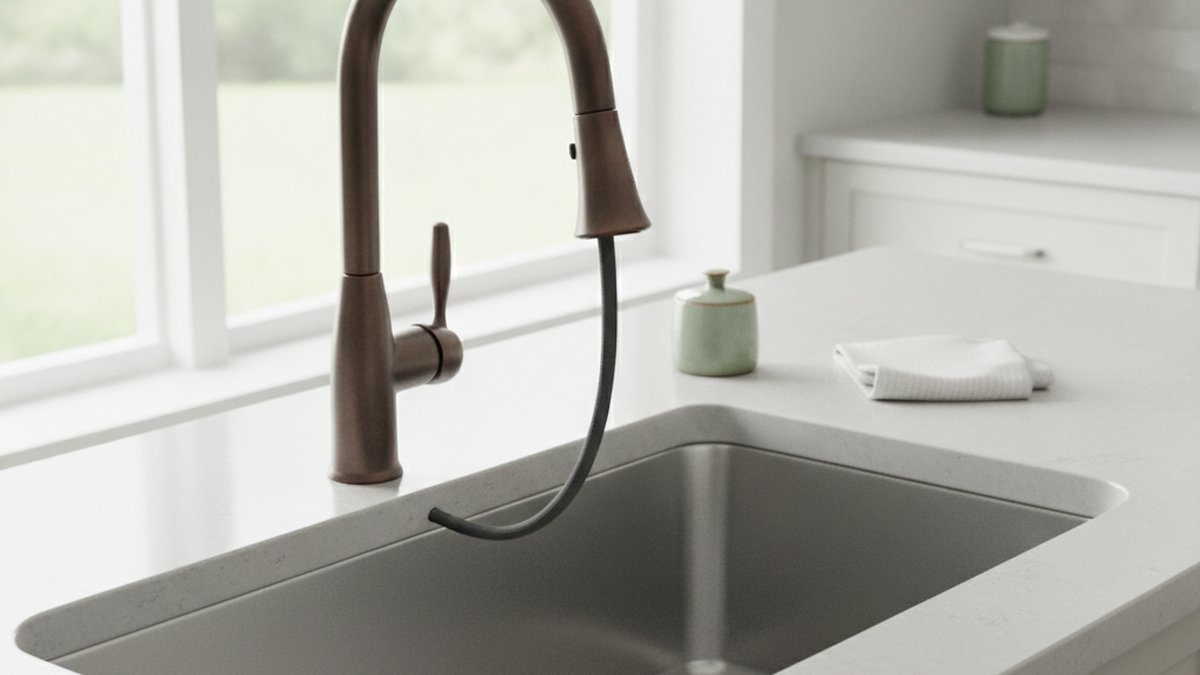
An oil rubbed bronze faucet on stainless sink setups is one of the most-searched “will this clash?” questions in kitchens and bathrooms right now, and the honest answer is that it works far more often than people fear. The trick is understanding why it works: oil rubbed bronze (ORB) is a warm, dark, almost espresso-brown finish with copper-toned high points, while stainless is a cool, neutral silver-gray. Warm-against-cool is exactly the kind of intentional contrast interior designers pay for — the same logic behind black hardware on white cabinets. It only reads as a “mistake” when the two metals fight for the same job with no supporting cast, so the whole game is contrast plus a little repetition.
Below I’ll walk through when this pairing sings, when it falls flat, how to tie it together, what it costs, and how to keep that bronze finish looking right for years. This is written for real kitchens and bathrooms — not a moodboard.
Will an oil rubbed bronze faucet clash with my stainless steel sink?
No — a brushed or satin stainless sink and an oil rubbed bronze faucet do not clash; they contrast, and contrast is the point. The two finishes sit at opposite ends of the warm/cool spectrum, so instead of competing they frame each other. Your eye reads the bronze faucet as a deliberate focal point and the steel sink as a quiet, neutral basin underneath it.
Where people get burned is with the wrong kind of stainless. A high-shine, mirror-polished sink throws sharp silver reflections that make the matte bronze look muddy and accidental next to it. A brushed, satin, or “matte” stainless finish has the same low-sheen quality as ORB, so the two finishes feel like they belong to the same family even though the colors differ. If your sink is already mirror-polished, you can still make it work — you just need to lean harder on repeating the bronze elsewhere so the contrast reads as a scheme, not a slip.
One more thing that quietly determines success: undertone. Cheap “bronze” finishes can skew reddish or orange, which fights the neutral gray of steel. A good oil rubbed bronze leans brown-black with subtle copper highlights — that brown-black is what harmonizes with stainless. If you’re shopping, look at the faucet in daylight, not showroom LEDs.
What kind of stainless sink works best with oil rubbed bronze?
A brushed or satin-finish stainless sink in a 16–18 gauge thickness is the ideal partner for oil rubbed bronze. The matte-on-matte relationship keeps both finishes calm, and the thicker gauge (16 is heaviest, 18 is standard) resists the “oil-canning” flex and drumming that makes a cheap sink feel tinny — which matters because a substantial sink visually holds its own against a bold bronze faucet.
Here’s how the common stainless finishes stack up against ORB:
| Stainless sink finish | Pairs with ORB? | Why |
|---|---|---|
| Brushed / satin | Best | Matte-on-matte; both finishes read intentional and low-glare |
| Matte / “gunmetal” stainless | Excellent | Darker steel narrows the contrast for a moody, cohesive look |
| Mirror-polished | Workable | Needs extra bronze accents to balance the shine; can look mismatched alone |
| Fingerprint-resistant PVD stainless | Very good | Slightly warmer steel tone bridges toward the bronze nicely |
Sink mount style matters less than finish, but an undermount stainless sink tends to flatter ORB more than a top-mount (drop-in) because the clean countertop edge lets the bronze faucet be the star. If you’re pairing bronze with a workstation or apron-front stainless sink, the same rules apply — just make sure the sink’s own accessories (grid, colander, cutting board rails) don’t introduce a third competing metal.
How do I tie the two finishes together so it looks intentional?
Repeat the bronze at least once — ideally twice — somewhere near the sink, and the whole pairing instantly reads as a designed choice instead of a leftover faucet. Metal mixing looks accidental only when a finish appears exactly once. The moment ORB shows up in two or three spots, your brain files it as “the accent metal.”
Easy, low-cost ways to echo the bronze around a stainless sink:
- Matching drain or basket strainer in oil rubbed bronze — the single highest-impact move, because it sits right in the steel sink and links the two metals directly.
- Cabinet hardware — bronze pulls or knobs on the sink base cabinet.
- Soap dispenser mounted in the deck next to the faucet, in matching ORB.
- Lighting — a bronze pendant or sconce above the sink.
- Bathroom carryover — towel bar, robe hook, or a matching ORB drain if this is a bath vanity.
You do not need everything in bronze. A common rule of thumb is roughly 80% of your dominant metal (here, stainless plus whatever appliances you have) and 20% accent bronze. Two supporting bronze pieces near a stainless sink is usually enough to lock it in. If you’re switching finishes and pulling the old faucet first, our guide on how to remove an old faucet from a sink without wrecking it will save you a scratched deck and a snapped supply line.
Oil rubbed bronze vs. matte black vs. brushed gold on a stainless sink — which finish should I pick?
Choose oil rubbed bronze if you want warmth and an aged, traditional character; choose matte black for a crisp modern contrast; choose brushed gold/brass for a softer, lighter warm tone. All three pair with stainless, but they send different messages. ORB is the coziest and most forgiving of the three on a busy stainless sink because its brown-black hides water spots and fingerprints better than almost any other finish.
| Faucet finish | Look on stainless | Hides water spots? | Best for |
|---|---|---|---|
| Oil rubbed bronze | Warm, high-contrast, traditional | Excellent | Farmhouse, transitional, warm kitchens |
| Matte black | Bold, graphic, modern | Very good | Contemporary, industrial spaces |
| Brushed gold / champagne bronze | Soft, luxe, warm-cool blend | Good | Light, airy, modern-glam rooms |
| Brushed nickel | Low contrast, safe, blends in | Good | Buyers who want it to disappear |
If you’re torn between the warm and the moody route, it’s worth reading how these dark finishes behave in a real bathroom — our take on the Jacuzzi matte black faucet and our comparison piece on a matte black kitchen faucet with side sprayer both dig into contrast, upkeep, and how bold finishes read day to day. And if you’re leaning the opposite direction — bright and light — our breakdown of a kitchen faucet in white shows how a non-metal finish plays against steel.
Is oil rubbed bronze hard to keep clean on an everyday kitchen sink?
No — oil rubbed bronze is actually one of the easiest finishes to keep looking good day to day, because its dark, low-sheen surface camouflages water spots, fingerprints, and toothpaste splatter that would scream on chrome or polished stainless. The catch is long-term care: ORB is a “living finish,” meaning the top coat can wear over years of heavy use and expose brighter copper at high-touch points like the handle and spout tip.
For most people that gentle aging is a feature, not a flaw — it’s why ORB looks great in traditional and farmhouse kitchens. But if you want it to stay uniform, follow a few rules:
- Wipe with a soft, damp cloth and dry it. That’s 95% of ORB care.
- Never use abrasive pads, scouring powders, or acidic descalers directly on the finish — they strip the protective coating and accelerate wear.
- Skip the vinegar/CLR soak on the faucet body. Hard-water descalers are fine for the aerator and showerheads but harsh on bronze. If you battle hard water, learn to clean the aerator specifically — our guide on cleaning a faucet head with CLR shows how to descale the parts that need it without touching the finish.
- Occasional wax — a thin coat of car or furniture wax once or twice a year adds a sacrificial layer that slows wear on a genuine ORB finish.
Worth knowing: many modern “oil rubbed bronze” faucets are actually a durable PVD (physical vapor deposition) bronze-tone coating, not the old lacquer-over-bronze. PVD is far more scratch- and wear-resistant and won’t patina much at all. If a consistent, unchanging color matters to you, buy a PVD-finished ORB faucet and check the spec sheet — reputable brands, Adeaga included, state the coating type and back it with a finish warranty.
Does an oil rubbed bronze faucet on a stainless sink hurt resale value?
No, a well-executed bronze-on-stainless kitchen or bath doesn’t hurt resale — buyers respond to a cohesive, cared-for space far more than to any single metal choice. What hurts resale is a room that looks unfinished or mismatched, and that’s a repetition problem, not an ORB problem. A stainless sink with a lonely bronze faucet and chrome cabinet pulls looks accidental; the same sink with a matching bronze drain and bronze pulls looks designed.
Two practical resale notes. First, oil rubbed bronze reads slightly more traditional than matte black or brushed gold, so it shows best in transitional and warm-toned homes; in an ultra-modern space, matte black may photograph better for a listing. Second, faucets are cheap and easy to swap compared to cabinets or countertops — so this is a low-risk finish decision. If a future buyer hates it, it’s a 30-minute change, not a renovation.
What should I budget for a quality oil rubbed bronze faucet?
Plan on roughly $90–$180 for a solid mid-range oil rubbed bronze kitchen faucet, $60–$140 for a bathroom faucet, and $200+ for premium pull-downs with PVD finishes and ceramic-disc cartridges. Below about $70, you’re often getting a thin lacquer coating over zinc that will wear and chip within a couple of years — which is exactly where ORB earns its “peeling finish” bad reputation.
Where your money actually goes in a bronze faucet:
- Finish type — PVD bronze costs more than lacquered bronze but lasts dramatically longer.
- Valve/cartridge — a ceramic-disc cartridge is the difference between a drip-free decade and a leaky first year.
- Body material — solid brass under the bronze resists corrosion; zinc or plastic bodies don’t.
- Spray/pull-down mechanics — a nylon-braided, retractable hose and a magnetic dock are worth paying for in a kitchen.
Look for faucets certified to NSF/ANSI 61 and 372 (safe drinking-water contact and lead-free compliance) and cUPC listing — these are the standards that matter for anything you drink from. A lifetime finish-and-function warranty is the strongest signal a brand actually trusts its bronze coating.
FAQ
Can you mix oil rubbed bronze and stainless steel in the same kitchen?
Yes. Mixing oil rubbed bronze and stainless is a proven warm-cool pairing. Keep the stainless as your dominant metal (sink, appliances) and use bronze as the accent in the faucet plus one or two supporting pieces like the drain or cabinet pulls. That repetition is what makes the mix look intentional.
Does oil rubbed bronze go with a black granite or white quartz countertop?
Both work well. Oil rubbed bronze pops beautifully against light quartz or marble because the dark finish becomes a focal point, and it blends warmly into black granite or dark quartz for a moody, cohesive look. With very busy stone, a solid bronze faucet gives the eye a calm anchor.
Will an oil rubbed bronze faucet fit a standard stainless sink?
Yes, finish has nothing to do with fit. What matters is the hole configuration — a single-hole, three-hole (widespread/centerset), or deck-plate setup — and whether the sink or countertop matches. Check your existing hole count and spacing before buying, and use a deck plate to cover extra holes if you’re going from a three-hole to a single-hole faucet.
Why does my oil rubbed bronze faucet look like it’s turning copper?
That’s the “living finish” wearing at high-touch points, exposing the brighter metal beneath the dark top layer. On a lacquered ORB faucet it happens over years of use and is normal (many people love it). If you want to avoid it entirely, choose a PVD-coated oil rubbed bronze faucet, which resists wear and holds its color.
Is oil rubbed bronze out of style in 2026?
No. While matte black and warm brass have grabbed headlines, oil rubbed bronze remains a staple in farmhouse, transitional, and traditional kitchens and baths because of its warmth and forgiving upkeep. It’s a classic accent finish, not a passing trend — and because faucets are easy to swap, it’s a low-risk choice regardless.
Should the drain and faucet match on a stainless sink?
Ideally, yes — a matching oil rubbed bronze drain or basket strainer is the single most effective way to tie a bronze faucet to a stainless sink. It places the accent metal directly inside the steel basin, which visually links the two finishes and makes the whole pairing read as deliberate.
The bottom line — and a note from our team
An oil rubbed bronze faucet on a stainless sink is a confident, warm, high-contrast choice that looks intentional as long as your sink is brushed rather than mirror-polished and you echo the bronze in a drain, pull, or fixture nearby. Buy a PVD or solid-brass model certified to NSF/ANSI 61/372, keep the care simple, and you’ll get a faucet that both photographs well and lasts.
Author note: This guide was written by the Adeaga fixtures team, drawing on years of hands-on faucet installation, finish testing, and customer feedback across thousands of kitchen and bath orders. Adeaga designs and stress-tests its faucets to cUPC and NSF/ANSI standards and backs its finishes with a warranty, because we’d rather you keep the faucet than return it. Finish trends come and go — a faucet that seals, sprays, and holds its color is what you actually live with.