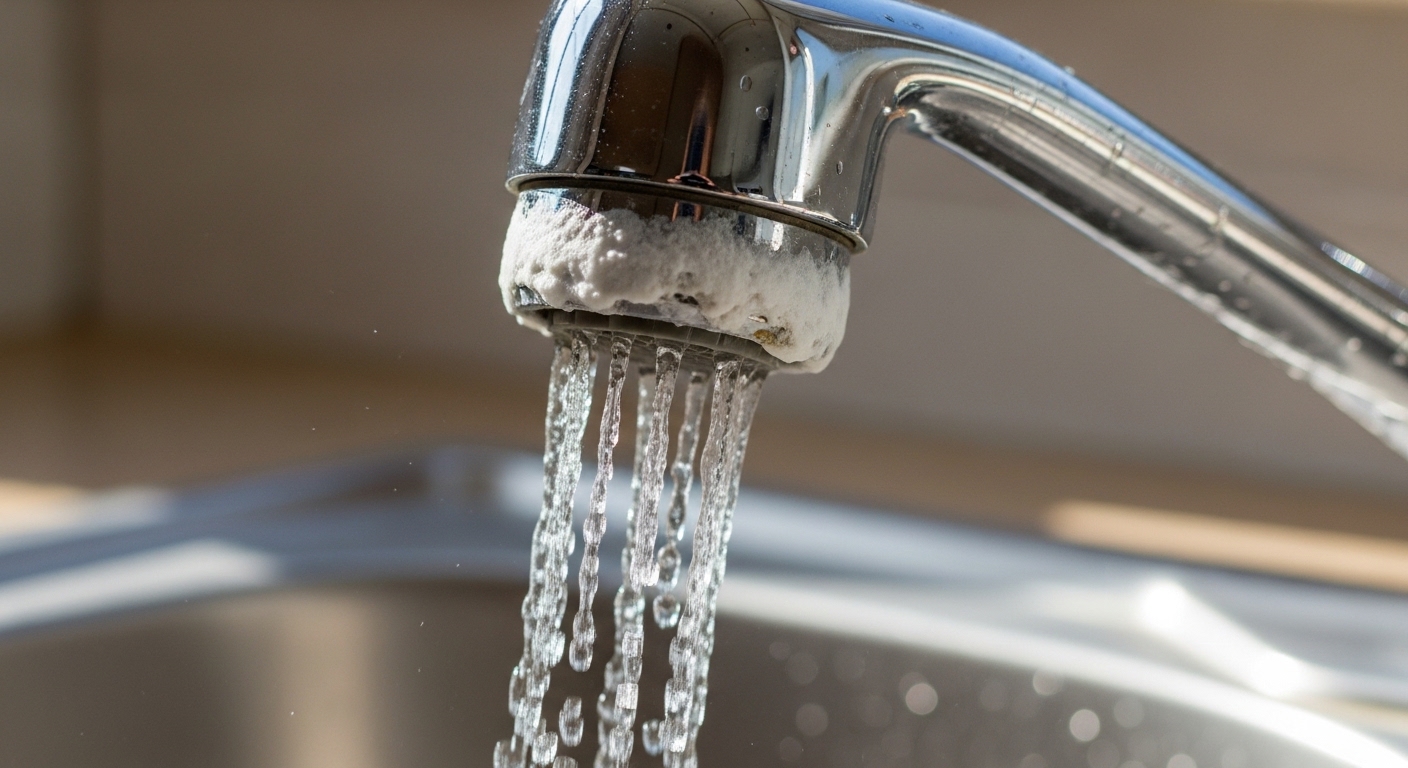
If you’ve been searching how to clean faucet head with CLR, you’re almost certainly staring at a faucet that sputters, sprays sideways, or trickles out half the water it used to. That white, crusty, chalky buildup is calcium and magnesium — hard water minerals — clogging the tiny holes in your aerator. CLR (Calcium, Lime & Rust remover) is one of the fastest ways to dissolve it, but it’s also strong enough to ruin certain finishes if you use it wrong. This guide walks you through exactly how to do it safely, how long to soak, what CLR is safe on, and when you should reach for vinegar instead.
Is CLR safe to use on my faucet head, or will it damage the finish?
CLR is safe on chrome, stainless steel, and solid brass — but it is not safe on natural stone, anodized aluminum, colored/coated finishes, brushed gold, oil-rubbed bronze, or old worn plating. The rule of thumb: if the finish is a thin decorative coating rather than solid metal, CLR’s acids can strip, cloud, or discolor it in minutes.
CLR works because it’s acidic (it contains lactic acid and gluconic acid). That acid is exactly what eats through limescale — but the same chemistry attacks soft or coated surfaces. Before you soak anything, figure out what your aerator is actually made of. Most standard kitchen and bathroom aerators are chrome-plated brass, which handles a short CLR soak fine. Trendy PVD finishes like matte black, brushed gold, and champagne bronze are a different story — those are coatings, and I’d keep CLR off them entirely.
| Faucet finish / material | CLR safe? | Recommended approach |
|---|---|---|
| Chrome-plated brass | Yes — max 2 min soak | CLR 1:1 with warm water |
| Stainless steel | Yes — max 2 min soak | CLR 1:1 with warm water |
| Solid/polished brass | Short soak only | CLR briefly, or white vinegar |
| Matte black / PVD coated | No | White vinegar soak only |
| Brushed gold / champagne bronze | No | White vinegar soak only |
| Oil-rubbed bronze | No | Warm soapy water + soft brush |
| Anodized aluminum | No | White vinegar, diluted |
| Natural stone nearby | Protect it | Cover stone; acids etch it |
When in doubt, do a spot test: dab a little diluted CLR on a hidden part of the aerator, wait 60 seconds, and rinse. If the finish dulls or changes color, stop and switch to vinegar.
How do I actually clean a faucet head with CLR, step by step?
The safe method is to remove the aerator, soak it in a 1:1 CLR-and-water mix for up to 2 minutes, scrub, and rinse hard. Removing the aerator is far better than bagging CLR around the whole faucet, because it limits the acid to just the part that’s clogged and keeps it off your decorative finish.
Here’s the full process:
- Turn off the faucet and lay a towel or rubber mat in the sink so you don’t lose small parts down the drain.
- Unscrew the aerator from the tip of the spout. Turn by hand first (righty-tighty, so lefty-loosey from your view looking up). If it’s stuck, wrap the aerator in a cloth and use pliers gently. Our guide on the faucet aerator washer shows how the parts stack together so you can reassemble in the right order.
- Disassemble the aerator into its screen, washer, and housing. Note the order — take a phone photo if you’re unsure.
- Mix 1 part CLR to 1 part warm water in a small glass or plastic bowl. Never use hot water (it makes the fumes worse) and never use a metal bowl for stone-safe reasons.
- Soak for up to 2 minutes. That’s the maximum on plated parts. For solid stainless or brass you can push a little longer, but check every couple of minutes.
- Scrub the holes with an old toothbrush. Poke stubborn holes clear with a toothpick or a straightened paperclip.
- Rinse under running water for at least 30 seconds. This is the step most people rush — any CLR residue left behind can keep etching and will taste and smell chemical.
- Reassemble and screw back on hand-tight, then run the faucet for 15–20 seconds to flush the line.
Wear gloves and work in a ventilated room. CLR is a real acid; it stings on broken skin and the fumes aren’t pleasant. If you get it on your hands, rinse right away.
How long should I soak the faucet head in CLR?
Two minutes is the safe maximum for chrome-plated and coated-brass aerators; CLR’s own label warns not to leave it on brass, copper, or coated metals longer than that. For solid stainless steel you can extend to 5–10 minutes if the buildup is severe, checking often.
The mistake people make is thinking “longer is better.” With CLR, longer just means more risk to the finish for very little extra cleaning power — the acid does most of its work in the first 60–90 seconds. If two minutes doesn’t fully clear the deposits, it’s better to rinse, scrub, and repeat a second short soak than to leave the part sitting in acid for 20 minutes. Heavy, rock-hard scale sometimes needs two or three short cycles rather than one long one.
Can I use vinegar instead of CLR to clean my faucet head?
Yes — white vinegar is the gentler, food-safe alternative and it’s what I recommend for any coated or colored finish (matte black, brushed gold, bronze). It’s slower than CLR, so you soak longer: 30 minutes to overnight depending on how bad the buildup is.
| Factor | CLR | White vinegar |
|---|---|---|
| Speed | 1–2 minutes | 30 min – overnight |
| Strength on heavy scale | Very strong | Moderate |
| Safe on coated finishes | No | Yes (still rinse well) |
| Fumes / handling | Ventilate, wear gloves | Mild, food-safe |
| Cost | ~$5–8/bottle | ~$3/gallon |
For most people with an ordinary chrome faucet and stubborn buildup, CLR is the faster fix. For a delicate finish or if you just prefer something you already have in the pantry, warm white vinegar in a bag rubber-banded around the aerator overnight works well. If your aerator is on an expensive fixture and you’re seeing recurring clogs, it may be worth reading up on whether the part itself needs replacing — our piece on a clogged tap aerator covers when cleaning stops being worth it.
Why does my faucet head keep clogging even after I clean it?
If buildup comes back within weeks, the problem isn’t your cleaning — it’s your water. Hard water (high in calcium and magnesium) constantly redeposits minerals, so aerators in hard-water homes need cleaning every 1–3 months instead of once a year.
A few things drive fast re-clogging:
- High water hardness — anything above ~120 mg/L as calcium carbonate is “hard,” and above 180 mg/L is “very hard.” The harder your water, the faster scale forms.
- A failing water heater or old galvanized pipes shedding sediment and rust flakes into the line.
- A worn aerator screen that no longer seals, letting debris lodge in the mesh.
- Debris after plumbing work — solder bits and pipe scale often land in the nearest aerator.
If you’re on very hard water, consider a whole-house softener or at least keep a spare aerator on hand so you can swap while one soaks. And if you notice the drip or spray stays wrong even after a spotless aerator, the issue may be upstream in the cartridge rather than the head — that’s a different repair, and worth diagnosing before you keep re-cleaning a part that isn’t the culprit.
What should I avoid doing when cleaning a faucet head with CLR?
The biggest mistakes are soaking too long, using CLR on the wrong finish, and skipping the rinse. Any one of them can leave you with a discolored spout or a chemical aftertaste in your water.
- Don’t soak plated parts beyond 2 minutes. More time doesn’t dissolve minerals meaningfully faster — it just risks the finish.
- Don’t use CLR on stone, coated, or colored finishes. Cover any nearby granite or marble; acid etches stone permanently.
- Don’t mix CLR with bleach or ammonia. That combination creates toxic fumes.
- Don’t skip the rinse. 30 seconds under running water, minimum, on every piece.
- Don’t over-tighten on reassembly. Hand-tight plus a light nudge is enough; cranking it cracks the washer and causes leaks.
Full-strength CLR is meant for tougher jobs like toilet bowls and coffee makers — for a faucet aerator, dilute it 1:1. Straight CLR on a delicate part is asking for trouble.
FAQ
Can I clean the faucet head with CLR without removing the aerator?
You can, but it’s riskier. Fill a small plastic bag with diluted CLR, rubber-band it around the spout so the aerator is submerged, and leave it no longer than 2 minutes before removing and rinsing. The downside is CLR then contacts your decorative finish, so removing the aerator is always the safer choice when you can.
Is CLR safe for drinking water fixtures?
Yes, as long as you rinse thoroughly. CLR is used to clean kettles, coffee makers, and dishwashers, so brief contact with a drinking-water faucet is fine — but you must flush the aerator and run the tap for 15–20 seconds afterward so no residue remains.
Will CLR remove rust stains from a faucet head too?
Yes. The “R” in CLR stands for rust, and it dissolves iron staining along with calcium and lime. If your aerator has orange-brown staining from iron in the water or old pipes, the same 1–2 minute soak usually clears it. Heavier rust may need a second short cycle.
How often should I clean my faucet aerator?
Once a year for soft or moderately hard water, and every 1–3 months for very hard water. If you notice reduced flow, uneven spray, or sputtering, clean it right away regardless of the calendar — those are the early signs of buildup.
What if the aerator is stuck and won’t unscrew for cleaning?
Wrap it in a cloth to protect the finish and use slip-joint pliers with gentle, steady pressure. If it’s seized by mineral deposits, wrap a vinegar-soaked cloth around the joint for 15–30 minutes first to loosen the scale, then try again. Avoid heat guns or excessive force, which can crack the spout.
Can I use CLR on a matte black or brushed gold faucet head?
No. Those are PVD or painted coatings that CLR’s acids can dull or strip. Use warm white vinegar instead, soak it longer, and rinse well. When in doubt about a coated finish, skip CLR entirely.
A quick note from our team
This guide was written by the Adeaga fixtures team, drawing on hands-on testing of aerator cleaning methods across chrome, stainless, and PVD-coated faucets in real hard-water conditions. Adeaga specializes in faucets and bathroom fixtures, and we build our care recommendations around manufacturer finish-care guidance and the ANSI/ASME A112.18.1 standard that governs faucet performance and aerator flow rates — the same standard behind the labeled flow ratings on the products we sell. We follow CLR’s own manufacturer guidance on soak times and finish compatibility, and we always err toward the gentler method when a finish’s warranty could be at risk, since acid damage from misuse is generally not covered. When a part is too far gone to clean, we’d rather point you to a $5 replacement aerator than have you damage a $200 faucet.
If your faucet troubles go beyond a clogged head — a persistent drip, a spray that won’t correct, or a stem that keeps leaking — cleaning won’t fix a worn internal part. In those cases, see our walkthrough on replacing a bathroom faucet stem, which covers the repair most people mistake for a “dirty” faucet.