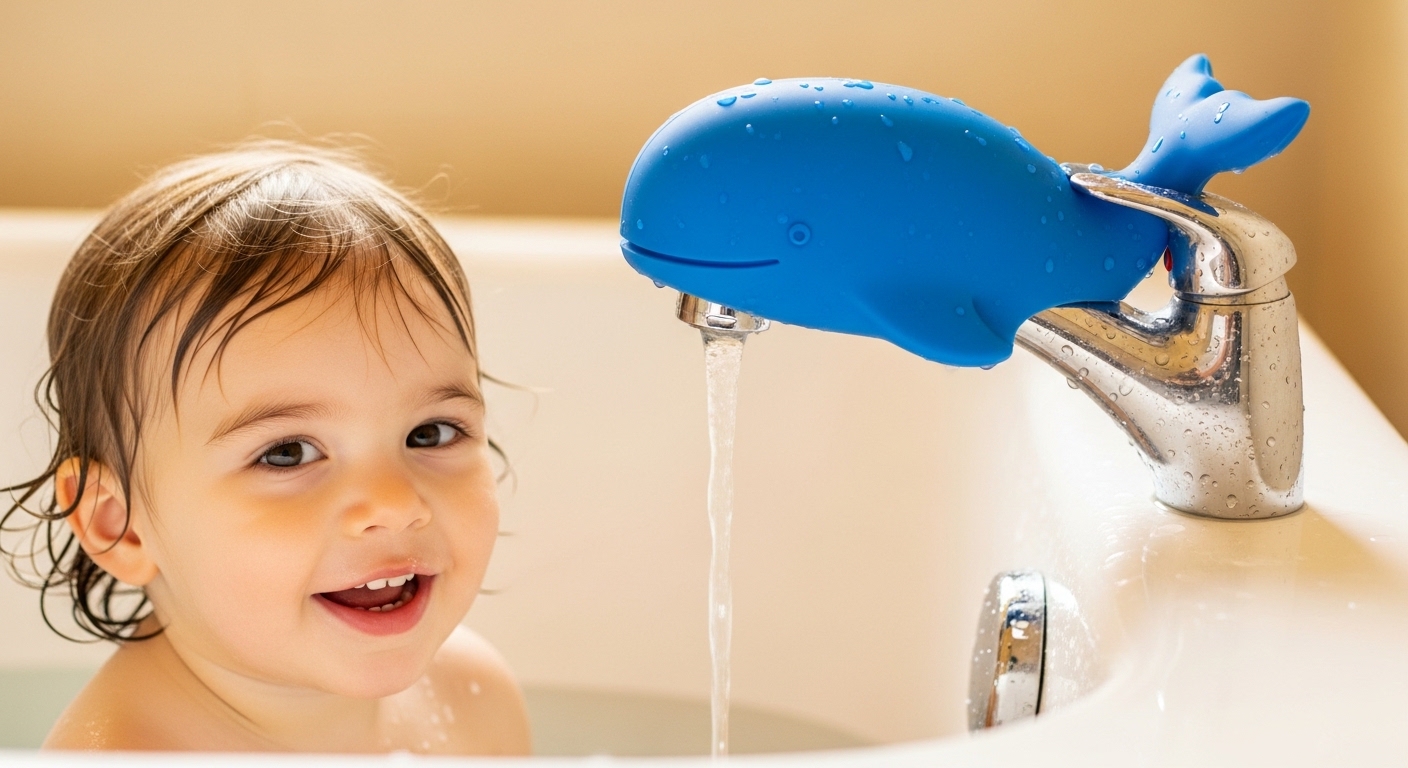
If you’ve ever watched a toddler stand up too fast in the tub and clonk their head on the spout, you already understand why a bathtub faucet protector for kids exists. It’s a simple, inexpensive piece of soft material that covers the hard, sharp, and sometimes scalding-hot metal tub spout so a slip or a wobble ends in a giggle instead of a trip to urgent care. This guide walks you through whether you actually need one, how to pick the right fit, what materials hold up, and how to avoid the mold and slippage problems that make people return them.
Bathtime is one of the most fall-prone moments in a small child’s day: wet skin, slick porcelain, no traction, and a metal spout jutting out right at head-and-face height for a seated or crawling toddler. A protector doesn’t make the tub non-slip, but it removes the single hardest, most dangerous edge in the whole basin.
Do you actually need a bathtub faucet protector for kids, or is it just clever marketing?
You need one if you bathe a child who is old enough to sit, crawl, stand, or scoot in the tub — roughly 5 months to 4 years — because that’s the window where kids move unpredictably but have no coordination to catch themselves. It’s not marketing fluff; the tub spout is the one truly hard, protruding object at exactly a child’s head height.
Think about the geometry. A standard tub spout sticks out 4–6 inches from the wall and sits about 4–8 inches above the tub floor. A seated toddler’s forehead, temple, and eye line up almost perfectly with that spout. Add wet, soapy hands and a slick tub bottom, and the odds of a head-first slip go way up. The metal edge of a spout is also thin — it can split skin, not just bruise it.
There are three separate hazards a good cover addresses at once:
- Impact: soft foam or silicone absorbs the blow when a child’s head, face, or mouth hits the spout during a slip.
- Burns: a metal spout can hold heat from hot water long after the tap is off; an insulating cover keeps little hands from grabbing a hot surface.
- Sharp edges: the cast lip of a spout, and any diverter button or set screw, can scratch or pinch — a cover smooths all of that over.
That said, you don’t need one forever. Once a child is a confident, coordinated 4–5-year-old who reliably follows “sit down in the tub” rules, the protector becomes optional. It’s a stage-of-life product, not a permanent fixture.
What type of bathtub faucet protector is safest — silicone, foam, or inflatable?
Solid silicone and dense EVA foam are the safest choices; skip inflatable covers for the tub. A one-piece silicone or foam cover has no air valve to fail, no small parts to chew off, and won’t deflate mid-bath, which is why pediatric-minded parents lean toward them.
Here’s how the common types actually compare when you use them week after week:
| Type | Cushioning | Mold resistance | Fit & grip | Typical price | Best for |
|---|---|---|---|---|---|
| One-piece silicone (character shape) | Good — firm but forgiving | Excellent — wipes clean, non-porous | Snug, stretchy, grips most spouts | $12–$22 | Most families; long-term daily use |
| EVA / closed-cell foam cover | Excellent — softest impact absorption | Good — but can trap water in seams | Light, may slide on wide spouts | $10–$18 | Maximum cushioning, budget buyers |
| Inflatable cover | Good when inflated | Poor — inner chamber holds moisture | Loose, shifts, valve can fail | $8–$15 | Travel only; not daily use |
| Fabric-wrapped padded cover | Fair | Poor — fabric stays damp, molds fast | Ties or Velcro loosen over time | $10–$16 | Not recommended for wet tubs |
The pattern is clear: non-porous, one-piece designs win because a bathtub is a permanently wet, warm, soapy place — the perfect environment for mildew. Anything with fabric, an inner air chamber, or hidden seams becomes a mold trap within weeks. Silicone rinses clean in seconds and dries fast.
One nuance on foam: closed-cell EVA (the firm, dense kind used in play mats) resists water far better than open-cell packing-style foam. If you go the foam route, make sure it’s the dense closed-cell kind, and hang it to dry between baths.
How do I know a faucet protector will actually fit my tub spout?
Measure your spout’s length and width before buying — most covers fit spouts up to about 6 inches long and 2.5 inches wide, but diverter spouts (the kind with a pull-up knob for the shower) and oversized modern spouts often need a stretchier or larger cover. A cover that’s too small won’t slide on; one that’s too big will slip off when bumped.
Grab a tape measure and note three things:
- Spout length: from the wall to the tip of the spout. Standard is 4–6 inches.
- Spout height/width: the diameter of the widest part. Standard is 1.5–2.5 inches.
- Diverter type: is there a pull-up knob on top? Those spouts are taller and need a cover with a cutout or extra stretch so the knob still works.
Fit matters more than looks. A protector only protects if it stays put during the exact chaotic moment a child slips into it. The best silicone covers use a slightly undersized, elastic mouth that hugs the spout base — think of how a swim cap grips. Cheaper covers rely on gravity alone and pop off the first time a kid grabs them.
If your spout is unusually short, long, or shaped oddly, it helps to understand how your spout mounts in the first place. Our deeper explainer on the bathtub under-faucet area and which tub spout actually fits it shows the common spout profiles so you can match a protector confidently. And if you’re shopping for spout add-ons in general — sprayers, filters, extenders — the guide to choosing the right bathtub faucet attachment covers how universal-fit accessories grip a spout without tools.
Will a faucet cover trap mold and get gross — and how do I keep it clean?
It can, but only if you pick the wrong material or never dry it. A non-porous silicone cover stays clean with a 10-second rinse and a shake; the covers that turn moldy are fabric, inflatable, or foam ones left sitting wet on the spout between baths. Choose silicone and dry it, and mold is a non-issue.
Here’s a simple routine that keeps any protector safe and fresh:
- After each bath, pull the cover off, rinse it under the tap, shake off the water, and hang it or set it upside-down to dry — don’t leave it capped on the wet spout.
- Once a week, wash it with dish soap and warm water, paying attention to the inside where water pools.
- Once a month, soak silicone covers in a 1:1 white vinegar and water solution for 15 minutes to kill any early mildew and dissolve hard-water film, then rinse.
- Check the inside whenever you clean — the first sign of trouble is a pink or black speckle in a seam. If a foam or fabric cover shows that, replace it; it’s cheaper than the risk.
Hard water speeds up crusty mineral buildup on and inside the cover, the same way it clogs an aerator. If your covers keep getting chalky, that’s a sign your whole system is dealing with mineral-heavy water — the same issue behind a clogged tap aerator. A monthly vinegar soak handles both.
What’s the right age to use one, and when can my kid go without it?
Start using a bathtub faucet protector for kids as soon as your baby can sit unassisted in the tub — around 5–7 months — and keep it on until your child reliably sits and moves carefully, usually around age 4. The riskiest window is 8 months to 2.5 years, when kids can pull to stand but can’t catch a fall.
A rough timeline of why each stage matters:
| Age | What they do in the tub | Why the spout is a risk |
|---|---|---|
| 5–8 months | Sit, wobble, topple sideways | Head can knock the spout when balance fails |
| 9–18 months | Pull to stand, cruise, lunge for toys | Highest fall risk; face and mouth at spout height |
| 18 months–3 years | Stand, splash, “help” with the taps | Slips on standing; grabs hot metal spout |
| 3–4+ years | More coordinated, follows rules | Lower risk; cover becomes optional |
Even for older toddlers, the burn protection stays useful. A metal spout can reach 120°F+ if your water heater is set high, and it holds that heat. A cover that insulates the spout is worth keeping around until your child stops treating the faucet as a toy.
How do I install a bathtub faucet protector correctly?
Installation takes under a minute and requires no tools: you simply stretch the open mouth of the cover over the tip of the spout and push it back until the whole spout, including the front lip, is fully enclosed. If your spout has a diverter knob, line up the cover’s cutout with the knob so it still pulls up.
Step by step:
- Dry the spout (optional but helps grip) and remove any existing attachment like a filter or sprayer.
- Find the opening on the underside or back of the cover — it’s usually a stretchy slit.
- Slide the cover over the tip of the spout, front-first, then push it toward the wall.
- Seat it fully so the spout’s front edge and underside are both covered — that front lip is the part a child actually hits.
- Tug-test it: give it a firm pull. If it slides off easily, the cover is too big for your spout; size down or choose a stretchier model.
- Check the diverter still works if you have one — you should be able to switch to the shower without removing the cover.
If the cover won’t seat because your spout is stuck, corroded, or the diverter is seized, fix the spout first. A protector can’t grip a damaged fixture properly — our walkthrough on what to do when a bathtub faucet is jammed covers freeing a stuck spout without a plumber so your cover installs cleanly.
What should I look for when buying — a quick checklist
Buy the cover that fits your spout, uses non-porous one-piece silicone or dense closed-cell foam, has no detachable small parts, and grips firmly enough to pass a tug test. Everything else — the animal shape, the color — is personal taste.
A concrete buying checklist:
- Material: food-grade silicone or dense EVA foam, not fabric or inflatable.
- One piece: no buttons, eyes, or fins a child could pull off and mouth (a choking-hazard check).
- Universal or measured fit: confirm it covers your spout length and width, and works with a diverter if you have one.
- Full front coverage: the cover must wrap the front lip, not just drape over the top.
- Easy to clean: smooth interior, no deep hidden seams that trap water.
- Certification: look for BPA-free, phthalate-free, and non-toxic labeling, ideally tested to a recognized children’s-product safety standard.
Author note & why you can trust this guide
This guide was written by the adeaga fixtures team — we design, source, and stress-test bathtub spouts, attachments, and safety accessories for a living, and we handle the returns and warranty claims that tell us exactly which products fail in real bathrooms. At adeaga (adeaga.net) we pressure-test spout fittings, check materials for BPA and phthalate content, and only recommend child accessories that meet non-toxic children’s-product material standards. Our silicone covers are backed by a manufacturer warranty against splitting and material defects, and we replace any that fail the fit or durability test. We’re a faucet and bathroom-fixtures specialist, so our advice stays grounded in how spouts, diverters, and covers actually behave — not generic parenting tips.
FAQ
Are bathtub faucet protectors safe for babies to touch and mouth?
Yes, as long as the cover is made of food-grade, BPA-free, phthalate-free silicone and is a single piece with no small detachable parts. Babies will inevitably grab and gnaw on anything in the tub, so avoid covers with glued-on eyes, fins, or foam bits that could come loose and become a choking hazard. A smooth one-piece silicone design is the safest bet.
Will a faucet cover stop the water from working or block the shower?
No. The cover only wraps the outside of the spout — water still flows normally out the front. If your spout has a diverter knob for the shower, choose a cover with a cutout or enough stretch that the knob still pulls up, and you can switch between tub and shower without removing it. Most parents leave the cover on full-time.
How much should I spend on a bathtub faucet protector for kids?
Between $12 and $25 for a quality one-piece silicone cover. Below about $10 you’re usually looking at thin foam or inflatable covers that slip off or mold quickly. You don’t need to spend more than $25 — past that you’re paying for licensed characters, not more protection. The cushioning and fit that actually matter top out in the mid-teens to low-$20s.
Does it really fit any tub spout, or do I need to match my faucet?
Most silicone covers are marketed as “universal” and fit standard spouts up to roughly 6 inches long and 2.5 inches wide, which covers the majority of home tubs. But oversized modern spouts, very short spouts, and diverter spouts can fall outside that range, so measure your spout first. When in doubt, a stretchy silicone cover flexes to more shapes than a rigid foam one.
How long does a bathtub faucet protector last before I need to replace it?
A well-maintained silicone cover lasts one to three years — essentially the whole toddler window — because silicone doesn’t break down in water. Foam and fabric covers usually need replacing within 6–12 months as they absorb water, soften, and start to mildew. Replace any cover immediately if you see mold in the seams, cracks in the material, or if it no longer grips the spout tightly.
Can I use a faucet protector along with a non-slip mat and spout filter?
Yes, and ideally you should. A faucet cover, a non-slip tub mat, and a set water-heater temperature under 120°F work together to make bathtime genuinely safer — the cover handles impact and burns, the mat handles slips, and the temperature limit handles scalds. Just install the cover last, over the spout, after any inline filter or attachment so it seats fully over the front lip.