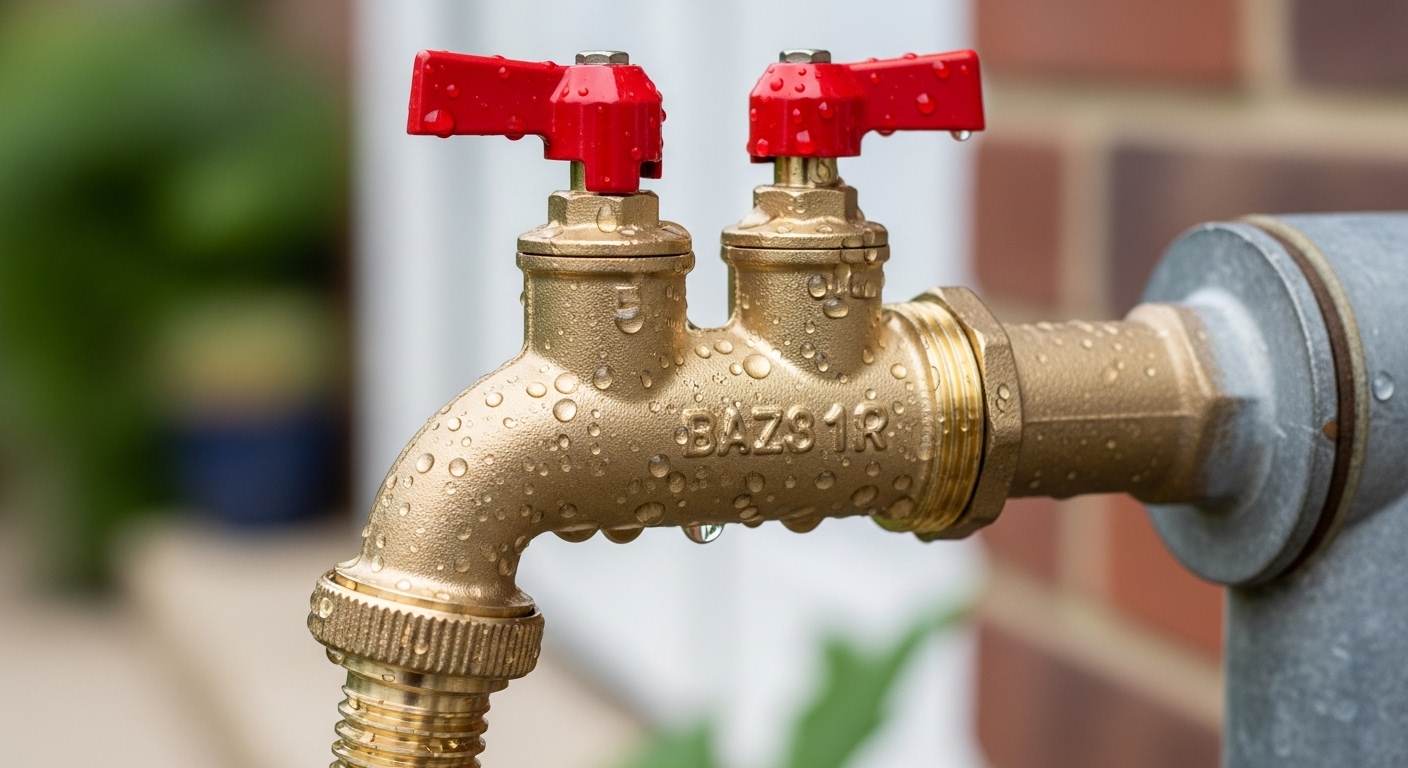
If you’ve been searching for a brass tap y splitter, you almost certainly have one faucet doing two jobs — an outdoor spigot feeding both a hose and a drip line, a laundry tap shared between a washing machine and a mop sink, or a bathroom faucet you want to split toward a handheld bidet. A Y splitter (sometimes called a “2-way tap connector” or “dual valve adapter”) solves that by giving you two independently controlled outlets from a single threaded outlet. The trick is choosing the right one, because the cheap versions fail fast and the wrong thread simply won’t fit. This guide walks through exactly what to look for, what it costs, and where a brass Y splitter beats plastic — in plain terms.
What exactly does a brass tap Y splitter do, and how is it different from a regular adapter?
A brass tap Y splitter takes one threaded water outlet and splits it into two separate outlets, each with its own valve so you can turn one side on while the other stays off. A plain adapter or coupler, by contrast, just changes a thread size or connects two hoses — it has no valves and no branching.
Think of it like a power strip for water. Your faucet is the single wall socket; the Y splitter is the two-outlet strip with individual switches. That “individual switches” part matters more than people expect. Without valves, splitting a line means both outlets run whenever the tap is open, and you’d have to physically cap the side you’re not using. With a proper Y splitter, you leave both accessories permanently connected — say, a hose and a pressure washer — and just flip the lever on whichever one you need.
The body shape is usually a literal “Y” or “T”: one inlet at the bottom, two angled outlets at the top. On better units, each outlet arm carries a quarter-turn lever valve (fully open to fully closed in a 90-degree flick) rather than a slow-turning screw knob. Quarter-turn ceramic-disc or ball valves are the ones you want — they’re faster, they don’t drip as they wear, and they survive far more open/close cycles.
Should I buy brass, or is a plastic Y splitter fine for my setup?
Buy brass if the splitter stays connected outdoors, handles line pressure, or gets used more than occasionally; plastic is only acceptable for light, seasonal, indoor-adjacent use where a failure wouldn’t cause damage. For anything permanent or pressurized, solid brass is the clear winner — it won’t crack in the cold, won’t get brittle in UV sunlight, and the threads won’t strip after a few hand-tightenings.
Here’s the honest breakdown. Plastic (usually ABS or nylon) splitters are cheap — often $5 to $10 — and they’re genuinely fine for a summer garden hose you disconnect every fall. But leave one on an outdoor tap through a freeze and the housing can split. Leave it in direct sun for two seasons and UV makes it chalky and brittle. And every time you over-tighten a plastic thread onto a metal faucet, you shave a little life off it.
One caution even within “brass”: a lot of budget listings say “brass” but mean zinc alloy with a brass-colored plating, or brass valves inside a plastic body. Real solid brass has weight to it — a proper 3/4-inch brass Y splitter feels dense and heavy in the hand. If a “brass” splitter is suspiciously light and cheap, it’s almost always zinc, which corrodes and can crack under freeze-thaw stress much like plastic. If you appreciate why a solid-brass build matters in a faucet body, the same logic that makes a pull-out kitchen tap in brass worth the money applies to the little splitter feeding it: mass and material are what survive years of pressure and temperature swings.
Brass vs. zinc vs. plastic Y splitters — a quick comparison
| Feature | Solid Brass | Zinc Alloy (“brass-look”) | Plastic (ABS/Nylon) |
|---|---|---|---|
| Typical price | $12–$30 | $8–$15 | $5–$10 |
| Freeze resistance | Excellent | Poor–fair | Poor (can crack) |
| UV / outdoor life | 10+ years | 2–5 years | 1–3 years |
| Thread durability | Very high | Moderate | Low (strips easily) |
| Pressure handling | High (mains + boost) | Moderate | Low–moderate |
| Best use | Permanent, outdoor, high-use | Light seasonal use | Temporary summer hose |
How do I know which thread size fits my tap?
Most garden and outdoor taps use a 3/4-inch GHT (Garden Hose Thread) in the US or a 3/4-inch BSP thread in the UK/EU, while indoor and bathroom taps vary widely — so measure before you buy. The single most common cause of a Y splitter that “won’t fit” is buying a garden-thread splitter for an indoor faucet, or mixing up GHT and BSP, which look similar but are not interchangeable.
Here’s how to figure out what you have without guessing:
- Look at the tap’s threads. External (male) threads on the spout mean you need a female-threaded splitter, and vice versa. Most outdoor spigots are male 3/4″.
- Measure the outside diameter of the threaded part. A 3/4″ GHT male thread measures about 1-1/16″ (26–27 mm) across the outside. Don’t go by the “3/4 inch” name alone — thread naming rarely matches the literal measurement.
- Check GHT vs. BSP vs. NPT. GHT (garden) and BSP (British) have different pitches; NPT (US pipe thread) is tapered and used for plumbing, not hoses. If you’re in the UK, you’re almost always dealing with BSP.
- For bathroom or kitchen faucets, the aerator often unscrews to reveal a standard 22 mm or 24 mm thread — you’ll usually need a faucet-to-hose adapter first, then the Y splitter.
If your faucet’s aerator is the connection point, it’s worth understanding how that part threads on and seals — the same fitting logic behind a faucet aerator washer is what makes a splitter seal cleanly against the spout instead of dribbling from the joint. A missing or wrong-durometer washer is the number-one reason a freshly installed splitter leaks at the top.
Can I connect a bidet or washing machine to a brass Y splitter?
Yes — a brass Y splitter is one of the most reliable ways to feed a non-electric bidet, a portable washing machine, or a utility sprayer from a tap you already use, precisely because each outlet has its own shut-off. You run your normal tap or hose off one arm and route the second arm to the bidet or appliance, controlling each independently.
This is where brass really earns its keep. A bidet or washing-machine feed is often left connected 24/7 and sees full line pressure the entire time. A plastic splitter under constant pressure is a slow-motion leak waiting to happen; brass shrugs it off. For the bidet route specifically, most tankless bidet attachments and handheld sprayers use a 3/8″ or 1/2″ feed, so you’ll pair the Y splitter with the right reducer. If you’re weighing that project, our guide on how to connect a bidet to tap water walks through the full fitting chain, and a solid-brass Y splitter is the component that lets you keep the sink usable while the bidet stays plumbed in.
A few real-world scenarios where a brass Y splitter shines:
- Laundry room: one arm to the washing machine, one arm to a utility hose or mop bucket — no more swapping connections every wash day.
- Outdoor tap: one arm to a soaker/drip irrigation line, one to a general-purpose hose, so the garden waters while you fill a watering can.
- Bathroom: one arm feeding a handheld bidet sprayer, the other left capped or feeding a cleaning wand.
- Workshop/garage: a hose on one side, a pressure washer or car-wash foam cannon on the other.
How do I install a brass tap Y splitter without leaks?
Installing a brass Y splitter takes about five minutes and no special tools: hand-tighten it onto the tap with a fresh washer or a wrap of PTFE tape, then snug it a quarter-turn with pliers if needed. The whole job is about getting a clean seal at the inlet thread and not cross-threading it.
Step by step:
- Turn off the tap and remove any existing hose or adapter.
- Check the inlet washer. A brass Y splitter with female threads should have a rubber washer seated inside. If it’s a threaded (tapered/NPT or BSP) joint instead, wrap the male thread with 2–3 turns of PTFE (plumber’s) tape clockwise.
- Thread it on by hand first. Start the splitter straight and turn gently — if it resists in the first turn, back off; you’re cross-threading. Brass is soft enough to damage its own threads if you force it.
- Snug it up. Hand-tight is often enough with a good washer. If it seeps, add a quarter-turn with slip-joint pliers, protecting the finish with a cloth.
- Attach your hoses/accessories to each outlet arm, close both lever valves, then open the tap.
- Test one side at a time. Open one valve, check for leaks at the joint and the arm, then the other. If the inlet weeps, it’s almost always a missing, misseated, or worn washer — not a defective splitter.
If you ever need to combine a splitter with a longer reach, the same threaded-connection principles apply to a kitchen tap extension — get the thread and washer right, and the joint stays dry for years.
What should I actually look for when buying one? (a quick spec checklist)
Prioritize solid-brass construction, quarter-turn lever valves, the correct thread type/size, and a rubber washer included — those four things separate a splitter that lasts a decade from one you replace next spring. Price is a weak signal on its own; a $25 splitter with ceramic valves outlives a $15 one with cheap rubber-seated valves.
- Material: solid brass (heavy in hand), ideally lead-free/DZR (dezincification-resistant) brass if it touches drinking water.
- Valves: quarter-turn ball or ceramic-disc levers, not slow screw knobs. Metal levers over plastic ones.
- Thread: match GHT/BSP/NPT and 3/4″ vs. other sizes to your tap; confirm male vs. female.
- Seals: included rubber washer(s); replaceable is a bonus.
- Finish: raw brass, chrome, or nickel plating — plating resists spotting but the underlying metal is what matters.
- Flow: a wide bore keeps pressure up when both outlets run at once; narrow arms throttle flow.
How much should a good brass tap Y splitter cost in 2026?
Expect to pay $12–$30 for a quality solid-brass Y splitter with quarter-turn valves in 2026; below about $10 you’re almost always getting zinc or plastic dressed up as brass. That’s a small price for a part that carries full water pressure and often stays connected year-round.
The value math is simple. A $6 plastic splitter that cracks in one freeze and floods a section of garage isn’t cheap — it’s expensive. A $20 brass one that lasts ten years costs you about $2 a year. For any use that involves an appliance, a bidet, or an outdoor tap left connected through winter, the brass version pays for itself the first time it doesn’t fail. Reserve the ultra-cheap plastic ones for a hose you set up in May and pack away in September.
FAQ
Will a brass tap Y splitter reduce my water pressure?
Running a single outlet, a quality wide-bore brass Y splitter causes almost no measurable pressure drop. If you open both outlets at once, the available flow divides between them, so each side feels a little weaker — but that’s flow-sharing, not a fault. Narrow-bore or plastic splitters restrict more; brass with a full-size bore restricts the least.
Can I leave a brass Y splitter on an outdoor tap over winter?
Brass tolerates cold far better than plastic or zinc, but no fitting is fully freeze-proof if water is trapped inside and freezes solid. Best practice: shut off and drain the outdoor line, open both splitter valves so any residual water can escape and expansion has somewhere to go, and if possible disconnect hoses. The brass body itself will survive normal winters; standing water inside any valve is what does the damage.
Is a Y splitter the same as a 3-way or 4-way manifold?
No — a Y splitter gives you two outlets, while 3-way and 4-way manifolds give you three or four, each typically with its own valve. The trade-off is flow: the more outlets you split into, the more you divide the available pressure when several run at once. For most home setups (hose plus one accessory), a 2-way brass Y splitter is the right, simplest choice.
Do I need PTFE tape, or is the rubber washer enough?
It depends on the joint. Hose-style (GHT/BSP parallel) connections seal with the rubber washer, so no tape is needed — and adding tape there can actually stop the washer from seating. Tapered pipe-thread joints (NPT) seal on the threads themselves and do need 2–3 clockwise wraps of PTFE tape. Match the method to the thread type and you won’t get leaks.
Can I use a brass Y splitter with drinking or bidet water?
Yes, but choose a splitter made from lead-free or DZR (dezincification-resistant) brass if the water is for drinking, cooking, or personal hygiene like a bidet. Standard brass is fine for garden and appliance use, but potable and body-contact applications should meet lead-free standards. Check the listing for a lead-free / NSF-type rating before buying for those uses.
My brass Y splitter drips from one valve — is it broken?
Usually not. A drip from an outlet arm most often means a valve seal or internal washer has worn or caught grit, and quarter-turn valves can sometimes be disassembled and cleaned or re-seated. A drip from the inlet is nearly always the inlet washer. Both are typically fixable without replacing the whole splitter — the same repair mindset behind clearing a clogged aerator applies here.
The bottom line: is a brass tap Y splitter worth it?
For anything beyond a disposable summer hose, yes — a solid-brass tap Y splitter is one of the highest-value $20 upgrades you can make to a tap. It turns a single outlet into two independently controlled ones, survives freezes and years of pressure, and lets a bidet, washing machine, or irrigation line stay plumbed in without giving up your everyday hose. Match the thread, insist on real solid brass with quarter-turn valves, seat the washer properly, and it’ll outlast most of the fixtures around it.
Author note: This guide was written by the Adeaga fixtures team, drawing on hands-on installation and bench-testing of tap connectors, splitters, and adapters across GHT, BSP, and NPT threads. Adeaga specializes in faucets, showers, and bathroom fixtures, and we evaluate hardware for material quality (solid vs. plated), valve durability, and seal integrity. As always, confirm your specific thread size before purchasing, and for potable or bidet use choose fittings that meet lead-free (DZR) standards; quality brass splitters typically carry a multi-year manufacturer warranty against defects.