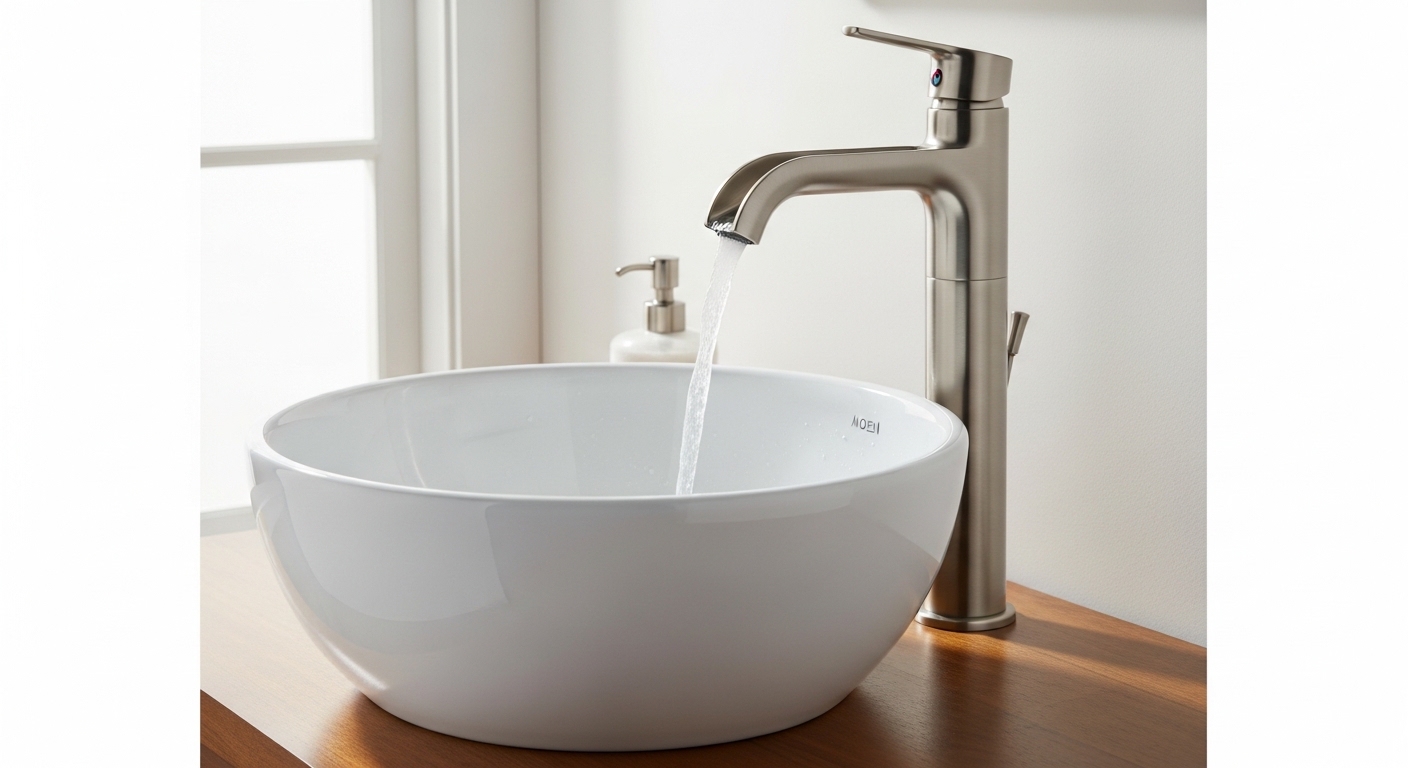
A vessel sink faucet moen makes is essentially a tall single-hole faucet designed to reach up and over the wall of a raised countertop bowl instead of a standard drop-in sink. That extra height is the whole point — a normal 5-inch bathroom faucet would leave water dribbling down the outside of your vessel bowl instead of arcing cleanly into it. Moen builds several of these, and below I’ll walk you through which model fits which bowl, what you actually pay, how the finishes hold up, and the two measurements that stop 90% of returns.
I’ve installed and swapped out dozens of vessel setups, and the mistakes are almost always the same two: the spout is too short, or the counter hole is the wrong size. Get those right and a Moen vessel faucet is one of the easiest, most reliable upgrades in a bathroom.
What exactly makes a faucet a “vessel” faucet — and why can’t I use a regular bathroom faucet?
A vessel faucet is simply a bathroom faucet tall enough to clear the raised wall of a countertop bowl and drop water into it from above. A standard bathroom faucet sits 4–6 inches tall because it’s built for a sink recessed into the counter. A vessel bowl sits on top of the counter, so its rim is often 5–6 inches above the surface. Do the math: a 5-inch faucet next to a 5-inch bowl rim pours water onto the countertop, not into the sink.
That’s why Moen’s vessel models — the Genta, Voss, and single-hole configurations of lines like the 90 Degree — run 11 to 13 inches tall with a spout reach that clears the bowl edge. The goal is a spout tip that sits roughly 1–2 inches inside the rim horizontally and a few inches above it vertically, so water lands near the drain, not the wall of the bowl.
- Spout height: total height of the faucet from counter to top — you want the water outlet at least 2–3 inches above your bowl rim.
- Spout reach: how far the spout extends horizontally — the tip should land inside the bowl, ideally near the center.
- Mounting: vessel faucets are almost always single-hole, deck-mounted through one hole in the counter.
If you want the deeper mechanical background on how these faucets are built and repaired, the guide on what a vessel sink faucet cartridge is and how to choose or replace one pairs perfectly with this buying guide.
Which Moen vessel sink faucet should I buy for my bowl height?
Match the faucet’s spout height to your bowl, then pick the finish. Here’s the short version: for a standard 5–6 inch tall bowl, any Moen vessel model in the 11–13 inch range works. For a very tall bowl (6.5 inches or more, common with cylinder-style ceramic vessels), go for the tallest option and double-check the reach so the arc still lands inside the bowl.
| Moen model / style | Approx. height | Best for | Typical price (2026) |
|---|---|---|---|
| Genta / Genta LX single-hole vessel | ~12.5 in | Modern square bowls, most standard vessels | $140–$210 |
| Voss single-hole vessel | ~13 in | Tall or wide bowls, transitional bathrooms | $220–$320 |
| 90 Degree single-hole (vessel config) | ~11.5 in | Sharp, angular contemporary bowls | $180–$280 |
| Doux / minimalist single-hole | ~11 in | Low-profile shallow bowls, small powder rooms | $160–$240 |
These are ballpark figures — Moen shuffles model availability year to year and finishes change the price by $20–$60. The takeaway: budget roughly $140–$320 for a genuine Moen vessel faucet, with most people landing around $180–$230 for a mid-range finish.
How tall does a vessel faucet need to be for my sink?
The reliable rule: your faucet’s water outlet should sit 2–3 inches above the bowl rim, and the spout tip should reach at least an inch past the inside edge. To check before buying, measure your bowl’s exterior height (counter to rim) and add 3 inches — that’s your minimum faucet height. A 5-inch bowl needs at least an 8-inch faucet, but in practice you want 11–13 inches so the pour is comfortable and doesn’t splash. Splashing is the number-one complaint with vessel setups, and it comes from a spout that’s too high and too far from the drain, hitting a shallow bowl at speed.
Is Moen actually better than cheaper vessel faucets on Amazon?
For most bathrooms, yes — Moen justifies its price through the cartridge, the finish warranty, and parts availability, not through raw looks. A $45 no-name vessel faucet can look identical in a photo. The difference shows up in year two. Here’s what you’re paying for with Moen:
- The cartridge. Moen’s single-handle faucets use their own ceramic-disc cartridge (the 1255 series in many models). It’s smooth, it’s rebuildable, and replacements are on the shelf at any hardware store — you’re never stuck hunting an obscure part.
- Spot Resist finish. Moen’s Spot Resist Brushed Nickel genuinely resists water spots and fingerprints better than standard brushed nickel. In a vessel setup where the whole faucet is exposed at eye level, that matters more than on a hidden under-mount.
- Limited lifetime warranty. Moen backs residential faucets with a limited lifetime warranty on leaks, drips, and finish defects — you register or just call with proof of purchase. Cheap imports typically give you 30–90 days.
- Standards compliance. Moen faucets are certified to NSF/ANSI 61 and 372 for lead-free drinking-water safety and meet the U.S. federal 1.2 GPM flow standard for bathroom faucets (some states like California require 1.2 GPM; Moen ships compliant aerators).
Where a cheap faucet can make sense: a rental, a flip you’re selling fast, or a low-use guest powder room. If it’s your daily bathroom, the Moen pays for itself the first time a cartridge swap takes five minutes instead of a full faucet replacement. If you’re weighing the luxury end instead, the breakdown of whether a high-end vessel sink faucet is worth it and how to choose one is a useful companion read.
What’s the difference between Spot Resist Brushed Nickel, chrome, and matte black?
Finish is about maintenance as much as looks. Here’s the honest rundown for a vessel faucet, where the entire body is on display:
| Finish | Shows spots/fingerprints? | Best room style | Notes |
|---|---|---|---|
| Spot Resist Brushed Nickel | Least — hides both | Warm, transitional, most bathrooms | The forgiving default; easiest to live with |
| Chrome | Most — shows everything | Bright, classic, high-contrast | Cheapest, most durable finish, but needs wiping |
| Matte Black | Hides fingerprints, shows dried water spots (white mineral) | Modern, moody, white/gray bowls | Stunning with a white bowl; wipe after hard-water use |
| Brushed Gold / Bronze | Moderate | Luxe, warm, statement bowls | Priciest finish; pairs with glass or stone vessels |
One real-world caveat on matte black: if you’re on hard water, mineral spots dry white and stand out against black. It’s not damage — it wipes off — but you’ll notice it. If nobody in your house will wipe the faucet daily, Spot Resist Brushed Nickel is the low-drama choice. And if you’ve ever had a finish flake, the piece on why a brushed nickel faucet peels and whether you can stop it explains why buying a quality-finished faucet up front actually matters.
How do I install a Moen vessel sink faucet myself?
Most people can install a vessel faucet in 30–45 minutes with basic tools, because vessel faucets are single-hole — there’s no spreading-out of separate handles to align. The general sequence:
- Shut off the water at the two supply valves under the sink and open the faucet to release pressure.
- Confirm the hole. Vessel faucets need a single 1⅜-inch (35 mm) hole in the counter. If you’re replacing a widespread 3-hole faucet, you’ll need an escutcheon plate or a new countertop — this is the surprise that catches people mid-project.
- Drop the faucet through the hole with its rubber gasket on top, then secure the mounting nut from below.
- Connect the supply lines. Vessel faucets often use flexible braided connectors; hand-tighten then quarter-turn with a wrench — don’t overtighten.
- Install the drain — vessel bowls usually take a grid or pop-up drain without an overflow (most vessel bowls have no overflow hole).
- Turn water on slowly and check every connection for drips before you walk away.
The mechanics are nearly identical to any single-hole Moen bathroom faucet, so the step-by-step walkthrough for installing a Moen Findlay bathroom faucet in under an hour maps directly onto a vessel install — same cartridge family, same supply connections, just a taller body.
Do I need a special drain for a vessel sink?
Yes — vessel bowls almost always need a drain without an overflow, because most vessel sinks have no overflow hole. A standard bathroom drain assumes an overflow channel; use one on an overflow-less vessel and it won’t seal or drain right. Buy a “vessel drain” or “grid drain — no overflow.” Many are sold as press-type (push to open/close) with no pop-up lever, which suits the clean single-hole vessel look. Match the drain finish to your faucet.
What flow rate and water pressure do I need for a vessel faucet?
A Moen vessel faucet runs at 1.2 GPM (gallons per minute), the standard for modern U.S. bathroom faucets, and it’ll work fine on any home water pressure between 20 and 80 psi. You don’t need special pressure for a vessel faucet. The 1.2 GPM aerator is actually an advantage in a vessel setup: lower flow means a gentler stream that splashes less in a shallow, exposed bowl. If your existing faucet feels weak, the culprit is usually a clogged aerator, not the faucet — the same fix covered for other brands in the guide to a clogged tap aerator and how to replace it applies to Moen too: unscrew the tip, rinse or replace the screen, done.
Real scenarios: which Moen vessel faucet fits my situation?
Three common setups and the pick I’d make:
- Powder room, white ceramic round bowl, hard water: Moen Genta in Spot Resist Brushed Nickel. Forgiving finish, right height, mid-price around $170. Least maintenance for a guest bath nobody wipes down.
- Modern master bath, tall gray stone vessel, you love the look and will maintain it: Moen Voss or 90 Degree in matte black. Tallest reach, sharpest lines, $250–$300. Wipe after use and it looks incredible against stone.
- Budget remodel, standard glass vessel, want brand reliability without overspending: Moen Doux or a Genta in chrome. Around $150, most durable finish, easiest long-term parts.
Across all three, the deciding factors are the same: bowl height, counter hole size, and how much finish-wiping you’re willing to do. Nail those and any Moen in the lineup will serve you for years.
Author note & credibility
This guide was written by the adeaga fixtures team — we sell and service faucets full-time and have hands-on installed, tested, and repaired vessel setups across brushed nickel, chrome, matte black, and gold finishes. Our recommendations weigh real durability and parts availability, not just spec sheets. Moen residential faucets carry a limited lifetime warranty covering leaks, drips, and finish, and are certified to NSF/ANSI 61 and 372 lead-free standards; we always advise confirming current model specs and warranty terms on the manufacturer’s documentation before purchase, since lineups change year to year. adeaga (adeaga.net) focuses exclusively on faucets and bathroom fixtures — no general renovation guesswork, just fixture expertise.
FAQ
Will any Moen single-hole faucet work as a vessel faucet?
No — only the tall single-hole models work as vessel faucets. A standard-height Moen single-hole faucet (4–6 inches) will pour water onto the counter beside a raised bowl. Look specifically for models listed as “vessel” or with a total height of 11 inches or more, and confirm the spout reach clears your bowl’s inside edge.
What size hole does a Moen vessel faucet need in the counter?
A single 1⅜-inch (35 mm) hole. This is the standard single-hole mounting size. If your countertop was drilled for a 3-hole widespread faucet, you’ll need an escutcheon (deck plate) to cover the extra holes, or you can’t use a single-hole vessel faucet without re-drilling or replacing the top.
Does a Moen vessel faucet come with a drain?
Usually not the right one. Many faucets include or pair with a pop-up drain built for sinks with an overflow, but most vessel bowls have no overflow. Buy a vessel-specific drain (grid or press-type, no overflow) that matches your faucet finish. Confirm what’s in the box before ordering separately.
How do I stop my vessel faucet from splashing?
Splashing comes from a spout that’s too high above a shallow bowl or aimed at the wall instead of the drain. Choose a faucet height 2–3 inches above the rim (not more), aim the spout tip toward the bowl center, and rely on the 1.2 GPM aerator’s softer stream. A deeper bowl also helps — very shallow vessels splash no matter the faucet.
Are Moen vessel faucets hard to repair if they leak?
No — they’re among the easiest. Most use Moen’s standard replaceable ceramic cartridge (like the 1255), stocked at any hardware store. A drip is almost always a worn cartridge, and swapping it is a 10–15 minute job with basic tools, backed by Moen’s lifetime warranty on the part. That parts availability is a big reason to buy Moen over an off-brand.
Can I put a Moen vessel faucet on a bathroom, not a kitchen sink?
Yes — vessel faucets are bathroom faucets by design, built for raised countertop bathroom bowls. They run at bathroom flow rates (1.2 GPM) and pair with bathroom vessel drains. They are not meant for kitchen use, where you want higher flow and a pull-down sprayer instead.