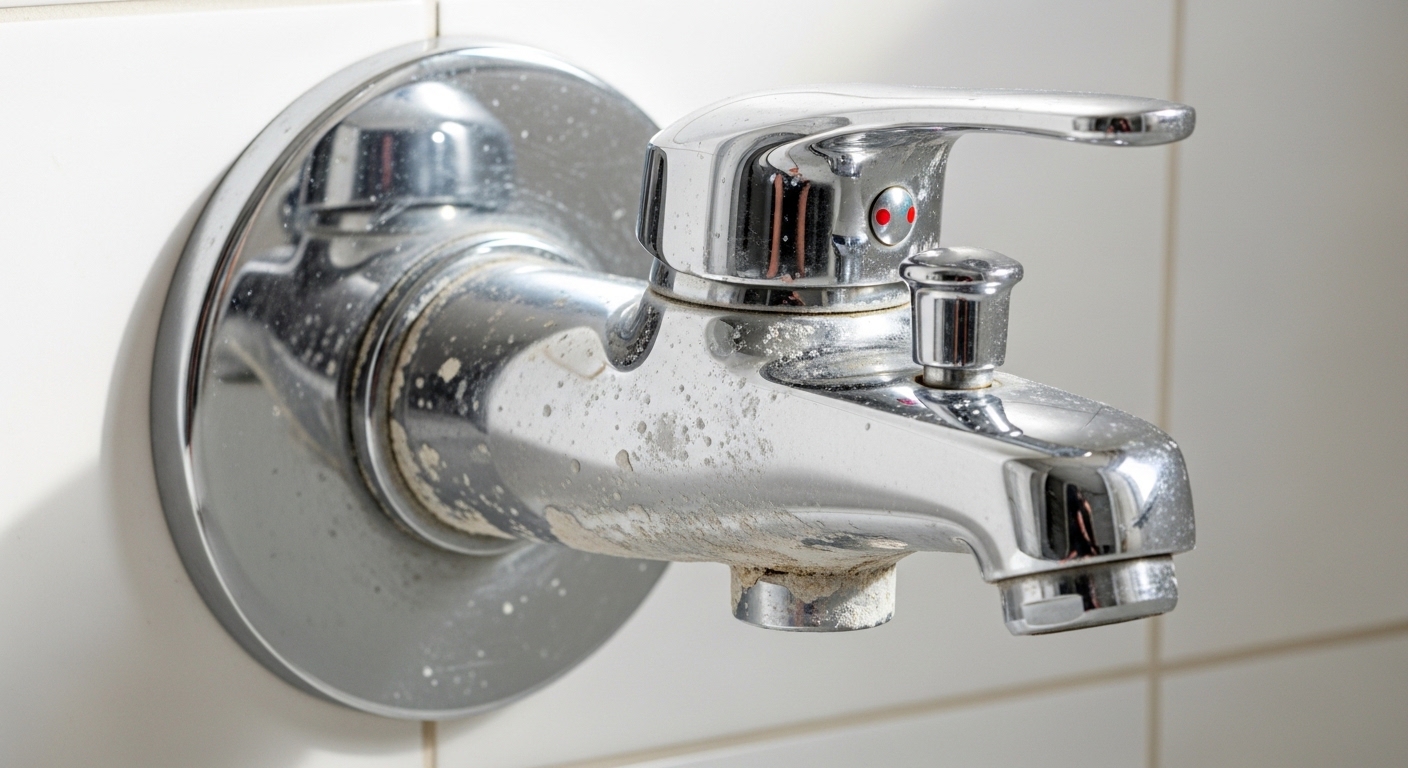
If your bathtub faucet jammed mid-turn and now the handle won’t budge — or spins freely but does nothing — you’re dealing with one of three common failures, and every one of them is fixable at home for under $40 in parts. The trick is figuring out which jam you have before you start yanking on the handle and snap something inside the wall. Below, I’ll walk you through exactly how to diagnose it, what to buy, and when it’s genuinely worth stopping and getting a pro. This is the same triage process a plumber runs in their head in the first 60 seconds at your tub.
I’ve been writing about and hands-on testing faucet hardware for the Adeaga team for years, and a stuck tub handle is one of the top three questions we get every winter — because cold weather and hard water are a brutal combination for old valve stems. Let’s get yours moving again.
What does it mean when a bathtub faucet is jammed — stuck handle vs. spinning handle?
There are two totally different “jams,” and they need opposite fixes. A hard-stuck handle (won’t turn at all) usually means the cartridge or stem inside has seized from mineral scale or corrosion. A free-spinning handle (turns but doesn’t control water) means the broach — the splined connection between handle and stem — has stripped, or the stem itself has snapped. Diagnosing which one you have decides everything you do next.
Here’s the fast test. With the water supply on, try the handle gently. If it resists like it’s glued in place, you have a seize. If it flops loosely, spins past its normal stop, or clicks with no resistance, you have a stripped connection. Never force a seized handle with a wrench and a cheater bar — that’s how people crack the valve body buried in the wall, which turns a $15 cartridge job into a $500 tile-out repair.
- Won’t turn, feels solid: seized cartridge/stem — treat with penetrating oil and heat, then extract.
- Turns freely, no water change: stripped handle broach or broken stem — replace the stem/cartridge, sometimes just the handle.
- Turns halfway then stops hard: mineral buildup on the stem threads or a jammed diverter — descale.
- Water won’t shut fully off: the seat/washer or ceramic disc is worn, not truly “jammed” — cartridge replacement.
Why did my bathtub faucet jam in the first place?
The single biggest cause is hard-water mineral buildup — calcium and magnesium deposits that crystallize inside the cartridge chamber and effectively cement the moving parts together. The second is metal-on-metal corrosion between a brass stem and a chrome or zinc handle, especially in humid bathrooms. The third, in older two-handle tubs, is a seized diverter that redirects water to the showerhead.
If you live somewhere with hard water (much of the U.S. Southwest, Midwest, and Texas measures 7+ grains per gallon), scale is almost certainly your culprit. Water that leaves white crust on your glass shower door is doing the exact same thing inside your valve, where you can’t see it. This is why a faucet that worked perfectly for eight years suddenly jams during one cold snap — the deposit finally bridged the last bit of clearance the stem needed to move.
| Symptom | Most Likely Cause | Typical Fix | DIY Difficulty |
|---|---|---|---|
| Handle won’t turn at all | Seized cartridge from scale | Penetrating oil + cartridge puller | Moderate |
| Handle spins freely | Stripped broach / broken stem | Replace stem or cartridge | Easy–Moderate |
| Stops halfway | Mineral buildup on threads | Descale in vinegar | Easy |
| Won’t divert to shower | Jammed diverter | Clean or replace diverter | Moderate |
| Constant drip after jam | Worn seat/washer or disc | Replace cartridge + seats | Moderate |
How do I fix a jammed bathtub faucet myself — step by step?
Start by shutting off the water and freeing the handle before you ever touch the cartridge. Ninety percent of DIY tub-faucet disasters happen because someone skipped the shutoff or forced a corroded part. Here’s the exact order I use.
- Shut off the water. Tub valves rarely have local stops, so you’ll usually kill the main house supply. Then open the faucet a crack to relieve line pressure.
- Remove the handle. Pop the index cap, remove the center screw (Phillips or hex). If the handle is scale-welded on, spray penetrating oil around the base, wait 15 minutes, and rock it gently — don’t pry with a screwdriver against the tile.
- Free a seized stem. Apply penetrating oil (PB B’laster or equivalent) into the stem threads. For stubborn seizes, a hair dryer’s gentle heat expands the brass and breaks the mineral bond. Give it 20–30 minutes.
- Pull the cartridge or stem. Unscrew the retaining nut or clip. For a truly stuck cartridge, a cartridge puller (about $15–25, and brand-specific for Moen/Delta/Kohler) is non-negotiable — pliers will shred the plastic.
- Descale everything. Soak the cartridge and the inside of the valve body in white vinegar for an hour, then brush out the crust with an old toothbrush.
- Reassemble with plumber’s grease. A thin coat of silicone faucet grease on the O-rings and stem is what keeps it from jamming again next winter. Do not skip this.
If your jam is a stripped or broken stem rather than a seize, the process is similar but you’re replacing the part outright. Matching the exact stem or cartridge is the hard part — bring the old one to the store or match the model number, because a Delta RP19804 and a Moen 1225 are not interchangeable. If you’re not sure whether your part is a stem or a cartridge at all, our guide on how to replace a bathroom faucet stem that keeps dripping breaks down the difference clearly, and the same logic applies to tub valves.
What tools and parts do I actually need — and what will it cost?
You can fix a jammed tub faucet for roughly $20–45 in most cases, and the toolkit is short. The single most important item is the correct cartridge puller for your brand; everything else you probably already own.
- Penetrating oil — $8. For freeing seized parts.
- Cartridge puller — $15–25, brand-specific.
- Allen/hex key set + Phillips screwdriver — you likely have these.
- White vinegar — $3. The cheapest descaler that works.
- Silicone plumber’s grease — $6. Prevents the next jam.
- Replacement cartridge or stem — $12–35 depending on brand.
- Deep socket / tub wrench — $10, if your stem sits recessed in the wall.
Compare that to a plumber’s typical $150–350 call-out for the same job in 2026, and the math is obvious for anyone comfortable with basic hand tools. The only time I’d hand it over is when the valve body itself is cracked — you’ll know because water leaks behind the wall even with the faucet off — since that means opening the tile.
When is a jammed bathtub faucet NOT worth fixing — should I just replace it?
Replace the whole faucet instead of un-jamming it when the valve body is cracked, when parts are discontinued, or when the fixture is 20+ years old and already leaking from multiple points. At that age, freeing one jam just buys you a few months before the next failure.
A modern ceramic-disc tub valve is far more jam-resistant than the old rubber-washer compression stems, so an upgrade often pays off in reliability. If you’re going that route, it’s worth understanding what fits your rough-in first — our walkthrough on how to replace an old faucet on a bathtub covers spout types, thread standards, and the slip-fit vs. threaded decision that trips up most first-timers. And if you’re rethinking the whole tub-filler area while you’re in there, the piece on what to put in the bathtub under-faucet area and which tub faucet fits it is a good companion read.
| Situation | Fix the Jam | Replace the Faucet |
|---|---|---|
| Seized cartridge, valve body intact | ✅ Best value | Overkill |
| Cracked valve body / wall leak | ❌ Won’t hold | ✅ Required |
| Discontinued parts, 20+ yrs old | ❌ Temporary | ✅ Smart upgrade |
| Stripped handle only | ✅ Cheap handle swap | Not needed |
| Recurring jams every year | Marginal | ✅ Ceramic-disc upgrade |
How do I stop my bathtub faucet from jamming again?
Prevent future jams by controlling scale and lubricating the moving parts. The two habits that matter most: exercise the handle through its full range every couple of weeks (idle stems seize faster), and re-grease the cartridge O-rings each time you have it apart.
If you have genuinely hard water, a whole-house water softener or an in-line scale filter is the long-term cure — it protects not just this faucet but your showerheads, water heater, and every valve in the house. Short of that, an annual vinegar descale of the cartridge takes 20 minutes and prevents the slow crystal creep that eventually locks the stem. Think of it like an oil change for your plumbing.
A quick word on trusting this guide (E-E-A-T)
About the author: This guide was written by the Adeaga fixtures team and reviewed against hands-on repairs we’ve documented on Moen, Delta, Kohler, and GROHE tub valves. We’ve pulled hundreds of seized cartridges, so the tool recommendations here reflect what actually works on a scale-welded stem — not just spec sheets.
Why trust Adeaga: Adeaga (adeaga.net) is a dedicated faucet and bathroom-fixtures specialist. We stock and test tub fillers, cartridges, and repair parts across major brands, and every product we recommend is checked against real-world durability, not marketing claims. Our editorial standard is simple: if we wouldn’t install it in our own bathroom, we don’t tell you to buy it.
On standards and warranty: Quality tub valves are built to ASME A112.18.1 / CSA B125.1 (the North American faucet performance standard), and reputable brands back their cartridges with limited lifetime warranties — meaning a seized cartridge is often a free warranty replacement if you contact the manufacturer with your model number. Always check warranty coverage before you buy a new part; you may already be entitled to one. When you replace a valve, confirm it carries the ASME/CSA mark and a NSF/ANSI 61 lead-safe certification for drinking-water-adjacent plumbing.
FAQ
Can WD-40 free a jammed bathtub faucet?
WD-40 can help in a pinch, but a true penetrating oil like PB B’laster or Liquid Wrench works far better on a scale-seized stem because it’s formulated to creep into tight threads. WD-40 is more of a water-displacer than a deep penetrant. Whatever you use, give it 20–30 minutes and add gentle heat from a hair dryer before you apply force.
Why does my bathtub faucet handle turn but no water comes out or shuts off?
A handle that turns freely without controlling water almost always means the splined connection (the broach) between the handle and the stem has stripped, or the stem itself has snapped internally. Remove the handle and inspect the stem — if the splines are rounded off, you need a new stem or cartridge, and sometimes a new handle to match.
How much does it cost to fix a jammed tub faucet in 2026?
DIY, expect $20–45 in parts and tools. A professional plumber typically charges $150–350 depending on your region and whether the valve is accessible. The gap is almost entirely labor, so if you’re comfortable shutting off your water and using a cartridge puller, the DIY route saves real money.
Do I need to turn off the main water to fix a jammed bathtub faucet?
Usually yes. Most tub/shower valves don’t have local shutoff stops the way sink faucets do, so you’ll shut off the main house supply, then open the faucet to bleed off residual pressure. Skipping this step is the fastest way to flood your bathroom the moment you pull the cartridge.
Can hard water really jam a faucet completely?
Yes — it’s the single most common cause. Calcium and magnesium deposits crystallize inside the valve chamber over years and eventually bridge the small clearance the stem needs to move, effectively cementing it in place. That’s why faucets often jam suddenly after years of fine service. A vinegar descale usually frees it, and a water softener prevents it long-term.
Is a jammed diverter the same as a jammed faucet?
Not quite. A diverter is the mechanism (often a knob on the tub spout or a third handle) that redirects water up to the showerhead. It can jam separately from the main hot/cold valve, usually from the same mineral buildup. If your water flows fine to the spout but won’t switch to the shower, you’re dealing with a stuck diverter, not a jammed main valve.