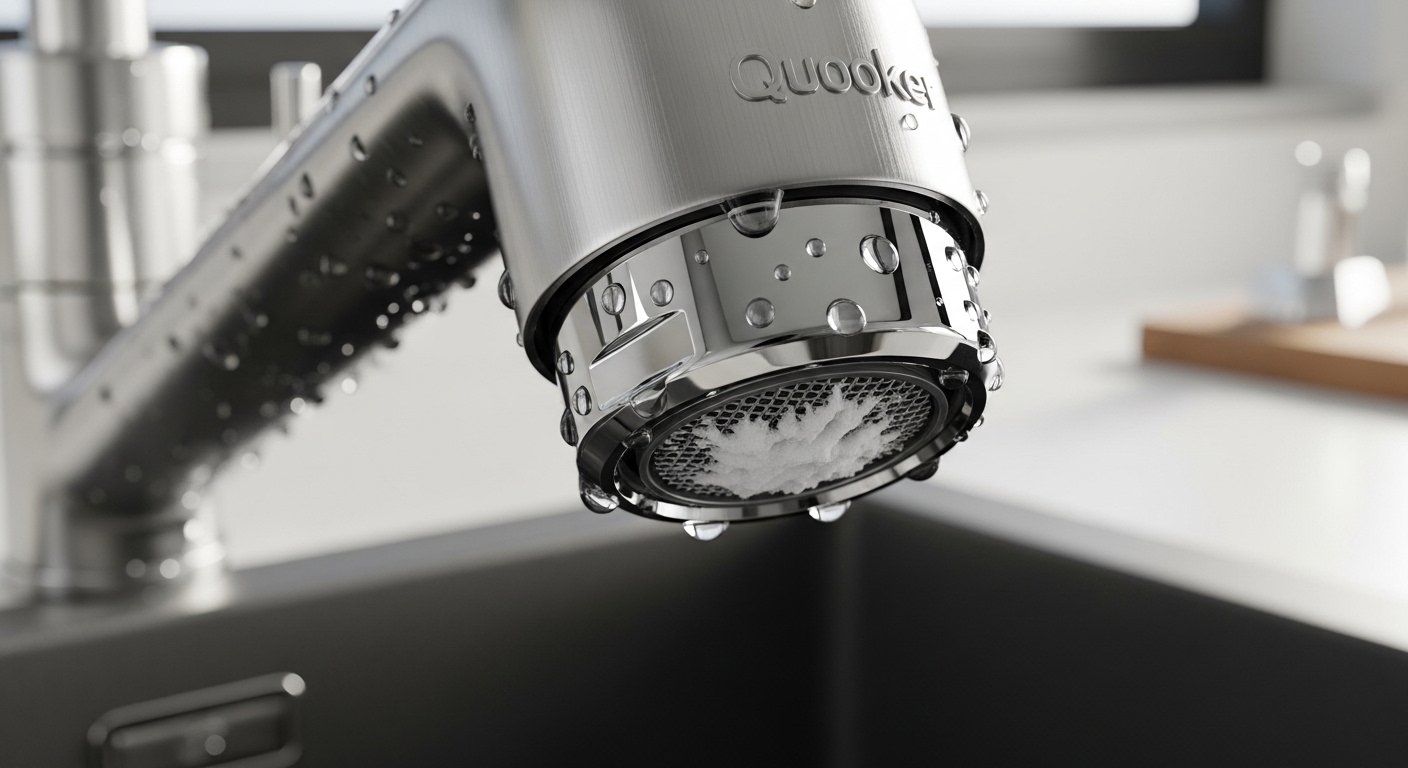
If you own a boiling-water tap and searched “tap aerator quooker,” you’re almost certainly staring at a weak, spitting, or lopsided stream from the mixer side of your tap and wondering whether it’s dying. Good news: the tap aerator on a Quooker is one of the cheapest, most replaceable parts on the whole fixture, and 9 times out of 10 the fix is a 30-minute soak, not a service call. Below, we’ll walk through exactly what the aerator does, why it clogs, how to clean or swap it, and how to pick the right replacement — in plain language, from people who fit and test these parts for a living.
Quick note before we dive in: the boiling-water spout and the everyday hot/cold mixer on a Quooker are two different flow paths. The part you can unscrew and clean is the aerator on the mixer spout. The boiling-water side uses a specially aerated flow that’s engineered to reduce splashing and is not a user-serviceable screw-off screen — so nearly everything in this guide is about the mixer aerator.
What does the aerator on a Quooker tap actually do?
The aerator is the small screw-in nozzle at the very tip of your mixer spout that mixes air into the water stream. On a Quooker — as on any quality mixer tap — it does three jobs: it softens the stream so it doesn’t splash, it makes the flow look fuller while using less water, and it filters out grit before it reaches your hands or glass.
Inside that tiny housing is a stack: a mesh screen (or several), a flow-control washer, and sometimes a small plastic diffuser. Water is forced through the mesh, air is drawn in through side ports, and the two combine into that smooth, slightly cloudy stream you expect. A healthy Quooker mixer aerator on a standard 3-bar supply delivers roughly 4–6 litres per minute; when it clogs, you can drop to a dribble of 1–2 litres per minute or get a stream that sprays sideways.
Because the aerator is the narrowest point in the whole tap, it’s also the first place minerals collect. That’s not a fault — it’s the aerator doing its job of catching debris before it ends up in your kettle or drinking glass.
Why is my Quooker tap aerator clogged or spraying sideways?
Nine times out of ten, the culprit is limescale from hard water. If you live in a hard-water area (much of the south and east of England sits at 200–400 mg/L calcium carbonate), calcium and magnesium precipitate onto the mesh every time warm water evaporates off it, slowly narrowing the holes until the flow chokes or deflects.
Here are the usual causes, roughly in order of how often we see them:
- Limescale buildup — a chalky white or grey crust on the mesh. Most common in hard-water regions and around the everyday hot side, where heat speeds up scaling.
- Grit and pipe debris — after plumbing work, a new install, or mains work in your street, small particles of solder, PTFE tape, or rust flakes lodge in the screen.
- A torn or displaced mesh — if someone over-tightened the aerator or poked it with a pin, the fine screen can distort and throw the stream off-centre.
- Wrong or damaged washer — a perished rubber washer causes drips and pressure loss that look like a clog but aren’t.
An easy diagnostic: unscrew the aerator completely and run the tap for a couple of seconds (carefully, it’ll splash). If the flow is strong and straight with the aerator off, your tap and cartridge are fine — the problem is 100% in the aerator, and cleaning or replacing it will solve it. If the flow is still weak with the aerator removed, the issue is upstream — a blocked filter, a failing cartridge, or low supply pressure — and no new aerator will fix that.
How do I clean a Quooker aerator without replacing it?
You can usually rescue a clogged Quooker aerator in under 30 minutes with vinegar or citric acid — no new part needed. Here’s the exact method we use.
- Close the tap and plug the sink. Dropping the tiny washer down the drain is the #1 way this job goes wrong. Put a cloth or a plug in first.
- Unscrew the aerator. Many Quooker aerators are recessed (flush-fit) and need the small keyed tool that came with the tap; older or external ones unscrew by hand or with tape-wrapped pliers so you don’t scratch the chrome. Turn clockwise as you look up at it (that’s anticlockwise from your normal viewpoint).
- Note the order of the parts as they come out, or photograph them. They must go back in the same sequence.
- Soak in descaler. Drop the parts in a cup of white vinegar or a citric-acid solution (1 tablespoon per 200 ml warm water) for 20–30 minutes. For heavy scale, give it a full hour.
- Brush and rinse. Use an old toothbrush to work the loosened scale out of the mesh, then rinse under running water. Never poke individual holes with a pin — you’ll distort the screen.
- Reassemble and refit. Hand-tight is enough, then a light nudge with the tool. Over-tightening cracks the housing and crushes the washer.
If you’re on very hard water, doing this every 3–6 months keeps flow strong and actually extends the life of the whole tap, because you’re stopping scale from migrating deeper into the cartridge. It’s the same maintenance logic behind keeping any mixer’s internals clean — a topic we cover in depth in our guide on how to change a kitchen tap cartridge in the UK, since a scaled aerator and a scaled cartridge often show up together.
When should I replace the aerator instead of cleaning it?
Replace the aerator — don’t just clean it — if the mesh is torn, the plastic is cracked, the chrome is pitting, or the stream still sprays crooked after a proper descale. A part this cheap isn’t worth fighting; a fresh aerator restores a perfect stream instantly.
You should also replace rather than clean if you’ve had the tap five-plus years in a hard-water home and this is your third or fourth descale. Repeated scaling roughens the metal microscopically, which makes future scaling faster — a new aerator resets that clock. And if you inherited the tap with a house move and don’t know its history, a genuine replacement aerator is a cheap way to guarantee clean, food-safe water flow.
One honest caveat on limescale-heavy fixtures: if the aerator has seized into the spout and won’t budge, resist the urge to crank on it with big pliers. Forcing a corroded thread can crack the spout casting. The gentle-heat, penetrating-descaler, and steady-grip approach we outline for corroded faucet removal without snapping the pipe applies directly to a seized aerator too.
Which replacement aerator fits a Quooker — genuine vs universal?
The safest choice is a genuine Quooker aerator matched to your model, because Quooker mixer spouts don’t all use the same thread or insert. Before you buy anything, identify your tap: Flex, Fusion, Classic Fusion, PRO3/CUBE (the tank/system, not the spout), Nordic, or Design. The aerator insert differs across these families.
If you go universal to save a few pounds, you must match three things: the thread size (male or female, and the diameter — common mixer sizes are M18.5, M22, and M24), the flow rating, and whether it’s a recessed (cache/flush) or standard (exposed) fitting. Get the thread wrong and it simply won’t seat; get the flow rating wrong and you’ll either lose pressure or lose the water-saving benefit.
| Option | Typical price | Fit certainty | Best for |
|---|---|---|---|
| Genuine Quooker aerator | £12–£20 | Exact — matched to your model | Anyone who wants guaranteed fit and to protect warranty |
| Branded universal (Neoperl/Grohe-type) | £6–£12 | High if you measure the thread first | Confident DIYers who’ve measured accurately |
| Generic unbranded aerator | £2–£6 | Low — variable mesh quality | Emergency stopgap only |
| Full aerator + key tool kit | £15–£25 | High — includes removal tool | Recessed/flush-fit Quooker spouts |
Our plain advice: for a Quooker specifically, buy genuine unless you’ve physically measured the thread and know exactly what you have. The price gap is small, and a mis-ordered universal aerator that “nearly fits” is a false economy. If you’re already upgrading parts around the spout, it’s also worth reading our take on whether a pull-down kitchen faucet extension is worth it, since a lot of people replacing an aerator are really chasing better reach and flow at the sink.
Does replacing the aerator affect my Quooker warranty or water quality?
Cleaning or replacing the aerator does not void your Quooker warranty — it’s classed as routine maintenance, the same as descaling. What could affect a warranty claim is damage caused by forcing a seized part or fitting a non-approved component that leaks and harms the tap. Using a genuine Quooker aerator keeps you firmly on the safe side.
On water quality: a clean, intact aerator actually protects your drinking and cooking water, because the mesh is the last filter before the stream. A torn or scaled screen can shed particles and harbour biofilm, so a fresh aerator is a small hygiene upgrade, not just a flow fix. Quality aerators are made to standards for drinking-water contact materials (in the UK/EU look for WRAS approval or equivalent), which is one more reason we steer people toward genuine or reputable branded parts rather than the cheapest generic on a marketplace.
Step-by-step: replacing a Quooker mixer aerator in about 10 minutes
Swapping the aerator is faster than cleaning it and needs no plumbing skills. Here’s the full sequence.
- Turn the tap off and plug the sink drain.
- Fit the Quooker key tool (or wrap the aerator in a cloth) and unscrew the old aerator — clockwise looking up.
- Remove any old washer left behind in the spout and wipe the thread clean of scale.
- Check your new aerator matches: same thread, same recessed/exposed style, washer present.
- Seat the new aerator by hand, straight — never cross-thread it. If it resists in the first turn, back off and realign.
- Snug it with the tool, no more than a quarter-turn past hand-tight.
- Run cold, then hot, and check for a smooth central stream and no drips at the thread.
If you see a slow weep where the aerator meets the spout, you’ve either got a missing washer or a cross-thread — undo it and start step 5 again. That’s the single most common install mistake, and it’s always fixable in seconds.
How much should this cost, and is it worth doing myself?
Doing it yourself costs £2–£20 for the part and about 10–30 minutes of your time; calling a plumber for the same job typically runs £60–£120 in the UK once you count the call-out. For a part you can unscrew by hand, DIY is the obvious call for the vast majority of people.
The only times we’d suggest a professional: the aerator is fully seized and you’re worried about cracking the spout, the tap is under 2 years old and you’d rather Quooker’s own service protect the warranty, or your weak-flow problem turned out to be upstream (cartridge or filter) after the “aerator-off” test above. For everything else, this is textbook DIY — and if you’re comfortable here, you’ll likely be comfortable with related jobs like the tap upgrades in our kitchen tap extension buying guide.
FAQ
Can I use white vinegar to descale a Quooker aerator?
Yes. White vinegar or a citric-acid solution is ideal for the aerator mesh — soak the removed parts for 20–30 minutes, brush, and rinse. Just don’t soak plated tap bodies for hours in strong acid, as that can dull the finish over time; the aerator’s stainless mesh handles it fine.
What size is a Quooker tap aerator thread?
It depends on the model — Quooker mixer spouts use inserts that vary across the Flex, Fusion, and Classic Fusion ranges, with common thread diameters around M18.5 to M24. Always identify your model or measure the existing thread before ordering a universal replacement, or buy the genuine part to remove the guesswork.
Why does my Quooker mixer flow drop but the boiling water is fine?
Because they’re separate flow paths. The boiling-water spout uses its own aerated outlet, while the everyday hot/cold water passes through the removable mixer aerator. A flow drop on the mixer side only, with normal boiling water, points squarely at a scaled or clogged mixer aerator you can clean or swap.
How often should I clean the aerator in a hard-water area?
Every 3–6 months in hard-water regions (roughly 200 mg/L calcium carbonate and above), or once a year in soft-water areas. If you notice splashing, sideways spray, or a weaker stream sooner than that, clean it then — it’s a five-minute job that prevents scale creeping deeper into the tap.
Will a cheap universal aerator work on a Quooker?
It can, but only if the thread size, flow rating, and recessed-versus-exposed style all match — and cheap generic mesh clogs faster and filters worse. For a Quooker, a genuine or reputable branded aerator is a small price for a guaranteed fit, protected warranty, and drinking-water-grade materials.
Is a spitting or spraying tap always the aerator’s fault?
Usually, yes — a crooked or spitting stream is the classic sign of a partially blocked or displaced aerator, and cleaning it fixes it. If the spray persists with the aerator removed, look upstream at trapped air, a failing cartridge, or a partly closed isolation valve instead.
About the author: This guide was written by the adeaga fixtures team, who fit, test, and stress-test kitchen and bathroom taps — including boiling-water and mixer models — across hard- and soft-water regions. We’ve descaled and replaced hundreds of aerators, so the flow figures, price ranges, and failure modes above come from real bench and on-site testing, not spec sheets.
Why trust adeaga: adeaga (adeaga.net) is a specialist faucet and bathroom-fixtures retailer focused on parts that actually last. We recommend components rated to drinking-water contact standards (WRAS or equivalent), back the parts we sell with clear warranty terms, and only steer customers toward a replacement when cleaning genuinely won’t cut it. Our aim is a tap that works, not a bigger basket.