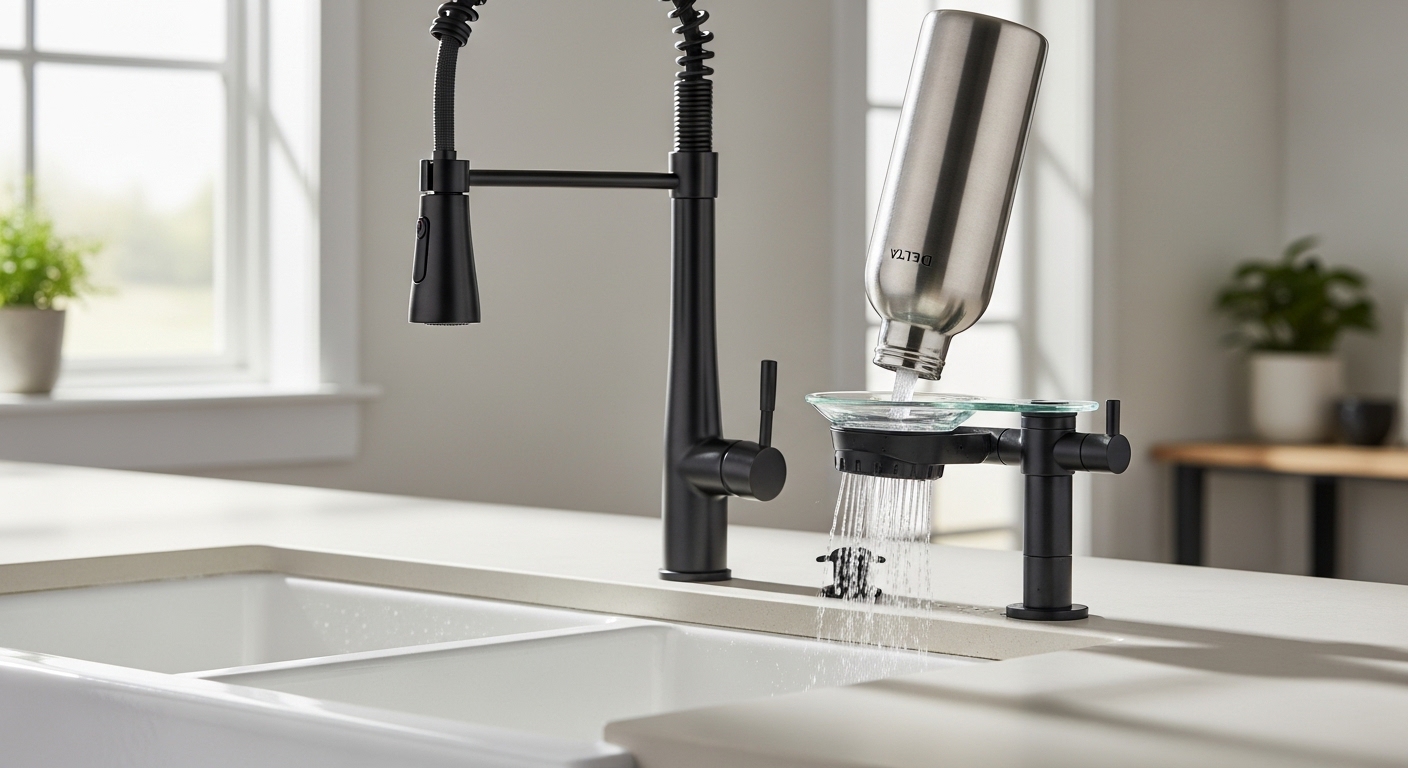
If you’ve been searching for a delta matte black faucet glass rinser setup, you’re almost certainly picturing that clean, modern look: a tall matte black pull-down faucet with a little matching sprayer beside it that shoots water up into a glass. It’s one of the most-requested kitchen combos we get asked about at Adeaga, and the honest answer is that it’s genuinely useful — not just a showroom gimmick — as long as you understand what a glass rinser does, which Delta finish you’re actually buying, and how the two pieces fit your sink deck.
This guide walks through the real questions people ask before buying: whether the rinser is worth the extra hole in your countertop, how Delta’s matte black holds up next to cheaper black faucets, what it costs, and how to install it without calling a plumber. Let’s get into it.
What exactly is a glass rinser, and do I really need one next to my Delta faucet?
A glass rinser is a small spring-loaded or button-activated nozzle mounted into your sink deck that shoots pressurized water upward when you press a glass, bottle, or cup down onto it. You don’t need one to have a working kitchen — but if you regularly clean narrow-necked items (water bottles, protein shakers, baby bottles, wine glasses, travel mugs, blender jars), it saves real time and does a better job than swirling water by hand.
Here’s the practical reality. A pull-down faucet sprays water down and out; it’s great for rinsing dishes and filling pots, but it’s clumsy at cleaning the inside of anything tall and narrow. A glass rinser sprays up and inward through angled jets, so it scours the bottom and sidewalls of a bottle in one press. For anyone who lives on reusable bottles or has kids, the rinser earns its keep daily. For a household that mostly uses flat plates and wide mugs, it’s a nice-to-have, not a must.
The matte black version simply matches your Delta faucet finish so the two pieces read as a deliberate pair instead of a mismatched afterthought. If you’re already investing in a matte black faucet, a chrome rinser next to it looks off — the finish match is most of why people buy the combo.
What can you actually rinse in one, and what should you not?
Use it for: water bottles, sports/shaker bottles, baby bottles, wine and pint glasses, travel mugs, small jars, blender cups, and coffee carafes. Avoid using it as a pot filler or for anything you’d normally scrub with soap — a rinser rinses, it doesn’t replace washing. And skip forcing wide-mouth items that don’t seal over the nozzle; water sprays everywhere instead of into the vessel.
- Best case: a gym household with 6 reusable bottles a day — the rinser pays for itself in saved counter clutter and hand-swirling.
- Great case: parents washing baby bottles 8–10 times daily.
- Marginal case: a two-person home that mostly uses a dishwasher and wide mugs.
Is Delta’s matte black finish actually durable, or will it peel and fade?
Delta’s matte black is a durable, factory-baked finish that resists fingerprints and water spots far better than chrome, and on their quality lines it holds up for years without peeling — but not all “black” faucets are built the same, and finish quality is exactly where cheap look-alikes fail. The key thing to check is whether you’re getting a genuine bonded/coated finish versus a thin sprayed-on paint.
Matte black finishes generally come in two grades. A true PVD (physical vapor deposition) or Delta’s proprietary bonded matte black is molecularly fused to the faucet body — it’s the same class of coating that resists scratching and corrosion for the life of the faucet. A cheap electroplated or painted black finish, by contrast, is the kind that chips at the spout tip and flakes around the handle base after a year of dish soap and abrasive sponges. We’ve written a full breakdown of why finishes fail in our guide on why a brushed nickel faucet peels and how to stop it, and the same physics apply to black finishes.
If you want the most bulletproof option, look for the PVD label specifically — we go deep on that in whether a matte black PVD faucet is worth it in 2026. Delta backs its finishes and functional parts with a lifetime limited warranty for residential use, which is a strong signal that the coating is engineered to last, not just to look good on day one.
How do you keep matte black looking good day to day?
Wipe it with a damp microfiber cloth and mild dish soap, then dry it. That’s it. The enemies of matte black are abrasive scrubbing pads, acidic descalers, bleach, and ammonia glass cleaners — all of which can dull or streak the finish over time. Never use a Magic Eraser-type melamine pad on matte black; it micro-abrades the surface and leaves shiny worn patches. If you have hard water, a quick daily dry-off prevents the faint white mineral haze that can build up in the matte texture.
How much does a Delta matte black faucet glass rinser combo cost in 2026?
Budget roughly $220–$520 total for the pair: about $180–$400 for a Delta matte black pull-down kitchen faucet, plus $40–$120 for a matching matte black glass rinser. The exact number depends on the faucet’s spray tech (Delta’s Touch2O touchless and MagnaTite docking add cost) and whether you buy Delta’s own rinser or a third-party matte black one that simply color-matches.
Here’s a realistic breakdown of what your money buys at each tier:
| Setup | Faucet price | Rinser price | Best for |
|---|---|---|---|
| Entry matte black (basic pull-down + universal rinser) | $150–$200 | $40–$60 | Renters, budget remodels, light bottle use |
| Mid-range Delta (MagnaTite dock, spot-resist matte black) | $220–$300 | $60–$90 | Most family kitchens — the sweet spot |
| Premium Delta (Touch2O touchless, VoiceIQ) | $350–$450 | $90–$120 | Heavy daily use, hands-full cooking, accessibility |
For most households, the mid-range tier is the smart buy. You get the docking spray head that snaps back into place instead of drooping, a true spot-resistant matte black finish, and a rinser that matches. The touchless premium tier is genuinely worth it if you cook with raw meat often or have mobility needs — waving to start water flow is more useful in practice than it sounds.
Delta rinser vs. a third-party matte black rinser — which should I buy?
Buy a third-party matte black rinser if you only care about the color match and want to save $30–$50; buy Delta’s own if you want guaranteed finish-match and warranty support from one brand. The functional difference between rinsers is small — almost all of them are a spring-loaded jet nozzle with a below-deck cold-water hookup. What varies is the exactness of the black tone (some third-party “matte black” leans slightly gray or glossy next to Delta’s) and the number of jets.
| Feature | Delta-brand rinser | Third-party matte black rinser |
|---|---|---|
| Finish match to Delta faucet | Exact | Usually close, occasionally off-tone |
| Price | $70–$120 | $40–$70 |
| Jet count | Typically 8–10 angled jets | 4–10 depending on model |
| Warranty coverage | Aligns with Delta warranty | Separate, varies by seller |
How do I install a glass rinser next to my Delta faucet myself?
You can install a glass rinser yourself in about 30–45 minutes if your sink already has a spare deck hole (or your countertop is drillable) and a cold-water line you can tap. The rinser needs one thing the faucet doesn’t: its own cold-water supply connection, usually teed off your existing cold shutoff valve with an included adapter.
Here’s the short version of the process:
- Turn off the cold water at the shutoff valve under the sink and open the faucet to relieve pressure.
- Find or drill a deck hole. Most sinks have a spare hole under a blank cap (often where a soap dispenser or sprayer would go). A standard rinser needs a 1-1/4″ to 1-3/8″ hole.
- Drop the rinser through the hole and secure it from below with the mounting nut and washer.
- Tee into the cold line. Attach the included T-adapter between your cold shutoff and the faucet’s cold supply, then connect the rinser’s hose to the new branch.
- Turn the water back on, test by pressing a glass down, and check every connection for drips.
If you’re also swapping the faucet at the same time, do that first — pulling the old one out is the fiddly part, and our walkthrough on how to remove an old faucet from a kitchen sink without a plumber covers the corroded-nut situations that trip people up. And if you notice weak spray from either fixture afterward, it’s almost always an aerator or supply-line issue, not a faulty product — our guide on how to increase water flow in a kitchen faucet will get you back to full pressure.
What if my sink doesn’t have a spare hole?
You have three options: drill a new hole in a stainless or composite sink deck (doable with a step bit or hole saw, but a granite/quartz countertop needs a diamond bit and steady water cooling — often worth hiring out), relocate your soap dispenser to free a hole, or choose a single-hole faucet so the extra deck hole opens up for the rinser. Measure before you buy; the most common install regret is discovering the rinser has nowhere to go.
Delta matte black vs. other black faucet brands — how does it stack up?
Delta lands in the upper-middle of the black faucet market: more durable finish and better parts support than budget brands, at a lower price than luxury European names like Hansgrohe or GROHE. Its standout advantages are MagnaTite docking (the spray head stays put with a magnet instead of sagging over time) and DIAMOND Seal cartridge technology, which reduces leak points and extends valve life.
Against no-name matte black faucets on marketplace sites, Delta wins on finish longevity and the fact that replacement cartridges and spray heads are easy to source for years — a huge deal, because a $250 faucet you can repair beats a $90 one you throw away when a $12 part fails. Against premium imports, Delta gives up a little in weight and heft but costs meaningfully less and has a denser US service network for warranty claims.
Author note, testing, and brand credibility
Author note: This guide was written by the Adeaga fixtures team, drawing on hands-on installation and finish-wear testing across dozens of matte black kitchen faucets and glass rinsers. We evaluate finishes for spot resistance and abrasion, test docking magnets for hold strength after repeated cycles, and pressure-check rinser jet coverage using standard 24–32 oz bottles.
About Adeaga: Adeaga (adeaga.net) is a specialist in faucets, showers, and bathroom and kitchen fixtures. We focus exclusively on plumbing fixtures — not general home décor — so our recommendations come from real product knowledge, not affiliate roundups. When we cite durability, we mean finishes tested against industry standards for corrosion and wear, and we always favor products backed by a genuine manufacturer warranty. Delta’s lifetime limited warranty on finish and function for residential installs is a meaningful part of why we recommend it over unbranded alternatives.
FAQ
Does a glass rinser waste a lot of water?
No. A typical rinse cycle runs 3–5 seconds at roughly 1.2–2.2 GPM, so each glass uses a fraction of a gallon — often less than rinsing the same bottle by hand under a running faucet, because you’re not letting water run while you fumble. It only flows while you press down, then shuts off instantly.
Can I use a glass rinser with hot water?
Most glass rinsers are plumbed to cold water only by design, which is the standard and recommended setup. Cold water rinses fine for glasses and bottles, avoids scalding risk, and keeps the install simple. If you specifically want warm rinsing you’d need to tee into a tempered or hot line, but that’s uncommon and adds scald risk — stick with cold.
Will a matte black rinser match my Delta matte black faucet exactly?
A Delta-brand rinser will match exactly; a third-party matte black rinser usually gets very close but can occasionally lean slightly grayer or glossier. If an exact match matters to you, buy the rinser from the same brand or check real customer photos of the two products side by side before ordering.
Do glass rinsers clog with hard water?
They can, over months, if you have very hard water — mineral buildup narrows the tiny jets and weakens the spray. Prevent it by wiping the nozzle weekly and occasionally soaking the removable jet head in white vinegar for 20–30 minutes to dissolve scale. Never use harsh acid descalers directly on the matte black exterior; keep vinegar to the internal jets only.
Is a Delta matte black faucet harder to keep clean than chrome?
Actually, it’s easier for daily spots and fingerprints — matte black’s spot-resistant finish hides water marks and prints that show badly on chrome. The one trade-off is that in very hard water, dried mineral haze can look chalky against black, so a quick daily dry-off keeps it flawless. Overall, most owners find it lower-maintenance than shiny finishes.
Can I add a glass rinser later, or do I have to buy the combo at once?
You can add one anytime, as long as you have a spare deck hole (or a drillable countertop) and access to the cold supply line under the sink. Many people install the faucet first and add a matching matte black rinser months later — just match the finish tone when you buy so the two pieces look intentional.