Learning how to change kitchen tap cartridge UK homeowners keep asking about is genuinely one of the easiest plumbing repairs you can do yourself — if you match the right cartridge and shut the water off first. A dripping monobloc mixer, a stiff lever, or a handle that spins without stopping the flow almost always means a worn ceramic disc cartridge, not a dead tap. Replacing that little valve saves you the £80–£150 a plumber charges for a call-out and 20 minutes of work, and it saves you buying a whole new tap you don’t need.
Below I’ll walk you through exactly how it’s done on a standard UK monobloc kitchen mixer, how to identify and buy the correct cartridge, and the two or three things that trip people up (spoiler: it’s usually the retaining nut or a mismatched cartridge). This guide is written for real British plumbing — isolation valves, ½” BSP tails, ceramic disc cartridges — not American compression washers.
How do I know it’s the cartridge and not something else?
You know it’s the cartridge when the tap drips from the spout even when fully closed, the lever feels gritty or stiff, or the handle turns but the water won’t fully stop. Those are the classic signs of a worn ceramic disc cartridge — the two polished ceramic plates inside that slide across each other to control flow and temperature.
Modern UK kitchen taps almost never use rubber washers anymore; that was the old ½” pillar tap design. Since roughly the mid-2000s, nearly every monobloc mixer sold in Britain uses a 35mm or 40mm ceramic cartridge. So if your tap is a single-lever mixer or a two-handle mixer made in the last 20 years, a drip is a cartridge problem, not a washer problem.
A quick diagnostic checklist before you buy anything:
- Drips from the spout, handle fully off — worn ceramic discs. Replace the cartridge.
- Water weeps from around the base of the handle — worn O-rings on the cartridge or spout, sometimes fixable with new O-rings alone.
- Lever is stiff, grinding, or notchy — limescale between the discs (common in hard-water areas like London and the South East). A new cartridge fixes it instantly.
- Both hot and cold are weak — that’s usually flow, not the cartridge. Our guide on how to increase water flow in a kitchen faucet covers that separately.
What tools and parts do I need to change a kitchen tap cartridge?
You need surprisingly little: an adjustable spanner or a set of spanners, a small Allen (hex) key, a flat-head screwdriver, an old cloth, and the correct replacement cartridge. Most jobs cost between £8 and £25 in parts and take under 40 minutes.
| Item | What it’s for | Typical UK cost |
|---|---|---|
| Replacement ceramic cartridge | The worn part you’re replacing (35mm or 40mm) | £8–£25 |
| Adjustable spanner / basin spanner | Loosening the brass retaining nut | £6–£15 |
| Allen key set | Removing the grub screw in the handle | £3–£8 |
| Flat-head screwdriver | Prying off the hot/cold index cap | £2–£5 |
| Silicone grease (optional) | Lubricating O-rings on reassembly | £4–£6 |
| Cloth / old towel | Protecting the tap finish and catching drips | Free |
One tip that saves a wasted trip: wrap the jaws of your spanner in a bit of cloth or electrical tape before you grip any visible chrome. Ceramic cartridges are cheap; a scratched brushed-nickel or matte-black finish is not, and it can start the finish flaking. If you’ve ever seen that happen, our piece on why a brushed nickel faucet peels explains how finish damage spreads.
How do I find the right replacement cartridge in the UK?
The single most important step: take the old cartridge out first and match it exactly, or identify your tap’s brand and model before buying. UK cartridges come in different diameters (most commonly 35mm and 40mm), different lengths, and with different spline counts on the stem — and a 2mm difference means it won’t seat or won’t fit the handle.
There are three reliable ways to get the right part:
- Remove the old one and measure it. Measure the diameter of the ceramic body (usually 35mm or 40mm) and the overall height, then take it to a plumbers’ merchant or photograph it for an online listing. This is the foolproof method.
- Search by tap brand and model. Big UK brands — Grohe, Bristan, Franke, Blanco, Abode, Methven — sell branded replacement cartridges. Grohe in particular uses proprietary cartridges, so a generic won’t always fit. Find the model number (often on the original box, the fitting instructions, or stamped under the spout).
- Buy a universal ceramic cartridge kit. These come with several adaptor splines and O-rings and cover many own-brand and budget taps (Screwfix, Wickes, B&Q, Toolstation all stock them). Great for unbranded taps from a bathroom showroom.
If your tap is a well-known brand still under warranty, check that first — many UK manufacturers offer 5-year, 10-year, or even lifetime guarantees on the tap body and will post you a genuine cartridge free of charge. It’s worth a five-minute email before you spend anything. When you’re sourcing parts and want to compare merchant options, our comparison of the best kitchen tap extensions Screwfix sells gives a feel for how UK merchant part ranges stack up.
Step by step: how to change a kitchen tap cartridge
Here’s the full process for a standard UK single-lever monobloc mixer. Two-handle mixers are the same idea — you just repeat it for each handle (and often only the leaking side needs doing).
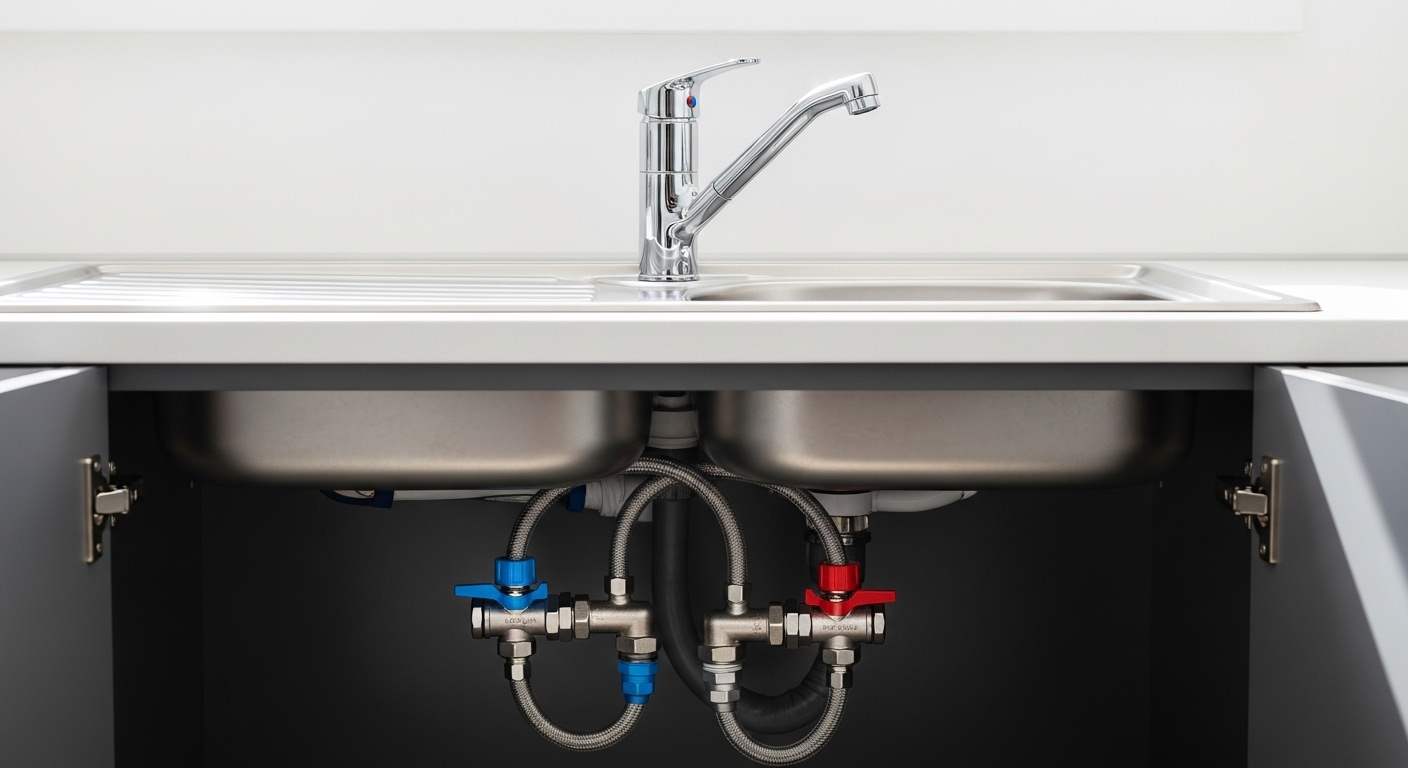
- Turn off the water. Look under the sink for the two small isolation (service) valves on the flexible tap tails — one blue-ish for cold, one red-ish for hot. Turn the slotted screw a quarter-turn with a flat screwdriver so the slot sits across (perpendicular to) the pipe. If there are no isolation valves, turn off your mains stopcock. Then open the tap to release pressure and confirm the water is off.
- Block the plughole. Put the plug in or stuff a cloth in the drain so no tiny screws or clips disappear forever.
- Remove the handle. Prise off the small red/blue index cap on top or side of the lever with a flat screwdriver. Underneath is a grub screw — loosen it with your Allen key (don’t fully remove it if you can avoid it). Lift the handle straight up and off.
- Remove the cover/dome. Unscrew the decorative chrome shroud or dome nut by hand, or gently with cloth-wrapped pliers. This exposes the brass retaining nut that clamps the cartridge down.
- Undo the retaining nut. Use your adjustable spanner to loosen the large brass nut anticlockwise. This is the step people find stiff — hold the spout body steady with your other hand so you don’t twist the whole tap and loosen the tails below.
- Lift out the old cartridge. It should pull straight up. Note its orientation — most cartridges have a locating lug or flat that sits in a matching notch in the tap body. Snap a photo before it comes out.
- Clean the seat. Wipe out any limescale grit from inside the tap body with your cloth. A clean seat is what stops the new cartridge weeping.
- Fit the new cartridge. Line up the locating lug with the notch and press it firmly and squarely down. A dab of silicone grease on the O-rings helps it seat and last longer. Getting the orientation right matters — fit it 180° out and your hot and cold will be reversed.
- Reassemble. Retaining nut back on and nipped up firm (not gorilla-tight — you’ll crack the ceramic), then the shroud, then the handle and grub screw, then the index cap.
- Turn the water back on slowly. Open the isolation valves a quarter-turn back. Run the tap, check for drips from the spout and around the base, and check underneath for leaks at the tails.
If you get a leak from underneath after turning the water back on, it’s almost always because the tap body twisted while you were undoing the retaining nut. Re-tighten the tap tails and it’ll stop. This is the same principle you’ll see in our broader guide on whether kitchen faucet repair is worth it.
What if the retaining nut or cartridge is seized with limescale?
If the brass nut or cartridge won’t budge, don’t force it with brute strength — spray it with penetrating oil or a descaler, wait 15–20 minutes, and try again. Hard-water limescale is the number-one reason a cartridge job goes from 20 minutes to an hour, especially in London, Cambridge, and much of southern and eastern England.
A few things that help with a seized tap:
- Warm it gently. A cloth soaked in hot water wrapped around the nut for a couple of minutes can free up limescale binding.
- Use the right spanner. A properly fitting spanner or basin wrench grips flat; an oversized adjustable rounds off brass corners.
- Steady the body. Always counter-hold so you’re twisting the nut, not the tap.
- Know when to stop. If the cartridge is fused solid and the tap is old and cheap, a whole new mixer costs £30–£60 and may be the smarter call. If you decide to swap the whole tap instead, our walkthrough on how to remove an old faucet from a kitchen sink takes it from there.
To stop it happening again, fit a cartridge from a quality brand and consider whether a water softener or scale reducer is worth it for your area — hard water is what kills ceramic discs early.
How long does it last, and is it worth doing myself?
A quality replacement ceramic cartridge typically lasts 5–10 years, and doing it yourself is almost always worth it — you’ll spend £8–£25 and half an hour versus £80–£150 for a plumber. The only time I’d call a pro is a seized branded cartridge on an expensive tap, or if you have no isolation valves and aren’t confident finding your mains stopcock.
Ceramic disc technology is genuinely durable when it’s made well — the discs are lapped flat to within microns and, in hard water, it’s limescale rather than wear that ends their life. That’s why matching a good-quality cartridge matters more than saving £3 on the cheapest generic. A well-made cartridge, seated on a clean body with greased O-rings, will outlast several cheap ones.
FAQ
Are all UK kitchen tap cartridges the same size?
No. UK ceramic cartridges are most commonly 35mm or 40mm in diameter, but lengths and stem splines vary between brands. Always remove and measure the old one, or buy a genuine cartridge for your tap’s make and model. Grohe and some premium brands use proprietary cartridges that generics won’t fit.
Can I change a cartridge without turning off the mains?
Usually yes — most UK kitchen taps fitted since the 2000s have isolation valves on the flexible tails under the sink, so you only shut off that one tap. Give the valve screw a quarter-turn so the slot sits across the pipe. If there are no isolation valves, you’ll need to turn off your mains stopcock instead.
Why is my tap still dripping after I changed the cartridge?
The three usual causes are a mismatched cartridge that doesn’t seat properly, grit or limescale left on the seat inside the tap body, or the retaining nut not tightened evenly. Take it back apart, clean the seat thoroughly, confirm the cartridge is the exact right size and orientation, and re-seat it with a little silicone grease.
How much does it cost to replace a kitchen tap cartridge in the UK?
Doing it yourself costs roughly £8–£25 for the cartridge plus a few pounds for tools you’ll keep. Calling a plumber typically runs £80–£150 including the call-out and labour, even though the job takes them well under half an hour. That’s why it’s one of the most cost-effective DIY plumbing fixes there is.
Can I use a universal cartridge instead of a branded one?
Often, yes — universal ceramic cartridge kits with multiple adaptor splines fit many unbranded and own-brand UK taps sold through showrooms and merchants. But for proprietary brands like Grohe, or if your tap is still under a manufacturer warranty, use the genuine part so you keep the guarantee and get a guaranteed fit.
My hot and cold are reversed after fitting the new cartridge — what went wrong?
You’ve almost certainly fitted the cartridge 180° out of position. Turn off the water, pull the cartridge, rotate it so the locating lug sits in the correct notch, and refit. It’s a two-minute fix and doesn’t mean anything is damaged.
A note on getting it right the first time
Author note: This guide was written by the Adeaga fixtures team, drawing on hands-on bench testing of monobloc mixers and ceramic cartridges from UK-market brands including Grohe, Bristan, Franke and Abode. We disassemble and refit these taps ourselves, in hard-water and soft-water conditions, so the steps and timings here reflect what actually happens on a real UK sink — not a generic overseas guide.
About Adeaga: Adeaga specialises in kitchen and bathroom taps, showers and fixtures, and we curate parts and complete taps that meet UK plumbing standards. Quality ceramic cartridges should conform to relevant performance standards (such as EN 817 for mechanical mixer taps and WRAS-approved materials for potable water contact), and reputable UK taps carry manufacturer warranties of 5 years and up — often lifetime on the tap body. Before you buy a replacement cartridge, always check whether your tap is still within its warranty period, because many brands will supply the genuine part free. If in doubt about your water supply or you can’t isolate the mains safely, use a registered plumber.