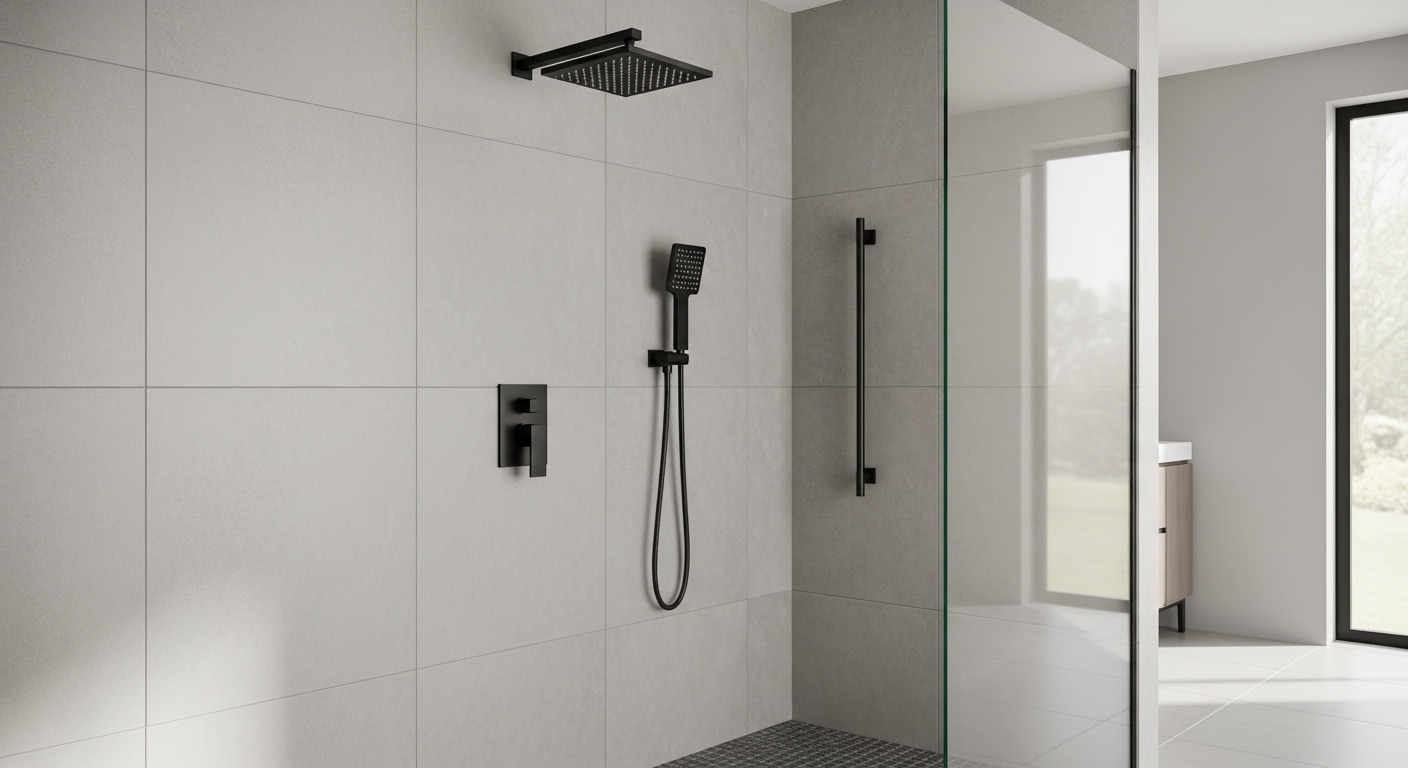
A shower system moen setup means you’re buying a coordinated kit — the in-wall valve, the trim (handle and escutcheon), the showerhead, and sometimes a handheld sprayer and a diverter — all engineered to fit together and share one finish. That’s the whole appeal: instead of guessing whether a random showerhead will play nice with your valve, you get parts Moen designed as a set, with the warranty and replacement-cartridge support that comes with one of the biggest names in American plumbing. This guide walks through which Moen system actually fits your bathroom, what the valve names mean, what you’ll pay, and where people go wrong.
What exactly is a “shower system” from Moen — and what’s in the box?
A Moen shower system is a bundled set of shower components built around one valve, so the handle, showerhead, and any extras share the same finish and hydraulics. At minimum you get a trim kit and a showerhead; fuller systems add a handshower, a hose, a slide bar or wall bracket, and a diverter that switches water between outlets.
Here’s the part that trips people up: Moen sells trim and valves separately for a reason. The valve is the brass body that gets soldered or press-fit into your wall — it’s the plumbing. The trim is everything you see and touch afterward. A “shower system” or “shower kit” packages compatible trim and heads together, but you almost always still need the matching rough-in valve (Moen’s is usually a Posi-Temp or Moentrol rough-in) unless the listing explicitly says the valve is included. Always read whether the box says “valve included” or “trim only.” Buying a gorgeous trim kit and discovering there’s no valve behind your tile is the classic Saturday-morning mistake.
- Trim only — you already have a compatible Moen valve in the wall and just want a new look or function.
- Trim + valve (complete system) — new construction or a full remodel where the wall is open.
- Shower + tub systems — add a tub spout for a combined bath/shower.
Posi-Temp vs Moentrol vs thermostatic: which Moen valve do I actually need?
For most homes, Moen’s Posi-Temp pressure-balancing valve is all you need — it’s the standard single-handle valve that keeps you from getting scalded when someone flushes a toilet. Step up to Moentrol or a full thermostatic valve only if you want independent volume control or multiple sprays running at the same time.
The valve is the single most important decision because it determines what your system can do, and it’s buried in the wall — changing it later means opening the tile. Here’s the plain-English breakdown of Moen’s main valve families.
| Valve type | What it does | Anti-scald? | Best for | Rough price (valve + trim) |
|---|---|---|---|---|
| Posi-Temp | Single handle controls temp; auto-balances hot/cold pressure | Yes (pressure-balancing) | Standard showers, most bathrooms, budget-to-mid remodels | $150–$350 |
| Moentrol | Pressure-balanced temp + separate push/pull volume control | Yes | Wanting to dial flow down or run two outlets | $300–$600 |
| ExactTemp / Thermostatic | Precise digital-style temp dial + separate volume; holds an exact degree | Yes (thermostatic) | Spa systems, rain head + body sprays together | $500–$1,200+ |
| Vertical Spa / U by Moen | Body sprays or app/voice-controlled digital showering | Yes | Luxury builds, smart-home fans | $1,000–$3,000+ |
The honest rule of thumb: if you have one showerhead and maybe a handheld, Posi-Temp is the right call and anything fancier is money you won’t feel. The moment you want a big rain head and a handshower and body jets all flowing simultaneously, you need the higher water volume that Moentrol or a thermostatic valve delivers — a Posi-Temp will simply choke and split the flow into a weak trickle. If you’re weighing which extra sprayers and diverters are worth adding, our rundown of shower faucet accessories that actually matter saves you from buying parts you’ll never use.
How much does a Moen shower system cost in 2026 — and where’s the sweet spot?
Expect to pay $150–$450 for a solid single-handle Moen system with a good showerhead, and $500–$1,200+ for a multi-function spa setup with a rain head, handshower, and thermostatic valve. The best value for most people sits right around $250–$400.
Prices swing based on three things: the valve type (above), the finish, and how many outlets the system feeds. A few concrete scenarios:
- Budget refresh ($150–$250): Posi-Temp trim + a single-function or 2-in-1 showerhead. Clean, reliable, anti-scald. Great for a rental or a guest bath.
- The sweet spot ($250–$400): Posi-Temp system with a rain-style showerhead plus a handheld on a diverter. Covers 90% of what people actually want — a big soft rain plus a handshower for rinsing, cleaning, and washing kids or pets.
- Spa build ($500–$1,200+): Moentrol or thermostatic valve, overhead rain head, handshower, and 2–4 body sprays. Real luxury, but budget for a plumber and higher water flow needs.
One cost people forget: the rough-in valve labor. If your wall is already tiled and you’re only swapping trim, a handy homeowner can do it in an afternoon. If the valve itself needs replacing, you’re opening the wall, and that’s a plumber’s job in most cases. Choose your valve before the tile goes up and you’ll never face that bill.
Which finish should I pick — and will matte black or brushed gold hold up?
Pick the finish that matches the rest of your bathroom hardware first, then check it’s a Moen Spot Resist or PVD finish for durability. Chrome and brushed nickel are the safest, most timeless choices; matte black and brushed gold look stunning but show water spots and require a little more wiping.
Moen’s finishes are genuinely good — their Spot Resist Brushed Nickel and Spot Resist Stainless are engineered to hide water spots and fingerprints, which matters in a hard-water home. Their matte black and bronze options increasingly use PVD (physical vapor deposition), a coating bonded at the molecular level that resists scratching and won’t peel the way cheaper electroplated finishes do. If you’re leaning dark, it’s worth understanding why the coating type matters — our guide on whether a matte black PVD faucet is worth it explains exactly what separates a finish that lasts a decade from one that flakes in two years.
A quick reality check on darker finishes: matte black and gold are absolutely on-trend and pair beautifully with modern tile, but in a home with hard water, mineral spots show up faster on them than on brushed nickel. It’s not a dealbreaker — a microfiber cloth and a quick wipe after showering keeps them pristine — just know what you’re signing up for.
Can I install a Moen shower system myself?
If you’re only replacing the trim on an existing compatible Moen valve, yes — it’s a genuine DIY job that takes most people under an hour with basic tools. If you’re installing or replacing the in-wall valve, that involves cutting into the wall and soldering or press-fitting connections, which is best left to a plumber unless you’re experienced.
Here’s the difference in practice:
- Trim swap (DIY-friendly): Shut off water, pull the old handle and escutcheon, replace the Posi-Temp cartridge if needed, thread on the new trim, and mount the new showerhead. Moen cartridges are standardized, so a fresh cartridge often fixes a temperamental old shower at the same time.
- Full valve install (call a pro): The wall is open, the valve body gets connected to hot, cold, showerhead, and tub-spout lines, and it must be set to the correct depth for your tile thickness. Get this wrong and the trim won’t seat flush.
The good news is that Moen’s engineering is famously forgiving for the everyday jobs — cartridge replacements and trim swaps are about as easy as plumbing gets. If you’ve tackled a bathroom faucet before, you already have the skills; our walkthrough on how to install a Moen faucet yourself in under an hour uses the same Moen-friendly approach and is a good confidence-builder before you touch the shower.
Moen vs Delta, Kohler, and Grohe — how does a Moen shower system stack up?
Moen wins on cartridge availability, warranty support, and mid-range value; Delta is its closest rival with a similar DIY-friendly approach; Kohler leans more designer/premium; and Grohe is the German-engineering luxury pick. For the average American homeowner, Moen and Delta are the two safest bets because parts are on the shelf at every hardware store.
| Brand | Anti-scald valve | Parts availability | Warranty | Vibe / price |
|---|---|---|---|---|
| Moen | Posi-Temp / Moentrol / thermostatic | Excellent — everywhere | Limited lifetime (residential) | Reliable value, $150–$1,200 |
| Delta | MultiChoice universal valve | Excellent | Limited lifetime | DIY-friendly, $150–$1,000 |
| Kohler | Rite-Temp / thermostatic | Good | Limited lifetime | Designer look, $250–$1,500 |
| Grohe | Grohtherm thermostatic | Fair (specialty) | Limited lifetime | German luxury, $400–$3,000 |
Moen’s real edge is the Posi-Temp cartridge ecosystem: those cartridges have been standardized for decades, so a valve installed in 2005 can usually be serviced today with a $20 part from any hardware store. That long-term serviceability is worth more than most people realize when you’re twelve years into owning a shower and it starts dripping.
What do I actually need to buy — a simple shopping checklist
To build a complete Moen shower system, confirm you have all of these before you check out:
- The valve — Posi-Temp for standard, Moentrol/thermostatic for multi-spray. (Skip only if reusing a compatible existing valve.)
- The trim kit — handle + escutcheon in your chosen finish, matched to the valve type.
- The showerhead — single-function, rain, or multi-setting. A handheld like the popular styles in our Jolie shower head review pairs well with a diverter.
- A diverter or transfer valve — only if you’re running more than one outlet (e.g., rain head + handshower).
- A slide bar or wall bracket — for adjustable handshower height, great for households with mixed heights or accessibility needs.
FAQ
Does a Moen shower system come with the valve, or do I buy it separately?
It depends on the listing. Many Moen “shower systems” and trim kits are sold trim-only, meaning you must add the matching Posi-Temp or Moentrol rough-in valve separately. Some complete kits include the valve. Always read the box or product page for the words “valve included” — if it doesn’t say so, assume you need to buy the valve too.
Are all Moen shower trims compatible with all Moen valves?
No. Trim is matched to a specific valve family. Posi-Temp trim fits Posi-Temp valves, Moentrol trim fits Moentrol valves, and so on. The good news is Moen labels this clearly, and Posi-Temp is by far the most common, so a Posi-Temp trim will fit the vast majority of existing Moen showers. If you’re unsure what’s in your wall, pull the handle and match the cartridge before buying.
Will a Moen rain shower system have weak water pressure?
A single rain head on a Posi-Temp valve gives plenty of pressure for most homes. Pressure only becomes an issue when you try to run a big rain head plus a handshower plus body sprays at once on a standard valve — that’s when you need a higher-flow Moentrol or thermostatic valve. In the US, showerheads are capped at 2.5 GPM by federal law (1.8 GPM in California and a few other states), so no system legally “boosts” pressure beyond that; the trick is matching your valve to how many outlets you run simultaneously.
What warranty does a Moen shower system come with?
Moen backs its residential faucets and shower systems with a Limited Lifetime Warranty covering defects in materials and workmanship for the original homeowner, with the finish and function covered for as long as you own the home. Electronic and commercial products have shorter terms. Keep your receipt — Moen’s support is well-regarded and often ships replacement cartridges and parts free of charge.
How long does a Moen shower system last?
The valve and brass body can easily last 20–30 years; the wear part is the cartridge, which may need replacing every 5–15 years depending on water quality. Hard water shortens cartridge life. The upside is that swapping a Posi-Temp cartridge is a cheap, standardized fix — so “the shower is failing” almost always means “it needs a $20 cartridge,” not a new system.
Is a Moen shower system good for hard water?
Yes, with two caveats: choose a Spot Resist or PVD finish to hide mineral spots, and expect to replace the cartridge a bit more often than in a soft-water home. Many Moen showerheads have flexible rubber spray nubs (Moen calls it a “self-cleaning” design) that let you wipe mineral buildup off with your thumb, which genuinely helps keep spray pattern strong in hard-water regions.
The bottom line
A Moen shower system is one of the safest fixture buys you can make in 2026: standardized valves, cartridges on every hardware-store shelf, a lifetime warranty, and finishes that hold up. Match the valve to how you shower — Posi-Temp for one head plus a handheld, thermostatic only if you want everything running at once — pick a Spot Resist or PVD finish, and confirm whether your kit includes the valve. Do those three things and you’ll have a shower that works, looks right, and stays serviceable for decades.
About the author & Adeaga: This guide was written by the Adeaga fixtures team, drawing on hands-on installation and testing of shower valves, trims, and showerheads across dozens of bathroom builds. Adeaga (adeaga.net) specializes in faucets, shower systems, and bathroom fixtures, and we evaluate products against real-world durability, water-flow standards (US 2.5 GPM / CA 1.8 GPM), anti-scald ASSE 1016 pressure-balancing requirements, and manufacturer warranty terms — so our recommendations reflect what actually holds up, not just what’s on sale. Always follow local plumbing codes and manufacturer instructions when installing.