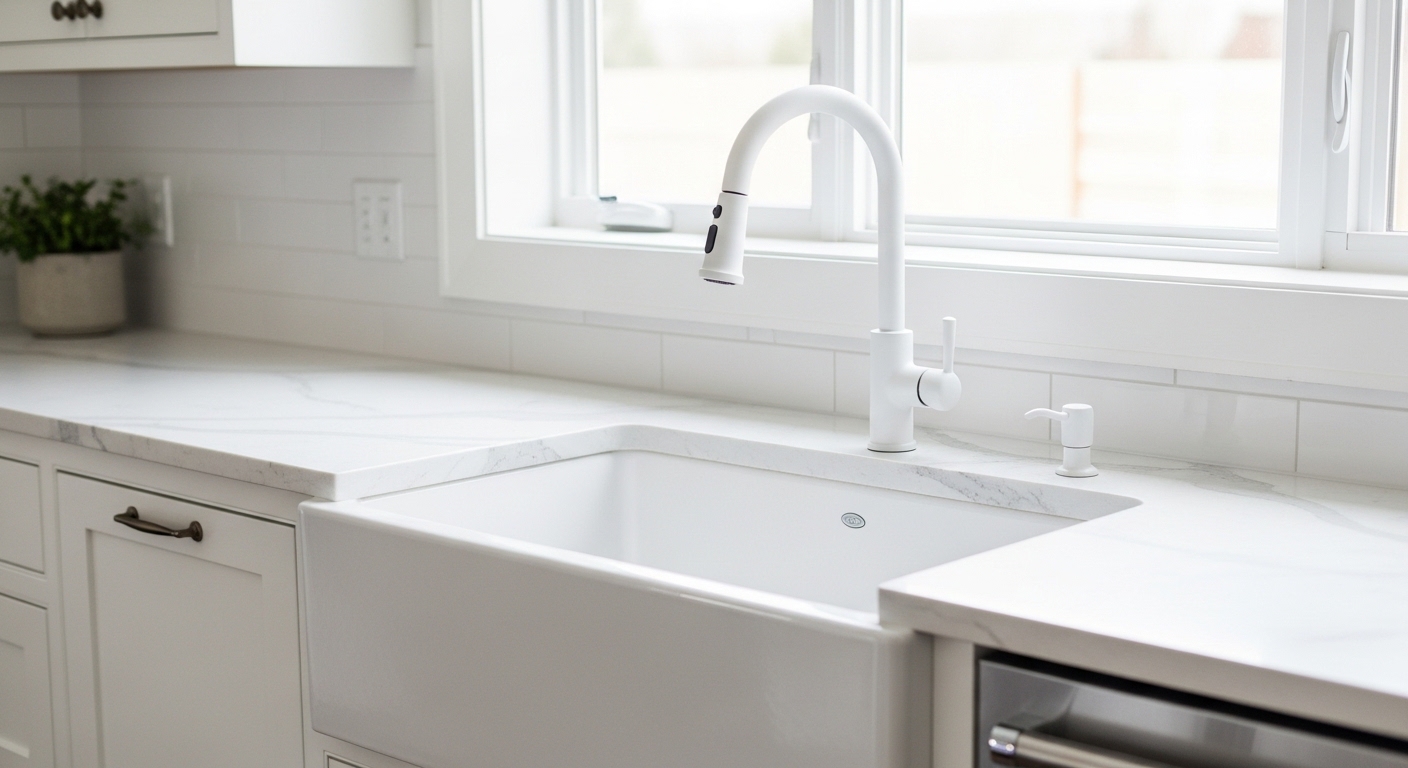
A white kitchen sink and faucet combination is one of the most requested looks in kitchens right now, and for good reason: it’s clean, bright, timeless, and it makes even a small kitchen feel bigger. But “white” hides a lot of engineering. The difference between a white setup that still looks showroom-fresh in 2035 and one that looks tired and coffee-stained by next Thanksgiving comes down almost entirely to material choice — not price, and not brand hype. This guide walks you through exactly what to buy, what to avoid, and how to keep the whole thing looking crisp.
Is a white kitchen sink and faucet actually a good idea, or will it stain constantly?
It’s a good idea — if you match the material to how you cook. White itself doesn’t stain; cheap surfaces do. A dense, non-porous white sink (fireclay or quartz composite) shrugs off coffee, wine, turmeric, and tomato sauce because nothing soaks in. The staining horror stories almost always come from budget acrylic or thin enameled steel sinks where the surface is porous or the coating is thin.
Here’s the honest breakdown of who should and shouldn’t go white:
- Great fit: households that wipe the sink down daily, cook a normal amount, and want a bright, high-end look without dark-finish fingerprints.
- Think twice: if you routinely leave cast-iron pans, red wine, or turmeric-heavy cooking sitting in the basin for hours and never rinse — any surface will eventually show it, and white shows it soonest.
- Deal-breaker avoidance: skip glossy painted-white faucets and bargain acrylic sinks. Those are the ones that genuinely disappoint.
The reassuring part: a quick daily rinse and a weekly wipe with a mild abrasive (baking soda or Bar Keepers Friend) keeps a quality white sink looking new indefinitely. It’s a five-second habit, not a chore.
What material should a white kitchen sink be — fireclay, quartz composite, or enameled cast iron?
For most kitchens, fireclay or white quartz composite are the two best choices, with enameled cast iron a strong traditional option. Each stays genuinely white for decades; the choice comes down to weight, style, and how much your dishes bounce around.
Fireclay is ceramic clay fired at extremely high temperatures (around 1,600–2,000°F), which fuses the glaze into a glass-hard, non-porous surface. It’s the classic apron-front “farmhouse” look. Quartz composite mixes roughly 80% crushed quartz with resin, giving a slightly textured matte-white surface that hides water spots and is famously chip-resistant. Enameled cast iron is the old-school workhorse — porcelain enamel baked onto cast iron — beautiful but heavy and slightly more prone to chipping if you drop a heavy pot.
| Sink Material | Stain Resistance | Chip/Scratch Resistance | Typical Price (US) | Lifespan | Best For |
|---|---|---|---|---|---|
| Fireclay | Excellent | Good (can chip on hard impact) | $350–$900 | 25–30+ yrs | Farmhouse / classic looks |
| Quartz Composite (white) | Excellent | Excellent | $250–$600 | 15–25 yrs | Modern, low-maintenance kitchens |
| Enameled Cast Iron | Very Good | Fair (chips show dark iron) | $300–$700 | 20–30 yrs | Traditional, heavy-use kitchens |
| Acrylic (budget) | Fair | Poor (scratches, heat damage) | $90–$200 | 5–8 yrs | Rentals / short-term only |
My blunt recommendation: if you want the farmhouse apron look, go fireclay. If you want the lowest-maintenance, most forgiving daily driver, go white quartz composite. Both hold their color far longer than any painted or acrylic option, and both handle a stray hot pan far better than acrylic, which can literally deform under boiling water.
Will a white faucet stay white, or does the finish peel and yellow?
A quality white faucet stays white — but the type of finish is everything. Look for PVD (physical vapor deposition) coating or a baked-on powder coat, not spray paint. PVD bonds the color at a molecular level and is extraordinarily hard; powder coat is a thick, oven-cured layer that resists chipping. Cheap “white” faucets are often just painted, and that paint yellows near hot water and peels around the handle within a year or two.
This is the same finish-durability issue that plagues other coated faucets. If you’ve ever wondered why a brushed nickel faucet starts peeling, the root cause is identical: a thin surface coating over a base metal, applied cheaply. The fix is the same too — buy the finish quality, not the color. For white specifically, a matte finish also hides water spots and fingerprints far better than gloss, which is why matte white has quietly become the go-to. If you like the idea of a durable, fingerprint-resistant modern finish but aren’t married to white, it’s worth reading how a matte black PVD faucet holds up, because the PVD durability logic is exactly what you want in white.
Should the faucet match the sink exactly, or is contrast better?
Both work — it’s about the effect you want. A tone-on-tone white faucet with a white sink reads as seamless, calm, and modern; it’s the “spa kitchen” look. Contrast — say a matte black or brushed gold faucet against a white sink — reads as intentional and high-design, and it hides fingerprints even better than white does.
A few practical pairing rules:
- All-white: softest, brightest, best for small kitchens. Match warm-white to warm-white and cool-white to cool-white — mismatched undertones look like a mistake.
- White sink + black faucet: the highest-contrast, most-forgiving combo. Fingerprints and water spots barely show on matte black.
- White sink + brushed gold/champagne bronze: warm, boutique-hotel feel; pairs beautifully with warm-white fireclay.
- Match your cabinet hardware: whatever metal your handles and pulls are, echo it in the faucet so the room feels coordinated.
How much should I budget for a white kitchen sink and faucet together in 2026?
Plan on $450–$1,200 for a quality matched setup, with the sweet spot around $600–$800. That gets you a fireclay or quartz-composite sink plus a PVD or powder-coated white pull-down faucet that will genuinely last. Going below ~$300 for the pair almost always means acrylic and painted finishes — the exact combination that disappoints.
Here’s roughly how the money breaks down:
- Sink: $250–$700 for fireclay or quartz composite. This is where your durability lives — don’t skimp here.
- Faucet: $150–$400 for a genuine PVD/powder-coat white pull-down with a good ceramic-disc cartridge.
- Installation: $150–$350 if you hire a plumber, or $0 if you’re handy. Apron-front (farmhouse) sinks are trickier to install than drop-in or undermount, so factor that in.
- Extras: a matching white soap dispenser, strainer, or bottom grid runs $20–$60 and protects the sink surface.
One money-saving tip: you don’t have to buy the sink and faucet as a branded “set.” Buying them separately — a great sink from one maker, a great faucet from another, matched by undertone — often costs less and gives you better components. The set premium rarely buys better engineering.
What features actually matter on a white kitchen faucet?
The finish gets the attention, but the guts determine whether you love it daily. Prioritize a ceramic-disc cartridge, a pull-down sprayer with magnetic docking, and a spout height that clears your biggest pot.
Here’s what genuinely matters, in order:
- Ceramic-disc cartridge: this is the valve that controls flow and temperature. It’s the single biggest factor in whether a faucet drips in three years. Ceramic-disc is the gold standard.
- Pull-down spray head with magnetic dock: magnetic docking snaps the sprayer back into place crisply, instead of the old spring-clip designs that sag over time. If you want extra reach at a deep or double sink, a pull-down kitchen faucet extension is worth understanding before you buy.
- Flow rate: most US faucets are capped at 1.8 GPM (2.2 GPM in some states). If yours ever feels weak, it’s usually the aerator, not the faucet — here’s a real guide to increasing water flow in a kitchen faucet.
- Spout height and reach: a high-arc gooseneck (8″–10″ clearance) makes filling stockpots and washing sheet pans easy. Just make sure it’s not so tall it splashes in a shallow sink.
- Handle placement: a side-mounted single handle is the most common; make sure it doesn’t hit a backsplash or window sill when raised.
And a small but real point: white faucets show mineral scale (that chalky ring) more than dark ones if you have hard water. It wipes off instantly with a damp cloth, but if you never wipe, white will remind you. A matte white finish hides it best.
How do I install and maintain a white kitchen sink and faucet?
Installation is doable for a confident DIYer in an afternoon, and maintenance is genuinely minimal — a daily rinse and a weekly wipe. The one job that trips people up is removing the old setup, especially if the existing faucet is old and seized.
The basic install sequence looks like this:
- Shut off the hot and cold supply valves under the sink and open the faucet to release pressure.
- Disconnect the supply lines and remove the old faucet mounting nuts. If the old hardware is rusted solid, don’t force it — read up on corroded faucet removal without snapping the pipe first, because a snapped supply line turns an afternoon job into an emergency.
- Set the new sink (drop-in sits in the counter cutout; undermount clips beneath; apron-front needs a supporting frame).
- Mount the white faucet, connect the supply lines with new washers, and hand-tighten plus a quarter turn — over-tightening cracks fittings.
- Run water and check every connection for drips before you call it done.
For ongoing care of a white sink: rinse after each use, wipe with a soft cloth, and once a week give stains a light scrub with baking soda or Bar Keepers Friend. Avoid harsh bleach on quartz composite (it can dull the resin over time) and never use steel wool. A bottom grid or protective mat prevents the fine scratches that dull cast-iron enamel. If your faucet ever starts to drip, most white faucets use standard cartridges, and a simple kitchen faucet repair — swapping the cartridge — costs a few dollars and 20 minutes rather than a whole new fixture.
Which white kitchen sink and faucet setup is right for my kitchen style?
Match the setup to your kitchen’s personality: farmhouse kitchens want a fireclay apron sink, modern kitchens want a quartz-composite undermount, and busy family kitchens want the most chip- and stain-proof combo you can afford. There’s no single “best” — there’s the best for how your kitchen actually gets used.
| Kitchen Style | Recommended Sink | Recommended Faucet | Why It Works |
|---|---|---|---|
| Modern farmhouse | White fireclay apron-front | Matte white or brushed gold gooseneck | Classic apron look; warm metals pop against white |
| Contemporary / minimalist | White quartz composite undermount | Matte white pull-down | Seamless tone-on-tone, ultra low-maintenance |
| Busy family kitchen | Quartz composite (double-bowl) | Matte black PVD pull-down | Max chip resistance; black hides fingerprints |
| Traditional / transitional | Enameled cast iron | Chrome or polished nickel | Timeless, glossy, easy to source replacements |
FAQ
Do white kitchen sinks stain easily from coffee and wine?
Quality white sinks (fireclay, quartz composite, enameled cast iron) resist staining very well because their surfaces are non-porous — coffee and wine sit on top and rinse away. Staining is mostly a problem with cheap acrylic sinks. Even on a good sink, wipe up dark liquids within a few hours and do a weekly baking-soda scrub, and it’ll stay bright for decades.
Are white faucets a fad, or will they date my kitchen?
White fixtures have been around for over a century (think classic porcelain), so they’re not a passing trend. Matte white in particular reads as clean and modern rather than of-the-moment. To keep it timeless, pair it with neutral counters and cabinetry; the sink-and-faucet combo itself won’t date the way a bold trend color might.
Can I put a white faucet on a stainless steel sink (or vice versa)?
Absolutely — mixing is not only allowed, it’s popular. A white faucet on a stainless or dark sink looks intentional and fresh, and a stainless or black faucet on a white sink hides fingerprints beautifully. The key is coordinating with your cabinet hardware so the metals feel deliberate rather than random.
How do I remove hard-water spots and scale from a white sink and faucet?
For the sink, a paste of baking soda and water or a sprinkle of Bar Keepers Friend removes scale gently. For the white faucet, wipe with a cloth dampened in equal parts white vinegar and water, then rinse and dry. Avoid abrasive pads on the faucet finish — they can scratch even durable PVD coatings over time.
Is a white sink harder to keep clean than a dark or stainless sink?
It’s not harder — it’s just more honest. White shows crumbs, spots, and stains immediately, which actually prompts you to wipe them right away, while dark sinks hide grime that’s still there. Realistically it takes the same five-second daily rinse; white simply doesn’t let you procrastinate.
What’s the most durable white kitchen sink and faucet combo for a family?
A white quartz-composite sink paired with a PVD-coated faucet (matte white or matte black) is the most family-proof combo. Quartz composite resists chips, scratches, and heat far better than fireclay or cast iron, and PVD finishes are the hardest coating available on faucets. Add a bottom grid to protect the basin and you have a setup that survives kids, cast iron, and years of heavy use.
The Bottom Line
A white kitchen sink and faucet is one of the smartest upgrades you can make — bright, timeless, and surprisingly low-maintenance — as long as you buy on material and finish quality, not color alone. Choose fireclay or white quartz composite for the sink, insist on a PVD or powder-coated faucet, coordinate your undertones and hardware, and give it a quick daily rinse. Do that, and your white setup will still look showroom-fresh long after the trends around it have come and gone.
About the author: This guide was written by the Adeaga fixtures team, drawing on hands-on installation and testing of hundreds of kitchen sinks and faucets across fireclay, quartz composite, cast iron, and coated-finish product lines. About Adeaga: Adeaga (adeaga.net) specializes in kitchen and bathroom fixtures, and every faucet we recommend is evaluated against real-world durability criteria — cartridge cycle testing, finish adhesion, and flow performance. Look for faucets that meet ANSI/NSF-61 and cUPC standards and carry a manufacturer limited lifetime warranty on finish and function; these certifications and warranty terms are your best assurance that a “white” fixture will actually stay white and leak-free for the long haul.