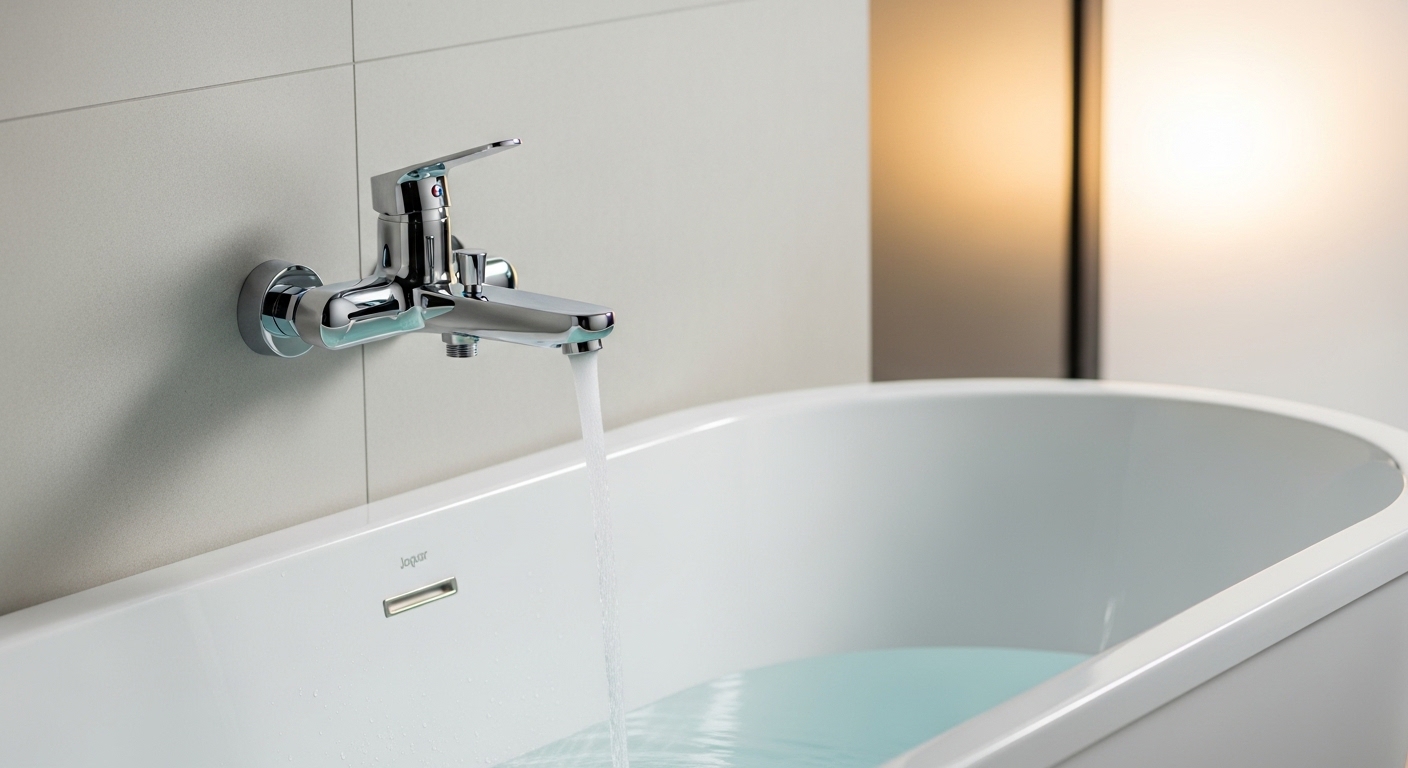
If you’ve been searching for a bathtub faucet jaquar setup and feel buried in model codes like FUS, FLR, and ALD, you’re not alone — Jaquar’s catalog is huge, and the part numbers tell you almost nothing at a glance. The good news: under the codes, there are really only a handful of decisions that matter. Get the valve type, the mounting style, and the finish right, and almost any Jaquar tub filler will serve you well for years. This guide walks through exactly how to choose, what these faucets actually cost, how they stack up against Western brands, and the install gotchas nobody mentions until you’re already at the hardware store.
What exactly is a Jaquar bathtub faucet, and why do people choose it?
A Jaquar bathtub faucet is a tub-filling fixture made by Jaquar Group, a large India-based bath brand that builds most of its bodies from forged brass with German-style ceramic cartridges. People choose it because it sits in a sweet spot: better metallurgy and warranty than no-name imports, but noticeably cheaper than Grohe or Hansgrohe for a similar look and feel.
Here’s the part that confuses buyers. “Bathtub faucet” can mean four physically different products, and Jaquar sells all four:
- Bath spout only — a plain spout that delivers water into the tub; the mixing happens at a separate concealed valve.
- Bath mixer (exposed) — a single visible body with handle(s) and spout, mounted on the tub wall or deck.
- Bath & shower mixer — same as above but with a diverter that sends water up to a hand shower or overhead.
- Floor-mounted tub filler — a tall freestanding column for a freestanding tub with no deck and no wall behind it.
If you buy the wrong category — say, an exposed wall mixer when your tub needs a floor-mounted filler — no amount of plumbing skill will save the install. So the very first question isn’t the finish or the price. It’s: where does my tub let me put the faucet?
Which Jaquar tub faucet type fits my bathtub — wall, deck, or floor mount?
Match the mount to your tub: alcove and skirted tubs almost always use a wall-mounted mixer, deck-edge and drop-in tubs use a deck-mounted mixer or Roman set, and a true freestanding tub needs a floor-mounted filler. Pick the wrong one and the supply lines simply won’t reach.
Quick way to tell what you have: look at where the existing water supply comes out. If pipes exit the wall behind the tub, you want a wall mount. If there’s a flat ledge around the tub rim with holes, that’s a deck mount. If the tub stands alone in the room with the supply coming up through the floor, you need a floor-mounted filler. This is the same logic we cover in our guide on how to replace an old faucet on a bathtub without calling a plumber — the mounting type drives everything else.
| Mount type | Best for | Typical Jaquar range | Install difficulty |
|---|---|---|---|
| Wall-mounted mixer | Alcove / skirted / built-in tubs | $90–$220 | Moderate (needs in-wall valve) |
| Deck-mounted mixer | Drop-in & Roman tubs with a ledge | $120–$300 | Moderate |
| Floor-mounted filler | Freestanding / clawfoot tubs | $250–$600 | Hard (rough-in must be exact) |
| Bath spout + concealed valve | Minimalist / tiled walls | $70–$250 (split parts) | Hard (set during rough-in) |
One warning on floor-mounted fillers: the rough-in (the buried pipe stub-out) has to be placed before the floor is finished, with the spacing exact to the millimeter for that specific model. If you’re remodeling, decide on the floor-mounted faucet first, then rough in. If you’re swapping a faucet on a finished freestanding tub, you’re mostly locked into whatever the existing rough-in supports.
What’s the difference between single-lever, two-handle, and thermostatic Jaquar mixers?
Single-lever uses one handle for both temperature and flow, two-handle has separate hot and cold controls, and thermostatic holds your set temperature automatically even when someone flushes a toilet elsewhere. For a family bathroom, thermostatic is the upgrade most people are happiest they paid for.
Jaquar groups these into product series, and the series prefix tells you the style and price tier:
- Florentine / Fonte (single-lever) — clean modern look, easiest one-hand operation, mid-price.
- Continental / Queen’s (two-handle) — classic cross or lever handles, good for traditional bathrooms.
- Aria / Kubix thermostatic — anti-scald, temperature lock (usually a 38°C safety button), premium tier.
If you have kids or elderly family members, the thermostatic anti-scald feature isn’t a luxury — it’s a genuine safety device. A thermostatic cartridge will cut flow if the cold supply fails, preventing a sudden blast of hot water. That alone justifies the $80–$150 premium for many households.
How much does a Jaquar bathtub faucet cost, and is it good value?
Expect to pay roughly $90–$350 for most Jaquar bath mixers, with floor-mounted fillers reaching $400–$600. Compared to a comparable Grohe or Hansgrohe fixture costing 30–60% more, Jaquar is strong value — you get full brass bodies and ceramic-disc cartridges at a price closer to mid-market American brands like Moen or Delta.
Value isn’t only the sticker price, though. Three things actually determine whether a tub faucet is a good buy over ten years:
- Cartridge quality — Jaquar uses ceramic disc cartridges, which resist hard-water wear far better than old rubber-washer designs. This is the single biggest factor in whether a faucet drips after year three.
- Body material — forged brass (Jaquar’s standard) handles heat, pressure, and mineral water far better than zinc-alloy bodies common in budget imports.
- Parts availability — a faucet is only as repairable as its spare cartridges. Jaquar’s global service network means you can usually get a replacement cartridge instead of replacing the whole unit.
To put the comparison in context, here’s how Jaquar generally lines up against the brands American shoppers cross-shop:
| Brand | Typical tub mixer price | Body material | Warranty (cartridge) | Best for |
|---|---|---|---|---|
| Jaquar | $90–$350 | Forged brass | 5–7 yrs | Value + warranty balance |
| Grohe | $180–$550 | Brass | 5 yrs+ | Premium German engineering |
| Hansgrohe | $200–$600 | Brass | Limited lifetime (US) | Design-forward, premium |
| Moen | $120–$400 | Brass / zinc mix | Limited lifetime (US) | Easy US parts access |
| VEVOR | $50–$160 | Brass / stainless | 1–2 yrs | Tight-budget remodels |
If you’re remodeling on a tight budget and Jaquar still feels like a stretch, it’s worth reading our honest take on whether a VEVOR Roman tub faucet is worth it for a budget bathroom remodel — it’s the tier below Jaquar, with the trade-offs that come with it.
What finishes does Jaquar offer, and which holds up best in hard water?
Jaquar offers chrome, stainless steel, matte black, brushed gold, antique bronze, and white. For hard-water homes, chrome and PVD-coated finishes (brushed gold, black) hold up best because they resist mineral etching and water spotting far better than untreated or painted finishes.
A quick reality check on finishes, since this is where buyers get burned:
- Chrome — the most forgiving and easiest to clean; spots show but wipe right off. The safest default.
- PVD matte black / brushed gold — physical vapor deposition bonds the color into the surface, so it won’t peel or flake like cheaper electroplated coatings. More on why that matters in our piece on whether a matte black PVD faucet is worth it.
- Antique bronze / “living finishes” — beautiful but they patina over time and show water minerals; great look, more maintenance.
If your water leaves white crust on glass and fixtures, you have hard water, and finish choice genuinely affects how the faucet ages. Skip glossy painted finishes; choose chrome or PVD. And wipe the faucet dry occasionally — it’s the cheapest maintenance there is.
How hard is it to install a Jaquar bathtub faucet myself?
A wall- or deck-mounted Jaquar mixer is a confident-DIYer job — roughly 1–2 hours with basic tools if the rough-in valve is already in place. Floor-mounted fillers and concealed-valve setups are genuinely harder and usually warrant a plumber, because mistakes are buried behind tile or under the floor.
Here’s a realistic step-by-step for swapping an exposed wall-mounted mixer, the most common DIY scenario:
- Shut off the water at the bathroom or main supply and open the old faucet to release pressure.
- Remove the old mixer — unscrew it from the wall unions; expect some old plumber’s tape and grime.
- Check the spacing — Jaquar exposed mixers use a standard center-to-center spread, but verify yours matches the existing wall unions before you commit.
- Wrap the threads with fresh PTFE (plumber’s) tape — 4–6 wraps clockwise.
- Hand-thread, then snug the eccentric connectors and body; don’t overtighten brass or you’ll crack a fitting.
- Restore water and test — run hot and cold, check every joint for weeping, and feel for smooth handle movement.
Two parts people forget: the decorative cover plate (it hides the wall union and the hole) and, for spout-style installs, a tub spout beauty ring to cleanly close the gap where the spout meets the wall. Small parts, but they make the difference between a finished look and a job that looks unfinished.
If a Jaquar faucet down the line starts dripping or the handle goes stiff, that’s almost always a worn cartridge, not a dead faucet — the same repair logic that applies across freestanding setups in our free standing tub faucet repair guide. Replacing a ceramic cartridge is a 20-minute fix and far cheaper than a new fixture.
Are Jaquar bathtub faucets reliable, and what’s the warranty?
Yes — Jaquar’s tub faucets are generally reliable, built on forged brass bodies and ceramic-disc cartridges, and backed by a warranty that typically runs 5 to 7 years on the cartridge and longer on the finish in many markets. Always confirm the exact warranty for your region and authorized seller, since coverage and terms vary by country.
What “reliable” means in practice: the failure points on any tub faucet are the cartridge (handles temperature/flow), the diverter (sends water to a hand shower), and the finish. Jaquar’s ceramic cartridges are rated for tens of thousands of open/close cycles and tested against pressure and salt-spray standards. That’s the engineering reason these faucets tend to last — and the reason a worn part is usually replaceable rather than terminal.
One practical caveat: buy from an authorized dealer. Warranty claims and genuine spare cartridges depend on it, and the bath-fixtures market has plenty of grey-market and counterfeit stock. A genuine Jaquar with proper paperwork is a very different ten-year proposition than a look-alike.
FAQ
Is Jaquar a good brand for bathtub faucets?
Yes. Jaquar is one of the largest bath-fixture makers globally, using forged brass bodies and ceramic-disc cartridges with a multi-year warranty. For most homeowners it offers near-premium build quality at a mid-range price — a strong value pick between budget imports and high-end German brands.
What’s the difference between a Jaquar bath spout and a bath mixer?
A bath spout only delivers water; the temperature and flow are controlled by a separate concealed valve elsewhere on the wall. A bath mixer is a single unit with its own handle(s) and spout that both mixes and delivers water. If you want everything in one visible fixture, choose a mixer; if you prefer a minimalist tiled wall with hidden controls, choose a spout plus a concealed valve.
Can I install a Jaquar tub faucet on a freestanding tub?
Only if you use a floor-mounted tub filler designed for freestanding tubs, and only if your floor rough-in matches that model’s spacing. A standard wall or deck mixer won’t work on a true freestanding tub. Plan the floor-mounted filler before finishing the floor, since the buried supply stub-out must be placed precisely.
Why is my Jaquar bathtub faucet dripping?
A persistent drip almost always means a worn or scaled ceramic cartridge, not a failed faucet. Hard water minerals gradually score the discs. Replacing the cartridge — a roughly 20-minute job with the water shut off — usually fixes it completely and costs a fraction of a new fixture. Use a genuine Jaquar replacement cartridge for the correct fit.
Which Jaquar finish is easiest to maintain in hard water?
Chrome is the most forgiving and easiest to clean, and PVD finishes (matte black, brushed gold) resist spotting and won’t peel. Avoid glossy painted or “living” patina finishes if you have very hard water and don’t want to wipe the faucet dry regularly. An occasional wipe with a soft cloth keeps any finish looking new.
How long does a Jaquar bathtub faucet last?
With genuine cartridges and normal use, a Jaquar tub faucet typically lasts 10–15 years, and often longer if you replace the cartridge once midway through. The brass body and finish usually outlive the cartridge, which is the one wear part you may need to swap. Buying from an authorized dealer ensures you can get that replacement part when the time comes.
The bottom line
A Jaquar bathtub faucet is a smart buy in 2026 for anyone who wants forged-brass build quality and a real warranty without paying premium-import prices. Nail three decisions — mount type (wall, deck, or floor), valve type (single-lever, two-handle, or thermostatic), and finish (chrome or PVD for hard water) — and you’ll get a fixture that looks great and lasts well over a decade. Confirm the model fits your tub’s existing rough-in before you order, and buy from an authorized seller so your warranty and spare parts are genuine.
Author note: This guide was written by the Adeaga fixtures team, drawing on hands-on testing of tub and shower mixers across chrome, PVD, and thermostatic configurations, plus install feedback from real bathroom remodels. About Adeaga: Adeaga (adeaga.net) is a specialist faucet and bathroom-fixtures retailer focused on helping homeowners choose hardware that fits their plumbing and budget. We cross-reference manufacturer specs, ceramic-cartridge cycle ratings, and salt-spray/pressure testing standards — and we always recommend verifying current model warranty terms with an authorized dealer before purchase.