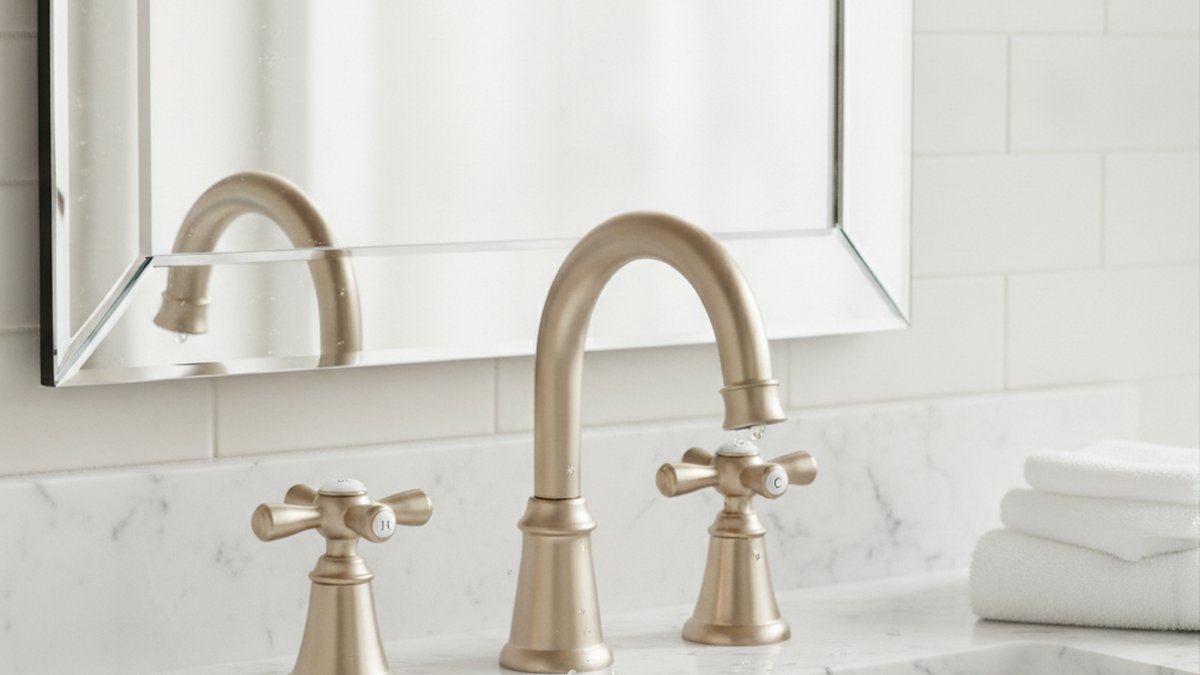
A brushed nickel faucet traditional look is easy to get right, but only if you pay attention to two things most shoppers ignore: the warmth of the nickel tone and the shape of the handles and spout. Brushed nickel itself is a soft, low-luster silver-gray with a faint warm undertone — that warmth is exactly what makes it feel “classic” instead of cold and contemporary like polished chrome or stainless. Put that finish on a curved spout with porcelain or cross handles, and you have a fixture that would look at home in a 1920s bungalow or a brand-new build styled to feel timeless.
Below we answer the real questions people ask before buying — is brushed nickel actually traditional, does it clash with other metals, how does it hold up to hard water, and which style details make or break the look — so you can choose with confidence.
Is brushed nickel actually a “traditional” finish, or is it more modern?
Brushed nickel is genuinely traditional — it’s arguably more historically authentic than the chrome most people think of as “classic.” Nickel plating was the premium plumbing finish of the late 1800s and early 1900s, long before bright chrome took over in the 1930s. So a brushed (satin) nickel faucet with period-correct handles is, if anything, closer to what an original Victorian or Craftsman home would have had.
Where people get confused is that “brushed nickel” describes the finish, not the style. The same finish can be applied to a razor-sharp single-lever modern faucet or to an ornate three-hole widespread with fluted handles. The finish leans traditional because of its muted, hand-worked look — the brushing scatters light so it never has that mirror-bright, industrial gleam. But the shape of the faucet is what ultimately decides whether the whole thing reads traditional or contemporary.
- Reads traditional: curved gooseneck or hook spouts, cross handles, lever handles with a slight flare, widespread three-hole layouts, exposed bridge faucets, porcelain accents.
- Reads modern: straight square spouts, single flat paddle handles, wall-mount minimalist blocks, tall right-angle industrial shapes.
What’s the difference between brushed nickel, satin nickel, chrome, and stainless?
They’re four different looks, and mixing them up leads to expensive mistakes. Brushed nickel and satin nickel are essentially the same warm, low-sheen silver — “satin” is just a slightly smoother version of the “brushed” texture, and most brands use the terms interchangeably. Chrome is cooler and mirror-shiny; stainless is cooler and more industrial. Here’s how they actually compare for a traditional room:
| Finish | Undertone | Sheen | Traditional fit | Hides spots/fingerprints |
|---|---|---|---|---|
| Brushed / satin nickel | Warm silver-gray | Low, soft | Excellent | Very good |
| Polished chrome | Cool blue-silver | High, mirror | Good (more classic-formal) | Poor |
| Stainless | Cool gray | Medium, brushed | Fair (leans modern) | Good |
| Polished nickel | Warm silver | High, soft mirror | Excellent (upscale period) | Poor |
For most people wanting a traditional feel that’s also low-maintenance, brushed/satin nickel is the sweet spot: the warm undertone gives you the period look, and the matte brushing hides the water spots that make polished chrome and polished nickel a daily chore to wipe. If your heart is set on a formal, high-shine period look and you don’t mind polishing, polished nickel is the more luxurious cousin — just know it costs more and shows every fingerprint.
Does brushed nickel go with warm or cool color schemes?
Both, which is a big part of why it’s so popular. Because brushed nickel has a warm undertone but stays in the neutral silver family, it bridges warm palettes (cream, beige, warm whites, wood vanities) and cooler ones (gray, soft blue, crisp white). That flexibility is exactly what you want in a traditional room, where cabinetry and tile tend to be softer and warmer than in a stark modern space.
Will a brushed nickel faucet clash with my other fixtures and hardware?
It won’t clash if you follow one simple rule: match your working metals and treat everything else as an accent. The faucet, showerhead, tub filler, and drains — the pieces you use with water — should generally share the same finish so the room feels intentional. Cabinet knobs, mirror frames, and lighting can either match or be a deliberate contrast (like matte black or aged brass) as long as the contrast repeats at least twice so it looks planned, not accidental.
Brushed nickel is forgiving here because its neutral warmth plays nicely with almost everything: white subway tile, marble, oak and walnut vanities, brass accents, and even black hardware. If you’re nervous about mixing metals, the safest traditional combination is brushed nickel plumbing fixtures with either matching nickel hardware or warm brass accents.
Deliberate metal mixing can look fantastic in a classic space, but there’s a difference between an intentional pairing and an accidental mismatch — the same principle we cover in our guide to whether an oil rubbed bronze faucet on a stainless sink actually looks good. And if you’re still weighing warm-neutral finishes against bolder statements, it’s worth reading our take on whether a Jacuzzi matte black faucet is worth it before you commit, since matte black is the main modern rival to nickel right now.
Which faucet shapes make brushed nickel look genuinely traditional?
The shape does the heavy lifting. To make brushed nickel read traditional rather than transitional or modern, choose classic silhouettes and period-appropriate handles. Here’s what to look for, in order of impact:
- Handle style: cross handles (four-spoke) are the single strongest traditional cue. Lever handles with a gentle curve are the next best and easier to grip with wet hands. Avoid flat paddle levers.
- Spout curve: a high-arc gooseneck or a hook-shaped spout reads classic. Straight, squared-off spouts pull the look modern.
- Configuration: a widespread three-hole layout (separate spout and two handles, 8 inches apart) is the most traditional bathroom setup. A bridge faucet — where the hot and cold connect above the deck — is the most period-authentic of all.
- Detailing: subtle fluting, porcelain lever inserts, or “hot/cold” ceramic buttons instantly age a faucet in the right direction.
What about a traditional brushed nickel faucet for the kitchen specifically?
In the kitchen, a traditional brushed nickel faucet usually means a high-arc “gooseneck” spout with either a bridge design or a single lever styled with a curved, slightly ornate handle. Pull-down sprayers are fine and now common even on classic-looking faucets — just choose one where the sprayhead is shaped and finished to blend in rather than a bulky industrial nozzle. Brushed nickel is especially practical in kitchens because it hides the water spotting and fingerprints that plague a busy sink, which is why we recommend it so often when readers compare finishes in our roundup of the best Moen kitchen faucet options for 2026.
How does brushed nickel hold up to hard water and daily cleaning?
Brushed nickel holds up very well — it’s one of the most forgiving finishes for hard-water areas. The matte, brushed texture scatters light, so mineral spotting and dried water marks simply don’t show the way they do on mirror chrome. Fingerprints and toothpaste splatter also disappear into the texture. For most households, a wipe with a damp microfiber cloth keeps it looking new.
That said, “hides spots” isn’t the same as “immune to buildup.” In hard-water regions, calcium and lime can still crust around the aerator and the base of the spout over months. The fix is gentle and routine:
- Wipe dry after heavy use to prevent mineral rings from forming.
- Clean weekly with mild dish soap and warm water — never abrasive pads, scouring powders, or ammonia-based glass cleaners, which can dull or scratch the brushed coating.
- For stubborn lime scale, use a diluted vinegar solution or a purpose-made descaler on a soft cloth, then rinse. We walk through the safe method step by step in our guide to cleaning a faucet head with CLR to remove hard-water buildup.
One warning worth repeating: keep harsh chemical cleaners off the finish. The PVD (physical vapor deposition) coating on quality brushed nickel is extremely durable, but cheaper electroplated versions can be worn down by aggressive chemicals over time. When you shop, look specifically for the words “PVD” or “lifetime finish warranty” — that’s your signal the finish will survive years of cleaning.
Is a brushed nickel faucet worth it, or should I choose a different finish?
For a traditional or transitional room, brushed nickel is worth it for most people — it delivers the classic warm-silver look, it’s the easiest silver finish to live with day to day, and it’s widely available at every price point from budget to luxury. You’d choose something else only in specific cases: go polished nickel or polished chrome if you want a formal, high-shine period look and don’t mind polishing; go matte black or aged brass if your “traditional” is really farmhouse-modern and you want more contrast.
Compared to trend-driven finishes, brushed nickel also ages gracefully — it’s been popular for over two decades and shows no sign of looking dated, which matters if you’re not planning to renovate again for ten years. If you’re specifically weighing it against a colored or painted finish, our comparison of whether a kitchen faucet in white is worth buying is a useful sanity check on how quickly bolder finishes can start to feel of-the-moment versus timeless.
How much should I expect to spend on a good one?
Here’s a realistic budget picture for a quality brushed nickel faucet with a traditional silhouette:
| Budget | What you get | Best for |
|---|---|---|
| $60–$120 | Electroplated finish, basic ceramic cartridge, lever handles | Rentals, secondary baths, tight budgets |
| $120–$250 | PVD finish, solid-brass body, cross or lever handles, widespread option | Most homeowners — the value sweet spot |
| $250–$500+ | Heavy solid brass, true bridge or period reproduction styling, lifetime finish + drip-free warranty | Period restorations, forever homes |
Our advice: spend in the middle tier if you can. A solid-brass body with a ceramic-disc cartridge and a PVD finish is where reliability and looks meet — cheaper faucets tend to use lighter zinc bodies and thinner coatings that wear faster in daily use.
FAQ
Is brushed nickel out of style in 2026?
No. Brushed nickel remains one of the top-selling faucet finishes and is considered a “safe neutral” that doesn’t follow trend cycles. Matte black and warm brass are more fashionable right now, but brushed nickel is the finish most designers still recommend when a client wants something that will look good in ten years. For traditional and transitional rooms specifically, it’s as relevant as ever.
Does brushed nickel show water spots and fingerprints?
Far less than polished chrome or polished nickel. The brushed, matte texture scatters light and camouflages both water spots and fingerprints, which is one of the main practical reasons people choose it. In hard-water areas you may still see occasional mineral haze near the aerator, but a quick wipe with a damp cloth handles it.
Can I mix a brushed nickel faucet with chrome or brass fixtures?
Yes, if you do it deliberately. Keep your water-contact fixtures (faucet, showerhead, tub filler) in one finish, then use a second metal — like brass or matte black — as a repeated accent on hardware, lighting, or the mirror frame. Repeating the accent at least twice makes the mix look intentional. Random one-off mismatches are what make a room look unplanned.
Is brushed nickel the same as satin nickel or stainless steel?
Brushed and satin nickel are effectively the same warm, low-sheen finish — brands use the names interchangeably. Stainless steel is different: it’s cooler and grayer with no warm undertone, and it leans more modern or industrial than traditional. For a classic look, choose nickel over stainless.
What handle style makes a brushed nickel faucet look most traditional?
Cross handles (the four-spoke style) are the strongest traditional cue, followed by gently curved lever handles. Pair either with a high-arc gooseneck or hook-shaped spout, ideally in a widespread three-hole or bridge configuration, and the faucet will read unmistakably classic.
How do I clean a brushed nickel faucet without damaging the finish?
Use mild dish soap, warm water, and a soft microfiber cloth for routine cleaning, and dry it afterward to prevent mineral rings. For lime scale, use diluted vinegar or a dedicated descaler on a soft cloth, then rinse. Avoid abrasive pads, scouring powders, and ammonia-based cleaners, which can dull the coating over time.
The bottom line from our team
If you want a finish that looks genuinely traditional, forgives hard water and busy hands, and won’t look dated before your next remodel, brushed nickel is the finish to beat — just pair it with classic handles and a curved spout to lock in the period look. Match your water-contact fixtures, choose a solid-brass body with a PVD finish and a real warranty, and you’ll have a faucet that looks right and lasts.
Author note: This guide was written by the Adeaga fixtures team, drawing on years of hands-on faucet installation, finish testing, and customer feedback across thousands of bathroom and kitchen orders. Adeaga specializes exclusively in faucets and bathroom fixtures, and every faucet we recommend is evaluated against real durability standards — ceramic-disc cartridge life, solid-brass construction, and finishes that carry a manufacturer lifetime finish warranty and meet low-lead compliance (NSF/ANSI 372). We test for finish wear, drip-free operation, and real-world cleaning before we put a fixture in front of our readers.