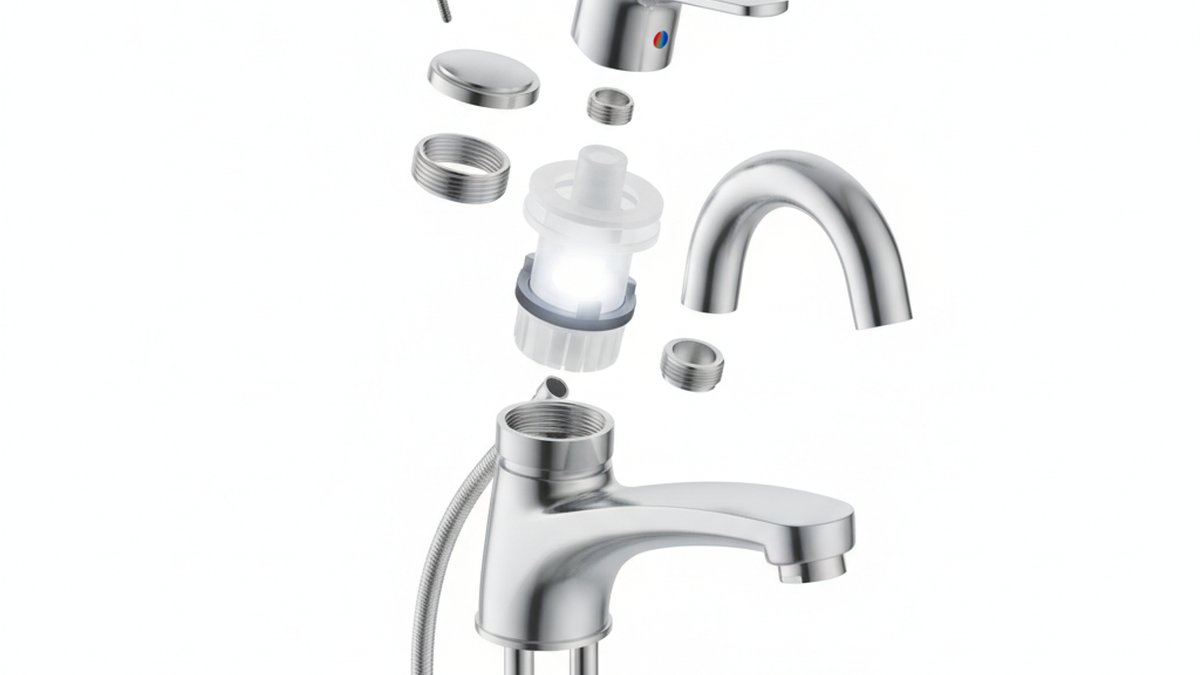
If your EuroStream faucet is dripping, hard to turn, or mixing hot and cold on its own, a EuroStream faucet cartridge replacement is almost always the fix — and it’s one of the most beginner-friendly plumbing repairs there is. The cartridge is the small valve cylinder inside the faucet body that controls how much water flows and how hot it gets. When it wears out, water sneaks past the internal seals and you get drips, screeches, or temperature swings. You don’t replace the whole faucet. You just swap the worn part.
Below, I’ll walk you through exactly how to identify the right cartridge, remove the old one, and install the new one — plus how to tell whether your problem is really the cartridge or something cheaper, like an aerator or O-ring. I’ve done this repair on dozens of single-handle and two-handle EuroStream units, and the steps rarely change.
How do I know if my EuroStream faucet actually needs a new cartridge?
You need a new cartridge if the faucet drips after you shut it fully off, the handle feels stiff or grinds, or the water won’t hold a steady temperature. Those three symptoms point almost directly at a worn ceramic disc or a cracked seal inside the cartridge — not at anything you can fix by tightening a nut.
Before you buy a part, rule out the two cheaper culprits. A steady drip from the spout tip only when the water is running — a weak, splitty stream — is usually a clogged aerator, not the cartridge. A drip that keeps going after you’ve turned the handle all the way off is the cartridge (or, in older two-handle units, a rubber seat and spring). Here’s a quick self-diagnosis:
- Drips when fully off → cartridge or valve seat. Replace the cartridge.
- Weak or sideways stream when on → aerator clog. Clean or swap the aerator first — it’s a $5 fix. (See our guide on why a faucet aerator washer matters and how to replace one without leaks.)
- Handle hard to turn / squeals → cartridge seals have dried out. Replace the cartridge.
- Hot creeps into cold (or vice versa) → ceramic disc worn. Replace the cartridge.
- Water pools around the base of the handle → usually the cartridge O-rings, sometimes the escutcheon gasket.
If your faucet is leaking around the base rather than the spout, the fix path is similar but the culprit is often the O-rings. The same logic that applies to other brands applies here — our walkthrough on a leaking Grohe kitchen faucet and how to fix it yourself covers that base-leak diagnosis in more depth, and it transfers cleanly to EuroStream models.
What tools and parts do I need for a EuroStream cartridge swap?
You need four cheap tools and one correct cartridge. Total damage is usually under $30, and most people already own the tools.
Here’s the full kit:
- Hex/Allen key set — most EuroStream handles use a 2.5mm or 3mm set screw.
- Phillips screwdriver — for handles that screw down through the top instead of a side set screw.
- Channel-lock or slip-joint pliers — to loosen the brass retaining nut. Wrap the jaws in a rag or painter’s tape to avoid scratching a finish (chrome, matte black, or brushed gold all mark easily).
- Needle-nose pliers — to pull the retaining clip on clip-style cartridges.
- The replacement cartridge — the single most important item, and the one people get wrong.
Optional but smart: a small dish of white vinegar to soak mineral-crusted parts, a headlamp, and a phone to snap “before” photos of each step so reassembly is foolproof.
How do I find the exact right EuroStream cartridge?
Match the cartridge by pulling the old one and comparing it side-by-side, or by reading your faucet’s model number off the box, the underside of the body, or the original paperwork. Never buy a cartridge on looks alone — a 2mm difference in length or a different spline count will leak or won’t seat.
The three things that must match exactly:
- Overall length and diameter of the cartridge body.
- The stem shape and spline count at the top — this is what the handle grips. Get it wrong and the handle won’t align to “off.”
- The retention style — threaded nut, brass clip, or push-in with a retaining ring.
The safest move: remove the old cartridge first (steps below), take it to the store or photograph it next to a ruler, and match it. If your faucet is a single-handle mixer, you almost certainly need a ceramic-disc mixing cartridge; if it’s a two-handle unit, you need a pair of quarter-turn stem cartridges (hot and cold are often mirror images — check the tab orientation).
How do I replace the EuroStream cartridge step by step?
Shut off the water, pull the handle, remove the retaining nut or clip, extract the old cartridge, and reverse the process with the new one. Here’s the full sequence — plan on 20–40 minutes for your first time.
- Shut off the water. Turn both angle-stop valves under the sink clockwise until they stop. No under-sink valves? Shut off the main. Then open the faucet to bleed pressure and confirm the water’s actually off.
- Plug the drain. Drop in a stopper or a rag so no small screws or clips vanish down the pipe.
- Remove the handle. Pry off the decorative cap (there’s often a red/blue button on the front or a plain cap on top), then loosen the set screw with your hex key. Lift the handle straight up. If it’s stuck from mineral buildup, wiggle gently — don’t yank sideways.
- Remove the trim/dome. Unscrew the decorative dome or bonnet nut by hand or with rag-wrapped pliers.
- Free the cartridge. Either unthread the brass retaining nut with pliers, or pull the horizontal brass clip straight out with needle-nose pliers. Note which way any tabs or flats are facing — take a photo.
- Pull the old cartridge straight up. Grip the stem and pull vertically. Corroded ones fight back; a gentle back-and-forth twist plus a cartridge puller (or locking pliers on the stem) breaks them loose. Never pry against the faucet body.
- Clean the bore. Wipe out the cavity, and soak any mineral crust with vinegar. A clean bore is why the new seals will actually seal.
- Insert the new cartridge. Line up the alignment tab or flat with its notch in the body — this sets your hot/cold orientation. Push it fully home; it should sit flush, not proud.
- Reassemble in reverse. Clip or nut, dome, handle, set screw, cap. Snug — not gorilla-tight. Over-torquing cracks ceramic.
- Restore water slowly. Open the angle stops half a turn, let the faucet run for 15 seconds to clear air and debris, then check for drips at the spout and around the base.
That’s it. If the handle now points the wrong way at “off,” you seated the cartridge one spline off — pull the handle and rotate the stem 180°. If hot and cold are swapped on a single-handle unit, the whole cartridge went in rotated; pull it and flip the alignment tab.
What if the old cartridge is stuck and won’t come out?
If the cartridge won’t budge, it’s seized by mineral scale — don’t force it with a screwdriver against the faucet body, or you’ll crack the casting. Instead, soak it, use a proper cartridge puller, and give the vinegar time to work.
The reliable rescue sequence:
- Soak it. Wrap a vinegar-soaked paper towel around the exposed stem and cavity for 20–30 minutes. Scale dissolves and grip loosens.
- Use a cartridge puller. A brand-agnostic puller tool ($10–$15) grips the stem and pulls straight up with leverage the faucet body can’t fight. It’s the single best $12 you can spend on a stubborn job.
- Rock, don’t pry. Gentle clockwise/counterclockwise quarter-turns break the mineral bond without stressing the housing.
- Heat, carefully. A hair dryer (not a torch) on the brass body for a minute expands it slightly and helps release a truly locked cartridge.
This same stuck-part patience applies across the whole world of DIY faucet repair. If you’ve ever wrestled an old faucet off a sink, you know the drill — our guide on how to remove an old faucet from a sink without wrecking it covers the same anti-corrosion tricks for the nuts underneath.
Should I replace the whole cartridge or just the O-rings and seals?
Replace the whole cartridge if the ceramic disc is scored, the handle grinds, or temperature won’t hold — those are internal wear you can’t rebuild. Replace just the O-rings if the faucet works fine but weeps a little around the base or the spout swivels loosely. When in doubt, replace the whole cartridge; it’s cheap insurance and eliminates the “did I miss a seal?” guesswork.
Here’s how the options compare:
| Fix | Best for | Cost | Time | Lifespan |
|---|---|---|---|---|
| Full cartridge replacement | Drips when off, stiff handle, temperature drift | $8–$30 | 20–40 min | 5–10 years |
| O-ring / seal kit only | Base weep, loose swiveling spout | $4–$10 | 15–30 min | 3–6 years |
| Aerator clean/replace | Weak or splitting stream | $0–$8 | 5–10 min | 2–5 years |
| Whole faucet replacement | Cracked body, obsolete parts, corrosion | $60–$300+ | 1–2 hrs | 10–15 years |
One honest caveat: if your EuroStream faucet is 15+ years old and replacement cartridges are hard to source, the math can tip toward a full new faucet — especially if the body shows corrosion. But 9 times out of 10, a cartridge swap buys you another decade for the price of a takeout lunch.
How often will I need to do this — and how do I make the cartridge last longer?
A quality ceramic-disc cartridge lasts 5–10 years; hard water shortens that, and that’s the single biggest variable you control. The mineral scale that eats aerators and shower heads also grinds down the ceramic discs inside your cartridge.
To stretch a cartridge’s life:
- Fight hard water. Descale your faucet parts once or twice a year. The same vinegar/CLR routine we cover in how to clean a faucet head with CLR to get rid of hard water buildup keeps grit out of the valve.
- Don’t crank the handle. Ceramic discs only need a light touch to seal. Slamming the handle to “off” accelerates wear.
- Flush after plumbing work. Debris kicked loose during any repair can score a new cartridge. Run the line before reseating the aerator.
- Match parts exactly. A near-fit cartridge stresses unevenly and fails early.
If you’re comfortable with a cartridge swap, you’re ready for adjacent fixes too — a bidet faucet replacement without calling a plumber uses the same shut-off-and-swap muscle memory.
FAQ
Can I replace a EuroStream cartridge without turning off the main water?
Yes, if your sink has under-cabinet angle-stop valves — just close those two. Only if there are no local shut-offs do you need the main. Either way, always open the faucet afterward to bleed the pressure before you take anything apart, or you’ll get a faceful of water.
Why is my EuroStream faucet still dripping after I replaced the cartridge?
Three common reasons: the new cartridge isn’t seated fully (push until flush), the alignment tab is one spline off so the handle never reaches true “off,” or debris got trapped under the new seal. Pull it, flush the line for 15 seconds, clean the bore, and reseat. If it still drips, double-check you bought the exact-match cartridge — a close-but-wrong part is the usual villain.
Are all EuroStream faucet cartridges interchangeable?
No. Single-handle mixers use a ceramic-disc mixing cartridge; two-handle faucets use paired quarter-turn stem cartridges. Even within one style, length, diameter, spline count, and retention method vary by model. Always match your old cartridge physically before buying.
How much does a plumber charge to replace a faucet cartridge?
Typically $100–$200 including a service-call fee, even though the part is $8–$30 and the labor is under an hour. That gap is exactly why this is such a satisfying DIY: you keep the $150 and gain a skill you’ll reuse on every faucet in the house.
What if I can’t find the model number on my EuroStream faucet?
Pull the cartridge and match it by physical dimensions — length, diameter, stem spline, and clip vs. nut. Bring the old part to a plumbing-supply counter or photograph it next to a ruler. The cartridge itself is your model number when the label’s long gone.
Is a cartridge drip an emergency, or can it wait?
It can wait a little, but don’t ignore it. A slow drip wastes hundreds of gallons a year and, more importantly, means water is passing seals that should be sealing — which can lead to base leaks and cabinet damage over time. Fix it within a few weeks, not months.
The bottom line on EuroStream cartridge replacement
A EuroStream faucet cartridge replacement is the definition of high-reward, low-risk DIY: cheap parts, common tools, and a 30-minute payoff that saves a $150 service call and stops wasting water. Diagnose first (drip-when-off means cartridge, weak-stream means aerator), match the part exactly, shut off the water, and swap it. If the old one’s stuck, soak it and use a puller — don’t force it. Do that, and your faucet will run tight and true for another 5–10 years.
Author’s note: This guide was written by the Adeaga fixtures team, drawing on hands-on repair of single- and two-handle mixer faucets across chrome, brushed nickel, and matte black finishes. About Adeaga: Adeaga is a specialist faucet and bathroom-fixture retailer; our product and repair content is reviewed by people who install and service these fittings, not just write about them. We reference manufacturer specifications, ceramic-disc cartridges built to standard NSF/ANSI 61 material safety guidelines, and typical 5-year faucet warranties so you can repair with confidence — and always confirm your specific model’s warranty before starting, since a self-repair is fine but you’ll want the paperwork if a defect claim ever comes up.