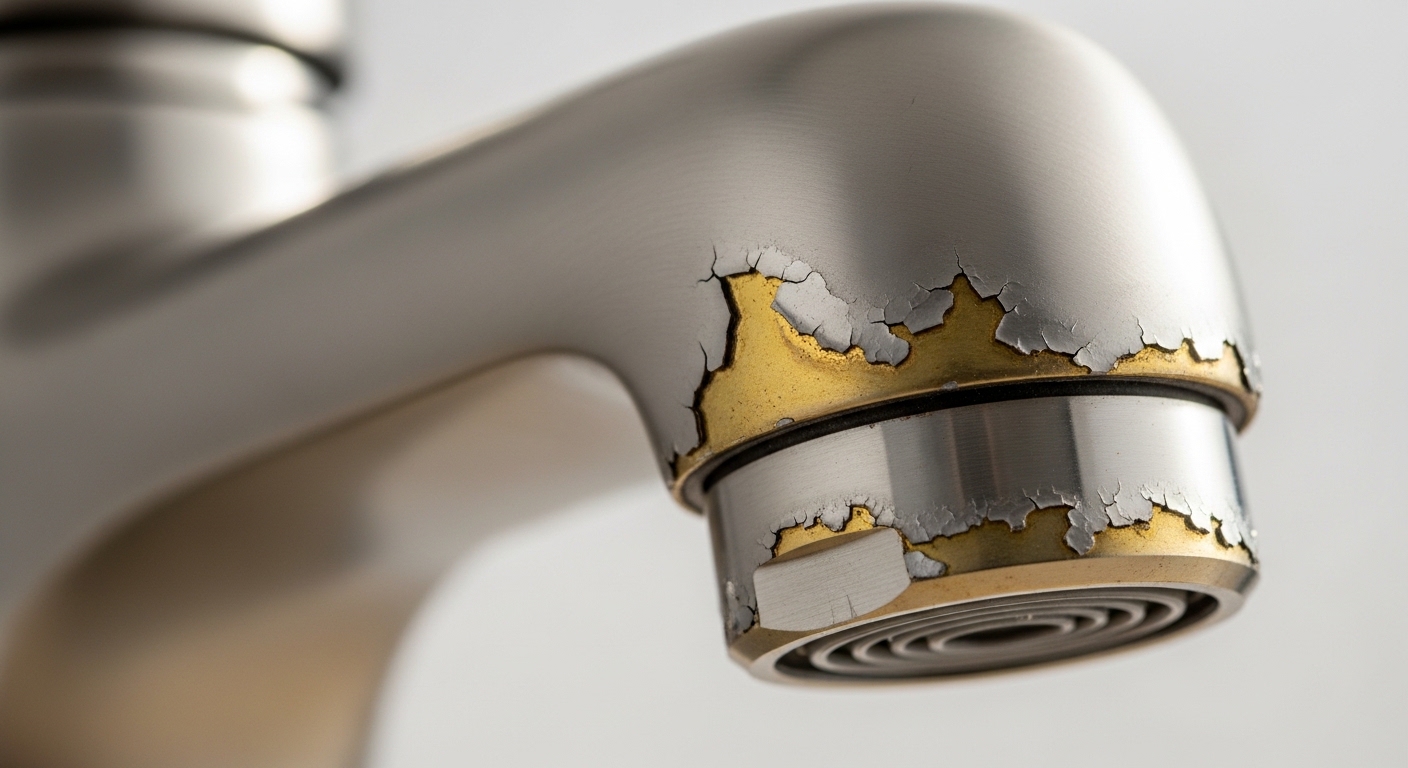
If you’ve noticed your brushed nickel faucet peeling — flaking, bubbling, or showing dull brassy-yellow patches near the spout and handles — you’re looking at a finish that has physically separated from the metal underneath. This isn’t dirt and it isn’t water spotting. It’s coating failure, and it tells you exactly what kind of faucet you bought. Below, I’ll explain why it happens, whether you can fix it (honestly, mostly you can’t), how to slow it down on your other fixtures, and what to buy so it never happens again.
I’ve handled returns, warranty claims, and finish testing for bathroom and kitchen fixtures for over a decade, and peeling brushed nickel is one of the most common complaints I see — and one of the most preventable.
Why is my brushed nickel faucet peeling in the first place?
Your brushed nickel faucet is peeling because the decorative finish was applied as a thin electroplated layer over a cheaper base metal — usually zinc alloy (zamak) — and that bond has broken down from water, heat, and chemicals. When the bond fails, the top layer lifts like old paint.
Here’s what’s actually going on under the hood. Most budget “brushed nickel” faucets aren’t solid nickel at all. They’re built from a zinc-alloy or thin brass body, then dipped in an electroplating bath that lays down a microns-thin coat of nickel and a clear topcoat to give that soft satin sheen. That coating is decorative, not structural. The moment water finds a microscopic gap — at a handle base, around the aerator threads, at a casting seam — it creeps underneath, oxidizes the base metal, and the corrosion pushes the finish off from below. That’s the bubbling and flaking you see.
Three things accelerate it dramatically:
- Abrasive and acidic cleaners. Anything with bleach, ammonia, or “scrubbing” grit eats the clear topcoat. Once the topcoat is breached, the nickel layer is exposed and it’s a countdown.
- Hard water. Mineral-heavy water leaves scale that people scrub harder to remove, and the calcium/magnesium deposits trap moisture against the finish.
- Heat and steam cycling. Hot water expands the metal; the coating and base metal expand at slightly different rates, and over thousands of cycles that stress works the plating loose. This is why peeling usually starts on the hot side of the faucet or on a shower fixture first.
So if you’re asking “is it something I did wrong?” — mostly no. You bought a plated faucet, and plated finishes have a shelf life. What you do afterward (cleaner choice, water hardness) just moves the date forward or back.
Can I fix or repair a peeling brushed nickel finish myself?
Honestly, no — you can’t truly repair a peeling brushed nickel finish, you can only hide it temporarily. Once the plating has lifted, there is no consumer product that re-bonds factory nickel plating to the base metal. Re-plating requires stripping the part to bare metal in a chemical bath and running it through an industrial electroplating line, which costs far more than a new faucet.
People try a few DIY routes. Here’s the realistic outcome of each:
| DIY “fix” | What it actually does | How long it lasts |
|---|---|---|
| Spray-on faucet paint / brushed-nickel paint pen | Covers the bare patch with pigment; never matches the satin grain | Weeks — peels again fast around water |
| Sanding/buffing the flaked edges | Smooths the lifted edge but removes more plating | Cosmetic only; speeds further peeling |
| Clear nail polish or lacquer over the spot | Seals one small area momentarily | Days to weeks; yellows and flakes |
| Metal polish (e.g., chrome polish) | Shines intact areas; strips more coating on peeling areas | No lasting fix; can worsen it |
| Full replacement with PVD faucet | Eliminates the root cause | Decades — the correct fix |
The takeaway: if the peeling is on a visible part like the spout or handle, repairs look bad and don’t hold. The money and afternoon you’d spend masking it is better put toward a replacement that won’t do this again. The good news is that swapping a faucet is genuinely a DIY-friendly job — if you’ve never done it, our walkthrough on how to replace an old faucet on a bathtub without calling a plumber covers the same shutoff-and-supply-line steps that apply to most sink faucets too.
What’s the difference between electroplated and PVD brushed nickel — and why does it matter?
The difference is bonding depth and hardness: electroplating lays a soft decorative skin on the surface, while PVD (Physical Vapor Deposition) fuses an ultra-hard finish into the metal at the molecular level inside a vacuum chamber. PVD brushed nickel essentially cannot peel under normal use; electroplated brushed nickel eventually will.
This is the single most important thing to understand when buying a replacement, so let me make it concrete:
| Feature | Electroplated brushed nickel | PVD brushed nickel |
|---|---|---|
| How it’s applied | Liquid chemical bath, thin nickel layer | Vaporized metal bonded in a vacuum |
| Hardness | Soft — scratches and wears | Up to 4× harder; near tool-grade |
| Peeling risk | High over 2–7 years | Virtually none |
| Cleaner tolerance | Damaged by acids/abrasives | Resists most household chemicals |
| Typical base metal | Zinc alloy (zamak) | Usually solid brass |
| Finish warranty | Limited 1–5 yrs, or none | Often lifetime |
| Price | $30–$90 | $120–$300+ |
The price gap is real, but so is the math: a $50 plated faucet you replace twice in eight years costs you more in money and weekend labor than one $180 PVD faucet you install once. PVD is the same technology that makes durable matte black and bronze finishes hold up — we go deep on the coating science in our guide to whether a matte black PVD faucet is worth it, and the same logic applies one-to-one to brushed nickel.
How do I know if a faucet is solid brass or zinc before I buy?
Weight and the spec sheet tell you almost everything. Solid-brass faucets are noticeably heavier for their size, and reputable listings will say “solid brass” body and “PVD” or “physical vapor deposition” finish in the specs. If a listing only says “metal,” “alloy,” “stainless-look,” or “premium coating” and the faucet feels surprisingly light, assume zinc with electroplating. A lifetime finish warranty is also a strong tell — manufacturers don’t offer it on platings they know will peel.
How long should a brushed nickel faucet last before it peels?
A quality PVD brushed nickel faucet should look new for 15–25 years; a cheap electroplated one often starts peeling in 2–5 years, sometimes within the first year if the water is hard or harsh cleaners are used. Anything peeling inside two years was either a defective batch or an extremely thin coating — and that’s a warranty claim worth filing.
What shortens the clock fastest, in order of impact:
- Abrasive/acidic cleaning products — the number-one killer of plated finishes.
- Hard water left to dry and scale repeatedly on the surface.
- Zinc-alloy bodies that corrode the instant water gets under the coat.
- High-heat use (kitchen and shower fixtures peel before rarely-used guest baths).
- Manufacturing defects — poor surface prep before plating leaves a weak bond.
If your faucet peeled fast and it’s a name brand, check the warranty before you toss it. Many major brands cover finish defects, and some — like the durability-focused fixtures recognized at industry events such as the Cutting-Edge Awards for ultra-durable bathroom hardware — are engineered specifically around finish longevity testing.
How do I keep my other brushed nickel faucets from peeling?
Protect the topcoat and never let hard water dry on the surface, and a brushed nickel finish will outlast its warranty. Since peeling almost always starts when the clear protective layer gets breached, your whole job is to keep that layer intact.
Here’s the routine I actually recommend to customers:
- Clean with mild dish soap and warm water only. A few drops on a soft cloth. That’s it for daily cleaning.
- Skip every “miracle” cleaner. No bleach, no ammonia, no vinegar straight, no Bar Keepers Friend, no Magic Eraser, no scouring pads. All of them attack the topcoat.
- Dry the faucet after use if you have hard water. Twenty seconds with a microfiber towel stops scale before it forms, which means no scrubbing later.
- For stubborn hard-water spots, use a 50/50 white-vinegar-and-water solution sparingly, leave it under a minute, then rinse and dry thoroughly. Never let acid sit.
- Wax it twice a year. A thin coat of car wax or a dedicated faucet polish adds a sacrificial barrier over the topcoat. Buff it off gently.
If your faucet already has loose handles or drips alongside the cosmetic wear, fix those at the same time — a wobbly handle wears the finish at the base faster. Our quick guide on a loose faucet handle and how to tighten it fast handles that in a few minutes.
Should I replace just the faucet, or is peeling a sign of bigger problems?
In nearly all cases, replace just the faucet — peeling is a surface-coating failure, not a plumbing failure, so your supply lines, valves, and rough-in are fine. The exception is a tub or shower valve, where the trim and the working cartridge are separate, and you may be able to upgrade the visible trim without touching the valve body in the wall.
For a standard sink faucet, replacement is the clean move: you get a fresh PVD finish, a new warranty, and modern internals (ceramic disc cartridges last far longer than old rubber-washer designs). If your peeling fixture is on a freestanding tub, you have more options — sometimes the spout or trim alone can be swapped — and our complete guide to free-standing tub faucet repair walks through when to repair versus replace.
One more buying note: if you’re replacing a bathroom sink faucet and love a warmer look than nickel, the same solid-brass, durable-finish logic applies to other colors — our buyer’s guide to oil-rubbed bronze 3-hole bathroom faucets compares finishes for widespread setups so you can match your sink’s hole configuration correctly.
What should I look for in a replacement so this never happens again?
Buy on four specs, in this order: solid-brass body, PVD finish, ceramic disc cartridge, and a lifetime finish-and-function warranty. If a faucet has all four, peeling is essentially off the table. If it’s missing the first two, you’re buying a future peeling problem at a discount. Adeaga builds its brushed nickel fixtures on solid brass with PVD finishing tested against standard salt-spray and abrasion cycles, and backs the finish for the life of the product — which is the whole point of moving past electroplating.
FAQ
Is a peeling brushed nickel faucet dangerous or just ugly?
It’s almost entirely cosmetic and not a health hazard — the exposed metal underneath is typically brass or zinc, not anything toxic in normal contact. The real risk is corrosion: once water gets under the finish, the base metal can pit and eventually leak at seams over a long period. So it’s not urgent, but it won’t get better and the faucet is on its way out.
Can a peeling faucet be re-plated instead of replaced?
Technically yes, but it’s not practical. Professional re-plating means shipping the stripped part to a plating shop, and the cost usually exceeds the price of a new mid-range faucet — without giving you a new warranty. For anything but a rare antique fixture, replacement is cheaper and lasts longer.
Does brushed nickel peel more than chrome or stainless?
Electroplated brushed nickel and electroplated chrome peel at similar rates because both are thin platings over the same cheap base metals. Solid stainless steel and PVD-coated finishes don’t peel because there’s no separate decorative skin to lift. The finish color matters far less than whether it’s electroplated or PVD.
Will my warranty cover a brushed nickel faucet that’s peeling?
Often yes, if it’s within the coverage window and from a brand with a finish warranty — peeling is considered a finish defect, not normal wear, especially in the first few years. Keep your proof of purchase, photograph the peeling, and contact the manufacturer. Premium PVD lines frequently carry lifetime finish coverage, which is exactly why they’re worth buying.
Why did my faucet start peeling right after I cleaned it?
Because the cleaner breached the protective topcoat. Bleach, ammonia, vinegar left to sit, abrasive powders, and Magic Erasers all strip or scratch the clear layer that protects the nickel. Once that’s gone, water reaches the plating and peeling accelerates fast. Switch to mild dish soap and a soft cloth on every fixture you own.
Is PVD brushed nickel really worth the extra cost over electroplated?
For a fixture you use daily, yes. A PVD brushed nickel faucet costs roughly two to three times more upfront but typically lasts three to five times longer without peeling, scratching, or dulling — and usually includes a lifetime finish warranty. Over the life of the fixture it’s the cheaper choice, and you skip the labor of replacing a peeling faucet every few years.
Author note: This guide was written by the Adeaga fixtures editorial team, drawing on hands-on finish testing, warranty-claim data, and over a decade of evaluating faucet coatings against salt-spray, abrasion, and hard-water exposure. Adeaga specializes in solid-brass, PVD-finished faucets engineered to industry durability standards — our goal is honest guidance first, so you buy the right fixture once.