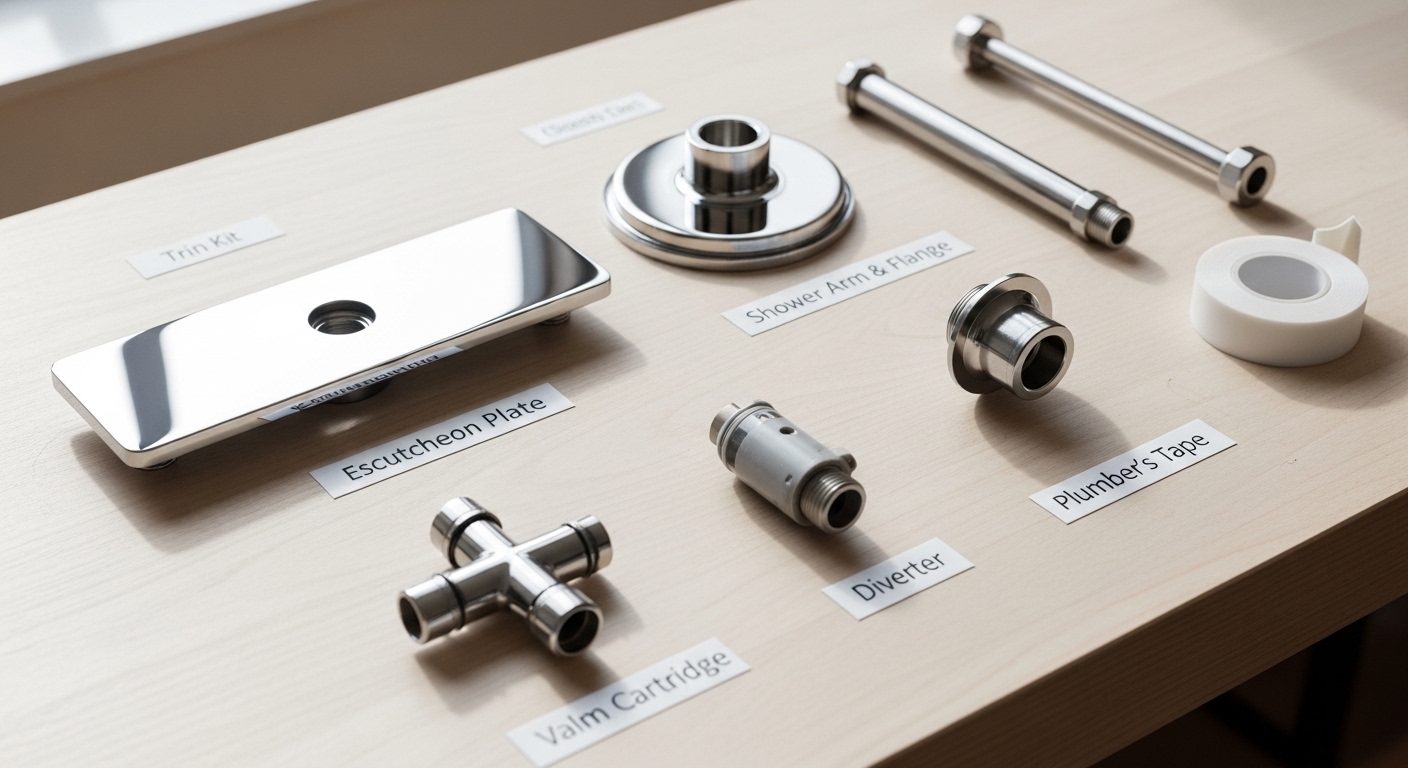
If you’ve ever stood in the plumbing aisle wondering which shower faucet accessories are genuinely useful and which are just upsells, you’re asking the right question. A “shower faucet” is really a small system — a valve in the wall, a handle, a spout or shower head, and a handful of trim and sealing parts that connect them. The accessories are everything that surrounds that valve: the parts that make it look finished, control where the water goes, and stop it from leaking. Buy the right three or four, and a tired shower looks and works like new. Buy the wrong ones, and you’ve got a drawer full of plastic you’ll never install.
I’ve installed, repaired, and tested hundreds of these parts, so this guide cuts straight to what matters: what each accessory does, when you actually need it, what to spend, and the specs that separate a 2-year part from a 20-year one.
What counts as a “shower faucet accessory” — and which ones do I actually need?
A shower faucet accessory is any add-on part that connects to, seals, controls, or finishes your shower valve — not the valve body itself. The ones most people actually need are a trim kit, an escutcheon (wall plate), a shower arm and flange, a cartridge, and the small sealing parts (washers, O-rings, plumber’s tape). Everything else is situational.
Here’s the honest breakdown. Your shower has a brass valve body buried in the wall — that part rarely fails. What you see and touch is the trim: the handle, the cover plate, the spout, and the shower head. Those are the “accessories,” and they’re where 90% of upgrades and repairs happen. The beauty of this is that you almost never have to open the wall. You can swap nearly every visible part from outside the tile.
- Trim kit — the handle, lever, and decorative plate that match a finish (chrome, brushed nickel, matte black, brushed gold). This is the single biggest visual upgrade.
- Escutcheon / wall plate — the round or square plate that hides the hole cut around the valve. A deep-flange escutcheon hides ugly tile cuts.
- Shower arm + flange — the chrome pipe coming out of the wall and the cap that hides where it enters. Swap this to reposition or raise your shower head.
- Diverter — the little pull-up knob or button that sends water from the tub spout to the shower head.
- Cartridge / valve stem — the heart of flow and temperature control. The most important “invisible” accessory.
- Sealing parts — O-rings, rubber washers, and PTFE (Teflon) tape. Cheap, but they’re what stops 80% of drips.
Which shower faucet accessories fix a leak — and which fix the looks?
For leaks, replace the cartridge, O-rings, and washers; for looks, replace the trim kit, escutcheon, and shower arm flange. They’re two different jobs with two different parts lists, and confusing them is the most common mistake I see.
If your shower drips after you shut it off, no decorative plate will help — that’s a worn cartridge or washer. A single-handle shower that drips almost always needs a new cartridge (a $15–$45 part), and a two-handle setup usually needs new rubber seat washers and springs. If your handle is just loose or wobbly, that’s often a stripped adapter or a backed-out set screw — a fix that’s closely related to a loose faucet handle, where tightening or replacing one small part solves the whole problem.
For looks, you’re after the trim. A new trim kit and a deep escutcheon can make a 15-year-old valve look brand new, and if you’re updating an old tub-and-shower combo, the same logic applies as when you replace an old bathtub faucet without calling a plumber — you’re swapping trim, not tearing into the wall.
What’s the difference between a trim kit, escutcheon, and shower arm flange?
A trim kit is the handle-and-plate set that controls the valve; an escutcheon is the larger plate that hides the wall opening; and a shower arm flange is the small cap around the pipe to your shower head. People mix these up constantly, so here’s how they actually differ in the wall.
| Accessory | What it does | When you need it | Typical price |
|---|---|---|---|
| Trim kit | Handle + cover plate that operate the valve and set the finish | Cosmetic refresh, finish change, broken handle | $40–$150 |
| Escutcheon plate | Hides the rough hole cut around the valve | Oversized or ragged tile cutout shows | $8–$35 |
| Shower arm + flange | Pipe and cap delivering water to the head | Raising, angling, or refinishing the head | $12–$40 |
| Diverter / spout | Switches flow tub-to-shower | Diverter won’t hold, water runs from both | $10–$35 |
| Cartridge | Controls flow & temperature inside the valve | Dripping, hard to turn, temp swings | $15–$45 |
| Beauty ring | Seals/decorates where the spout meets the wall | Gap or caulk line around the tub spout | $6–$20 |
One accessory that quietly does a lot of work is the beauty ring around your tub spout. It’s a small trim collar that hides the messy caulk line where the spout meets the tile. If you’re unsure whether yours is missing or just optional, this guide on the tub spout beauty ring and whether you actually need one walks through exactly when it’s worth installing.
Are matching-finish shower accessories worth it, or can I mix brands?
Matching finishes are worth it for anything you see and touch; for hidden parts, brand and material matter far more than the finish. In other words, match the look on the surface, match the spec underneath.
The visible accessories — handle, escutcheon, shower arm, flange, shower head — should share the same finish family so the bathroom looks intentional. The catch is that finishes aren’t standardized between brands. One company’s “brushed nickel” leans warm; another’s leans gray. Whenever possible, buy your visible trim from a single brand and series so the tones match. Finish durability matters too: a physical-vapor-deposition (PVD) coating resists scratching and tarnish far better than a sprayed lacquer, which is exactly why a matte black PVD faucet holds its color in a steamy bathroom while cheaper coatings chalk and fade.
For hidden parts — cartridges, washers, O-rings — finish is irrelevant, but compatibility is everything. A cartridge has to match your specific valve body brand and model, or it simply won’t seat. Bring the old cartridge to the store or photograph the valve’s stamped model number. This is where mixing brands fails: a “universal” cartridge that’s close-but-not-exact will weep or stick within a season.
- Match by sight: handle, escutcheon, shower arm, flange, shower head, beauty ring.
- Match by spec, not finish: cartridge, seat washers, springs, O-rings, diverter stem.
- Always replaceable: PTFE tape and rubber washers — buy fresh ones every install; they’re pennies.
How do I install shower faucet accessories myself without opening the wall?
Most shower faucet accessories install from outside the wall in under 30 minutes with a screwdriver, an adjustable wrench, and plumber’s tape — only cartridge and valve work needs the water shut off. Here’s the realistic, water-off-first sequence.
- Shut off the water. Use the in-line stops behind the trim plate if your valve has them, or the main supply. Open the handle to drain pressure.
- Remove the old trim. Pop the handle cap, back out the set screw, and pull the handle. Unscrew the escutcheon. Everything behind it stays in the wall.
- Swap sealing parts. If you’re chasing a leak, pull the cartridge with the brand’s puller tool, replace O-rings, and slide in the new cartridge in the same orientation.
- Wrap threads. Wind 3–4 turns of PTFE tape clockwise on the shower arm and spout threads before reinstalling. This single step prevents most behind-the-wall drips.
- Reinstall trim and test. Hand-tighten, then a quarter-turn with a wrench — never crank it. Restore water and run hot and cold for two minutes, checking for weeps.
If after all this your shower head still trickles, the problem may not be an accessory at all — it can be supply pressure or a clogged head. The same diagnostic logic in this guide on increasing weak water flow applies to showers: check the aerator/spray face for mineral buildup before blaming the valve.
What should I budget for a full shower faucet accessory refresh?
A complete cosmetic-and-function refresh runs $80–$220 in parts if you keep the existing valve body, which covers a new trim kit, escutcheon, shower arm, flange, cartridge, and sealing parts. You only approach plumber territory if the valve body itself is corroded.
Here’s a realistic mid-range shopping list: trim kit ($60), deep escutcheon ($20), shower arm + flange ($25), replacement cartridge ($30), beauty ring ($12), and a kit of O-rings, washers, and PTFE tape ($15). That’s about $162 for a shower that looks and performs like a full remodel. Going premium with a single-brand PVD trim series pushes you toward $220; going budget with a value trim kit drops you near $90. Either way, you’re spending a fraction of a contractor quote because the labor is yours and the wall stays closed.
Which shower faucet accessories last longest — and what specs prove it?
The longest-lasting accessories use solid-brass bodies, ceramic-disc cartridges, and PVD finishes — and the proof is in the certifications and warranty length. Vague “high quality” claims mean nothing; the spec sheet does.
Look for three things. First, a ceramic-disc cartridge rather than rubber-washer compression — ceramic discs are tested to hundreds of thousands of open/close cycles and don’t wear like rubber. Second, NSF/ANSI 61 and 372 compliance, which certifies the part is safe for drinking-water contact and “lead-free” (≤0.25% weighted lead). Third, look for valve and finish components tested against ASME A112.18.1 / CSA B125.1, the North American standard for plumbing fixture fittings. A part that meets these and carries a lifetime finish-and-function warranty is telling you it expects to outlive your tile.
| Spec to look for | Why it matters | What “good” looks like |
|---|---|---|
| Cartridge type | Determines drip resistance & lifespan | Ceramic disc, 500k+ cycle rated |
| Body material | Corrosion & thread durability | Forged or solid brass, not zinc |
| Finish process | Scratch & tarnish resistance | PVD coating |
| Certifications | Safety & lead-free compliance | NSF/ANSI 61 & 372, ASME A112.18.1 |
| Warranty | Manufacturer’s confidence | Lifetime on finish & function |
At adeaga, every shower trim and cartridge we recommend is checked against these standards before it earns a place in a buyer’s guide — because an accessory that fails in a year isn’t a deal at any price.
FAQ
Are shower faucet accessories universal across brands?
Visible trim is somewhat interchangeable by finish, but cartridges and valve-specific parts are not universal. A cartridge must match your valve body’s exact brand and model or it won’t seat properly. Always identify your valve before buying internal parts — photograph the stamped model number or bring the old part with you.
Can I change my shower handle finish without replacing the valve?
Yes. The handle and escutcheon are trim parts that unscrew from the front of the wall, so you can switch from chrome to matte black or brushed gold by buying a matching trim kit for your existing valve series — no need to open the wall or replace the brass valve body.
Why does my shower drip even after I replaced the handle?
Because the handle isn’t what stops the water — the cartridge or seat washers are. A drip after shut-off means worn internal seals. Replace the cartridge (single-handle) or the rubber seat washers and springs (two-handle), and the drip stops. Swapping just the handle only changes the look.
Do I need plumber’s tape on shower arm and spout threads?
Yes, almost always. Wrap 3–4 clockwise turns of PTFE (Teflon) tape on the male threads of the shower arm and any threaded spout before installing. It seals microscopic gaps in the threads and prevents the slow behind-the-wall leaks that cause hidden water damage.
What’s the cheapest accessory that makes the biggest difference?
A fresh cartridge or a kit of O-rings and washers. For under $40 you can eliminate drips, restore smooth handle motion, and fix temperature swings — the functional problems people most often blame on a “bad faucet.” Cosmetically, a $12–$20 beauty ring or deep escutcheon hides gaps for the lowest cost.
How long should quality shower faucet accessories last?
A ceramic-disc cartridge typically lasts 10–20 years, a PVD finish can last the life of the bathroom, and rubber washers and O-rings are wear items you’ll replace every few years. Buying brass-bodied, NSF-certified parts with a lifetime warranty is the single best predictor of a long service life.
Author note: This guide was written and field-tested by the adeaga fixtures team, who install, repair, and bench-test shower trim, cartridges, and valves against ASME A112.18.1 and NSF/ANSI 61/372 standards. adeaga is a B2C bathroom-fixtures brand focused on durable, certified shower and faucet hardware backed by manufacturer warranties.