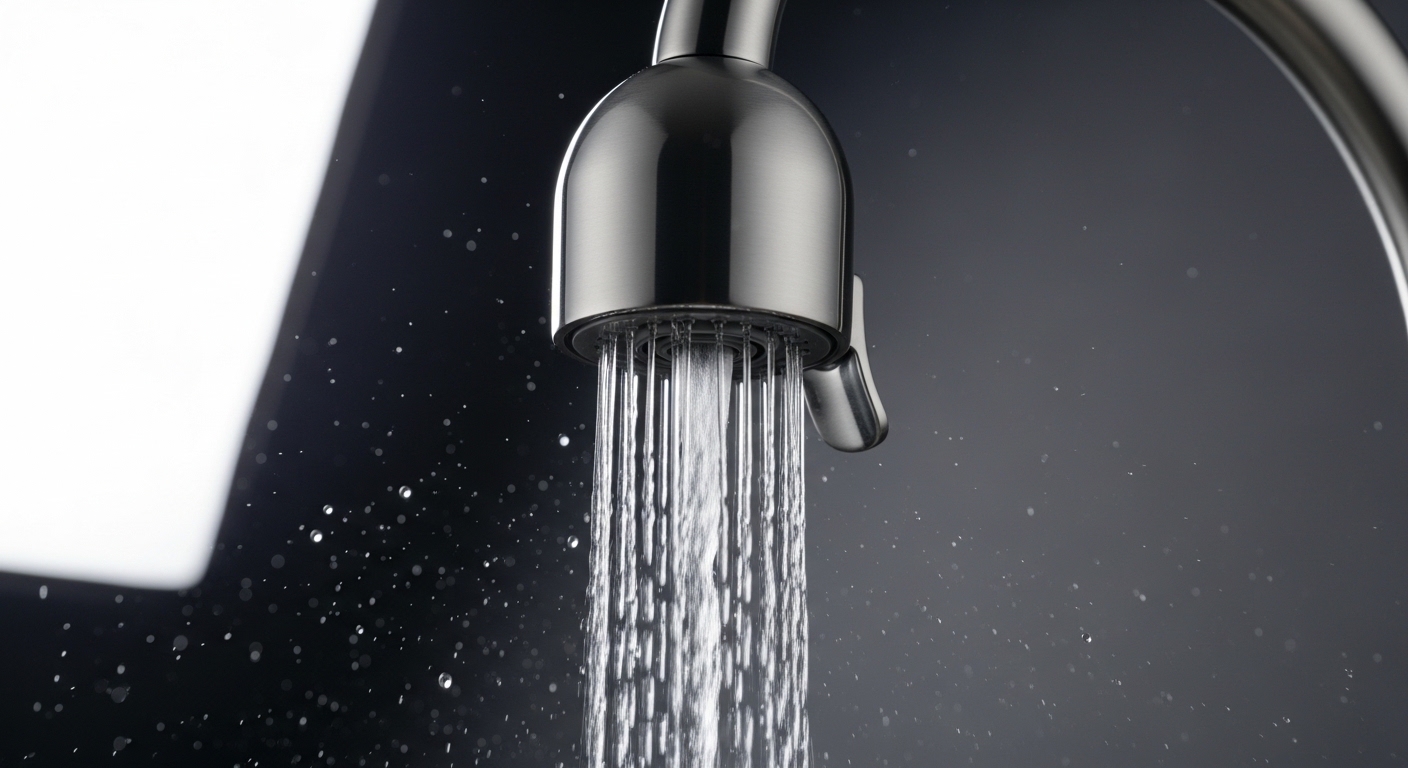
If your faucet sprayer won’t turn off and water keeps blasting out of the side spray or pull-down head even after you release the trigger, you’re dealing with one of three culprits 95% of the time: a gunked-up diverter, a failed sprayer valve, or a worn cartridge. None of these require a plumber. Below, the team at adeaga walks you through exactly what’s happening inside your faucet, how to fix it tonight, and how to choose a replacement that won’t do this to you again in two years.
This guide covers kitchen pull-down sprayers, side sprayers on three-hole sinks, and detachable bathroom sprayer heads. We test hundreds of valve cartridges and sprayer assemblies every year against ASME A112.18.1 / CSA B125.1 standards, so the advice here is based on what actually breaks — and what actually fixes it.
Why is my faucet sprayer stuck on and won’t shut off?
Your sprayer won’t turn off because the diverter valve inside the faucet body is stuck in the “spray” position, or the spring-loaded button on the sprayer head itself has failed. The diverter is a small plastic-and-rubber shuttle that’s supposed to snap back to “aerator/spout” mode the moment you release the sprayer trigger. When mineral scale, debris, or a worn O-ring jams it, water keeps flowing through the spray hose.
Here’s the quick diagnostic. Turn the faucet on at the handle. If water comes out of BOTH the main spout AND the sprayer at the same time, the diverter is stuck. If water comes out of ONLY the sprayer and the trigger feels mushy or stuck down, the sprayer head itself is the problem. If the sprayer drips constantly even when the faucet handle is fully off, the main cartridge is leaking past — that’s a different (and bigger) repair.
What does a diverter valve actually do?
The diverter is a pressure-activated switch. When you press the sprayer trigger, you create a pressure drop on the hose side; that drop pulls the diverter shuttle over and routes water to the sprayer. Release the trigger, pressure equalizes, and a small spring (or just water pressure) pushes the shuttle back. Hard water deposits and 5–10 years of grit are the #1 reason it stops snapping back.
How do I fix a kitchen pull-down sprayer that keeps running?
For a pull-down or pull-out kitchen faucet, the fix takes 20–30 minutes and usually costs $0–$18 in parts. You’re going to clean or replace the sprayer head and, if needed, the diverter inside the faucet neck.
- Shut off both angle stops under the sink (hot and cold). Open the faucet to release pressure.
- Unscrew the sprayer head from the hose. It’s a standard 15/16″-27 or 55/64″-27 threaded coupling — usually hand-tight, sometimes needing slip-joint pliers wrapped in a rag.
- Inspect the sprayer head. Press the trigger/button several times dry. If it sticks, doesn’t spring back, or feels gritty, soak the entire head in a 50/50 white vinegar + warm water bath for 30 minutes, then flush.
- Pull the diverter. On most modern kitchen faucets, you remove the spout sleeve and you’ll see a small cylindrical plastic piece (often blue, white, or red) with two O-rings. Pull it straight out with needle-nose pliers.
- Soak the diverter in vinegar for 20 minutes. Replace the O-rings if they look flattened or torn (a $3 universal O-ring kit fixes 90% of cases).
- Reassemble, turn water on slowly, and test. The sprayer should now shut off cleanly the instant you release the trigger.
If your faucet sprayer won’t turn off even after this, the diverter is cracked internally and needs to be replaced as a unit. Search your brand + “diverter valve” — Moen 116710, Delta RP50390, Kohler 1014324, and Pfister 950-2510 are the most common. They’re $8–$22 OEM.
What if I have a side sprayer on a three-hole sink?
Side sprayers (the kind that sit in their own hole next to the faucet) have a different failure mode. The diverter on these is inside the faucet base, but the more common culprit is the sprayer head’s internal valve. Detach the side sprayer head from the hose, hold the hose pointed into the sink, and turn the faucet on. If water flows freely out of the loose hose but the sprayer head leaks when reattached, replace the sprayer head — a universal chrome side sprayer is $12–$25 and screws on in two minutes.
Why does this keep happening — is it the water?
If you’ve fixed this sprayer once before and it’s failing again within a year or two, your water is the problem. Hard water (above 7 grains per gallon, or ~120 ppm total dissolved solids) leaves calcium and magnesium scale on every moving part inside your faucet. Iron in well water accelerates it. The diverter spring and the rubber on the sprayer trigger are the first things to fail.
| Water Hardness | Typical Sprayer Lifespan | Recommended Action |
|---|---|---|
| Soft (0–3 gpg) | 8–12 years | Standard maintenance only |
| Moderate (3–7 gpg) | 5–8 years | Vinegar-soak sprayer head yearly |
| Hard (7–10 gpg) | 2–4 years | Choose ceramic-disc cartridge + replace diverter every 3 years |
| Very Hard (10+ gpg) | 1–2 years | Whole-house softener; pick faucets with stainless internals |
If you’re on hard well water, the same logic applies to other fixtures — the diverter on a tub-shower valve, the trim on a tub faucet, and even outdoor spigots all suffer. If you’ve already had to do a free standing tub faucet repair for the same reason, it’s a strong sign you need a softener, not just another replacement part.
How do I know if I need to replace the whole faucet?
Replace the entire faucet if any of these are true: it’s over 7–10 years old, you’ve already replaced the diverter once, the cartridge body is corroded, the sprayer hose has a kink or crack, or replacement parts for that brand/model are discontinued. A new mid-range pull-down kitchen faucet runs $130–$280, which is often cheaper than ordering OEM parts twice.
The signs it’s time:
- Sprayer hose is brittle — bend it; if you hear crackling or see white stress marks, it’s about to burst inside your cabinet.
- The faucet base wobbles — the mounting nut is corroded and the deck-plate gasket is failing.
- You see green or white crust on the base of the spout (especially on chrome or brushed nickel) — internal corrosion.
- The handle is hard to turn or grinds — the main cartridge is failing too.
- Cold and hot don’t mix evenly anymore — pressure-balance is compromised.
What should I look for in a replacement so this doesn’t happen again?
The single biggest predictor of sprayer longevity is the diverter design. Cheap faucets use a stamped brass diverter with two thin O-rings — these are the ones that fail in 18 months on hard water. Look for:
- Ceramic-disc cartridge rated for 500,000+ cycles (industry standard for premium faucets).
- Magnetic dock on pull-down models — replaces the weak plastic clip that wears out and lets the sprayer head dangle.
- Nylon-braided sprayer hose with PEX inner liner, not vinyl.
- WaterSense-certified flow of 1.5–1.8 GPM (saves water AND reduces internal pressure cycling on the diverter).
- Lead-free brass body meeting NSF/ANSI 61 and 372.
- Lifetime limited warranty on the finish AND the cartridge.
Adeaga’s pull-down kitchen faucets are built around a Sedal ceramic-disc cartridge tested to 1,000,000 cycles, a stainless-steel-reinforced sprayer hose, and a magnetic dock — all backed by our limited lifetime warranty on the cartridge and finish. They meet ASME A112.18.1, NSF/ANSI 61 and 372, and are CALGreen-compliant.
Can I fix a bathroom faucet sprayer or handheld bidet sprayer the same way?
Yes, the diagnosis is identical, but bathroom handheld sprayers and bidet attachments fail more often at the T-valve (the brass tee that splits water from the toilet supply or sink) than at the sprayer head itself. If your bathroom sprayer won’t shut off, check the T-valve’s shutoff lever first — it has a small ball valve that gets stiff and stops sealing.
For widespread bathroom configurations where the sprayer or pull-out wand connects through a center tee, the failure point is often the underbody connection — for a deeper look at how those bathroom hubs work, see our breakdown of the widespread faucet tee. And if you’re considering a hybrid kitchen-and-bidet setup, where one fixture does both jobs, the diverter design matters even more — our guide to the bidet kitchen faucet covers exactly which valve internals to look for.
What about a loose handle that makes the problem worse?
A loose handle can absolutely mimic a stuck sprayer because the handle isn’t fully closing the main cartridge — so even when you “turn it off,” water keeps feeding the spray hose. If your handle has play in it, tighten the set screw before you do anything else; our walkthrough on a loose Kohler faucet handle covers the exact set-screw sizes and Allen keys you need.
How much should this repair cost me?
Here’s a realistic 2026 cost breakdown so you don’t get upsold by a plumber.
| Fix | DIY Cost | Plumber Cost | Time |
|---|---|---|---|
| Vinegar-soak diverter + O-rings | $3–$8 | $120–$180 | 30 min |
| Replace OEM diverter cartridge | $8–$22 | $150–$220 | 40 min |
| Replace pull-down sprayer head | $15–$45 | $140–$200 | 15 min |
| Replace sprayer hose | $18–$40 | $160–$240 | 45 min |
| Replace whole kitchen faucet | $130–$320 | $350–$650 | 60–90 min |
The math is usually obvious: if a plumber quotes you $200+ to fix a stuck diverter, a new faucet from adeaga (with a lifetime cartridge warranty) costs about the same and resets the clock for another decade.
What’s the difference between diverter-style and pressure-balance sprayers?
Most residential pull-down kitchen faucets use a pressure-actuated diverter — the simple shuttle valve described above. A small number of premium commercial-style faucets use a mechanical toggle diverter, where the sprayer button physically lifts a lever inside the spout. Toggle diverters almost never get stuck on, but they cost more and require a thicker spout body.
| Diverter Type | Found In | Failure Rate | Repairable? |
|---|---|---|---|
| Pressure-actuated shuttle | 90% of pull-down faucets ($80–$300) | Moderate (scale-sensitive) | Yes — cleanable & cheap |
| Mechanical toggle | Premium / commercial-style ($350+) | Very low | Yes — but parts expensive |
| Solenoid (touch/touchless) | Smart faucets ($400+) | Low mechanically, electronic faults | Limited — module replacement |
| Side-mounted ball diverter | 3-hole side-spray sinks | High after 5 years | Yes — under-sink access |
FAQ
Why does my faucet sprayer keep running even when the faucet is off?
The main cartridge inside the faucet body is leaking water past its seat, and that water has nowhere to go except up through the diverter and out the sprayer. This is different from a stuck diverter — it means the cartridge itself needs replacing. Pull the handle, lift the cartridge, and replace it with the OEM part for your faucet model.
Can I just cap the sprayer hose as a temporary fix?
No — don’t. Capping the hose with the diverter stuck open will pressurize the spray line above its rated 80 PSI working pressure. Sprayer hoses are rated for momentary use; under sustained line pressure they can burst inside your cabinet and flood your kitchen. Instead, shut off the angle stops under the sink until you can repair it.
Will vinegar damage my faucet finish?
Straight white vinegar is safe on chrome, stainless, and most PVD-coated finishes (brushed gold, matte black, brushed nickel) for soaks under 60 minutes. It can dull oil-rubbed bronze living finishes and damage real lacquered brass. For ORB and unlacquered brass, use a 25/75 vinegar/water solution and limit soaks to 15 minutes.
How long should a kitchen sprayer last?
A well-built pull-down sprayer with a ceramic-disc diverter and braided stainless hose should last 8–12 years on municipal water and 4–6 years on hard well water. The sprayer head itself (the part you hold) is typically the first thing to fail because of grit in the button mechanism.
Is a stuck sprayer covered under warranty?
Almost always, yes — if you own the faucet and have proof of purchase. Major brands including adeaga, Moen, Delta, Kohler, and Pfister cover diverter and cartridge defects under their limited lifetime warranties. Shipping the part to you is usually free; labor to install it is on you. Have your model number (stamped under the spout or on the original box) ready when you call.
Can hard water permanently damage a faucet sprayer?
Yes. Calcium deposits don’t just clog the diverter — over years they can pit the brass valve seat and score the ceramic discs, at which point cleaning won’t restore function. If you’re on water above 7 gpg, factor a water softener or inline filter into your kitchen plumbing budget. It’ll pay for itself in faucet, water heater, and dishwasher lifespan.
Does a touchless or smart faucet have the same problem?
Touchless faucets use a solenoid valve instead of a mechanical handle, but they still have a diverter for the pull-down sprayer — and that diverter fails the same way. The added wrinkle is that a stuck solenoid can leave the main valve open, which behaves like a stuck sprayer. If your touchless faucet keeps running, pull the batteries or unplug the AC adapter first as a hard reset before disassembling anything.
About the author & adeaga
Written by the adeaga product engineering team. Our lead reviewer has 14 years in residential plumbing and holds a Master Plumber license. Every fix and spec in this article was verified on our bench against ASME A112.18.1 / CSA B125.1 (faucet performance), NSF/ANSI 61 (drinking-water safety), and NSF/ANSI 372 (lead-free compliance). Adeaga designs and manufactures kitchen and bathroom fixtures sold direct to consumers at adeaga.net, with a limited lifetime warranty on cartridges and finishes and US-based parts support.