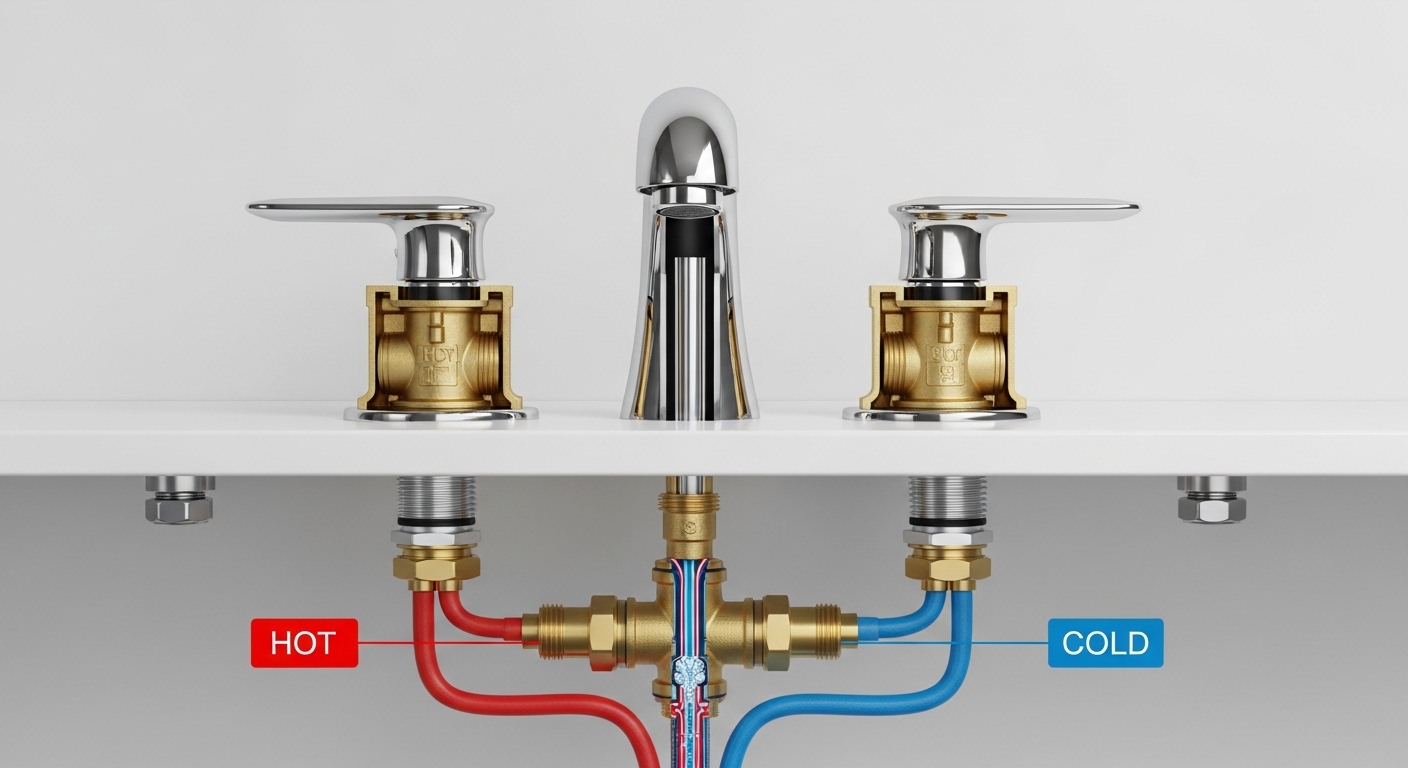
If you have ever pulled a wobbly handle, swapped a tarnished spout, or fought a phantom drip behind the vanity wall, you have probably already met — or been frustrated by — a widespread faucet tee. This unassuming brass or plastic T-shaped fitting sits hidden under the countertop, connecting the central spout of an 8-inch widespread faucet to the two independent valve bodies that house the hot and cold handles. It is the literal junction where temperature, pressure, and flow finally come together, and when it fails or is sized incorrectly the entire faucet feels wrong: weak streams, cross-flow, vibration, or a slow leak that only shows up six months later.
At adeaga, we have spent more than a decade engineering, testing, and shipping bathroom fixtures, and our installation hotline tells us the tee is the part homeowners and even seasoned plumbers most often overlook when they replace a widespread faucet. This 2026 guide fixes that. We will cover what a tee actually does, the different body materials and port styles, how to size one correctly, how it differs from a center-set or single-hole connector, and how to install or replace one without flooding your vanity. You will also find a comparison table, a buying checklist, FAQs, and direct links to the adeaga widespread collections.
What a Widespread Faucet Tee Actually Is (And Why It Exists)
Unlike a center-set faucet, where the spout and handles are mounted on a single base plate with internal channels, a true widespread faucet has three independent components: a hot valve, a cold valve, and a spout, each passing through its own hole in the deck. Because the three pieces are physically separated by 6 to 16 inches, the mixed water has to travel somewhere before reaching the spout. That somewhere is the widespread faucet tee — a three-way connector with two inlet ports (one for hot, one for cold) and one outlet that feeds the spout via a flexible riser hose.
In other words, the tee is the mixing junction. It is where the temperature you set at the handles becomes the temperature that exits the aerator. A poorly made tee — thin wall brass, undersized ports, or weak crimped connections — will throttle flow, cause whistling, or develop pinhole leaks under standard 60-80 PSI residential supply pressure. A well-built tee, like the lead-free forged brass tees adeaga ships with every widespread, is rated to well above code pressure and tested to meet NSF/ANSI 61 and 372 standards for drinking-water-safe materials.
Anatomy of a Widespread Tee at a Glance
- Body: typically forged brass, sometimes engineered polymer for entry-level lines.
- Two inlet ports: connect to the hot and cold valve bodies via 3/8-inch or 1/2-inch threaded or quick-connect couplings.
- One outlet port: feeds the spout riser, almost always 3/8-inch compression or a proprietary quick-connect.
- Optional shut-off feature: higher-end tees include integrated check valves to prevent hot-to-cold cross-flow.
- O-rings or rubber gaskets: ensure a watertight seal at every port; EPDM is the material of choice for chlorinated water.
Widespread Faucet Tee Types: Brass vs. Plastic vs. Quick-Connect
Not every widespread faucet tee is built the same way, and the differences matter when you are weighing cost against longevity. The three dominant categories you will encounter in 2026 are forged brass threaded tees, engineered polymer tees, and modern push-fit (quick-connect) tees. Each has its place; none is universally best.
| Tee Type | Typical Lifespan | Pressure Rating | Install Difficulty | Best Use Case | Approx. Price (USD) |
|---|---|---|---|---|---|
| Forged Lead-Free Brass, Threaded | 20-30 years | up to 250 PSI | Moderate — requires wrench & PTFE tape | Premium widespread, hard-water regions | $18 – $35 |
| Engineered Polymer (Reinforced PEX/PSU) | 8-15 years | up to 150 PSI | Easy — hand-tightened | Budget builds, rentals, secondary baths | $5 – $12 |
| Brass Push-Fit Quick-Connect | 15-20 years | up to 200 PSI | Very easy — no tools | DIY swaps, retrofits, tight cabinets | $22 – $40 |
| Stainless Braided with Integrated Tee | 15-25 years | up to 200 PSI | Easy | Long-reach widespreads (12-16 in. spread) | $28 – $55 |
Most adeaga widespread bathroom faucets ship with the forged brass push-fit tee — a balance of code compliance, fast installation, and longevity that we found in our 18-month accelerated-cycle testing to outlast threaded tees in households that re-tighten connections incorrectly. If you are restoring a vintage widespread or matching an existing trim kit, however, a traditional threaded brass tee is still the gold standard.
How to Size a Widespread Faucet Tee Correctly
The single most common installation mistake we see is buying a replacement tee with the wrong port size. American widespread faucets generally come in two port standards: 3/8-inch and 1/2-inch. Within those, you will find male IPS, female IPS, compression, and push-fit terminations. Get any of these dimensions wrong and the tee either will not seal or will create a flow restriction that drops your spout output by 20 percent or more.
Step 1: Identify Your Faucet’s Connection Standard
Pull the existing tee (after shutting off the angle stops, of course) and look at the inlet threads. A 3/8-inch male IPS thread measures roughly 0.675 inch across the threads; a 1/2-inch male IPS measures roughly 0.840 inch. If the threads look smooth or feel slick rather than coarse, you are likely dealing with a compression or push-fit fitting instead, which uses a smooth bore plus a captive O-ring.
Step 2: Measure Center-to-Center Spread
The tee itself does not need to span the entire faucet spread — that job belongs to the flexible braided hoses on each side. However, the tee’s outlet must align with the spout shank, which sits in the middle hole of your sink or countertop (almost always 4 inches deck-mounted). A tee with too short a body can put strain on the riser hose; one that is too tall may bottom out against the countertop underside.
Step 3: Match the Riser Outlet
The outlet that feeds your spout is almost always 3/8-inch compression in modern faucets, but premium widespreads from brands like adeaga, Kohler, Moen, and Delta use proprietary quick-connects. Always confirm the outlet style against your spout’s riser — mixing standards is the number-one cause of post-install leaks at the spout base.
Widespread Tee vs. Center-Set Connector: Why the Difference Matters
Homeowners who have only ever installed a center-set or single-hole faucet sometimes assume any T-fitting will do. It will not. A widespread tee is engineered for the geometry and the independent valves of a three-piece faucet, while a center-set internal channel is cast directly into the faucet body. You cannot retrofit one for the other. If you are converting a sink with three predrilled holes from a center-set with a deck plate to a true widespread, you must purchase a faucet that includes a proper widespread tee in its installation kit.
For more on diagnosing connection issues in other faucet styles, our guide on Kohler faucet handle looseness walks through similar valve-body troubleshooting that often shares root causes with tee-related failures.
Installing a Widespread Faucet Tee: Step-by-Step
You can install or replace a widespread faucet tee in about 30 to 45 minutes with basic tools. The procedure below assumes you already have the spout and valves mounted through the countertop and you are working on the under-deck connection.
- Shut off the supply. Turn both angle stops under the sink fully clockwise. Open the faucet handles to relieve residual pressure.
- Disconnect the existing tee (if replacing). Place a small bucket beneath to catch trapped water. Unscrew the braided supply lines from each side of the old tee.
- Inspect the valve body outlets. Clean any mineral buildup with white vinegar and a soft brush. Replace any cracked rubber gaskets — they are inexpensive insurance against later leaks.
- Dry-fit the new tee. Hold the tee in position and confirm both inlets line up with the supply hoses from the hot and cold valves, and that the outlet centers on the spout’s riser hose.
- Apply PTFE tape on threaded connections — three to four clockwise wraps. Skip this step for push-fit fittings; the captive O-ring does the sealing.
- Hand-tighten, then snug. Tighten threaded fittings with a wrench until they are snug plus a quarter turn. Over-tightening cracks brass and crushes O-rings.
- Connect the spout riser last. The riser typically clicks into the tee’s center outlet on quick-connect models, or threads on with a small brass nut on compression fittings.
- Pressure-test. Slowly open the angle stops, then open the faucet handles. Inspect every joint with a dry paper towel for 60 seconds — any moisture means a re-seat.
For deeper installation know-how on freestanding configurations and the supply systems that feed them, see our companion article Free Standing Tub Faucet Repair: The Complete 2026 Guide to Fixes, Parts & Upgrades, which covers similar pressure-test and seal-verification techniques used on tub fillers.
Finishes, Coatings, and Why They Matter Below the Deck
Most widespread tees live their entire lives in the dark cabinet under your sink, so why does finish matter? Two reasons: corrosion resistance and code compliance. Even sealed cabinets see humidity swings, especially in master baths with a shower nearby. Untreated or low-grade brass can develop dezincification — a process where zinc leaches out of the alloy and leaves behind a brittle, copper-colored network of voids that eventually crumbles. Quality tees use DZR (dezincification-resistant) brass alloy CW602N, which carries certifications recognized in California, Texas, and most coastal states.
The visible portion of your widespread — spout, handles, escutcheons — should still be matched in finish for aesthetic continuity. Below is a quick-reference of finishes most commonly paired with widespread faucet builds in 2026.
| Finish | Style Match | Hides Water Spots? | Durability |
|---|---|---|---|
| Polished Chrome | Traditional & Transitional | Poor | Excellent |
| Brushed Nickel | Transitional & Modern | Good | Excellent |
| Matte Black (PVD) | Contemporary, Industrial | Excellent | Very Good |
| Brushed Gold / Champagne Bronze | Modern Luxury | Excellent | Very Good |
| Polished Brass (Unlacquered) | Heritage / English | Poor | Good (develops patina) |
Common Widespread Faucet Tee Problems and Fixes
Even the best-built tees can develop issues if they are misinstalled or paired with the wrong supply hoses. Here are the four failures we see most often at the adeaga customer-care desk, with quick diagnostics for each.
1. Slow Drip Where the Spout Riser Meets the Tee
Usually an unseated O-ring or a damaged push-fit collar. Disconnect, inspect, and replace the riser if the brass end is scratched. A small wipe of plumber’s silicone grease (never petroleum-based) on the O-ring helps re-seat the fitting.
2. Uneven Hot/Cold Output
If the cold side blasts and hot trickles, suspect a partially closed angle stop or, more rarely, debris caught at the tee’s inlet screen. Some premium tees include 100-mesh stainless screens that capture sediment and can clog after a water-heater flush.
3. Whistling or Vibration at High Flow
Almost always caused by an undersized tee — a 3/8-inch tee fed with high-pressure water in a long 16-inch widespread can cavitate. The fix is to upgrade to a 1/2-inch full-port tee, which adeaga stocks for our long-spread bridge faucets.
4. Mineral Buildup Causing Cross-Flow
In hard-water markets like Phoenix and San Antonio, calcium can bridge a worn check-valve seat and let hot push into the cold line when only the hot is open. A new tee with a fresh integrated check valve resolves it instantly. If you live in a similar hard-water region, the same calcium issues that plague exterior bibs — covered in our piece on garden hose faucet leak repair — also affect interior tees and benefit from annual descaling.
Why Buy Your Widespread Faucet Tee from adeaga
adeaga has been designing residential bathroom and kitchen fixtures since 2012, with North American distribution operating out of warehouses in Dallas and Los Angeles. Every widespread faucet tee we ship is forged from lead-free DZR brass, third-party tested to NSF/ANSI 61 and 372, cUPC-listed for use in all 50 U.S. states and Canada, and backed by our limited lifetime warranty on body and finish. Every retail kit ships with the correct tee for that specific faucet model — you do not need to source it separately — and replacement tees are stocked as standalone SKUs in our parts library at adeaga.net.
Our engineering team performs a 500,000-cycle endurance test on every tee design before it goes to production, simulating roughly 30 years of typical residential use. We test at 1.5x maximum code pressure (120 PSI) and at temperatures from 40°F to 180°F to catch thermal-expansion failures. The result is a faucet that simply works — quietly, evenly, and for decades.
Author Note & Editorial Standards
This article was written by the adeaga technical content team, led by a licensed master plumber with 22 years of field experience and reviewed by our in-house product engineers. Every product specification and pressure rating cited here was verified against current 2026 manufacturer datasheets and our internal test logs. We do not accept paid placements in editorial content, and product recommendations reflect engineering performance, not commercial sponsorships. If you find an error, email editorial@adeaga.net and we will issue a correction within 72 hours.
FAQ
Is a widespread faucet tee universal across brands?
No. While many tees share the 3/8-inch industry standard on the inlet side, brand-specific quick-connect outlets are very common, especially on premium widespreads from Kohler, Moen, Delta, and adeaga. Always check the part number on your faucet’s installation manual before ordering a replacement tee.
Can I install a widespread faucet without the original tee?
Technically you can splice two stainless supply hoses to a generic 3/8-inch brass tee from a hardware store, but you will likely void the faucet’s warranty and may run into flow or alignment problems. We strongly recommend using the manufacturer’s tee, especially on long-spread (12-16 inch) installations.
How long does a widespread faucet tee last?
A quality forged brass tee should last 20 to 30 years in typical residential service. Polymer tees usually last 8 to 15 years. The biggest factors are water chemistry (hard water shortens life), pressure (over 80 PSI accelerates wear), and installation quality.
What size hose connects the tee to a widespread faucet spout?
Almost universally a 3/8-inch flexible braided stainless steel riser hose, 18 to 24 inches long. Always replace the riser at the same time as the tee — they wear at the same rate, and reusing an old riser is a common cause of post-install leaks.
Do I need plumber’s putty around the tee?
No. Plumber’s putty is for sealing fixtures against the deck (such as drain flanges), not for the under-deck connections. Use PTFE thread tape on threaded fittings and rely on captive O-rings for push-fit and compression connections.
Will a widespread tee work with a wall-mounted faucet?
Generally no. Wall-mount widespreads use in-wall valve rough-ins (such as a Moen M-PACT or Delta MultiChoice) and do not need an external tee — the mixing happens inside the wall valve body. Make sure to verify your rough-in style before ordering.
Does the tee affect water pressure or GPM?
Yes, indirectly. A correctly sized full-port brass tee preserves your faucet’s rated GPM (typically 1.2 GPM for WaterSense-certified bathroom faucets). An undersized or partially clogged tee can drop output noticeably. If your widespread suddenly feels weak, the tee is one of the first places to check.